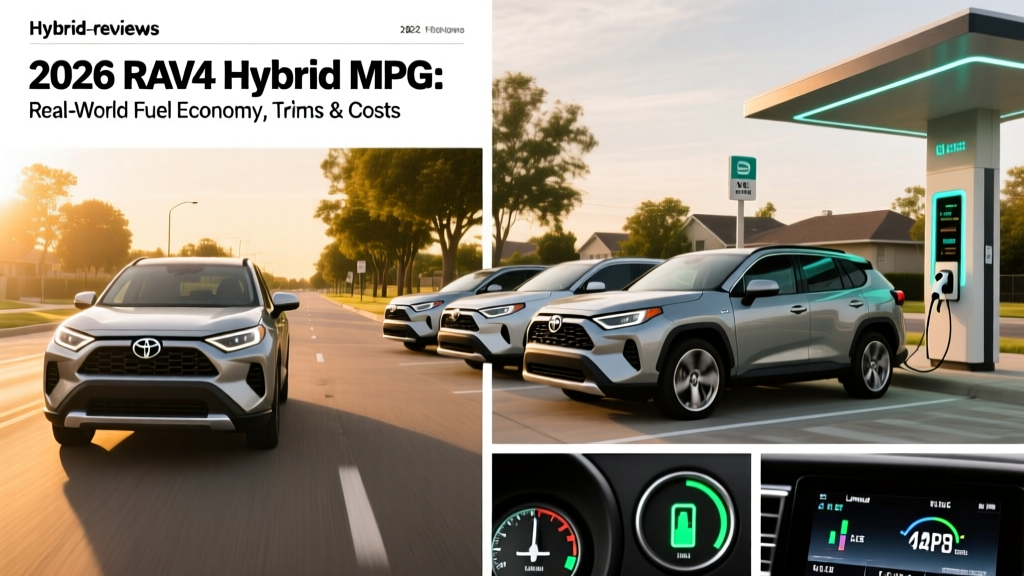
2026 RAV4 Hybrid: The Compact SUV MPG Benchmark
Toyota's RAV4 Hybrid has held its position as one of the most fuel-efficient compact SUVs on the market for years, and the 2026 model year continues that tradition. With an EPA-estimated 41 MPG city, 38 MPG highway, and 39 MPG combined, the 2026 RAV4 Hybrid offers a compelling mix of utility and efficiency without requiring a plug or lifestyle change. For buyers researching 2026 RAV4 Hybrid MPG figures, this guide covers the exact numbers, how they translate to real-world driving, and whether the hybrid, plug-in hybrid (Prime), or a full battery-electric vehicle (BEV) is the right call for your garage.
| Spec | Value |
|---|---|
| Powertrain | 2.5L 4-cyl + 3 electric motors (AWD) |
| Combined Horsepower | 219 hp |
| Drivetrain | Electronic AWD (eAWD) |
| EPA MPG (City / Hwy / Combined) | 41 / 38 / 39 MPG |
| Fuel Tank Capacity | 14.5 gallons |
| Total Driving Range | ~565 miles |
| Battery Type | Lithium-ion (1.6 kWh, sealed) |
| 0–60 mph | 7.4 seconds |
| Cargo Volume (behind rear seats) | 37.6 cu ft |
| Towing Capacity | 1,750 lbs |
| Starting MSRP (LE trim) | $33,855 |
| Hybrid Battery Warranty | 10 years / 150,000 miles |
2026 RAV4 Hybrid MPG: EPA Estimates vs. Real-World Results
The headline number for the 2026 RAV4 Hybrid is 39 MPG combined per the EPA's fueleconomy.gov listing. But as any hybrid owner knows, real-world results depend heavily on driving patterns — and hybrids often behave differently than their window stickers suggest.
| Driving Scenario | Expected MPG | Notes |
|---|---|---|
| EPA City | 41 MPG | Regen-heavy, low-speed cycles favor hybrids |
| EPA Highway | 38 MPG | Sustained speed; electric motor assists less |
| EPA Combined | 39 MPG | 55% city / 45% highway blend |
| Real-World City (owner-reported) | 40–44 MPG | Many owners exceed EPA city; stop-and-go maximizes regen |
| Real-World Highway (70–75 mph) | 33–36 MPG | Aero drag and sustained ICE load reduce efficiency |
| Cold Weather (below 32°F) | 33–37 MPG combined | Engine runs more for cabin heat; battery less efficient |
| Mountainous / Hilly Terrain | 30–35 MPG | Grade-dependent; regen recovers energy on descents |
Why city MPG beats highway in hybrids: Unlike gas-only vehicles, hybrids recapture kinetic energy through regenerative braking during frequent stops. The electric motor handles low-speed propulsion where internal combustion engines are least efficient. On the highway, the 2.5L gasoline engine does most of the work, which is why the RAV4 Hybrid's highway number drops to 38 MPG — and real-world highway driving at 75+ mph can push that closer to 33–34 MPG.
The cold-weather factor: Expect a 5–10% MPG reduction in winter months. The gasoline engine must run more frequently to generate cabin heat (hybrids lack the waste heat of conventional engines at idle), and the lithium-ion battery's charge/discharge efficiency drops at low temperatures. Owners in northern climates commonly report 34–37 MPG combined from December through February.
HEV vs. PHEV: RAV4 Hybrid vs. RAV4 Prime
Toyota offers the RAV4 in two electrified flavors, and confusing them is one of the most common mistakes shoppers make. Here's the critical distinction:
| Attribute | RAV4 Hybrid (HEV) | RAV4 Prime (PHEV) |
|---|---|---|
| Plug-in Required? | No — self-charging via engine + regen | Yes — 18.1 kWh battery, plugs into Level 1/2 |
| Electric-Only Range | ~0.5–1 mile at low speed | 42 miles (EPA) |
| Combined MPG (hybrid mode) | 39 MPG | 38 MPG (after battery depletes) |
| MPGe (electric + gas combined) | N/A | 94 MPGe |
| Total Range | ~565 miles | ~600 miles (42 EV + 558 gas) |
| Combined Horsepower | 219 hp | 302 hp |
| 0–60 mph | 7.4 sec | 5.7 sec |
| Battery Capacity | ~1.6 kWh (sealed) | 18.1 kWh usable |
| DC Fast Charging | No | No (Level 2 AC only, ~2.5 hrs at 240V) |
| Starting MSRP | $33,855 | $44,855 |
| Federal Tax Credit (§30D) | Not eligible | Up to $7,500 (subject to eligibility) |
The RAV4 Hybrid is a conventional hybrid electric vehicle (HEV). It never plugs in. Its small 1.6 kWh battery charges through regenerative braking and the gasoline engine. You drive it exactly like a gas car — fill up at the pump and go — but the hybrid system slashes fuel consumption, especially in city driving.
The RAV4 Prime is a plug-in hybrid electric vehicle (PHEV). It carries a much larger 18.1 kWh battery that provides 42 miles of pure electric driving before the gasoline engine kicks in. If your daily commute is under 42 miles and you can charge at home, you may go weeks without visiting a gas station. Once the battery depletes, it operates as a conventional hybrid at 38 MPG combined.
Important note on RAV4 Prime charging: The Prime does not support DC fast charging. Level 2 charging at 240V takes approximately 2.5 hours from empty. On a standard 120V household outlet (Level 1), expect around 10–12 hours — feasible for overnight top-ups but slow for full recharges.
Powertrain and Performance Details
The 2026 RAV4 Hybrid uses Toyota's fifth-generation hybrid system, pairing a 2.5-liter Dynamic Force four-cylinder engine with three electric motors — two on the front axle and one dedicated motor powering the rear wheels for electronic all-wheel drive (eAWD).
- Gasoline engine: 176 hp / 163 lb-ft torque (2.5L Atkinson-cycle I4)
- Front electric motors: Integrated into the transaxle, providing low-speed torque and regenerative braking
- Rear electric motor: 54 hp, activates for AWD traction and low-speed electric driving
- Net system output: 219 hp combined
- Transmission: Electronically controlled CVT (eCVT) — gearless, smooth, and efficient
The eAWD system is fully electronic — there is no mechanical driveshaft connecting the front and rear axles. The rear motor engages automatically when the system detects slip, during hard acceleration, or at low speeds for stability. This eliminates the weight and friction losses of a traditional AWD system, contributing to the strong MPG figures.
At 7.4 seconds to 60 mph, the RAV4 Hybrid is not a performance SUV, but it provides confident highway merging and passing. The eCVT keeps the engine in its optimal efficiency band, which means acceleration is linear rather than sporty. If speed matters more than MPG, the RAV4 Prime's 302 hp and 5.7-second 0–60 time is a significant upgrade.
Pricing, Trims, and Tax Credit Eligibility
The 2026 RAV4 Hybrid is available across multiple trim levels, all featuring standard AWD:
- Hybrid LE: $33,855 — base trim with Toyota Safety Sense 3.0, 8-inch touchscreen, wireless Apple CarPlay/Android Auto
- Hybrid XLE: $35,355 — adds SofTex seats, power liftgate, blind-spot monitoring
- Hybrid XLE Premium: $37,405 — adds sunroof, 18-inch alloy wheels
- Hybrid SE: $37,905 — sport-tuned suspension, 19-inch wheels
- Hybrid Woodland Edition: $38,305 — off-road-oriented with TRD-tuned suspension, all-terrain tires
- Hybrid XSE: $39,005 — sport appearance, SofTex/mixed-media seats
- Hybrid Limited: $42,005 — leather, 12.3-inch display, premium audio, heated/ventilated front seats
Federal Tax Credit Status
The conventional RAV4 Hybrid (HEV) does not qualify for the federal §30D Clean Vehicle Credit. This credit applies only to plug-in electric vehicles (PHEVs and BEVs) with qualifying battery sourcing and MSRP/income thresholds.
The RAV4 Prime (PHEV) may qualify for up to $7,500 under IRS §30D rules, subject to:
- Buyer income caps: $150,000 single / $300,000 joint MAGI
- MSRP cap: $80,000 for SUVs (RAV4 Prime clears this easily)
- Battery critical-mineral and component sourcing requirements (subject to annual tightening)
- Point-of-sale transfer available at participating dealers
Always confirm current-year eligibility with a tax professional or the IRS before relying on credit assumptions — sourcing rules change annually and can disqualify a previously eligible vehicle mid-year.
For the conventional Hybrid, some states offer their own hybrid or efficient-vehicle rebates, though these are less common than EV incentives. Check your state's energy or environmental agency for current programs.
Battery Warranty, Reliability, and Replacement Costs
Hybrid battery longevity remains one of the top concerns for first-time hybrid buyers. Here's what the data shows for Toyota's hybrid systems:
2026 RAV4 Hybrid Battery Warranty
- Hybrid Battery: 10 years / 150,000 miles (whichever comes first)
- Hybrid System Components: 8 years / 100,000 miles (inverter, transaxle, control modules)
- Basic Vehicle Warranty: 3 years / 36,000 miles
- Powertrain Warranty: 5 years / 60,000 miles
Toyota's hybrid battery warranty was extended to 10 years/150,000 miles starting with 2020 model-year vehicles, providing substantially more coverage than the earlier 8-year/100,000-mile standard. The RAV4 Hybrid's 1.6 kWh lithium-ion pack is far smaller and less stressed than a BEV battery — it operates within a narrow state-of-charge window (roughly 40–80%), which dramatically reduces degradation.
Real-world reliability data: Toyota's hybrid system is among the most proven in the automotive industry, with over 25 million hybrid vehicles sold globally. Taxi fleets running Toyota hybrids routinely surpass 300,000 miles on the original hybrid battery. The RAV4 Hybrid consistently earns top marks from IIHS and high reliability scores from long-term ownership surveys.
Battery replacement cost: If the hybrid battery fails outside warranty, a replacement from Toyota costs approximately $3,000–$4,500 including labor. Third-party refurbished batteries are available for $1,500–$2,500. Given the 10-year warranty and the battery's proven longevity, out-of-pocket replacement is rare for typical ownership cycles.
Who Should Choose the RAV4 Hybrid vs. Prime vs. a Full EV?
The right choice depends on your driving habits, charging access, and budget. Here's a practical decision framework:
Choose the RAV4 Hybrid (HEV) if:
- You don't have access to home or workplace charging
- You want maximum simplicity — no plug, no charging apps, no range planning
- Your budget is under $40,000 and you want AWD standard
- You drive a mix of city and highway and want consistent 37–42 MPG
- You plan to keep the vehicle 8–10+ years (strong reliability track record)
Choose the RAV4 Prime (PHEV) if:
- You can charge at home (Level 2 at 240V recommended)
- Your daily round-trip commute is under 42 miles
- You want electric daily driving with gas-engine flexibility for road trips
- You qualify for the federal §30D tax credit (income and sourcing requirements met)
- You value the 302 hp performance upgrade alongside efficiency
Choose a Full EV (e.g., Tesla Model Y, Hyundai Ioniq 5) if:
- You have reliable home Level 2 charging
- Your daily driving is under 250 miles and you road-trip infrequently
- You want zero tailpipe emissions and minimal maintenance (no oil changes, no gas engine)
- You want the lowest per-mile fuel cost (electricity at $0.13/kWh ≈ $0.04/mile vs. $0.12/mile at 39 MPG with $3.50/gal gas)
- You qualify for the full $7,500 federal credit and applicable state EV rebates
2026 RAV4 Hybrid — Pros
- 39 MPG combined — among the best in the compact SUV class
- Standard eAWD on every trim — no FWD-only base model
- No plug-in required — zero lifestyle change from a gas car
- 10-year/150,000-mile hybrid battery warranty
- Strong resale value and proven reliability
- Toyota Safety Sense 3.0 standard (adaptive cruise, lane-keeping, auto emergency braking)
- 565-mile total range — fewer fill-ups on road trips
2026 RAV4 Hybrid — Cons
- No federal tax credit eligibility (HEV, not a plug-in)
- Highway MPG drops to 33–36 in real-world 75+ mph driving
- eCVT drone under hard acceleration — not sporty
- 1,750-lb towing capacity — below some turbo-gas competitors
- Infotainment still uses an 8-inch screen on lower trims
- No DC fast charging (irrelevant for HEV, but Prime also lacks it)
Frequently Asked Questions
How many MPG does the 2026 RAV4 Hybrid actually get?
The EPA rates the 2026 RAV4 Hybrid at 41 city / 38 highway / 39 combined MPG. In real-world driving, owners frequently report 40–44 MPG in city conditions thanks to regenerative braking, while highway driving at 70–75 mph typically yields 33–36 MPG. Cold weather reduces combined MPG by 5–10%.
Does the RAV4 Hybrid need to be plugged in?
No. The RAV4 Hybrid is a conventional hybrid (HEV). Its small battery charges through regenerative braking and the gasoline engine. You never plug it in — just fill up at the gas station as normal.
How far can the RAV4 Prime go on electric only?
The 2026 RAV4 Prime (PHEV) provides an EPA-estimated 42 miles of electric-only range on a full charge. This covers most daily commutes. After the battery depletes, it operates as a conventional hybrid at 38 MPG combined for a total range of approximately 600 miles.
Is the RAV4 Hybrid reliable, and what does battery replacement cost?
Toyota's hybrid system has over 25 years of proven reliability, with many examples surpassing 200,000+ miles on the original hybrid battery. The 2026 model carries a 10-year/150,000-mile hybrid battery warranty. Out-of-warranty battery replacement costs approximately $3,000–$4,500 from Toyota, or $1,500–$2,500 for a refurbished unit.
Does the 2026 RAV4 Hybrid qualify for any tax credit?
The conventional RAV4 Hybrid (HEV) does not qualify for the federal §30D Clean Vehicle Credit, which is limited to plug-in vehicles (PHEVs and BEVs). The RAV4 Prime (PHEV) may qualify for up to $7,500, subject to buyer income limits, MSRP caps, and battery sourcing requirements. Check current IRS guidelines and consult a tax professional before purchasing.
How does the RAV4 Hybrid compare to the Honda CR-V Hybrid?
The 2026 Honda CR-V Hybrid is rated at 40 city / 35 highway / 37 combined MPG with AWD. The RAV4 Hybrid edges it out on highway and combined MPG (39 vs. 37), while the CR-V Hybrid offers slightly more cargo space. Both carry strong reliability reputations and similar pricing. The RAV4 Hybrid's 10-year hybrid battery warranty also edges Honda's 8-year/100,000-mile coverage.
What's the cost to fuel a RAV4 Hybrid vs. a gas-only RAV4?
The gas-only 2026 RAV4 AWD is rated at 27 MPG combined. At $3.50/gallon and 15,000 miles/year, that's $1,944 annually in fuel. The Hybrid at 39 MPG combined costs $1,346 per year — a savings of roughly $598 per year, or about $3,000 over five years. The Hybrid's MSRP premium over the gas model is typically $1,500–$2,000, meaning the fuel savings pay back the price difference in under four years.