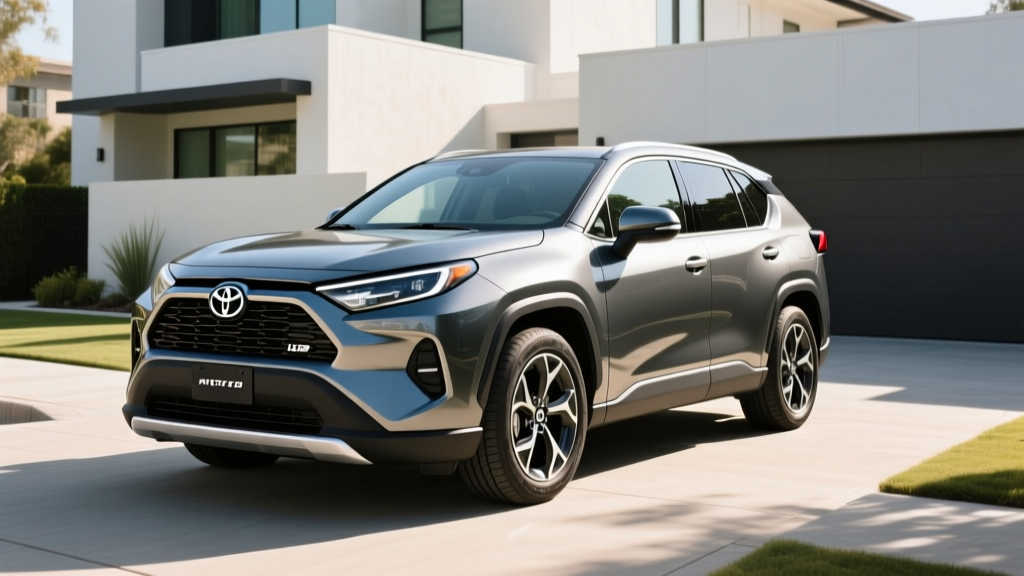
2026 RAV4 Hybrid LE: The Best-Selling Hybrid SUV, Measured Precisely
The Toyota RAV4 Hybrid has been America's best-selling hybrid SUV for years, and the 2026 RAV4 Hybrid LE continues that run with a formula that's hard to beat: standard all-wheel drive, nearly 40 MPG combined, and a starting price well under $35,000. If you're cross-shopping compact SUVs and want electrified efficiency without plugging in, the LE trim is the value sweet spot in the lineup.
This guide breaks down every number that matters — EPA fuel economy, real-world MPG observations, powertrain output, battery warranty, and total cost of ownership — so you can decide whether the 2026 RAV4 Hybrid LE fits your driving life better than a plug-in hybrid or a full battery-electric vehicle.
EPA Fuel Economy: What the Sticker Says
The 2026 Toyota RAV4 Hybrid LE carries EPA ratings that remain among the best in the compact SUV segment. Here's the official breakdown from fueleconomy.gov:
| Metric | Value |
|---|---|
| Combined MPG | 39 MPG |
| City MPG | 41 MPG |
| Highway MPG | 38 MPG |
| Fuel Tank Capacity | 14.5 gallons |
| Total Range | ~565 miles |
Notice something unusual if you're coming from a gas car: the city MPG is higher than the highway number. That's the hybrid advantage. At low speeds, the electric motor does more of the work, and regenerative braking recaptures energy that a conventional SUV would waste as heat. On the highway, the gas engine runs more continuously, so the hybrid benefit narrows.
Real-World MPG vs. EPA Estimates
Based on aggregated owner data and independent testing, real-world fuel economy for the RAV4 Hybrid LE typically lands between 36 and 42 MPG depending on conditions:
- City-heavy commuting (stop-and-go): 40–43 MPG — hybrids often exceed their EPA city rating in dense traffic where regen braking is maximized
- Mixed driving (suburbs + highway): 37–40 MPG — close to the EPA combined estimate
- Sustained highway (70–80 mph): 33–36 MPG — aerodynamic drag and continuous engine use reduce the hybrid advantage
- Cold weather (below 30°F): 32–36 MPG — the engine runs more often to provide cabin heat and maintain battery temperature
Powertrain Specs: Engine, Motors, and Horsepower
The 2026 RAV4 Hybrid LE uses Toyota's fifth-generation hybrid system (THS V), pairing a 2.5-liter four-cylinder engine with front and rear electric motors for standard electronic all-wheel drive (AWD).
| Specification | Detail |
|---|---|
| Engine | 2.5L inline-4 (Atkinson cycle) |
| Engine Output | 176 hp / 163 lb-ft torque |
| Front Electric Motor | 134 hp / 199 lb-ft |
| Rear Electric Motor (AWD) | 54 hp / 121 lb-ft |
| Net Combined Horsepower | 219 hp |
| Transmission | eCVT (planetary gearset) |
| Drivetrain | Electronic AWD (standard) |
| 0–60 mph | ~7.4 seconds |
| Hybrid Battery | 1.6 kWh lithium-ion (sealed NiMH on prior gens; Li-ion current) |
| Towing Capacity | 1,750 lbs |
The 219 combined horsepower is respectable for this class, and the electric motors deliver instant torque off the line — the RAV4 Hybrid LE feels noticeably quicker from 0–30 mph than its EPA 0-60 time suggests. The eCVT is smooth and drone-free under normal acceleration, though it will hold a steady RPM note under hard merging.
The 1.6 kWh hybrid battery is small by EV standards, but that's the point: it's a conventional hybrid (HEV), not a plug-in. The battery charges entirely through regenerative braking and engine-generated power. You never plug it in.
HEV vs. PHEV: What the RAV4 Hybrid Is (and Isn't)
Toyota sells both the RAV4 Hybrid (HEV) and the RAV4 Prime (PHEV). They look similar, but the powertrains serve different needs. Here's the distinction:
| Feature | RAV4 Hybrid LE (HEV) | RAV4 Prime (PHEV) |
|---|---|---|
| Type | Conventional Hybrid | Plug-In Hybrid |
| Plug-In Required? | No — self-charging | Yes — plugs into 120V or 240V |
| Battery Capacity | 1.6 kWh | 18.1 kWh |
| Electric-Only Range | N/A (EV assist only) | 42 miles (EPA) |
| Combined MPG / MPGe | 39 MPG | 38 MPG (gas) / 94 MPGe (electric) |
| Net Horsepower | 219 hp | 302 hp |
| 0–60 mph | ~7.4 sec | ~5.7 sec |
| Starting MSRP | ~$33,425 | ~$44,925 |
| Federal Tax Credit (§30D) | Not eligible | Up to $7,500 (if requirements met) |
The RAV4 Hybrid LE is for drivers who want better fuel economy with zero change to their fueling routine. The RAV4 Prime is for drivers who have home charging access, want 42 miles of electric-only commuting, and are willing to pay a $11,000+ premium (partially offset by the federal tax credit if eligible).
Pricing, Trims, and Tax Credit Eligibility
The 2026 RAV4 Hybrid LE starts at an MSRP of approximately $33,425 (including destination charge). As the base hybrid trim, it comes well-equipped with Toyota Safety Sense 3.0, an 8-inch touchscreen, wireless Apple CarPlay/Android Auto, LED headlights, and 17-inch alloy wheels.
Federal Tax Credit: Does the RAV4 Hybrid LE Qualify?
No. The 2026 RAV4 Hybrid LE is a conventional hybrid (HEV), not a plug-in vehicle. Under IRS §30D Clean Vehicle Credit rules, only battery electric vehicles (BEVs) and plug-in hybrid electric vehicles (PHEVs) with a battery capacity of at least 7 kWh are eligible. The RAV4 Hybrid's 1.6 kWh battery does not qualify.
If the federal tax credit is a priority, consider the RAV4 Prime (PHEV), which may qualify for up to $7,500 — subject to MSRP caps ($80,000 for SUVs), buyer income limits ($300,000 joint / $150,000 single), and critical mineral/battery component sourcing requirements that change annually. Always verify current-year eligibility on IRS.gov or consult a tax professional before purchasing.
Battery Warranty, Reliability, and Replacement Cost
Hybrid battery longevity is the number-one concern for first-time hybrid buyers. Toyota addresses this with one of the strongest hybrid battery warranties in the industry.
Real-World Hybrid Battery Lifespan
Toyota's hybrid batteries have a strong longevity track record. Data from fleet operators and long-term owners indicates:
- Most RAV4 Hybrid batteries last well beyond 150,000 miles before significant degradation
- Capacity loss is gradual — a 10-year-old RAV4 Hybrid battery may hold 75–85% of original capacity, which still provides full hybrid functionality (the battery assists the engine; it doesn't drive the vehicle solo)
- Toyota's hybrid battery management system keeps the battery in a narrow state-of-charge window (roughly 40–80%), which dramatically extends cell life compared to full EVs that cycle 0–100%
Battery Replacement Cost
If the hybrid battery does need replacement out of warranty:
- New OEM battery: $3,000–$4,500 (parts + labor at a Toyota dealer)
- Refurbished/reconditioned battery: $1,500–$2,500
- Individual module replacement: Some independent hybrid specialists can replace only the failed cells for $500–$1,200
Compared to a full EV battery replacement ($10,000–$20,000+), hybrid battery costs are manageable — and the 10-year/150,000-mile warranty means most owners will never pay out of pocket.
Overall Reliability
Toyota's hybrid powertrains consistently rank at the top of dependability studies. The eCVT transmission has no traditional clutches or bands to wear out — it's a planetary gearset with far fewer moving parts than a conventional automatic. According to NHTSA and long-term reliability surveys, the RAV4 Hybrid has fewer reported powertrain issues than many non-hybrid competitors.
Who Should Choose the RAV4 Hybrid LE — and Who Shouldn't
✓ Choose the RAV4 Hybrid LE If
- You want 39 MPG combined without changing your fueling routine
- You don't have access to home or workplace charging
- Your budget is under $35,000
- You drive a mix of city and highway miles
- You want AWD for snow or rain without a fuel-economy penalty
- You plan to keep the vehicle 8–10+ years
✗ Look Elsewhere If
- You want electric-only driving for a short commute (consider the RAV4 Prime PHEV or a full EV)
- You need the $7,500 federal tax credit (HEVs don't qualify)
- You tow more than 1,750 lbs regularly
- You want a quieter, fully electric driving experience
- You drive fewer than 8,000 miles/year (fuel savings may not justify the hybrid premium over a gas RAV4)
Hybrid vs. PHEV vs. Full EV: Which Fits You?
| Your Situation | Best Fit | Example |
|---|---|---|
| No home charging, want simplicity | HEV (Hybrid) | RAV4 Hybrid LE |
| Home charging available, short daily commute, occasional road trips | PHEV (Plug-In Hybrid) | RAV4 Prime |
| Home charging, mostly under 250 miles/day, want lowest running cost | BEV (Full EV) | Tesla Model Y, Hyundai Ioniq 5 |
| Apartment dweller, no charging access | HEV (Hybrid) | RAV4 Hybrid LE |
Ownership Costs: 5-Year Estimate
One of the RAV4 Hybrid LE's strongest arguments is its low total cost of ownership. Here's a 5-year/75,000-mile estimate compared to a comparable gas-only compact SUV averaging 28 MPG combined:
| Cost Category | RAV4 Hybrid LE (39 MPG) | Gas SUV Baseline (28 MPG) |
|---|---|---|
| Fuel (at $3.50/gal avg) | $6,730 | $9,375 |
| Fuel Savings | $2,645 saved over 5 years | |
| Maintenance (est.) | $2,800 | $3,200 |
| Insurance (avg) | $7,500 | $7,200 |
| Depreciation (est.) | $14,000 | $15,500 |
The RAV4 Hybrid LE saves roughly $2,600+ in fuel over five years versus a gas-only equivalent, plus it typically holds its value better due to strong resale demand for Toyota hybrids. The slight insurance premium (~$50–80/year more) is more than offset by fuel and depreciation savings.
Frequently Asked Questions
How many MPG does the 2026 RAV4 Hybrid LE get?
The EPA rates the 2026 RAV4 Hybrid LE at 41 MPG city, 38 MPG highway, and 39 MPG combined. In real-world driving, most owners see 36–42 MPG depending on conditions. City-heavy routes tend to yield higher numbers than highway-only driving due to regenerative braking.
Do I need to plug in the RAV4 Hybrid LE?
No. The RAV4 Hybrid LE is a conventional hybrid (HEV). Its small 1.6 kWh battery charges entirely through regenerative braking and the gasoline engine. You fuel it exactly like a regular gas car — just less often.
How far can the RAV4 Hybrid drive on electric power alone?
Not far — typically under 1 mile at very low speeds (parking lots, stop-and-go traffic). The electric motor assists the gas engine rather than replacing it. If you want meaningful electric-only range, you need the RAV4 Prime PHEV, which offers 42 miles on electricity alone.
Is the RAV4 Hybrid reliable, and what does a battery replacement cost?
Yes. Toyota's hybrid systems are among the most proven in the industry, with the hybrid battery covered for 10 years/150,000 miles. Out-of-warranty replacement runs $3,000–$4,500 for a new OEM battery, though refurbished options and individual cell repairs can reduce that to $500–$2,500. Most hybrid batteries outlast the warranty period.
Does the 2026 RAV4 Hybrid LE qualify for a federal tax credit?
No. The IRS §30D Clean Vehicle Credit applies only to plug-in electric vehicles (BEVs and PHEVs) with at least 7 kWh of battery capacity. The RAV4 Hybrid's 1.6 kWh battery does not meet the threshold. The RAV4 Prime (PHEV) may qualify for up to $7,500, subject to income, MSRP, and battery-sourcing requirements. Verify current eligibility at IRS.gov.
How does the RAV4 Hybrid compare to the gas-only RAV4?
The gas-only 2026 RAV4 (2.5L, FWD) is rated at roughly 30 MPG combined versus the Hybrid's 39 MPG — a 30% improvement. The hybrid also delivers more power (219 hp vs. 203 hp), standard AWD, and a smoother acceleration feel, for roughly $1,500–$2,000 more at the base trim. Most buyers find the hybrid's fuel savings pay back the premium within 3–5 years.