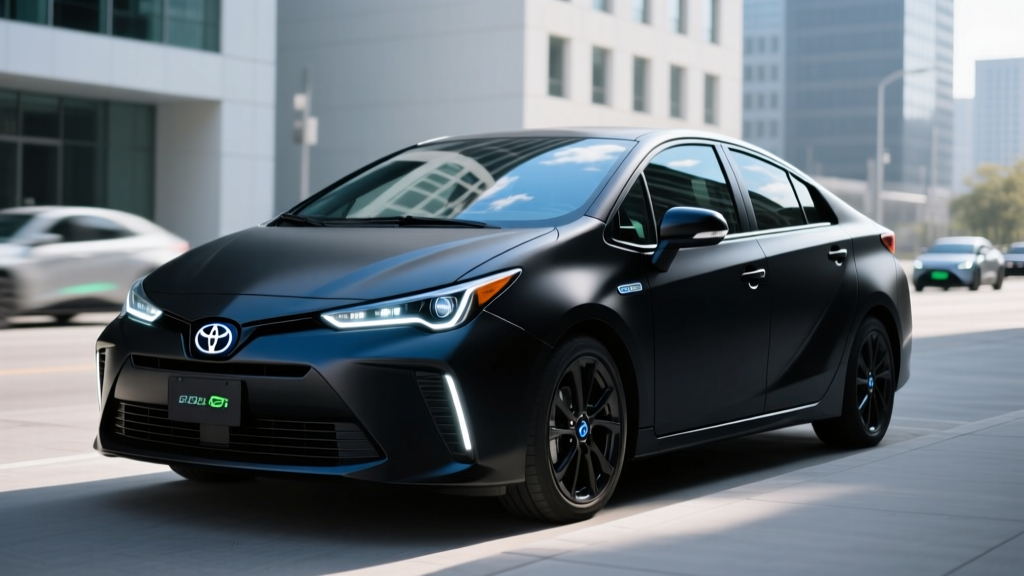
The 2026 Toyota Prius Plug-In Hybrid Nightshade Edition takes Toyota's most efficient PHEV and wraps it in a monochrome, blacked-out aesthetic that has nothing to do with saving fuel and everything to do with looking sharp while doing it. But beyond the gloss-black 19-inch alloy wheels and dark badging, the Nightshade carries the same impressive plug-in hybrid powertrain as the rest of the Prius Prime lineup: 44 miles of EPA-rated electric-only driving, 220 combined horsepower, and the kind of real-world efficiency that makes gas stations feel optional for daily commutes.
This review breaks down every number that matters — electric range, MPG, charging speed, pricing, tax credit eligibility, and long-term battery reliability — so you can decide whether the Nightshade trim's style premium is worth it, or whether a different Prius Prime (or a full BEV) better fits your life.
HEV vs. PHEV: Where the Prius Prime Nightshade Fits
Toyota sells two distinct Prius families, and confusing them is the most common mistake shoppers make:
| Feature | Prius (HEV) | Prius Prime (PHEV) |
|---|---|---|
| Plug-in charging | No — self-charging via regenerative braking and engine | Yes — plug in to charge the larger battery |
| Battery size | ~1.0 kWh (small buffer) | 13.6 kWh usable (lithium-ion) |
| Electric-only driving | Less than 1 mile at low speeds | Up to 44 miles (EPA) |
| Combined horsepower | 194 hp (FWD) / 196 hp (AWD) | 220 hp |
| Fuel economy (gas mode) | 57 MPG combined (LE) | 52 MPG combined (after battery depletes) |
| Starting MSRP | ~$28,550 | ~$33,975 (SE) |
| Federal tax credit | Not eligible | Up to $3,750 (§30D, if eligible) |
The Prius Prime is the plug-in hybrid version. You can charge it from a wall outlet or Level 2 charger to unlock its full electric-only range. Once the battery depletes, it operates exactly like a conventional Prius hybrid — the gasoline engine and regenerative braking sustain the small remaining buffer. You never have to plug it in, but doing so is where the savings and smoothness come from.
Electric-Only Range and Total Range
The 2026 Prius Prime Nightshade carries a 13.6 kWh usable lithium-ion battery pack, delivering:
- EPA electric-only range: 44 miles (SE/SE Premium trims with 19-inch wheels)
- Total combined range (electric + gas): approximately 440 miles
- MPGe (electric mode): 127 MPGe combined
Once the battery depletes, the Prime Nightshade switches seamlessly to hybrid mode, returning an EPA-estimated 52 MPG combined — a figure that still beats most compact sedans and crossovers, even without a plug.
Fuel Economy Breakdown
| Mode | City | Highway | Combined |
|---|---|---|---|
| Electric-only (MPGe) | 127 MPGe | 108 MPGe | 127 MPGe |
| Hybrid (gasoline, after depletion) | 50 MPG | 47 MPG | 52 MPG* |
*EPA combined for Prius Prime SE/XSE trims with 19-inch wheels. Source: fueleconomy.gov
Real-world MPG for Toyota's hybrid system often exceeds EPA estimates in city driving, where regenerative braking recaptures energy at every stop. Owners frequently report 54–58 MPG in urban stop-and-go traffic. Highway fuel economy tends to land closer to (or slightly below) the EPA sticker, especially above 70 mph where aerodynamic drag dominates. If your commute is mostly highway, expect 47–50 MPG in hybrid mode.
Powertrain and Performance
| Specification | 2026 Prius Prime Nightshade |
|---|---|
| Powertrain | 2.0L 4-cylinder + permanent-magnet electric motor (PHEV) |
| Combined horsepower | 220 hp |
| Engine output | 150 hp @ 6,000 rpm |
| Electric motor output | 161 hp (front axle) |
| Transmission | Electronically controlled CVT (eCVT) |
| Drivetrain | Front-wheel drive |
| 0–60 mph | ~6.6 seconds |
| Battery (usable) | 13.6 kWh lithium-ion |
| Electric-only top speed | 84 mph |
The 220-hp combined output makes the Prius Prime genuinely quick for a car optimized around efficiency. The 0–60 mph time of roughly 6.6 seconds puts it ahead of many compact crossovers and makes highway merging effortless. In EV mode, the electric motor delivers instant torque and near-silent acceleration up to 84 mph — more than enough for suburban and freeway driving without waking the gas engine.
Charging: What You Need to Know
The Prius Prime uses a standard J1772 connector for AC charging. There is no DC fast-charging port — this is an AC-only PHEV, which is typical for plug-in hybrids with smaller battery packs.
| Charging Level | Power | 0–100% Charge Time | Where |
|---|---|---|---|
| Level 1 (120V household outlet) | ~1.4 kW | ~11 hours | Any standard outlet |
| Level 2 (240V home/public) | ~3.3 kW (onboard charger limit) | ~4 hours | Home wallbox, public L2 stations |
| DC Fast Charging | Not supported | N/A | N/A |
The onboard charger is limited to 3.3 kW, which means even if you plug into a 7.2 kW or 11.5 kW Level 2 station, the Prime will only draw 3.3 kW. A full charge still takes about 4 hours on Level 2 — practical for overnight charging or topping up during a workday, but not something you'd rely on at a public fast-charging stop during a road trip.
Practical charging advice: Most Prius Prime owners charge at home overnight using either a standard 120V outlet (Level 1) or a 240V Level 2 wallbox. Level 1 is sufficient if your daily electric-only driving is under 30 miles — an 11-hour overnight session fully replenishes the 13.6 kWh battery. A Level 2 installation (typically $500–$1,500 for equipment and electrician, depending on panel proximity) cuts charge time to 4 hours and is worth it if you want to top up mid-day or have a shorter overnight window.
Nightshade Trim: What You Get (and What It Costs)
The Nightshade Edition is a styling package layered onto the Prius Prime's mid-tier trim, adding:
- Gloss-black 19-inch alloy wheels
- Black exterior badging and mirror caps
- Dark-tinted rear privacy glass
- Black SofTex-trimmed interior with red stitching
- Smart Key system on all doors
- 8-inch Toyota Audio Multimedia touchscreen with wireless Apple CarPlay and Android Auto
- Toyota Safety Sense 3.0 (standard across all Prius trims)
2026 Prius Prime pricing (estimated MSRP):
- Prius Prime SE: ~$33,975
- Prius Prime XSE: ~$36,675
- Prius Prime Nightshade Edition: ~$37,500
- Prius Prime XSE Premium: ~$40,175
The Nightshade commands roughly an $800–$1,000 premium over the XSE trim. You're paying for the blackout aesthetic, not additional performance or range. If the monochrome look isn't a priority, the XSE delivers identical efficiency and powertrain specs at a slightly lower price.
Federal Tax Credit and Incentives
- Maximum credit: Up to $3,750 (based on battery capacity and critical-mineral sourcing requirements)
- Income caps: Modified AGI ≤ $150,000 (single), ≤ $225,000 (head of household), ≤ $300,000 (joint)
- MSRP cap: Vehicle MSRP must not exceed $55,000 (sedans) — all Prius Prime trims qualify
- Battery sourcing: Credit amount depends on percentage of critical minerals and battery components sourced from the U.S. or FTA partners — Toyota's supply chain qualifies for partial credit
- Point-of-sale transfer: Eligible buyers can transfer the credit to the dealer at purchase, reducing the out-of-pocket price immediately
- Important: Rules are subject to change. Verify current eligibility at IRS.gov and consult a tax professional before relying on the credit in your purchase decision.
Unlike a full battery-electric vehicle, which may qualify for up to $7,500 under §30D, the Prius Prime's smaller battery typically yields a $3,750 credit for eligible buyers. That still meaningfully reduces the effective price — a Nightshade at ~$37,500 drops to ~$33,750 after the credit, putting it in the same territory as well-equipped compact crossovers.
Some states offer additional PHEV rebates or HOV lane access (California, Colorado, and New York are notable examples). Check your state's energy or DMV website for current programs.
Reliability, Battery Warranty, and Long-Term Costs
- Hybrid battery: 10 years / 150,000 miles (whichever comes first)
- Hybrid system components: 8 years / 100,000 miles
- Limited vehicle warranty: 3 years / 36,000 miles basic, 5 years / 60,000 miles powertrain
Toyota's hybrid reliability track record is among the strongest in the industry. The Prius family has been in production since 1997, and the hybrid synergy drive system is thoroughly proven. The 13.6 kWh PHEV battery is larger than a conventional Prius battery but still modest compared to full EVs — meaning lower thermal stress and slower degradation over time.
Battery replacement cost: If the hybrid battery fails outside of warranty, a replacement pack for the Prius Prime typically costs $3,500–$5,500 including parts and labor at a Toyota dealer. Third-party hybrid battery refurbishers may offer lower prices ($2,000–$3,500). However, widespread reports from Prius owners suggest that hybrid batteries routinely last 150,000+ miles and 12–15 years with normal use. Degradation is gradual — you may lose 10–15% of electric-only range over the first decade, not a sudden failure.
Maintenance costs are low: the Prius Prime has no traditional transmission fluid to change, regenerative braking extends brake pad life significantly (60,000–100,000 miles before replacement is common), and the gasoline engine runs less frequently than in a conventional car, reducing oil-change intervals' urgency (though Toyota still recommends changes every 10,000 miles or 12 months).
Pros and Cons
Pros
- 44 miles of electric-only range covers most daily commutes without gasoline
- 52 MPG combined in hybrid mode — excellent even without plugging in
- 220 hp makes it genuinely quick (6.6s 0–60)
- 10-year/150,000-mile hybrid battery warranty
- ~$3,750 federal tax credit for eligible buyers
- Nightshade styling stands out in a segment of conservative designs
- Toyota Safety Sense 3.0 standard (pre-collision, lane tracing, adaptive cruise)
- No range anxiety — gas engine provides 400+ miles of total range
Cons
- 3.3 kW onboard charger means slow Level 2 charging (~4 hours)
- No DC fast-charging capability
- FWD only — no AWD option (the conventional Prius offers AWD-e)
- Nightshade premium is cosmetic only — no performance or tech upgrade
- Rear seat and cargo space tighter than RAV4 Prime or larger PHEVs
- $3,750 tax credit is less than the $7,500 available on many full EVs
- Electric range drops noticeably in cold weather (~30–35 mi)
Who Should Choose the Prius Prime Nightshade vs. a Full EV or Gas Car?
Choose the Prius Prime Nightshade if:
- Your daily commute is under 40 miles and you can charge at home overnight
- You want electric daily driving but need gas-engine flexibility for road trips
- You don't have reliable access to DC fast chargers for long trips
- You want the lowest possible fuel cost without the higher upfront price of a long-range EV
- You value Toyota's reliability reputation and 10-year battery warranty
Choose a full EV (e.g., Tesla Model 3, Hyundai Ioniq 6) if:
- You want zero gasoline use and zero oil changes
- You have reliable home and workplace charging
- You qualify for the full $7,500 federal tax credit on a BEV
- Your road trips are planned around DC fast-charging networks
Choose a conventional gas car (or the standard Prius HEV) if:
- You cannot charge at home or at work (apartment, street parking)
- Your daily driving exceeds 50+ miles and you don't want to manage plug-in charging
- You want the lowest possible purchase price and don't need electric-only driving
The Prius Prime Nightshade occupies a specific and valuable niche: it's the car for drivers who want the EV experience for their commute but aren't ready to commit to full-electric ownership. If you can plug in at home, you'll burn almost no gasoline Monday through Friday. On a weekend road trip, you'll fill up at any gas station and never think about charging infrastructure. That duality is the PHEV advantage, and the Nightshade wraps it in a package that actually looks good in a parking lot.
Frequently Asked Questions
How many MPG does the 2026 Prius Prime Nightshade get?
In hybrid mode (after the battery is depleted), the EPA rates the Prius Prime at 52 MPG combined — 50 city / 47 highway. In electric-only mode, it achieves 127 MPGe combined. Real-world city MPG often exceeds the EPA estimate thanks to regenerative braking, with many owners reporting 54–58 MPG in urban driving.
How far can the Prius Prime Nightshade go on electric only?
The EPA rates the Prius Prime with 19-inch wheels at 44 miles of electric-only range. Real-world range varies: expect 38–42 miles in moderate weather and 30–35 miles in freezing temperatures due to cabin heating demands and reduced battery efficiency. Total combined range (electric + gasoline) is approximately 440 miles.
Does the 2026 Prius Prime qualify for a federal tax credit?
Yes, the Prius Prime is eligible for up to $3,750 under the IRS §30D Clean Vehicle Credit, subject to buyer income caps ($150K single / $300K joint), MSRP limits (under $55K for sedans — all Prime trims qualify), and battery sourcing requirements. Eligible buyers can transfer the credit to the dealer at the point of sale for an immediate price reduction. Always verify current rules at IRS.gov and consult a tax professional.
Is the Prius Prime reliable, and what does battery replacement cost?
Toyota's hybrid system is among the most proven in the automotive industry, with decades of Prius data supporting long-term reliability. The hybrid battery is warrantied for 10 years / 150,000 miles. Out-of-warranty replacement costs approximately $3,500–$5,500 at a dealer, though hybrid batteries commonly last 150,000+ miles and 12–15 years with gradual (not sudden) capacity loss.
Can the Prius Prime Nightshade charge at DC fast-charging stations?
No. The Prius Prime supports only AC charging via a J1772 connector — Level 1 (120V, ~11 hours for a full charge) and Level 2 (240V, ~4 hours at its 3.3 kW onboard charger limit). DC fast charging is not available. This is standard for PHEVs with smaller battery packs, which are designed for overnight home charging rather than road-trip fast charging.
Does the Nightshade Edition have more horsepower or range than other Prius Prime trims?
No. The Nightshade Edition is a styling and appearance package — it shares the same 220 hp powertrain, 13.6 kWh battery, 44-mile electric range, and 52 MPG hybrid rating as the XSE trim. The differences are cosmetic: gloss-black 19-inch wheels, blacked-out badges and mirror caps, and a black interior with red stitching.