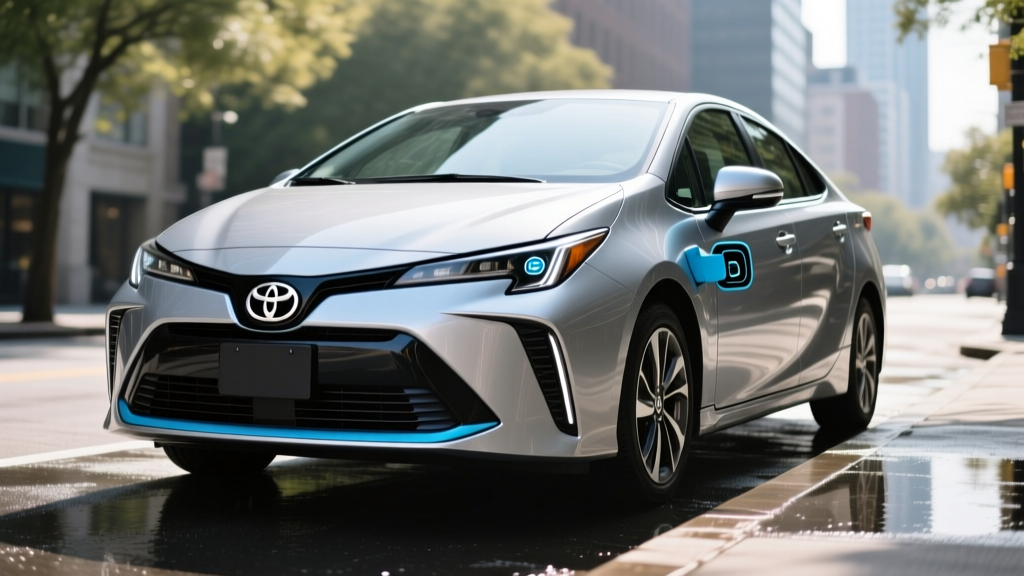
The Toyota Prius Prime — officially the Prius Plug-In Hybrid — has been one of the most practical PHEVs on the market since its redesign, and the 2026 model year carries forward the formula that made it a standout: a usable all-electric range for daily commuting, a highly efficient hybrid powertrain for road trips, and a starting price that undercuts most pure EVs by thousands. If you want to drive on electricity most days without ever worrying about charging infrastructure on a long trip, the 2026 Prius Plug-In is one of the most compelling options available.
This guide breaks down every critical number — EPA range and MPGe, real-world efficiency, battery specs, charging times, powertrain output, pricing by trim, and federal tax credit eligibility — so you can decide whether this PHEV fits your driving life better than a conventional hybrid or a full battery-electric vehicle.
2026 Prius Plug-In Hybrid: Key Specs at a Glance
| Spec | Value |
|---|---|
| EPA Electric-Only Range | 44 miles (SE trim, 19" wheels on XSE may reduce to ~40 mi) |
| EPA Combined MPGe (EV mode) | 127 MPGe |
| EPA MPG (Hybrid mode, combined) | 52 MPG (SE) / 48 MPG (XSE) |
| Total Combined Range | ~510 miles (EV + hybrid) |
| Battery Capacity | 13.6 kWh (lithium-ion) |
| Combined System Horsepower | 220 hp |
| 0–60 mph | 6.6 seconds |
| Level 2 Charge Time (0–100%) | ~4 hours (3.5 kW onboard charger) |
| DC Fast Charging | Not available |
| Base MSRP (SE) | $33,445 (incl. destination) |
| Battery Warranty | 10 years / 150,000 miles |
HEV vs PHEV: What the Prius Plug-In Does Differently
Toyota sells two versions of the Prius, and understanding the difference is essential before you buy.
Conventional Prius (HEV)
- You never plug it in. The battery recharges through regenerative braking and the gas engine.
- EPA combined fuel economy: up to 57 MPG.
- No electric-only driving beyond very short, low-speed moments.
- Lower starting price (~$28,000).
- No federal tax credit eligibility.
Prius Plug-In Hybrid (Prius Prime, PHEV)
- You plug it in to charge a larger 13.6 kWh battery.
- 44 miles of pure electric driving before the gas engine starts.
- After EV range is depleted, it operates as a conventional hybrid at 52 MPG combined.
- Higher starting price (~$33,445) but eligible for a federal tax credit (see details below).
- Total range exceeds 510 miles — no range anxiety on road trips.
The bottom line: if you can charge at home and your daily round-trip commute is under 40 miles, the Prius Prime lets you drive almost entirely on electricity on weekdays while keeping full hybrid flexibility for weekends and road trips. If you can't charge at home or regularly drive more than 50 miles one-way, the standard Prius HEV may be the simpler, more economical choice.
Electric-Only Range and Efficiency: EPA vs Real World
The EPA rates the 2026 Prius Prime SE at 44 miles of all-electric range and 127 MPGe when running on its battery. The XSE trim, which rides on larger 19-inch wheels and carries slightly more equipment, drops to roughly 40 miles of EV range.
In mild weather (60–75°F) on suburban roads at 35–50 mph, owners consistently report matching or slightly exceeding the 44-mile EPA rating — 45 to 48 miles is common. On the highway at 70+ mph, expect the EV range to drop to approximately 32–36 miles. In cold weather (below 30°F), battery chemistry and cabin heating demands can reduce electric range by 20–30%, yielding roughly 30–35 miles on the SE.
This is typical PHEV behavior — electric range is most sensitive to speed and temperature, just like a full EV. The Prius Prime's advantage is that when the battery depletes, you simply keep driving on an extremely efficient hybrid powertrain rather than hunting for a charger.
MPG Breakdown by Mode and Trim
| Trim | EV Mode (MPGe) | Hybrid City | Hybrid Hwy | Hybrid Combined |
|---|---|---|---|---|
| SE | 127 MPGe | 53 MPG | 51 MPG | 52 MPG |
| XSE | ~119 MPGe | 50 MPG | 47 MPG | 48 MPG |
| XSE Premium | ~119 MPGe | 50 MPG | 47 MPG | 48 MPG |
According to fueleconomy.gov, the SE trim's combined 52 MPG in hybrid mode places it among the most efficient plug-in hybrids sold in the United States. In real-world city driving, hybrids often exceed their EPA city numbers because regenerative braking recovers energy at every stop. Many Prius Prime owners report 55–60 MPG in stop-and-go urban traffic once the battery is depleted.
Powertrain and Performance
The 2026 Prius Prime pairs a 2.0-liter four-cylinder engine with two motor-generators and a 13.6 kWh lithium-ion battery pack for a combined system output of 220 horsepower. That's a significant step up from earlier Prius generations and translates to a 0–60 mph time of 6.6 seconds — genuinely quick for a vehicle focused on efficiency.
The engine produces 150 hp on its own, supplemented by electric motors drawing from the battery. In EV mode, the car is smooth and quiet, with adequate acceleration for merging and passing up to about 50 mph. Above that, the gas engine seamlessly engages — the transition is one of the smoothest in the PHEV segment.
Toyota's eCVT (electronic continuously variable transmission) manages power delivery without the rubber-band sensation of older CVTs. The Prius Prime also features EV Mode, HV Mode (hybrid), and Auto EV/HV, which intelligently switches between electric and hybrid based on your route and driving pattern. An EV Hold mode lets you save battery charge for later — useful if you're driving on the highway and want to preserve electric range for city driving at your destination.
Charging: Level 2 Only, No DC Fast Charging
The Prius Prime has a 3.5 kW onboard charger, which means Level 2 charging (240V) from empty to full takes approximately 4 hours. This is adequate for overnight home charging and for topping up during a workday if your workplace offers Level 2 stations.
| Charging Level | Power | Time (0–100%) | Miles Added per Hour |
|---|---|---|---|
| Level 1 (120V standard outlet) | ~1.4 kW | ~10–11 hours | ~4–5 miles EV range/hr |
| Level 2 (240V home/public) | 3.5 kW | ~4 hours | ~11–12 miles EV range/hr |
| DC Fast Charging | Not supported | N/A | N/A |
The lack of DC fast charging is a deliberate tradeoff. Toyota has opted to keep the battery relatively small (13.6 kWh vs. 60–100+ kWh on full EVs), which keeps vehicle weight down and cost low. Since you only need to replenish 44 miles of range rather than 300+, a 4-hour Level 2 charge is practical for most owners who charge at home overnight.
However, if you rely exclusively on public charging and want to top up quickly during the day, the Prius Prime's 3.5 kW ceiling means you won't benefit from the growing network of 150–350 kW DC fast chargers. This is a key reason why PHEVs are best suited to drivers with home or workplace charging access.
Home charging setup: A standard 120V outlet will fully recharge the Prius Prime overnight (~10–11 hours). If you want faster Level 2 charging, a basic 240V outlet (NEMA 14-50) with a quality Level 2 EVSE (such as a ChargePoint Home Flex or Emporia Level 2) will handle it in about 4 hours. Installation costs for a Level 2 home charger typically range from $500 to $2,000 depending on your electrical panel and wiring run.
Pricing, Trims, and Federal Tax Credit Eligibility
The 2026 Prius Prime is offered in three trims:
- SE — $33,445 MSRP (incl. destination). Best efficiency (44 mi EV, 52 MPG hybrid). 17" wheels.
- XSE — ~$36,995 MSRP. Sport-tuned suspension, 19" wheels, SofTex seats, larger touchscreen. EV range drops to ~40 mi.
- XSE Premium — ~$40,495 MSRP. Adds panoramic fixed glass roof, premium audio, heated/ventilated front seats, digital rearview mirror.
Federal Tax Credit (§30D) — Does the Prius Prime Qualify?
Under current IRS rules for the §30D Clean Vehicle Credit, the Prius Prime may qualify for up to $3,750 (partial credit). Full eligibility depends on several factors that change frequently:
- MSRP Cap: Sedans must be under $55,000 MSRP. All Prius Prime trims qualify.
- Buyer Income Cap: AGI must not exceed $150,000 (single), $225,000 (head of household), or $300,000 (joint).
- Battery Sourcing Requirements: The credit is split into two halves ($3,750 for critical minerals, $3,750 for battery component sourcing). As of the 2026 model year, the Prius Prime typically qualifies for the critical-minerals half ($3,750) but may not meet the battery-component requirement due to foreign entity of concern (FEOC) restrictions. Confirm current-year sourcing compliance with your dealer and IRS guidance at time of purchase.
- Point-of-Sale Transfer: You can elect to transfer the credit to the dealer at purchase, reducing your out-of-pocket cost immediately rather than waiting for a tax refund.
Important: Tax credit rules are subject to legislative and regulatory changes. Always verify eligibility with a tax professional and the official IRS credit page before purchasing.
Battery Warranty, Reliability, and Replacement Cost
Toyota Hybrid Battery Warranty
The 2026 Prius Prime's 13.6 kWh lithium-ion traction battery is covered by Toyota's hybrid battery warranty: 10 years or 150,000 miles (whichever comes first), in all 50 states. This warranty guarantees the battery against defects and excessive capacity loss.
Toyota has been manufacturing hybrid battery packs longer than any other automaker — the Prius hybrid system debuted in 1997 — and real-world degradation data on Toyota hybrid batteries is among the best in the industry. Most Toyota hybrid batteries retain well over 85% of their original capacity after 100,000 miles.
Is the Prius Prime Reliable?
Toyota's hybrid powertrain is one of the most proven and reliable drivetrains in the automotive industry. The Prius platform has accumulated billions of real-world miles across multiple generations. The eCVT design eliminates the traditional transmission — no gears to shift, no torque converter, no clutch — which removes a major failure point found in conventional vehicles.
The Prius Prime's 2.0-liter engine is a naturally aspirated, port-injected design that prioritizes longevity over peak power. Combined with Toyota's conservative battery management (a large buffer prevents deep discharge and overcharge), the system is engineered for a long service life.
Battery Replacement Cost
If the traction battery ever needs replacement outside of warranty, expect to pay between $3,000 and $5,000 for a new OEM battery pack including installation at a Toyota dealer. Third-party refurbished or reconditioned batteries are available for $1,500–$2,500. Given the 10-year/150,000-mile warranty coverage and Toyota's track record, most owners will never face this cost.
Prius Prime vs Full EV vs Standard Hybrid: Which Should You Buy?
Choose the Prius Prime (PHEV) if:
- You can charge at home (even a standard 120V outlet works overnight).
- Your daily commute is under 44 miles round-trip.
- You take road trips of 200+ miles several times a year and don't want to plan around charging stations.
- You live in an area with limited public DC fast charging infrastructure.
- You want to drive on electricity most days while keeping gas-car flexibility.
Choose a Full EV (e.g., Tesla Model 3, Hyundai Ioniq 6) if:
- You have reliable home Level 2 charging and your daily drive is under 250 miles.
- You want zero tailpipe emissions and the lowest per-mile fuel cost.
- You want access to DC fast charging for road trips (10–80% in 18–25 minutes).
- You're eligible for the full $7,500 federal tax credit on a qualifying BEV.
Choose the Standard Prius (HEV) if:
- You cannot charge at home or at work.
- Your daily commute regularly exceeds 50 miles.
- You want the lowest purchase price and simplest ownership experience.
- You don't want to manage plug-in charging habits.
Pros and Cons of the 2026 Prius Plug-In
Pros
- 44-mile EV range covers most daily commutes entirely on electricity
- 52 MPG hybrid mode is among the most efficient of any PHEV after battery depletion
- 220 hp and 6.6-second 0–60 — genuinely quick for the class
- 510+ mile total range eliminates road-trip charging anxiety
- Charges on a standard 120V outlet overnight (no Level 2 required)
- 10-year / 150,000-mile hybrid battery warranty
- Under $55,000 MSRP — qualifies for at least partial §30D federal tax credit
- Toyota's long-term reliability track record
Cons
- No DC fast charging — 3.5 kW Level 2 is the maximum charge rate
- EV range drops to ~30–35 miles in cold weather
- XSE and Premium trims sacrifice 4–5 miles of EV range for styling/features
- Rear seat and cargo space are tighter than crossover PHEVs (e.g., RAV4 Prime)
- Only partial federal tax credit ($3,750), not the full $7,500
- 3.5 kW onboard charger means slower public Level 2 top-ups
Frequently Asked Questions
How many MPG does the 2026 Prius Plug-In get?
The Prius Prime SE achieves 52 MPG combined (53 city / 51 highway) when operating as a hybrid after the battery is depleted. In electric mode, it's rated at 127 MPGe. The XSE trim rates slightly lower at 48 MPG combined due to larger wheels and added weight.
How far can the 2026 Prius Prime go on electric only?
The EPA rates the SE trim at 44 miles of all-electric range. Real-world results vary: expect 45–48 miles in mild city driving, 32–36 miles at sustained highway speeds, and 30–35 miles in freezing temperatures. The XSE trims drop to approximately 40 miles.
Does the 2026 Prius Prime qualify for a federal tax credit?
Under current IRS §30D rules, the Prius Prime typically qualifies for a partial credit of $3,750 (the critical-minerals half), subject to buyer income limits and MSRP caps. All trims fall under the $55,000 sedan cap. Battery-component sourcing rules may limit the credit to $3,750 rather than the full $7,500. Verify eligibility at IRS.gov and with your tax professional before purchasing.
Is the Prius Prime reliable, and what does battery replacement cost?
Toyota's hybrid powertrain has one of the strongest reliability records in the industry. The traction battery is warranted for 10 years / 150,000 miles. Out-of-warranty replacement costs $3,000–$5,000 for an OEM pack, though most owners never need one. The eCVT design eliminates traditional transmission failure points.
Can the Prius Prime charge at DC fast chargers?
No. The Prius Prime does not support DC fast charging. Its maximum charge rate is 3.5 kW on Level 2 (240V), which fully charges the battery in about 4 hours. Level 1 (120V) charging takes about 10–11 hours. This is a deliberate design choice to keep the battery small and the vehicle affordable.
What's the total range of the 2026 Prius Prime?
Combining the 44-mile electric range with the 11.4-gallon fuel tank and 52 MPG hybrid efficiency, the Prius Prime SE delivers approximately 510+ miles of total range before needing to refuel or recharge — more than enough for any road trip without range anxiety.
Should I buy the Prius Prime or a full EV?
If you have home charging and your daily commute is under 44 miles, the Prius Prime lets you drive on electricity most days while keeping gas flexibility for long trips. A full EV offers lower per-mile costs, DC fast charging, and a larger tax credit, but requires more planning on road trips and access to reliable charging infrastructure. For one-car households or drivers in areas with sparse charging networks, the Prius Prime is often the more practical choice.