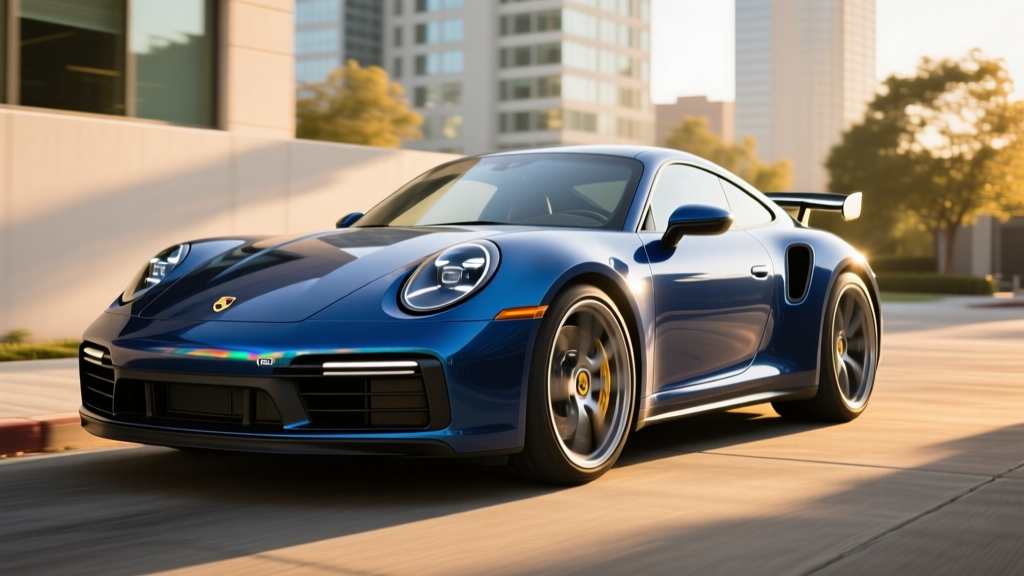
Porsche electrified its halo sports car for the 992.2 generation, and the flagship result is the 2026 Porsche 911 Turbo S Hybrid — a machine that pairs a revised twin-turbo flat-six with a 400-volt mild-hybrid system to produce 791 horsepower while squeezing out measurably better fuel economy than its predecessor. This is not a plug-in hybrid. There is no electric-only driving mode, no charging port, and no EV range to speak of. Instead, Porsche's T-Hybrid architecture recovers energy under braking and redeploys it through an integrated electric motor for torque fill, turbo spool-up, and efficiency gains. The question for buyers is whether that complexity delivers real-world MPG improvements commensurate with its six-figure price premium.
2026 Porsche 911 Turbo S Hybrid — Key Specifications
| Attribute | Specification |
|---|---|
| Powertrain | 3.8L twin-turbo flat-6 + integrated electric motor (T-Hybrid) |
| Combined Output | 791 hp / 590 lb-ft torque |
| Electric Motor | ~54 hp integrated into 8-speed PDK |
| Hybrid Battery | ~1.9 kWh (high-voltage, non-plug-in) |
| System Voltage | 400V architecture |
| 0–60 mph | 2.3 seconds (manufacturer est.) |
| Top Speed | 205 mph |
| EPA MPG (Combined) | 22 MPG (est., pending final EPA certification) |
| EPA City / Highway | 19 city / 25 highway (est.) |
| Drivetrain | All-wheel drive (AWD) |
| Transmission | 8-speed PDK dual-clutch |
| Base MSRP | ~$245,000 (est., before options) |
| Battery Warranty | 8 years / 100,000 miles (hybrid components) |
HEV vs PHEV: What the 911 Turbo S Hybrid Actually Is
The single most important thing to understand before researching this car: the 2026 Porsche 911 Turbo S Hybrid is a conventional hybrid (HEV), not a plug-in hybrid (PHEV). It cannot be plugged in. It has no charging port. You will never see an electric-only range figure because the vehicle does not drive on electric power alone for any meaningful distance.
HEV vs PHEV — Quick Distinction
| Feature | HEV (911 Turbo S Hybrid) | PHEV (e.g., Cayenne E-Hybrid) |
|---|---|---|
| Plug-in Charging | No | Yes |
| Electric-Only Range | None (torque assist only) | 15–35 miles typical |
| Battery Size | ~1.9 kWh | 17–25 kWh |
| Charging Port | None | Level 2 AC (some DC) |
| Federal Tax Credit | Not eligible | Possibly (if under MSRP/income caps) |
| Primary Benefit | Torque fill, efficiency bump | Short commutes on electricity |
Porsche's T-Hybrid system in the 992.2 Turbo S uses a compact high-voltage battery (approximately 1.9 kWh of usable capacity) paired with an electric motor integrated into the PDK transmission housing. The motor serves three functions: it spools the turbochargers almost instantly (eliminating lag), provides up to ~54 hp of torque fill during acceleration, and recovers kinetic energy during deceleration to recharge the battery. Think of it as a Formula 1-style energy recovery system adapted for a road car — performance-first, efficiency-second.
Fuel Economy: EPA Estimates and Real-World MPG
For a 791-hp all-wheel-drive sports car, the fuel economy story is genuinely noteworthy. The outgoing 992.1 Turbo S (non-hybrid) returned an EPA-estimated 17 city / 24 highway / 20 combined MPG per fueleconomy.gov. Porsche has indicated the T-Hybrid system improves efficiency by roughly 10–15% across the cycle, which would place the 2026 model in the range of 19 city / 25 highway / 22 combined MPG once final EPA certification is published.
EPA Fuel Economy Breakdown (Estimated)
| Driving Cycle | 2026 Turbo S Hybrid (Est.) | Outgoing 992.1 Turbo S | Improvement |
|---|---|---|---|
| City | 19 MPG | 17 MPG | +2 MPG |
| Highway | 25 MPG | 24 MPG | +1 MPG |
| Combined | 22 MPG | 20 MPG | +2 MPG |
Real-world expectations: Hybrid systems tend to outperform their EPA city estimates in stop-and-go driving, where regenerative braking recovers the most energy. Owners doing mixed urban commuting may see 20–21 MPG in practice. Conversely, sustained highway driving at speeds above 75 mph will push consumption closer to 22–23 MPG, as aerodynamic drag dominates and the hybrid system contributes less. Track use will crater efficiency into the low teens — this is physics, not a flaw.
The efficiency gain matters less for fuel cost savings (at 22 MPG and ~$3.50/gallon, you are spending roughly $2,400/year on fuel at 15,000 miles) and more for the engineering statement: Porsche extracted 791 hp from a powertrain that sips fuel like a 2015 V6 Camry.
The T-Hybrid Powertrain: How 791 Horsepower Works
The heart of the 2026 Turbo S Hybrid is a revised 3.8-liter twin-turbocharged flat-six engine. On its own, this engine produces approximately 737 hp. The integrated electric motor in the PDK transmission adds up to ~54 hp, but because the electric motor and combustion engine don't peak simultaneously, the combined system output is rated at 791 hp and 590 lb-ft of torque.
Key powertrain details:
- Electric turbocharger assist: The electric motor can spin the turbo compressor independently of exhaust gas flow, effectively eliminating turbo lag. Throttle response is near-instantaneous — a meaningful improvement even over the already responsive 992.1.
- Regenerative braking: Under deceleration, the electric motor acts as a generator, converting kinetic energy into electrical energy stored in the high-voltage battery. This reduces brake wear and recovers energy that would otherwise be lost as heat.
- Torque fill: During hard acceleration, the electric motor provides immediate torque while the turbos spool, creating a seamless power delivery curve with no perceptible lag or flat spot.
- 400-volt architecture: Higher voltage means thinner wiring, less weight, and faster energy transfer between the battery and motor — critical in a weight-sensitive sports car.
The result is a 0–60 mph time Porsche estimates at 2.3 seconds, with a top speed of 205 mph. The hybrid system adds approximately 120–150 lbs over the outgoing Turbo S, but the performance and efficiency gains more than offset the mass penalty.
Battery Warranty, Reliability, and Replacement Cost
Hybrid Battery Warranty
Porsche covers the high-voltage hybrid battery and associated electric powertrain components for 8 years or 100,000 miles (whichever comes first). This is consistent with industry-standard hybrid battery warranties and aligns with federal requirements for emissions-related hybrid components. The 12V auxiliary battery carries a separate, shorter warranty typical of conventional vehicles.
Reliability outlook: The 992.2 T-Hybrid system is new for this generation, so long-term reliability data specific to this powertrain does not yet exist. However, the underlying 3.8L flat-six is an evolution of a proven architecture, and the PDK transmission has been in production since 2008 with iterative improvements. The hybrid components (motor, inverter, battery) are relatively simple compared to full PHEV or BEV systems — there is no onboard charger, no thermal management loop dedicated to a large battery pack, and no high-voltage cabling running the length of the vehicle. Fewer components generally means fewer failure points.
Battery replacement cost: Should the high-voltage battery require replacement out of warranty, expect a cost in the range of $4,000–$7,000 including parts and labor. This is significantly less than a full BEV or PHEV battery replacement (which can exceed $15,000–$20,000) because the T-Hybrid battery is small (~1.9 kWh). Individual cell or module repairs may reduce this cost further. Porsche dealerships and certified hybrid technicians would handle this work.
For context, Toyota's hybrid batteries in the Prius routinely last 150,000–200,000+ miles. Porsche's battery is subject to higher charge/discharge rates and more aggressive thermal cycling, but its small size and active thermal management should support a service life well beyond the warranty period under normal use.
Pricing, Tax Credits, and Total Cost Context
The 2026 Porsche 911 Turbo S Hybrid carries an estimated base MSRP of approximately $245,000, with well-optioned examples easily crossing $270,000–$280,000 once you add carbon ceramic brakes, Sport Chrono packages, exclusive paint-to-sample colors, and carbon fiber interior trim.
Federal tax credit eligibility: The 911 Turbo S Hybrid does not qualify for the IRS §30D clean vehicle credit. There are two disqualifying factors:
- MSRP cap: §30D limits eligibility to vehicles with an MSRP under $55,000 (sedans) or $80,000 (SUVs, trucks, vans). The Turbo S Hybrid exceeds both thresholds by a wide margin.
- Powertrain type: The §30D credit requires a plug-in electric vehicle with a minimum battery capacity of 7 kWh. The T-Hybrid's ~1.9 kWh battery and lack of a charging port make it ineligible regardless of price.
No state-level hybrid incentives currently apply to vehicles in this price range either. Buyers should budget the full purchase price plus applicable state and local taxes without expecting electrification-related rebates.
Total cost of ownership context: At $245,000 base, the Turbo S Hybrid competes with the Lamborghini Huracán, McLaren 750S, and Ferrari Roma — none of which offer hybrid efficiency. Annual fuel costs at 15,000 miles and 22 MPG average roughly $2,400. Insurance premiums for a 791-hp exotic will run $6,000–$12,000+ per year depending on driver profile and location. Scheduled maintenance (annual oil service, brake fluid, PDK fluid) runs $1,500–$3,000 per visit at a Porsche dealer. Depreciation on 911 Turbo S models has historically been moderate relative to other exotics — 3-year retention of 65–75% is typical per industry data.
Who Should Choose the 911 Turbo S Hybrid vs a Full EV or Gas Car?
Pros
- 791 hp with near-zero turbo lag — best throttle response in the 911 lineage
- 22 MPG combined in a supercar — genuine efficiency engineering
- No charging infrastructure needed — refuels like any gas car
- 911 practicality: daily-drivable, rear seats (small), frunk storage
- Strong resale value relative to exotic competitors
- AWD and PDK make it a legitimate all-weather performance car
Cons
- ~$245,000 starting price; $270K+ typical out-the-door
- No EV mode, no tax credit, no plug — purely performance hybrid
- Added hybrid system weight (~120–150 lbs) vs. non-hybrid predecessor
- First model year of T-Hybrid — unproven long-term reliability
- Fuel savings vs. outgoing model are negligible at this price point
- Still requires premium 93-octane fuel
Choose the 911 Turbo S Hybrid if: You want the fastest, most responsive 911 Porsche has ever built, you value the engineering achievement of hybrid-assisted performance, and you have no interest in plugging in a vehicle. This is a sports car buyer's hybrid — the efficiency gains are a bonus, not the point.
Consider a full EV (Taycan Turbo GT, Lucid Air Sapphire) if: You have home charging, you want instant electric torque without turbo spool, and you prioritize lowest per-mile energy cost. The Taycan Turbo GT delivers 1,092 hp and sub-2.2-second 0–60 times with zero emissions at the tailpipe, though it sacrifices the flat-six sound and adds range/charging logistics to road trips.
Consider the standard 911 Turbo (non-S, non-hybrid) if: You want 911 Turbo performance at a lower entry price and the hybrid system's complexity does not appeal to you. The base Turbo still delivers 572+ hp and sub-3-second 0–60 times with proven mechanical simplicity.
Frequently Asked Questions
How many MPG does the 2026 Porsche 911 Turbo S Hybrid get?
Porsche targets approximately 22 MPG combined (19 city / 25 highway), pending final EPA certification. This represents a ~10–15% improvement over the outgoing non-hybrid Turbo S, which returned 20 MPG combined. Real-world city driving with frequent regenerative braking may yield slightly higher numbers; sustained high-speed highway driving will reduce them.
Can the 911 Turbo S Hybrid drive on electric power alone?
No. This is a conventional hybrid (HEV), not a plug-in hybrid. The electric motor assists the gasoline engine during acceleration and recovers energy during braking, but it cannot propel the car independently. There is no EV mode, no electric-only range, and no charging port.
Does the 2026 911 Turbo S Hybrid qualify for any federal tax credit?
No. The IRS §30D clean vehicle credit requires a plug-in vehicle with at least 7 kWh of battery capacity and an MSRP below $55,000 (cars) or $80,000 (SUVs/trucks). The Turbo S Hybrid meets none of these criteria. No state hybrid incentives apply at this price point either.
Is the hybrid system reliable, and what does battery replacement cost?
The T-Hybrid system is new for the 992.2 generation, so multi-year reliability data is not yet available. The hybrid battery is covered for 8 years / 100,000 miles. Out-of-warranty replacement is estimated at $4,000–$7,000 — far less than a full EV battery because the pack is only ~1.9 kWh. The underlying flat-six engine and PDK transmission are proven, evolved components.
How does the hybrid system affect weight and handling?
The T-Hybrid system adds approximately 120–150 lbs over the outgoing 992.1 Turbo S. Porsche has offset this through weight-saving measures elsewhere (lightweight battery housing, optimized cooling). The electric motor's torque-fill and turbo-spool functions improve responsiveness enough that most drivers will perceive the car as more agile, not less, despite the marginal weight increase.
What is the difference between the 911 Turbo S Hybrid and the Cayenne E-Hybrid?
They are fundamentally different systems. The Cayenne E-Hybrid is a plug-in hybrid (PHEV) with a larger battery (~25 kWh), a charging port, and 20–30 miles of electric-only range. The 911 Turbo S Hybrid is a conventional hybrid (HEV) with a tiny battery (~1.9 kWh), no plug, and no EV mode. The Cayenne prioritizes electric commuting; the 911 prioritizes performance augmentation.
Does the hybrid system require special maintenance?
Beyond standard 911 maintenance (oil, PDK fluid, brake fluid, filters), the hybrid system requires minimal additional service. Porsche recommends periodic inspection of high-voltage connections and cooling circuits. The regenerative braking function reduces brake pad wear, potentially extending brake service intervals. There are no hybrid-specific fluids or filters that owners need to track separately.