Quick Verdict: The Outlander PHEV Bridges the Gap
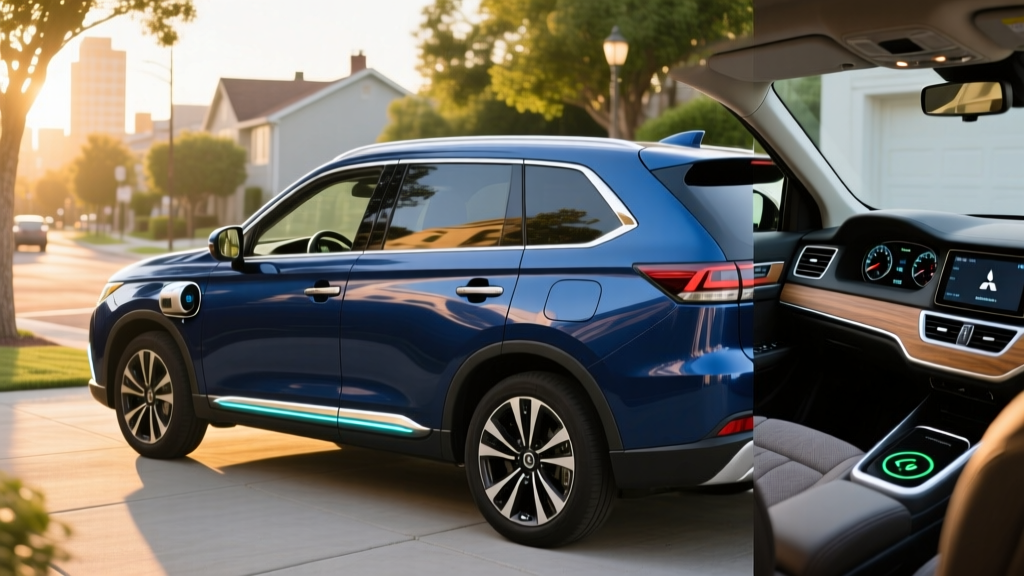
The 2026 Mitsubishi Outlander PHEV occupies a practical middle ground for families who want electric commuting but can't commit to a full battery-electric vehicle. With 38 miles of EPA-rated electric-only range, standard all-wheel drive, and a starting MSRP around $36,695, it undercuts most three-row PHEV competitors while offering genuine daily-drivability on electrons alone. If your commute fits within that ~38-mile envelope and you can charge at home, the Outlander PHEV operates as an EV five days a week and a gas SUV on weekends.
| Spec | Value |
|---|---|
| EPA Electric-Only Range | 38 miles |
| EPA Combined MPGe | 64 MPGe |
| EPA MPG (gas only, combined) | 26 MPG |
| Total Combined Range | ~420 miles |
| Battery Capacity (usable) | 20.0 kWh (lithium-ion) |
| Combined Horsepower | 248 hp |
| Drivetrain | S-AWC (standard AWD) |
| 0–60 mph | ~7.4 seconds |
| Level 2 Charge Time (0–100%) | ~6.5 hours (240V, 15A) |
| DC Fast Charge (CHAdeMO) | ~38 min (0–80%), ~22 kW peak |
| Seating | 7-passenger (3 rows) |
| Cargo (behind 3rd row) | 11.7 cu ft |
| Base MSRP (ES trim) | $36,695 |
| Battery Warranty | 10 years / 100,000 miles |
HEV vs. PHEV: What's the Difference and Why It Matters
Before diving deeper, let's clarify a common point of confusion. The Mitsubishi Outlander is sold in two electrified forms — and they work very differently:
| Feature | Conventional Hybrid (HEV) | Plug-In Hybrid (PHEV) |
|---|---|---|
| Plug-in charging? | No — charges via regen & engine | Yes — plug in to charge the larger battery |
| Battery size | ~1.5 kWh | 20.0 kWh usable |
| Electric-only driving | Minimal (low-speed assist only) | 38 miles EPA at highway-capable speeds |
| Fuel economy | ~26 MPG combined | 64 MPGe (electric + gas combined) |
| Tax credit eligible? | No | Check §30D eligibility — see below |
This article focuses on the PHEV Outlander — the plug-in variant. If you cannot charge at home or at work, the conventional Outlander HEV may be a simpler choice, though you lose the electric-only commute advantage and any potential tax credit.
Electric-Only Range and Fuel Economy Breakdown
| Mode | City | Highway | Combined |
|---|---|---|---|
| Electric + Gas (MPGe) | 68 MPGe | 60 MPGe | 64 MPGe |
| Gas Only (MPG) | 25 MPG | 27 MPG | 26 MPG |
Electric-only range: 38 miles (EPA). In real-world commuting, expect 32–36 miles in moderate temperatures with mixed city/highway driving. In cold weather (below 35°F), cabin heating and battery resistance can reduce electric range to roughly 25–30 miles. If your daily round-trip commute is under 30 miles, you'll rarely visit a gas station on weekdays.
Real-world gas MPG: Once the battery depletes, the 2.4-liter four-cylinder engine and twin electric motors operate as a series-parallel hybrid system. Expect 25–27 MPG combined in real-world driving — closely matching the EPA sticker. Highway cruising at 75+ mph may dip to 23–24 MPG due to the Outlander's boxy aerodynamics and 4,700-pound curb weight.
Total range: With a full charge and a full 14.8-gallon tank, you can expect roughly 420 miles of combined range — enough for most road trips without range anxiety.
Powertrain and Performance: 248 HP with Standard AWD
The Outlander PHEV's powertrain pairs a 2.4-liter Atkinson-cycle four-cylinder engine (126 hp) with two electric motors — one on each axle — producing a combined system output of 248 horsepower. The rear motor enables Mitsubishi's S-AWC (Super All-Wheel Control) system, which is standard on every PHEV trim, not an expensive add-on.
The result is a 0–60 mph time of approximately 7.4 seconds — adequate for merging and passing, though not sporty. The electric motors provide instant torque from a stop, making city driving feel more responsive than the horsepower figure alone suggests. The twin-motor AWD system also delivers confident traction in rain and light snow without the efficiency penalty of a mechanical driveshaft.
Charging: Level 2 and DC Fast Charging Explained
The Outlander PHEV charges through three methods:
| Level | Power | 0–100% Time | Notes |
|---|---|---|---|
| Level 1 (120V household) | ~1.4 kW | ~14 hours | Emergency/trickle only |
| Level 2 (240V home/public) | ~3.6 kW | ~6.5 hours | Overnight home charging |
| DC Fast (CHAdeMO) | ~22 kW peak | ~38 min (0–80%) | CHAdeMO connector — increasingly rare |
Critical note on DC fast charging: The Outlander PHEV uses the CHAdeMO connector for DC fast charging — not the more common CCS1 or the Tesla NACS standard. CHAdeMO infrastructure is declining in the U.S. as Electrify America, EVgo, and other networks standardize on CCS and NACS. Before relying on DC fast charging, verify CHAdeMO availability on your routes using apps like PlugShare. Many newer public stations no longer include CHAdeMO connectors.
Home charging is the sweet spot. A Level 2 home charger (240V, 15–20 amp circuit) will fully replenish the 20 kWh battery overnight in about 6.5 hours. Since most PHEV owners charge at home and rarely use DC fast charging, the CHAdeMO limitation matters less than it would for a full BEV — but it's still worth knowing.
Pricing, Trims, and Federal Tax Credit Eligibility
The 2026 Outlander PHEV starts at $36,695 for the ES trim, rising to approximately $46,000+ for the fully loaded SEL Platinum Edition. Key trims include:
- ES: $36,695 — base AWD, 18-inch wheels, 8-inch touchscreen
- SE: ~$39,000 — heated seats, power liftgate, upgraded interior
- SEL: ~$42,000 — leather, panoramic sunroof, premium audio
- SEL Platinum Edition: ~$46,500 — all options, unique styling
Federal Tax Credit (§30D): Does the Outlander PHEV Qualify?
Under current IRS §30D rules, the Outlander PHEV may qualify for up to $3,750 of the federal plug-in vehicle tax credit — not the full $7,500. The credit amount depends on critical-mineral and battery-component sourcing requirements that change annually. Key eligibility factors:
- MSRP cap: SUVs must be under $80,000 — the Outlander PHEV clears this easily
- Buyer income cap: AGI must not exceed $150,000 (single) / $300,000 (joint)
- Battery sourcing: Partial credit ($3,750) if critical-mineral OR component requirements are met; full $7,500 if both are met
- Point-of-sale transfer: Eligible buyers can apply the credit at purchase, reducing the dealer price directly
Verify current-year eligibility at IRS.gov's qualified manufacturer list before purchasing. Rules and sourcing compliance update regularly, and a tax professional can confirm your personal eligibility.
Reliability, Battery Warranty, and Long-Term Costs
Mitsubishi's hybrid battery warranty: 10 years / 100,000 miles — one of the longest in the industry. This covers the traction battery against defects and excessive capacity loss (typically defined as dropping below ~70% of original capacity). The powertrain warranty also extends to 10 years / 100,000 miles, and the basic vehicle warranty is 5 years / 60,000 miles.
Reliability track record: Mitsubishi's PHEV system has been in production since 2013 globally (the current-generation Outlander PHEV arrived in the U.S. for the 2023 model year). The twin-motor AWD architecture is proven, and the 2.4L Atkinson-cycle engine is a simple, low-stress design. Long-term owner forums report minimal battery degradation in the 3–5% range over the first 60,000 miles — consistent with the conservative battery management system Mitsubishi employs.
Battery replacement cost: If the traction battery fails outside warranty, expect a replacement cost of approximately $8,000–$12,000 including parts and labor. However, PHEV batteries are smaller and less expensive to replace than full BEV packs, and the 10-year/100,000-mile warranty means most original owners will never face this cost. Mitsubishi's 10-year powertrain warranty also provides a strong safety net for second owners who purchase within the warranty window.
Maintenance advantage: As a plug-in hybrid, the Outlander PHEV still requires oil changes, spark plug replacement, and transmission fluid service for its gasoline engine — but these intervals are often extended because the engine runs less frequently when you commute on electricity. Budget roughly $150–$250/year for routine maintenance, compared to $100–$150/year for a pure EV with no engine.
Outlander PHEV vs. Full EV vs. Gas SUV: Which Is Right for You?
Choose the Outlander PHEV if:
- Your daily commute is under 35 miles round-trip and you can charge at home
- You need three rows and AWD but can't install a Level 2 charger fast enough for a full EV
- You take regular road trips where charging infrastructure is sparse
- You want to reduce fuel consumption without committing to full electrification
Choose a full EV (e.g., Kia EV9, Tesla Model Y) if:
- You have reliable home Level 2 charging and your daily driving is under 250 miles
- You want zero engine maintenance and the lowest per-mile fuel cost
- You qualify for the full $7,500 federal tax credit on a qualifying BEV
Choose a conventional gas SUV or HEV if:
- You cannot charge at home or at work
- Your budget is under $30,000 and you need three rows
- You drive very high annual miles where the PHEV premium doesn't pay back quickly
Pros and Cons
Pros
- 38 miles of electric range covers most commutes
- Standard AWD on every trim — no expensive option package
- Three-row seating in a PHEV — rare at this price point
- 10-year / 100,000-mile battery and powertrain warranty
- CHAdeMO DC fast charging available (though infrastructure is declining)
- Under $37,000 starting MSRP for a plug-in AWD SUV
Cons
- CHAdeMO connector is losing ground to CCS/NACS at public stations
- Third row is tight — best for children only
- Cargo space behind 3rd row (11.7 cu ft) is limited
- Gas-only MPG (26 combined) is average, not class-leading
- Partial federal tax credit (~$3,750), not the full $7,500
- Infotainment system lags behind competitors in responsiveness
Frequently Asked Questions
How many MPG does the Outlander PHEV get?
The EPA rates the 2026 Outlander PHEV at 64 MPGe when combining electric and gas operation, and 26 MPG combined when running on gasoline alone after the battery depletes. Real-world gas-only driving typically returns 25–27 MPG combined. (Source: fueleconomy.gov)
How far can the Outlander PHEV go on electric only?
The EPA rates it at 38 miles of electric-only range. In real-world conditions, expect 32–36 miles in moderate weather and 25–30 miles in cold weather (below 35°F) due to cabin heating demands and battery resistance.
Does the Outlander PHEV qualify for a federal tax credit?
It may qualify for up to $3,750 under the IRS §30D clean vehicle credit, depending on current battery-sourcing compliance rules. Buyer income caps ($150k single / $300k joint) and the $80,000 SUV MSRP cap apply. Check the IRS qualified manufacturer list for current-year eligibility before purchasing.
Is the Outlander PHEV reliable, and what does battery replacement cost?
Mitsubishi's PHEV system has been in global production since 2013 and has a strong reliability record. The battery is covered by a 10-year / 100,000-mile warranty. Out-of-warranty battery replacement costs approximately $8,000–$12,000, though most owners will never need this service within the warranty period.
Can I charge the Outlander PHEV at a Tesla Supercharger?
Not directly. The Outlander PHEV uses a J1772 connector for Level 2 AC charging and CHAdeMO for DC fast charging. Tesla Superchargers use the NACS connector. No adapter currently allows CHAdeMO-to-NACS DC fast charging. You can use a J1772-to-NACS adapter for Level 2 AC charging at some Tesla destination chargers, but not at Supercharger stalls.
Should I get the Outlander PHEV or a full EV?
If you can charge at home, drive under 35 miles daily, and regularly take road trips where charging infrastructure is uncertain, the PHEV gives you electric commuting with gas-powered flexibility. If you have reliable home charging and your daily driving stays under 250 miles, a full EV like the Kia EV9 or Tesla Model Y will deliver lower operating costs and zero engine maintenance.
Does the Outlander PHEV have three usable rows?
Yes, but the third row is best suited for children or short trips. Adults will find legroom and headroom tight in the way-back seats. Cargo volume behind the third row is just 11.7 cubic feet — enough for a few grocery bags, not luggage for seven.