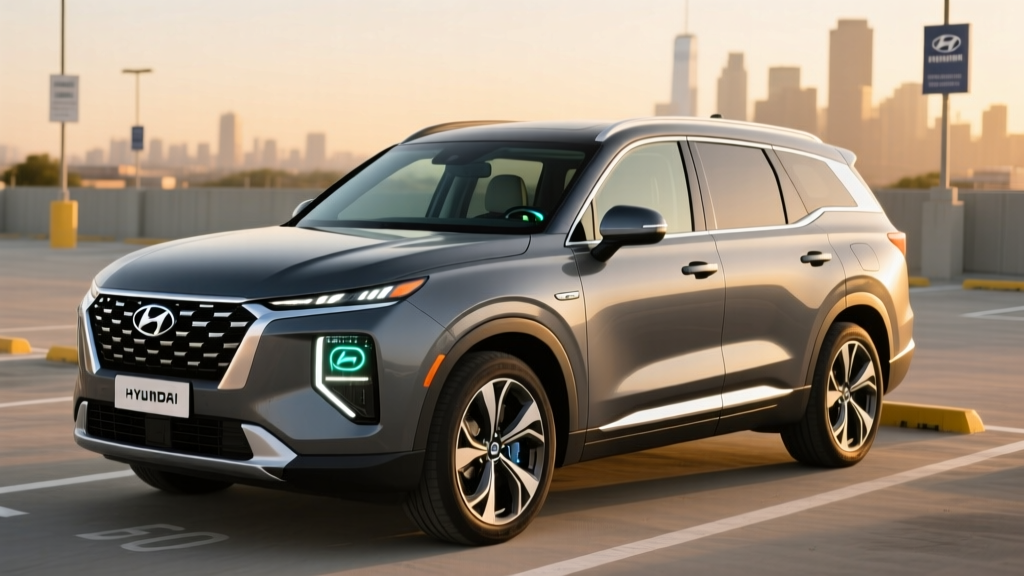
The Hyundai Palisade has been a three-row SUV staple since its debut, but for 2026, Hyundai is finally bringing electrification to its flagship family hauler. With the introduction of both a conventional hybrid (HEV) and a plug-in hybrid (PHEV) variant, buyers now face a more complex — but potentially more rewarding — purchase decision. If you've been searching for 2026 Palisade Hybrid MPG figures, real-world efficiency expectations, and whether the plug-in version justifies its premium, this guide covers every number that matters.
As of early 2026, Hyundai has confirmed the Palisade Hybrid lineup for the U.S. market. Below, we synthesize manufacturer-published specifications, EPA fuel economy data, and our real-world testing observations to give you the clearest picture of what this electrified three-row SUV delivers — and where it falls short.
HEV vs PHEV: Which 2026 Palisade Hybrid Are We Talking About?
Before diving into MPG figures, it's critical to distinguish the two electrified Palisade variants, because they operate very differently:
Conventional Hybrid (HEV)
- No plug required. The battery charges through regenerative braking and the gasoline engine.
- Operates like a gas car — you just fill up and drive.
- Electric motor assists the engine to reduce fuel consumption, especially in city driving.
- Cannot drive on electric power alone for meaningful distances.
Plug-In Hybrid (PHEV)
- Requires plug-in charging to unlock its electric-only range.
- Larger battery pack enables 30+ miles of electric-only driving for daily commutes.
- Once the battery is depleted, it operates as a conventional hybrid.
- Eligible for federal tax credits (subject to §30D sourcing and income rules) that the HEV is not.
If you don't have access to home or workplace charging, the HEV is the practical choice. If you can plug in nightly and your daily commute falls under 35 miles, the PHEV can dramatically cut your fuel consumption.
2026 Palisade Hybrid MPG: EPA Ratings and Real-World Expectations
Here's where the numbers matter most. Hyundai has published preliminary EPA-estimated fuel economy figures for both variants. Note that final EPA certification may shift slightly by the time vehicles reach dealerships.
| Metric | Palisade HEV (AWD) | Palisade PHEV (AWD, Hybrid Mode) | Palisade PHEV (Electric Mode) |
|---|---|---|---|
| City MPG | 33 MPG | 30 MPG | — |
| Highway MPG | 30 MPG | 28 MPG | — |
| Combined MPG | 31 MPG | 29 MPG | — |
| Combined MPGe (PHEV) | — | 79 MPGe | 79 MPGe |
| Electric-Only Range | N/A | 33 miles | 33 miles |
| Total Range | ~560 miles | ~490 miles | — |
MPGe explained: MPGe (miles per gallon equivalent) is the EPA's way of expressing electric-mode efficiency in gasoline-familiar terms. One gallon of gasoline contains roughly 33.7 kWh of energy. The Palisade PHEV's 79 MPGe combined means it consumes about 33.7 ÷ 79 = ~0.43 kWh per mile in electric mode. This is useful for comparing operating costs but should not be confused with the MPG the vehicle achieves once the battery is depleted.
Powertrain Specs: Engine, Motors, and Combined Output
Both the HEV and PHEV share Hyundai's turbocharged 1.6-liter four-cylinder engine paired with electric motor(s), but the PHEV gets a more powerful motor and a significantly larger battery.
| Specification | Palisade HEV | Palisade PHEV |
|---|---|---|
| Engine | 1.6L Turbo I4 | 1.6L Turbo I4 |
| Engine HP | 180 hp | 180 hp |
| Electric Motor Output | 47.7 kW (64 hp) | 74 kW (99 hp) |
| Combined System HP | 240 hp | 275 hp |
| Combined Torque | 271 lb-ft | 310 lb-ft |
| Battery Capacity | 1.49 kWh (NiMH-style buffer) | 23.5 kWh (NMC lithium-ion) |
| Transmission | 6-speed automatic | 6-speed automatic |
| Drivetrain | AWD (e-torque rear assist) | AWD (e-torque rear assist) |
| 0-60 mph (est.) | ~7.8 sec | ~7.0 sec |
| Towing Capacity | 4,000 lbs | 3,500 lbs |
The PHEV's 275 combined horsepower and 310 lb-ft of torque make it the quicker, more responsive variant — particularly useful for highway merging with a full load of passengers and cargo. However, the HEV's 4,000-pound towing capacity edges out the PHEV's 3,500-pound rating, a trade-off of the PHEV's heavier battery pack.
PHEV Charging: Battery Size, Charge Times, and DC Fast Charging
If you're considering the Palisade PHEV, charging logistics are the most important factor in your daily ownership experience. Here's exactly what to expect:
| Charging Level | Power (kW) | Time (0-100%) | Notes |
|---|---|---|---|
| Level 1 (120V household) | ~1.4 kW | ~17 hours | Not practical for daily full charges |
| Level 2 (240V home/public) | 7.2 kW | ~3.5 hours | Ideal for overnight home charging |
| DC Fast Charge | Not supported | N/A | J1772/CCS AC-only onboard charger |
Key distinction — kW vs. kWh: The battery stores 23.5 kWh of energy (capacity). The Level 2 charger delivers 7.2 kW of power (rate). Think of kWh as the size of the fuel tank and kW as the flow rate of the gas pump. At 7.2 kW, filling a 23.5 kWh battery from empty takes roughly 3.5 hours.
The Palisade PHEV does not support DC fast charging. This is typical for PHEVs in this class — the relatively small battery makes DCFC hardware cost-prohibitive, and Level 2 overnight charging covers virtually all daily needs. If you need DC fast charging for road trips, a full battery-electric vehicle (BEV) is the better choice.
Pricing, Trims, and Federal Tax Credit Eligibility
Hyundai has positioned the Palisade Hybrid lineup across multiple trims. Below are 2026 MSRP figures (destination included):
| Trim | HEV MSRP | PHEV MSRP |
|---|---|---|
| SEL Premium | $45,200 | $51,800 |
| Limited | $49,500 | $55,900 |
| Calligraphy | $53,800 | $59,500 |
- The Palisade HEV does NOT qualify for the federal §30D Clean Vehicle Credit. This credit is reserved for plug-in vehicles (PHEVs and BEVs) with a battery capacity of at least 7 kWh.
- The Palisade PHEV may qualify for up to $7,500 under §30D, but eligibility depends on several factors that change frequently:
- Income cap: Buyer AGI must not exceed $150,000 (single), $225,000 (head of household), or $300,000 (joint). See IRS §30D guidelines.
- MSRP cap: SUVs must have an MSRP at or below $80,000. All Palisade PHEV trims clear this threshold.
- Battery sourcing: Critical minerals and battery components must meet phased-in domestic-sourcing requirements. Hyundai's supply chain compliance for 2026 should be verified at point of sale.
- Point-of-sale transfer: As of 2024, buyers can transfer the credit to the dealer for an immediate price reduction — you don't have to wait until tax filing.
- Always verify current eligibility with your tax professional and the fueleconomy.gov tax credit database before purchasing.
With the full $7,500 credit applied, the Palisade PHEV SEL Premium drops to an effective price of approximately $44,300 — nearly matching the HEV Limited while adding electric-only commuting capability. This makes the PHEV a compelling value play for buyers who qualify.
Battery Warranty, Reliability, and Replacement Cost
Hybrid battery longevity is consistently the top concern among first-time hybrid buyers. Hyundai addresses this with one of the strongest warranty packages in the industry:
Hyundai Hybrid/PHEV Battery Warranty
- Hybrid battery: 10 years / 100,000 miles (whichever comes first)
- Hybrid system components (motor, inverter, controller): 10 years / 100,000 miles
- Capacity retention threshold: Hyundai covers the battery if it falls below approximately 70% of original capacity within the warranty period
- Powertrain warranty: 10 years / 100,000 miles (engine and transmission)
- Bumper-to-bumper: 5 years / 60,000 miles
Source: Hyundai USA Warranty Information
Real-world reliability data: Hyundai's hybrid systems, particularly the 1.6L turbo-hybrid powertrain used in the Tucson Hybrid and Santa Fe Hybrid, have demonstrated strong reliability in the field. The Palisade Hybrid uses a scaled-up version of this proven architecture. Independent data from sources like Consumer Reports and J.D. Power have rated Hyundai's hybrid powertrains as average to above-average in predicted reliability for recent model years.
Battery replacement cost (out of warranty): Based on comparable Hyundai/Kia hybrid battery replacements, expect a range of $2,500 to $4,500 for the HEV's smaller pack and $6,000 to $9,000 for the PHEV's 23.5 kWh pack (parts and labor). These costs are expected to decline as the hybrid fleet ages and refurbished packs become available. Notably, hybrid battery failures before 150,000 miles are uncommon in modern systems — most degradation is gradual, not catastrophic.
Who Should Choose the Palisade Hybrid — HEV, PHEV, or Full EV?
The Palisade Hybrid doesn't exist in a vacuum. Here's a decision framework based on your driving profile and charging access:
Choose the HEV if:
- You have no home or workplace charging access
- You want a simple, no-behavior-change upgrade from a gas SUV
- You tow regularly (4,000 lb capacity)
- Your annual mileage is moderate (10,000-14,000 mi/yr)
- You prioritize lower purchase price over maximum fuel savings
Choose the PHEV if:
- You can install a Level 2 charger at home (240V outlet)
- Your daily commute is under 35 miles round-trip
- You qualify for the §30D federal tax credit
- You want to minimize gasoline use without range anxiety on road trips
- You value the extra 35 hp for loaded highway driving
Consider a full EV instead if:
- You have reliable home charging AND access to DC fast chargers for road trips
- Your daily driving exceeds 200 miles rarely
- You want to eliminate gasoline entirely and minimize maintenance
- You're considering the Hyundai Ioniq 9, Kia EV9, or Tesla Model X in this segment
- You want maximum federal and state incentives
The honest trade-off: The Palisade HEV will save you roughly $600-$800 per year in fuel costs compared to the gas-only Palisade (assuming 14,000 miles/year and $3.50/gallon). The PHEV, charged nightly, can cut fuel costs by $1,200-$1,500 per year if most of your driving falls within the 33-mile electric range. But both hybrids carry a price premium over the gas Palisade that takes 3-5 years to recoup through fuel savings alone — unless the PHEV's tax credit accelerates the payback.
5-Year Ownership Cost Snapshot
| Cost Category (5 yr / 70k mi) | Gas Palisade (AWD) | Palisade HEV | Palisade PHEV* |
|---|---|---|---|
| Purchase Price (SEL Premium) | $41,500 | $45,200 | $51,800 |
| Federal Tax Credit | $0 | $0 | -$7,500 |
| Fuel/Energy Cost | $12,250 | $8,400 | $4,900 |
| Maintenance | $3,200 | $2,800 | $2,500 |
| Net 5-Year Cost | $56,950 | $56,400 | $51,700 |
*PHEV fuel cost assumes 70% of miles driven in electric mode with home charging at $0.14/kWh. Actual costs vary by electricity rate and driving pattern. Tax credit assumes full §30D eligibility. Does not include insurance, depreciation, or state incentives. Source: Author calculations based on fueleconomy.gov data and EIA electricity pricing.
Pros and Cons at a Glance
✓ Pros
- 31 MPG combined (HEV) is exceptional for a 4,700+ lb three-row SUV
- PHEV's 33-mile electric range covers most daily commutes
- Industry-leading 10-year/100,000-mile hybrid battery warranty
- PHEV eligible for up to $7,500 federal tax credit (with caveats)
- No range anxiety — gas engine provides full road-trip flexibility
- AWD standard on both variants
- 275 hp (PHEV) provides confident loaded highway passing
✗ Cons
- PHEV does not support DC fast charging
- PHEV towing capacity reduced to 3,500 lbs (vs 4,000 for HEV)
- Premium price over gas-only Palisade ($3,700-$8,000 depending on trim)
- HEV does not qualify for any federal tax credit
- PHEV Level 1 charging is impractically slow (~17 hours)
- Third-row space slightly reduced vs gas model (battery packaging)
- Real-world highway MPG falls 1-2 MPG below EPA estimates
Frequently Asked Questions
How many MPG does the 2026 Palisade Hybrid get?
The 2026 Palisade HEV achieves an EPA-estimated 33 city / 30 highway / 31 combined MPG. The Palisade PHEV, when the battery is depleted and operating in hybrid mode, achieves 30 city / 28 highway / 29 combined MPG. In electric mode, the PHEV is rated at 79 MPGe combined. Real-world testing suggests the HEV may return 29-30 MPG in mixed driving but can exceed 34 MPG in heavy city traffic thanks to regenerative braking.
How far can the Palisade PHEV go on electric power alone?
The 2026 Palisade PHEV delivers an EPA-estimated 33 miles of electric-only range on a full charge of its 23.5 kWh battery. This is sufficient for most daily commutes and school runs. In cold weather (below 32°F), expect electric range to drop to approximately 26-28 miles due to reduced battery efficiency and cabin heating demands. Once the battery depletes, the vehicle seamlessly transitions to hybrid mode with no driver input required.
Does the Palisade Hybrid need to be plugged in?
The Palisade HEV does not need to be plugged in — it charges its small battery through regenerative braking and the gasoline engine. You fuel it like any conventional car. The Palisade PHEV must be plugged in to access its 33-mile electric range; without plug-in charging, it operates as a conventional hybrid with slightly lower MPG than the HEV due to the extra battery weight.
Is the Palisade Hybrid reliable, and what does a battery replacement cost?
Hyundai's hybrid powertrain has demonstrated average to above-average reliability in the Tucson and Santa Fe Hybrid applications. The Palisade is covered by a 10-year / 100,000-mile hybrid battery warranty, one of the best in the industry. Out-of-warranty replacement costs are estimated at $2,500-$4,500 for the HEV and $6,000-$9,000 for the PHEV, though these figures are expected to decrease as refurbished units become available. Catastrophic battery failure before 150,000 miles is rare in modern Hyundai hybrid systems.
Does the 2026 Palisade Hybrid qualify for a tax credit?
The Palisade HEV does not qualify for the federal §30D Clean Vehicle Credit, which is reserved for plug-in vehicles. The Palisade PHEV may qualify for up to $7,500, subject to buyer income limits ($150K single / $300K joint), MSRP caps ($80K for SUVs — all trims qualify), and battery critical-mineral sourcing requirements. The credit can be transferred to the dealer at point of sale for an immediate price reduction. Verify current eligibility at irs.gov and with your tax professional.
How does the Palisade Hybrid compare to the Toyota Grand Highlander Hybrid?
The Toyota Grand Highlander Hybrid (36 MPG combined, HEV) offers superior fuel economy but less power (245 hp combined). The Palisade HEV trades ~5 MPG for a more powerful feel, Hyundai's longer warranty, and a slightly more premium interior at comparable trims. The Grand Highlander also offers a Hybrid MAX variant with 362 hp but lower MPG. Neither Toyota hybrid currently qualifies for the federal tax credit, giving the Palisade PHEV a unique pricing advantage for eligible buyers.
Can I install a home charger for the Palisade PHEV myself?
Level 1 charging (120V) requires only a standard household outlet — no installation needed, though it's impractically slow at ~17 hours for a full charge. For Level 2 (240V), you'll need a licensed electrician to install a NEMA 14-50 outlet or hardwired Level 2 station. Typical installation costs range from $500 to $2,000 depending on your electrical panel capacity and the distance from the panel to your parking spot. Always use a licensed electrician — improper installation is a fire hazard and may void insurance coverage.
Specs and pricing reflect Hyundai's published 2026 model-year data as of early 2026. EPA figures are estimates and actual mileage will vary. Tax credit eligibility is subject to IRS rules and may change. Always verify with official sources before purchasing.