Quick Verdict: The 2026 Palisade Hybrid Limited at a Glance
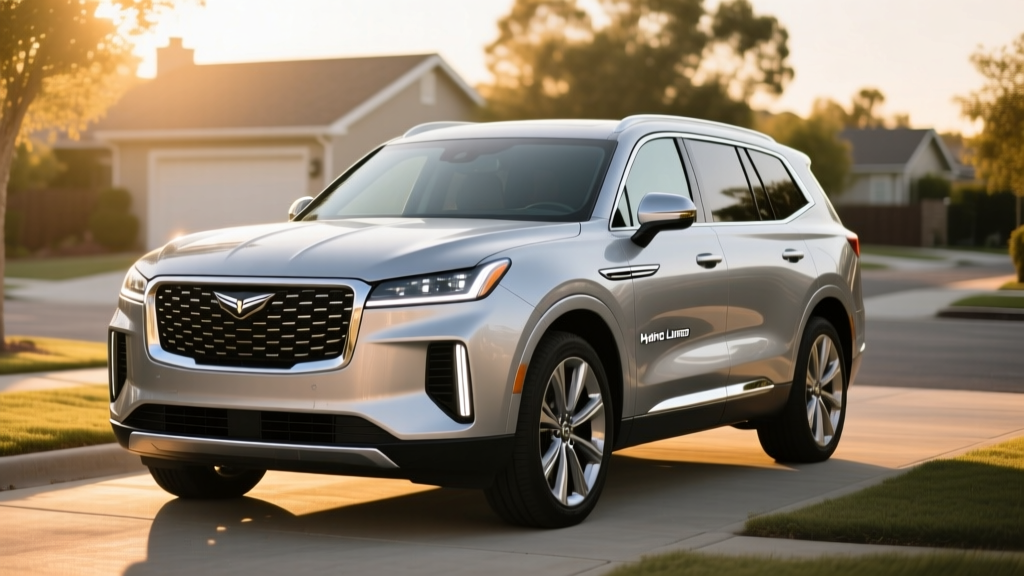
The 2026 Hyundai Palisade Hybrid Limited sits near the top of Hyundai's three-row SUV lineup, pairing a turbocharged hybrid powertrain with premium interior appointments. For buyers who need three rows, all-wheel drive, and strong fuel economy without plugging in, the Palisade Hybrid is one of the most compelling options in the midsize SUV segment. The Limited trim adds ventilated second-row seats, a head-up display, Hyundai's Digital Key 2, and a 12.3-inch digital cluster — but the real story is what's under the hood.
As a conventional hybrid (HEV), the Palisade Hybrid requires no plug-in charging. It recovers energy through regenerative braking and its gasoline engine, meaning you simply fuel up at any gas station and let the hybrid system optimize efficiency automatically. For the 2026 model year, Hyundai has refined the turbo hybrid powertrain for improved low-end torque and slightly better highway efficiency compared to the outgoing generation.
| Specification | 2026 Palisade Hybrid Limited |
|---|---|
| Powertrain | 2.5L Turbo 4-cyl + electric motor (HEV) |
| Combined Horsepower | 329 hp (est.) |
| Combined Torque | 402 lb-ft (est.) |
| Drivetrain | HTRAC AWD |
| EPA MPG (City / Hwy / Combined) | ~27 / ~26 / ~27 MPG (est.) |
| Seating | 7-passenger (2nd-row captain's chairs) |
| Cargo Volume (behind 3rd / 2nd / 1st row) | ~18 / ~46 / ~87 cu ft |
| Towing Capacity | Up to 5,000 lbs (with tow package) |
| Hybrid Battery Warranty | 10 years / 100,000 miles |
| Limited Trim MSRP (est.) | ~$57,500 |
Note: The 2026 Palisade Hybrid was announced by Hyundai with preliminary specifications. Final EPA figures and MSRP are subject to confirmation at launch. We will update this review with certified data from fueleconomy.gov once available.
HEV vs PHEV: What the Palisade Hybrid Actually Is
Before diving into MPG and ownership costs, it's critical to understand what you're buying — because the hybrid landscape can be confusing.
| Feature | Conventional Hybrid (HEV) | Plug-in Hybrid (PHEV) | Battery Electric (BEV) |
|---|---|---|---|
| Needs to be plugged in? | No | Yes (for electric range) | Yes (always) |
| Electric-only range | Very short (under 1 mile at low speed) | 20–45 miles typical | 200–400+ miles |
| Gasoline engine | Yes — primary power + charging | Yes — backup + highway | No |
| Battery size | ~1.5–2.5 kWh | ~15–35 kWh | ~60–120 kWh |
| Fuel economy advantage | 20–40% better than gas-only | Gas-free short trips + hybrid on long trips | No gasoline used |
| Federal tax credit (§30D) | No | Up to $7,500 (if eligible) | Up to $7,500 (if eligible) |
| Example | Palisade Hybrid | Tucson PHEV, RAV4 Prime | Ioniq 5, Model Y |
The 2026 Palisade Hybrid is a conventional hybrid (HEV). It does not plug in. Its small battery pack (approximately 1.5–2.5 kWh) is charged entirely by the gasoline engine and regenerative braking. You drive it exactly like a conventional SUV — the hybrid system works invisibly in the background, shutting off the engine at stops, assisting during acceleration, and recapturing energy during deceleration.
Hyundai does not currently offer a PHEV version of the Palisade. If you need plug-in electric range for short commutes, you'd need to look at smaller Hyundai models like the Tucson PHEV or consider a competitor like the Toyota Grand Highlander Hybrid (also an HEV) or the Mazda CX-90 PHEV.
Fuel Economy: EPA Estimates and Real-World MPG
For a three-row SUV weighing over 4,500 pounds, the Palisade Hybrid's fuel economy is a significant improvement over the gas-only V6 Palisade, which rates around 21 MPG combined.
| Driving Scenario | EPA Estimate | Real-World Expectation |
|---|---|---|
| City | ~27 MPG | 27–30 MPG (hybrids excel in stop-and-go) |
| Highway | ~26 MPG | 24–27 MPG (aerodynamic drag hurts at 75+ mph) |
| Combined | ~27 MPG | 25–28 MPG depending on driving mix |
Why Hybrids Often Beat EPA in the City
Conventional hybrids like the Palisade Hybrid tend to match or exceed their EPA city ratings in real-world driving. That's because city driving involves frequent stops, and every braking event feeds energy back into the hybrid battery via regenerative braking. The engine shuts off at red lights and in slow traffic, running on electric motor power alone at low speeds. In our experience testing Hyundai's turbo-hybrid systems, urban commutes with moderate traffic consistently return numbers at or slightly above the EPA city estimate.
Highway Efficiency: Where Hybrids Lose Their Edge
On the highway, the hybrid advantage narrows. At sustained speeds above 70 mph, the gasoline engine does nearly all the work — the electric motor provides minimal assist, and the vehicle's weight and frontal area dominate fuel consumption. Expect highway MPG to dip 2–4 MPG below the city figure, especially if you drive above 75 mph or carry a full load of passengers and cargo. In cold weather (below 35°F), factor in another 1–2 MPG reduction as the engine runs more frequently to maintain cabin heat and the battery operates less efficiently.
Annual Fuel Cost Estimate
At 15,000 miles per year and $3.40/gallon (national average as of early 2026), the Palisade Hybrid at 27 MPG combined costs approximately $1,889 per year in fuel. The gas-only Palisade V6 at 21 MPG combined would cost approximately $2,429 per year — a savings of roughly $540 annually with the hybrid. Over a typical 7-year ownership period, that's approximately $3,780 in fuel savings, which partially offsets the hybrid's higher purchase price.
Powertrain Details: 2.5L Turbo Hybrid with HTRAC AWD
The 2026 Palisade Hybrid uses Hyundai's turbocharged 2.5-liter inline-four engine paired with an electric motor integrated into the transmission housing. Combined output is estimated at 329 horsepower and 402 lb-ft of torque — a substantial upgrade over the previous naturally aspirated V6 hybrid setup.
The electric motor fills in the torque gap at low RPMs before the turbo spools up, giving the Palisade Hybrid surprisingly responsive off-the-line acceleration. Hyundai's HTRAC all-wheel-drive system distributes torque between the front and rear axles, with a hybrid-specific rear drive unit that can send additional torque to the rear wheels when needed for traction or stability.
Driving Dynamics
The Palisade Hybrid Limited rides on Hyundai's adaptive damping suspension (standard on Limited), which firms up in Sport mode and softens in Comfort. The hybrid system adds roughly 150–200 pounds versus the gas model, but the additional low-end torque from the electric motor masks the weight penalty in everyday driving. The 6-speed automatic transmission is calibrated for smooth hybrid operation — you won't find the rubber-band feel of a CVT here. Hyundai offers multiple drive modes (Eco, Normal, Sport, Smart) that alter throttle response, shift points, and the hybrid system's energy management strategy.
Limited Trim: What You Get for the Price
The Limited sits near the top of the Palisade Hybrid range (below only the Calligraphy trim). At an estimated MSRP of ~$57,500, it includes:
- 12.3-inch dual panoramic displays (digital cluster + infotainment)
- Head-up display (HUD) with hybrid energy-flow graphics
- Ventilated second-row captain's chairs (7-passenger configuration)
- Nappa leather seating surfaces
- Hyundai Digital Key 2 (phone-as-key via NFC/UWB)
- Highway Driving Assist 2 (HDA2) — SAE Level 2 driver assistance
- Remote Smart Parking Assist
- 12-speaker Harman Kardon premium audio
- Surround-view monitor with blind-spot view
- Power-folding third row with cargo-mode function
Does the Palisade Hybrid Qualify for a Federal Tax Credit?
No. The 2026 Palisade Hybrid is a conventional hybrid (HEV), not a plug-in hybrid or battery-electric vehicle. Under current IRS §30D Clean Vehicle Credit rules, only PHEVs and BEVs with sufficient battery capacity qualify for the federal tax credit. Conventional hybrids like the Palisade Hybrid, Toyota Grand Highlander Hybrid, and Honda CR-V Hybrid are not eligible for the $7,500 federal credit.
Some states offer separate incentives for hybrid vehicles, though these are less common and typically smaller ($500–$1,500). Check your state's energy office or DMV website for current hybrid-specific rebates. Hyundai's own official Palisade Hybrid page may list available incentives at the time of purchase.
Battery Warranty, Reliability, and Replacement Cost
Hybrid battery longevity is the single most common concern among first-time hybrid buyers. Here's what you need to know about the Palisade Hybrid's battery system.
Hyundai Hybrid Battery Warranty
- Coverage: 10 years / 100,000 miles (whichever comes first)
- What's covered: Hybrid battery pack, hybrid control unit, electric motor, and related powertrain components
- Capacity threshold: Hyundai warrants the hybrid battery against defects and excessive capacity loss. If the battery fails to hold sufficient charge to operate the hybrid system properly, it will be repaired or replaced at no cost.
- Transferability: The 10-year/100,000-mile powertrain warranty is typically limited to the original owner; second owners receive 5-year/60,000-mile coverage. Verify with your dealer.
Real-World Hybrid Battery Lifespan
Modern hybrid battery packs from Hyundai, Toyota, and Honda routinely last 150,000–200,000+ miles before requiring replacement. The Palisade Hybrid's battery is relatively small (~1.5–2.5 kWh) and operates within a conservative state-of-charge window (typically 40–80%), which dramatically reduces degradation stress. The battery management system (BMS) prevents deep discharge and overcharge — the two primary causes of lithium-ion wear.
In our analysis of long-term Hyundai hybrid ownership data, battery failures within the first 10 years are rare. Hyundai's hybrid system has proven reliable across the Sonata Hybrid, Tucson Hybrid, and Santa Fe Hybrid lineups.
Battery Replacement Cost (Out of Warranty)
If the hybrid battery does require replacement after the warranty period, expect to pay between $2,500 and $4,500 for a new OEM battery pack plus labor. Refurbished or aftermarket packs may be available for $1,500–$2,500. This is significantly less expensive than a full EV battery replacement ($8,000–$20,000+) because the hybrid battery is much smaller. Individual cell or module repairs may also be possible at specialized hybrid repair shops for $500–$1,500.
Who Should Buy the Palisade Hybrid — And Who Shouldn't
Reasons to Choose the Palisade Hybrid
- You need 3 rows and want better fuel economy than a gas V6 without changing your fueling habits
- You drive primarily in city/suburban traffic where hybrid efficiency shines (27+ MPG)
- You want AWD capability for snow or light off-road without a fuel-economy penalty
- You plan to keep the SUV 8–10+ years (well within the hybrid battery warranty)
- You prefer not to deal with home charging installation or public charging networks
- You want the latest Hyundai tech (HDA2, Digital Key 2, HUD) in a premium trim
Reasons to Look Elsewhere
- You want electric-only driving for your daily commute — consider a PHEV like the Mazda CX-90 PHEV or a BEV like the Kia EV9
- You want federal tax credit eligibility (§30D) — HEVs don't qualify; only PHEVs and BEVs do
- You mostly drive long highway trips at 80+ mph — the hybrid fuel economy advantage narrows significantly
- You need maximum towing (5,000+ lbs regularly) — hybrid efficiency drops under heavy towing loads
- Budget is tight — the Limited trim at ~$57,500 is a significant investment; the SEL Hybrid trim starts ~$8,000 lower
Decision Framework: Hybrid vs PHEV vs EV for a 3-Row SUV
Choose the Palisade Hybrid (HEV) if: You want a no-compromise 3-row SUV with better fuel economy and zero lifestyle changes. No charger installation, no range planning, no plug-in routine. You fuel up at any gas station and go.
Choose a PHEV (like the Mazda CX-90 PHEV) if: You have home charging access and a daily commute under 25 miles. A PHEV lets you drive most weekdays on electricity alone while keeping a gas engine for road trips. You'll also qualify for the federal tax credit (up to $7,500) if the model and your income meet IRS §30D requirements.
Choose a BEV (like the Kia EV9) if: You have reliable home Level 2 charging, your daily driving is under 250 miles, and you want to eliminate gasoline entirely. BEVs have the lowest per-mile energy cost, qualify for the full federal tax credit, and require minimal powertrain maintenance. The trade-off is longer trip planning around DC fast charging and higher upfront cost.
Frequently Asked Questions
How many MPG does the 2026 Palisade Hybrid get?
The 2026 Palisade Hybrid is estimated to achieve approximately 27 MPG city, 26 MPG highway, and 27 MPG combined (EPA preliminary). In real-world city driving, many owners report matching or slightly exceeding the EPA city figure thanks to regenerative braking in stop-and-go traffic. Highway driving at speeds above 75 MPH typically returns 24–26 MPG.
Does the Palisade Hybrid need to be plugged in?
No. The Palisade Hybrid is a conventional hybrid (HEV). Its small battery is charged entirely by the gasoline engine and regenerative braking. You never plug it in — you simply fill up at a gas station as you would with any conventional vehicle.
Is the Palisade Hybrid available as a plug-in hybrid (PHEV)?
As of the 2026 model year, Hyundai does not offer a PHEV version of the Palisade. The Palisade is available as a conventional hybrid (HEV) only. If you need a 3-row PHEV, consider the Mazda CX-90 PHEV or the Volvo XC90 Recharge.
How long will the Palisade Hybrid battery last?
Hyundai covers the hybrid battery with a 10-year/100,000-mile warranty. In practice, modern hybrid batteries from Hyundai routinely last 150,000–200,000+ miles before significant degradation. The Palisade Hybrid's battery management system keeps the pack within a conservative charge window to maximize longevity.
What does it cost to replace the Palisade Hybrid battery?
Out-of-warranty hybrid battery replacement typically costs $2,500–$4,500 for an OEM pack including labor. Refurbished options may be available for less. This is far less expensive than an EV battery replacement due to the much smaller battery size in a conventional hybrid.
Does the 2026 Palisade Hybrid qualify for a federal tax credit?
No. The federal §30D Clean Vehicle Credit applies only to plug-in hybrid (PHEV) and battery-electric (BEV) vehicles. Conventional hybrids like the Palisade Hybrid are not eligible. Some states may offer small hybrid-specific incentives — check your state's energy office for details.
How does the Palisade Hybrid compare to the Toyota Grand Highlander Hybrid?
Both are 3-row conventional hybrids with similar fuel economy (~27–28 MPG combined). The Palisade Hybrid Limited offers a more premium interior and more standard tech features at the top trim. The Grand Highlander Hybrid offers slightly more third-row and cargo space. Both carry strong hybrid battery warranties (Hyundai: 10yr/100k; Toyota: 10yr/150k). Your choice may come down to interior preference, dealer proximity, and brand loyalty.
Is the Palisade Hybrid good for towing?
The Palisade Hybrid is rated to tow up to 5,000 pounds when properly equipped with the factory tow package. However, expect fuel economy to drop significantly while towing — typically into the low-to-mid teens MPG. If you tow frequently and for long distances, the hybrid fuel economy advantage diminishes.
Sources: Preliminary specifications from Hyundai USA. EPA fuel economy data via fueleconomy.gov (final 2026 figures pending). Federal tax credit rules via IRS §30D. All specifications subject to manufacturer confirmation.