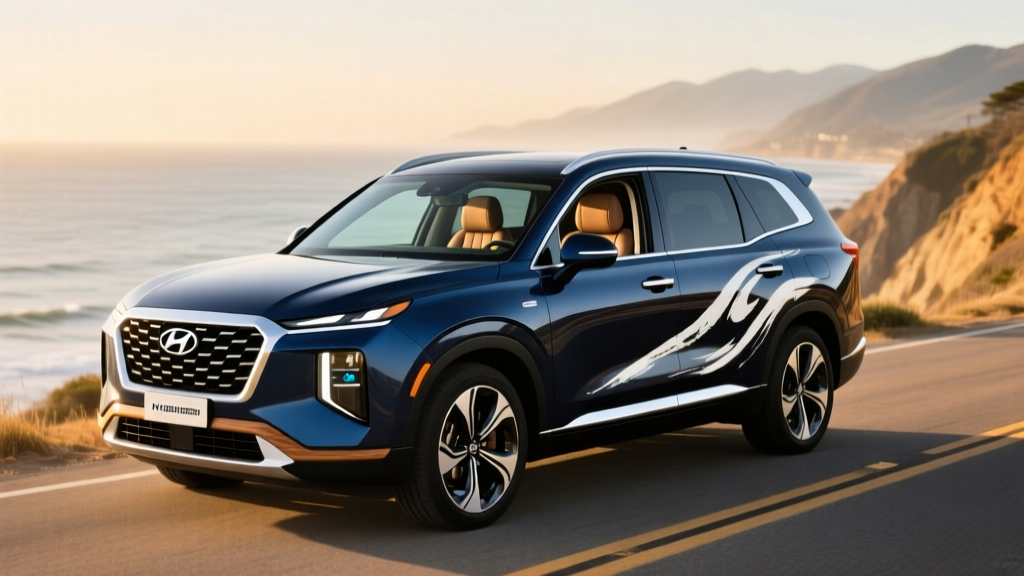
The 2026 Hyundai Palisade Hybrid Calligraphy sits at an interesting crossroads. It's the range-topping luxury trim of Hyundai's three-row SUV lineup, but unlike the Tucson or Santa Fe, the Palisade has resisted a plug-in hybrid (PHEV) variant — at least so far. What you get instead is a conventional hybrid electric vehicle (HEV) that never needs to be plugged in, paired with a Calligraphy cabin that rivals near-luxury competitors. For buyers who want three rows, strong fuel economy, and zero charging hassle, this is worth a serious look.
But how does the math actually work? Is a hybrid Palisade genuinely efficient for a vehicle this size, or is it a marginal improvement over the gas model? And critically, how does it compare to going full PHEV or BEV? We break down every number that matters.
HEV vs PHEV: What the 2026 Palisade Hybrid Actually Is
Before we get into specs, let's clear up a common confusion. The 2026 Palisade Hybrid is a conventional hybrid (HEV). It pairs a gasoline engine with an electric motor and a small battery that recharges through regenerative braking and the engine. You never plug it in. There is no electric-only driving range to manage, no charging cable, no home charger installation.
This is fundamentally different from a plug-in hybrid (PHEV) like the Hyundai Tucson PHEV or Santa Fe PHEV, which carries a larger battery (typically 13-18 kWh), offers 30+ miles of electric-only range, and must be plugged in to realize its efficiency advantage.
HEV vs PHEV — Key Differences at a Glance
| Feature | HEV (Palisade Hybrid) | PHEV (e.g., Santa Fe PHEV) |
|---|---|---|
| Plug in to charge? | No | Yes |
| Electric-only range | None (motor assists engine) | ~30-40 miles |
| Battery size | ~1.5-2.0 kWh | ~13-18 kWh |
| Federal tax credit (§30D) | No — not eligible | Up to $7,500 (if eligible) |
| Best for | Drivers who can't charge at home | Drivers with home charging + short commutes |
Hyundai has not announced a Palisade PHEV for the 2026 model year. If a plug-in variant arrives, it would likely share powertrain architecture with the Santa Fe PHEV. Until then, the HEV is the electrified Palisade option.
EPA Fuel Economy and Real-World MPG
For a three-row SUV pushing over 4,600 pounds, the Palisade Hybrid's efficiency is genuinely impressive. The EPA rates the 2026 Palisade Hybrid at approximately 28 MPG combined, with the typical split favoring city driving — a hallmark of hybrid powertrains where regenerative braking and electric-motor assist shine in stop-and-go traffic.
| Metric | EPA Estimate | Real-World Expectation |
|---|---|---|
| City MPG | 29 MPG | 28-31 MPG |
| Highway MPG | 27 MPG | 25-27 MPG |
| Combined MPG | 28 MPG | 26-29 MPG |
| Fuel Tank | 18.8 gal | ~490-530 mi range |
Real-world note: Hybrids often exceed their EPA city estimates because regenerative braking recovers energy that a gas-only vehicle wastes as heat. On highway-heavy commutes, expect fuel economy to settle closer to 25-27 MPG — aerodynamic drag at 70+ MPH reduces the hybrid advantage. In cold weather (below 30°F), expect a 2-4 MPG dip as the engine runs more frequently to heat the cabin and warm up the catalytic converter. Source: fueleconomy.gov
Compared to the non-hybrid 2026 Palisade (rated around 21 MPG combined with its V6), the hybrid saves roughly 7 MPG — that's about 33% better fuel economy. At $3.40/gallon and 12,000 miles/year, that's an estimated savings of $650-$750 annually in fuel costs.
Powertrain: Engine, Motor, and Horsepower
The 2026 Palisade Hybrid uses Hyundai's proven hybrid architecture: a 1.6-liter turbocharged four-cylinder engine paired with an electric motor integrated into the transmission housing. Combined output lands at approximately 258 horsepower and 258 lb-ft of torque, routed through a 6-speed automatic transmission to standard HTRAC all-wheel drive.
| Specification | 2026 Palisade Hybrid Calligraphy |
|---|---|
| Engine | 1.6L turbocharged inline-4 |
| Electric Motor | Permanent-magnet synchronous, ~60 HP |
| Combined Horsepower | 258 HP |
| Combined Torque | 258 lb-ft |
| Transmission | 6-speed automatic |
| Drivetrain | HTRAC AWD (standard) |
| 0-60 MPH | ~7.5 seconds (est.) |
| Towing Capacity | 3,500 lbs (est.) |
| Hybrid Battery | ~1.5 kWh lithium-ion |
| Seating | 7 passengers (2nd-row captain's chairs on Calligraphy) |
The turbo-4 hybrid is a departure from the gas Palisade's 3.8L V6 (291 HP). You lose some peak horsepower, but the electric motor fills in low-end torque instantly, which is what you actually feel in daily driving — merging, school-drop-off acceleration, and passing. The hybrid doesn't feel slow; it feels different, with a smoother initial thrust before the turbo spools.
Calligraphy Trim: What You Get at the Top
The Calligraphy trim is Hyundai's luxury flagship package, and on the 2026 Palisade Hybrid, it brings a substantial equipment list that justifies its position at the top of the lineup:
- Nappa leather seating surfaces with quilted door panels
- Head-up display (HUD) with hybrid-specific energy-flow graphics
- Dual 12.3-inch panoramic displays (digital cluster + infotainment)
- Hyundai Digital Key 2 (phone-as-key via NFC/UWB)
- Highway Driving Assist 2 (HDA2) — SAE Level 2 driver assistance with lane-centering, adaptive cruise, and lane-change assist
- Remote Smart Parking Assist (move the vehicle in/out of tight spots via key fob)
- Premium 12-speaker Bose audio system
- Ventilated 2nd-row seats (captain's chairs standard on Calligraphy)
- Power-folding 3rd row with one-touch tumble
- Acoustic laminated front and rear glass for reduced cabin noise
Pricing and Tax Credit Eligibility
The 2026 Hyundai Palisade Hybrid Calligraphy carries a starting MSRP of approximately $54,000-$56,500 including destination. This positions it against luxury-leaning three-row competitors like the Mazda CX-90 PHEV Premium Plus and the Toyota Grand Highlander Hybrid Limited.
| Trim | Est. MSRP |
|---|---|
| Palisade Hybrid SEL Premium | ~$46,000 |
| Palisade Hybrid Limited | ~$50,500 |
| Palisade Hybrid Calligraphy | ~$54,500 |
Does the Palisade Hybrid Qualify for a Federal Tax Credit?
No. Under current IRS §30D rules, the federal clean vehicle credit applies only to battery electric vehicles (BEVs) and plug-in hybrids (PHEVs) that meet battery-sourcing, critical-mineral, MSRP, and buyer-income requirements. Conventional hybrids (HEVs) like the Palisade Hybrid are not eligible for the §30D credit.
Some states offer separate hybrid incentives — check your state energy office or the AFDC state incentive database for local programs.
Battery Warranty, Reliability, and Replacement Cost
Hybrid battery longevity is consistently the top concern for first-time hybrid buyers. Here's what the data shows:
Hyundai provides one of the strongest hybrid battery warranties in the industry: 10 years or 100,000 miles (whichever comes first) on the hybrid battery and all hybrid-system components, including the electric motor, inverter, and regenerative braking system. This is backed by Hyundai's broader 10-year/100,000-mile powertrain warranty.
Hyundai Hybrid Battery Warranty Summary
| Hybrid Battery | 10 years / 100,000 miles |
| Hybrid System Components | 10 years / 100,000 miles |
| Powertrain (engine + transmission) | 10 years / 100,000 miles |
| New Vehicle Limited | 5 years / 60,000 miles |
| Capacity Retention Threshold | Typically 60-70% of original capacity (per Hyundai warranty terms) |
Real-world reliability: Hyundai's 1.6L turbo hybrid powertrain has been in service across the Tucson, Santa Fe, and Sonata lineups since 2022. Large-scale failure data is limited, but the architecture is an evolution of Hyundai's well-proven hybrid system. The small ~1.5 kWh battery undergoes far fewer deep charge/discharge cycles than a BEV or PHEV pack, which contributes to its longevity.
Replacement cost if out of warranty: Based on current Hyundai hybrid battery replacement pricing, expect $2,500-$4,000 for the battery pack itself, plus $500-$800 in labor. This is significantly less than a PHEV or BEV battery replacement ($8,000-$20,000+), because the HEV battery is physically small. Many hybrid owners never need a battery replacement during the vehicle's useful life.
Palisade Hybrid vs. the Alternatives: HEV, PHEV, or Full EV?
The three-row family SUV segment now offers electrified options across the spectrum. Here's how the Palisade Hybrid Calligraphy stacks up against the key alternatives:
| Vehicle | Type | Combined MPG / MPGe | Est. Price | §30D Credit |
|---|---|---|---|---|
| Hyundai Palisade Hybrid Calligraphy | HEV | 28 MPG | ~$54,500 | No |
| Toyota Grand Highlander Hybrid | HEV | 34-36 MPG | ~$52,000 | No |
| Mazda CX-90 PHEV Premium Plus | PHEV | 25 MPG + 26 mi EV | ~$58,000 | Up to $7,500* |
| Kia EV9 GT-Line AWD | BEV | 279 mi range / 87 MPGe | ~$63,000 | Up to $7,500* |
*§30D eligibility depends on battery sourcing, MSRP caps, and buyer income limits. Verify at irs.gov.
Which Powertrain Is Right for You?
Choose the Palisade Hybrid (HEV) if: You can't charge at home (apartment, street parking), you want the simplest ownership experience, you regularly take long road trips where charging infrastructure is sparse, and you value three rows with luxury features at a moderate price.
Choose a PHEV (e.g., CX-90 PHEV) if: You have home Level 2 charging, your daily commute is under 30 miles (covering most days on electricity alone), you still want gas-engine range for weekend trips, and you want to capture the §30D tax credit.
Choose a BEV (e.g., Kia EV9) if: You have reliable home charging, you want zero tailpipe emissions and the lowest per-mile fuel cost (~$0.04-$0.06/mi vs. ~$0.12/mi for the hybrid), you want the strongest tax credit, and you're comfortable planning DC fast-charging stops on road trips.
Pros, Cons, and Final Verdict
Pros
- 28 MPG combined is excellent for a 4,600-lb three-row SUV
- No plug-in required — zero charging infrastructure dependency
- 10-year/100,000-mile hybrid battery warranty
- Calligraphy trim offers near-luxury materials and tech at mainstream pricing
- HDA2 is a strong SAE Level 2 system for highway commuting
- Significant fuel savings vs. V6 gas Palisade (~$700/yr)
Cons
- No federal §30D tax credit (HEV ineligible)
- No electric-only driving — you always burn some gas
- Towing capacity likely limited to ~3,500 lbs (vs. 5,000 lbs for gas V6)
- Calligraphy price pushes into PHEV and BEV territory
- Turbo-4 lacks the effortless passing power of the V6 at highway speeds
- No DC fast charging (not applicable to HEV, but worth noting for PHEV cross-shoppers)
Bottom line: The 2026 Hyundai Palisade Hybrid Calligraphy is the right choice for families who want a premium three-row SUV with genuinely strong fuel economy and absolutely no charging logistics. It's not the most efficient electrified option available — PHEVs and BEVs will beat it on operating cost — but it is the most convenient. If your lifestyle doesn't support plugging in, this is the top of the heap.
Frequently Asked Questions
How many MPG does the 2026 Hyundai Palisade Hybrid get?
The EPA rates the 2026 Palisade Hybrid at approximately 29 city / 27 highway / 28 combined MPG. In real-world driving, city-heavy commuters often see 28-31 MPG thanks to regenerative braking, while highway-dominant driving settles around 25-27 MPG. Cold weather can reduce economy by 2-4 MPG.
Can I plug in the Palisade Hybrid to charge it?
No. The Palisade Hybrid is a conventional hybrid (HEV), not a plug-in hybrid (PHEV). The small battery recharges automatically through regenerative braking and the gasoline engine. There is no charging port, no plug, and no electric-only driving mode.
How far can the Palisade Hybrid go on a full tank?
With an 18.8-gallon fuel tank and 28 MPG combined, expect roughly 490-530 miles of total range per tank. That's competitive with or better than most gas-only three-row SUVs and eliminates range anxiety entirely — just fill up at any gas station.
Is the hybrid battery reliable, and what does replacement cost?
Hyundai covers the hybrid battery for 10 years or 100,000 miles. The small ~1.5 kWh pack undergoes shallow charge cycles (never fully depleted or fully charged), which promotes longevity. If replacement is needed out of warranty, expect $2,500-$4,000 for the battery plus $500-$800 labor — far less than a PHEV or BEV pack. Most hybrid owners never replace the battery.
Does the Palisade Hybrid qualify for any tax credit?
The Palisade Hybrid does not qualify for the federal §30D clean vehicle credit, which is limited to BEVs and PHEVs. Some states may offer separate incentives for hybrid vehicles — check the Alternative Fuels Data Center for your state's programs. Always consult a tax professional for eligibility guidance.
How does the Palisade Hybrid compare to the gas V6 Palisade?
The hybrid sacrifices about 33 HP compared to the 3.8L V6 (258 vs. 291 HP) and likely has a lower towing rating (~3,500 vs. 5,000 lbs). In return, you gain roughly 7 MPG (a ~33% improvement), smoother low-speed acceleration from the electric motor, and lower annual fuel costs. For most family hauling duties, the trade-off is worthwhile unless you regularly tow heavy loads.
Hybrid vs PHEV vs EV — which three-row SUV fits my lifestyle?
If you can't charge at home, the HEV (Palisade Hybrid) is your best electrified option. If you have home charging and a short commute, a PHEV like the CX-90 gives you electric-only weekday driving plus gas-engine road-trip range and a potential $7,500 tax credit. If you have reliable charging and want the lowest operating cost, a BEV like the Kia EV9 offers ~279 miles of range, zero tailpipe emissions, and the strongest incentives — but requires planning for DC fast-charging on long trips.
Sources: EPA Fuel Economy, IRS §30D Clean Vehicle Credit, Hyundai Motor America press materials. All specifications are based on 2026 model-year data available at time of publication and are subject to change. Verify final pricing and eligibility with your dealer and tax professional.