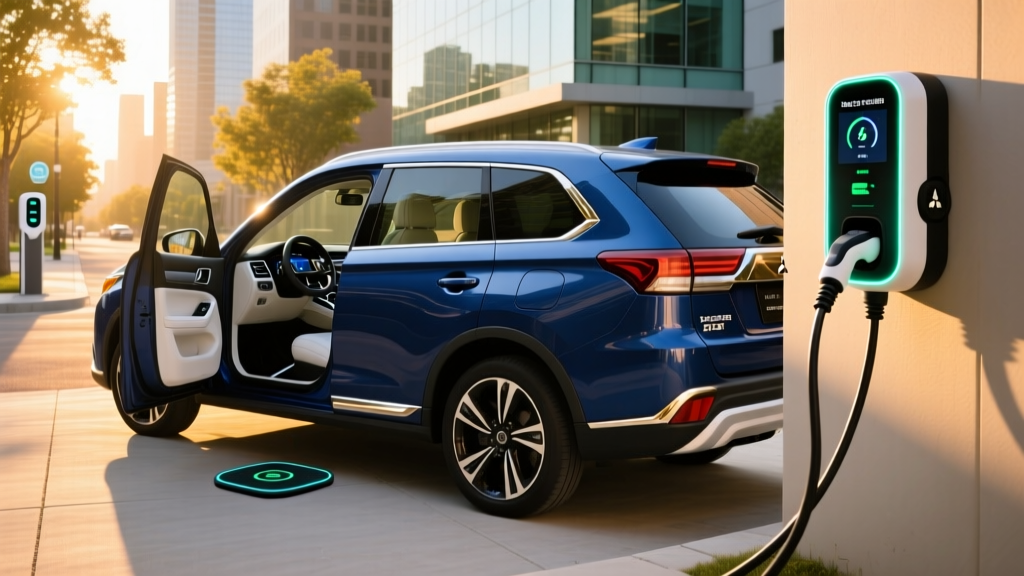
The Mitsubishi Outlander PHEV has carved out a specific niche: a three-row plug-in hybrid SUV that doesn't demand you choose between electric commuting and family road-trip capability. For 2026, the Outlander PHEV continues with the formula that made it one of the best-selling PHEVs in North America — a 20 kWh traction battery, standard all-wheel drive via twin rear motors, and enough electric-only range to cover most daily commutes without burning a drop of gasoline.
But does the real-world efficiency match the EPA sticker? What does home charging actually cost? And does the 2026 Outlander PHEV still qualify for any federal tax incentives? This guide walks through every number that matters.
HEV vs PHEV: What the Outlander Actually Is
Before getting into the specs, it's worth clarifying the distinction, because Mitsubishi sells the Outlander in both forms in some markets, and buyers frequently confuse them.
Conventional Hybrid (HEV)
- Small battery (~1-2 kWh) charged only by regenerative braking and the engine
- Never plugs in — no charging cable, no outlet needed
- Electric motor assists the gas engine; cannot drive on electric power alone for meaningful distances
- Typical efficiency gain: 20-35% better MPG than a gas-only equivalent
Plug-In Hybrid (PHEV) — The Outlander PHEV
- Larger battery (20 kWh usable) that charges via a plug — Level 1 (120V) or Level 2 (240V)
- Can drive on pure electric power for ~38 miles before the gas engine starts
- After battery depletion, operates as a conventional hybrid with the engine and regenerative braking
- DC fast charging capable (rare among PHEVs) via CHAdeMO connector
The 2026 Outlander PHEV is firmly a plug-in hybrid. If you never plug it in, you're carrying 400+ pounds of battery dead weight and getting worse fuel economy than a conventional hybrid would. The economics only work if you charge regularly.
EPA Fuel Economy and Electric-Only Range
Here are the official numbers from fueleconomy.gov for the 2026 Mitsubishi Outlander PHEV:
| Metric | EPA Rating |
|---|---|
| Combined MPGe (electric + gas) | 64 MPGe |
| Electric-only range | 38 miles |
| Total combined range (electric + gas) | 402 miles |
| Gas-only combined MPG (after battery depletion) | 26 MPG combined |
| Gas-only city MPG | 25 MPG |
| Gas-only highway MPG | 27 MPG |
| Electric consumption | 63 kWh/100 mi |
| Fuel tank capacity | 14.8 gallons |
Real-World Range and MPG Expectations
Electric-only range: The EPA rates 38 miles, but expect 30-34 miles in real-world mixed driving. In cold weather (below 35°F), cabin heating and battery thermal losses can cut that to 22-28 miles. Highway-speed electric driving (70+ mph) also reduces range significantly due to aerodynamic drag — plan on ~28-30 miles if your commute is mostly interstate.
Gas-only MPG: Once the battery is depleted, the Outlander PHEV operates as a heavy hybrid. The EPA's 26 MPG combined is achievable in suburban driving, but highway-heavy trips at 75+ mph will return closer to 23-24 MPG. City driving with frequent regenerative-braking opportunities can push it to 27-28 MPG.
Key insight: If your daily round-trip commute is under 35 miles and you charge nightly, you may go weeks without the engine running. If you regularly drive 60+ miles daily without charging, you're essentially driving a 26 MPG midsize SUV — respectable, but not exceptional.
Battery, Charging Speeds, and Home Setup
The 2026 Outlander PHEV uses a 20 kWh lithium-ion battery pack (approximately 17-18 kWh usable, with the remainder as a buffer to protect longevity). This is one of the larger PHEV batteries on the market — for comparison, the Toyota RAV4 Prime offers 18.1 kWh and the Ford Escape PHEV offers 14.4 kWh.
| Charging Level | Power | Time (0-100%) | Connector |
|---|---|---|---|
| Level 1 (120V household outlet) | ~1.4 kW | ~14 hours | J1772 |
| Level 2 (240V home/public) | ~3.3 kW (onboard charger limit) | ~6.5 hours | J1772 |
| DC Fast Charge | Up to ~22 kW peak | 0-80% in ~38 min | CHAdeMO |
Critical detail on the onboard charger: The Outlander PHEV's Level 2 onboard charger is limited to 3.3 kW. That means even if you plug into a 48-amp Level 2 home charger capable of delivering 11.5 kW, the Outlander will only accept 3.3 kW. You don't need an expensive high-amperage charger for this vehicle — a basic 16-amp, 240V Level 2 unit (~$300-$400 for the hardware) is sufficient.
DC fast charging — a PHEV rarity: The Outlander PHEV is one of the very few plug-in hybrids that supports DC fast charging. However, it uses the CHAdeMO connector, not CCS or NACS. CHAdeMO infrastructure is declining in the U.S. as networks standardize on CCS and NACS. Before relying on DC fast charging for this vehicle, check your local CHAdeMO availability via apps like PlugShare. The ~22 kW peak charge rate is modest — it won't rival BEV fast-charging speeds, but it can top up the battery to 80% during a lunch stop.
Estimated Home Level 2 Charging Installation
| Item | Cost Range |
|---|---|
| Level 2 charger hardware (16A-32A, 240V) | $250 – $500 |
| Electrician labor (240V outlet or hardwire) | $500 – $1,500 |
| Permit and inspection (where required) | $50 – $200 |
| Electrical panel upgrade (if needed, 100A→200A) | $1,500 – $3,500 |
| Total (no panel upgrade) | $800 – $2,200 |
| Total (with panel upgrade) | $2,300 – $5,700 |
Note: Because the Outlander PHEV only draws 3.3 kW, you can use a simpler, lower-cost Level 2 charger. A 240V/16A circuit is adequate. Always have a licensed electrician assess your panel capacity before installation.
Powertrain: Engine, Motors, and Horsepower
The 2026 Outlander PHEV pairs a 2.4-liter Atkinson-cycle four-cylinder gasoline engine with a twin-motor all-wheel-drive system. Here's the full breakdown:
| Specification | Value |
|---|---|
| Gas engine | 2.4L 4-cylinder Atkinson-cycle, 126 hp |
| Front electric motor | 85 kW (114 hp) |
| Rear electric motor | 100 kW (134 hp) |
| Combined system output | 248 hp / 332 lb-ft torque |
| Drivetrain | Standard AWD (S-AWC — Super All-Wheel Control) |
| 0-60 mph | ~7.0 seconds |
| Transmission | Single-speed reduction gear (no traditional transmission) |
| Towing capacity | 1,500 lbs |
| Drive modes | EV, Series Hybrid, Parallel Hybrid (auto-managed) |
The S-AWC system is genuinely capable for a PHEV crossover. The rear motor provides torque-vectoring capability, and the system can send up to 100% of rear axle torque to either wheel. It's not a rock crawler, but it handles snow, rain, and light off-road use with more confidence than most AWD crossovers in this class.
Drive mode clarity: In EV mode, the Outlander runs purely on battery power (up to ~38 miles). In Series Hybrid mode, the engine acts as a generator to charge the battery while the motors drive the wheels. In Parallel Hybrid mode, the engine directly drives the front wheels alongside the electric motor — this engages primarily at sustained highway speeds where the engine operates most efficiently. The vehicle manages these transitions automatically; no driver intervention is required.
Pricing, Trims, and Tax Credit Eligibility
The 2026 Mitsubishi Outlander PHEV is available in four trims. Pricing below includes destination charge:
| Trim | MSRP (incl. destination) | Key Features |
|---|---|---|
| ES | $41,640 | 18" wheels, 8" touchscreen, heated front seats, basic ADAS |
| SE | $44,240 | 20" wheels, synthetic leather, power liftgate, 360° camera |
| SEL | $47,840 | Nappa leather, panoramic sunroof, Bose audio, head-up display |
| SEL Black Edition | $48,940 | SEL content + black exterior accents, black wheels |
Federal Tax Credit: Does the 2026 Outlander PHEV Qualify?
Under current IRS §30D clean vehicle credit rules for 2026, PHEVs can qualify — but eligibility depends on several requirements that change frequently:
- MSRP cap: SUVs must be priced at or below $80,000. All Outlander PHEV trims clear this threshold.
- Battery capacity: Must be at least 7 kWh. The Outlander PHEV's 20 kWh pack qualifies.
- Buyer income limits: Modified AGI must not exceed $150,000 (single), $225,000 (head of household), or $300,000 (joint). Check your specific tax situation with a professional.
- Battery component sourcing: A percentage of battery components must be manufactured or assembled in North America. This threshold increases annually and is the most common reason vehicles lose eligibility.
- Critical minerals sourcing: A percentage of critical minerals must be sourced from the U.S. or FTA-partner countries. This threshold also increases annually.
- Final assembly: Must occur in North America. The Outlander PHEV is assembled in Okazaki, Japan — this likely disqualifies it from the full §30D credit.
- Point-of-sale transfer: If eligible, you can transfer the credit to the dealer at purchase for an immediate price reduction.
Bottom line on tax credits: Because the Outlander PHEV is assembled in Japan, it does not meet the North American final assembly requirement for the §30D new clean vehicle credit. However, some buyers may qualify for state-level PHEV incentives — check your state's energy office or DSIRE (Database of State Incentives for Renewables & Efficiency) for current programs. States like California, Colorado, and New York have offered PHEV rebates that are not restricted by assembly location.
Battery Warranty, Reliability, and Replacement Cost
Mitsubishi PHEV Battery Warranty
| Traction battery warranty | 10 years / 100,000 miles |
| Capacity retention threshold | Warranty covers defects and significant capacity loss (typically below ~70% state of health) |
| Powertrain warranty | 10 years / 100,000 miles |
| Basic vehicle warranty | 5 years / 60,000 miles |
| Roadside assistance | 5 years / unlimited miles |
Reliability context: Mitsubishi's PHEV powertrain has been in production since 2013 (first in the original Outlander PHEV), giving it over a decade of real-world refinement. The 2.4L Atkinson-cycle engine is naturally aspirated and mechanically simple — fewer failure points than turbocharged alternatives. The electric motors have no wear items. Early-model Outlander PHEVs (2014-2018) in global markets have shown strong battery longevity, with most units retaining 85-90% state of health at 100,000 miles when charged primarily on Level 2.
Battery replacement cost: If the traction battery needs replacement outside warranty, expect a dealer quote in the range of $6,000 to $9,000 including parts and labor. Third-party hybrid battery rebuild services may offer lower-cost options ($3,500-$5,500), though availability varies by region. For context, PHEV battery replacements are rare before 150,000+ miles when the vehicle is charged properly (avoiding chronic 100% SoC storage and extreme-temperature DC fast charging).
Longevity tips: The Outlander PHEV's battery management system maintains a healthy buffer at both the top and bottom of the charge range, which protects the cells. To maximize battery life, rely on Level 2 charging for daily use and reserve DC fast charging for road trips. Avoid leaving the vehicle at 100% state of charge for extended periods in hot weather.
Who Should Buy the Outlander PHEV (and Who Shouldn't)
Choose the 2026 Outlander PHEV If:
- Your daily commute is under 35 miles round-trip and you have access to Level 1 or Level 2 charging at home
- You need three rows of seating but don't want a full-size SUV
- You take regular road trips (400+ mile total range eliminates range anxiety entirely)
- You live in an area with limited DC fast-charging infrastructure (the gas engine is your backup)
- You want standard AWD for snow/rain without the efficiency penalty of a conventional AWD gas SUV
Choose a Full BEV Instead If:
- Your daily driving exceeds 40 miles and you don't want to manage both gas and electric
- You have reliable access to fast charging and want lower per-mile fuel costs
- You want to eliminate oil changes and engine maintenance entirely
- Tax credit eligibility is a priority (U.S.-assembled BEVs like the Tesla Model Y or Ford Mustang Mach-E qualify for §30D)
Choose a Conventional Hybrid (HEV) Instead If:
- You cannot charge at home or at work (apartment, street parking, no outlet access)
- You want hybrid efficiency without the complexity of plug-in charging
- Your budget is tighter — conventional hybrids like the Toyota Highlander Hybrid start ~$5,000-$8,000 less
Pros and Cons at a Glance
Pros
- 38-mile electric-only range covers most commutes
- Standard AWD with capable S-AWC torque vectoring
- Three-row seating (rare in the PHEV segment)
- DC fast charging capable (CHAdeMO)
- 10-year/100,000-mile battery and powertrain warranty
- 402-mile total range eliminates road-trip range anxiety
- Proven PHEV powertrain with 10+ years of refinement
Cons
- 3.3 kW onboard charger limits Level 2 charging speed
- CHAdeMO DC connector — declining U.S. infrastructure
- Assembled in Japan — likely ineligible for §30D federal tax credit
- Gas-only MPG (26 combined) is unexceptional once battery is depleted
- Third row is tight — best for children or short trips
- Cargo space reduced vs. gas Outlander due to battery placement
- Infotainment and interior materials lag behind rivals at this price point
Frequently Asked Questions
How many MPG does the 2026 Outlander PHEV get?
The EPA rates the Outlander PHEV at 64 MPGe when combining electric and gas operation. Once the battery is depleted, it returns 26 MPG combined (25 city / 27 highway) as a conventional hybrid. Real-world gas-only MPG ranges from 23-28 depending on driving conditions.
How far can the 2026 Outlander PHEV go on electric only?
The EPA rates 38 miles of electric-only range. Real-world expectations are 30-34 miles in mixed driving, 28-30 miles at highway speeds, and 22-28 miles in cold weather (below 35°F). Total combined range (electric + full gas tank) is 402 miles.
Does the 2026 Outlander PHEV qualify for the federal tax credit?
Likely not. Under current IRS §30D rules, the vehicle must undergo final assembly in North America. The Outlander PHEV is assembled in Japan, which disqualifies it from the federal new clean vehicle credit. Check your state's incentive programs for possible state-level PHEV rebates.
Is the Outlander PHEV reliable, and what does a battery replacement cost?
The Outlander PHEV powertrain has been in production since 2013 and has demonstrated strong reliability. Mitsubishi backs it with a 10-year/100,000-mile battery and powertrain warranty. Out-of-warranty battery replacement runs approximately $6,000-$9,000 at a dealer. Most PHEV batteries retain 85-90% capacity at 100,000 miles with proper charging habits.
Can I charge the Outlander PHEV at a Tesla Supercharger?
No. The Outlander PHEV uses a J1772 connector for Level 1/2 charging and CHAdeMO for DC fast charging. Tesla Superchargers use the NACS connector. You cannot use a Tesla Supercharger with this vehicle. For public Level 2 charging, any J1772-compatible station (ChargePoint, EVgo, Blink, etc.) will work.
Do I have to plug in the Outlander PHEV?
You don't have to, but you should. If you never plug it in, the Outlander PHEV operates as a heavy hybrid and returns about 26 MPG — worse than a purpose-built hybrid like the Toyota Highlander Hybrid (35 MPG combined). The PHEV premium over a gas model only pays off if you charge regularly to use the 38-mile electric range.
How long does it take to charge at home?
On a standard 120V household outlet (Level 1), a full charge takes about 14 hours — fine for overnight charging if your daily use is modest. On a 240V Level 2 charger, a full charge takes approximately 6.5 hours. The onboard charger is limited to 3.3 kW, so upgrading to a higher-amperage Level 2 unit won't reduce charge time.