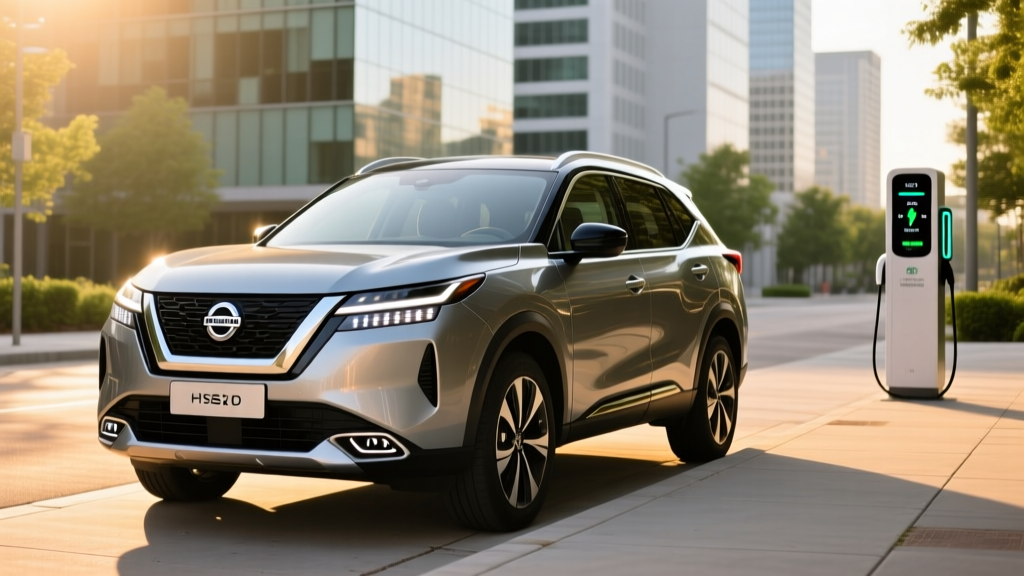
The compact SUV segment is one of the most competitive in the U.S., and the Nissan Rogue has long been a volume player. For 2026, Nissan offers the Rogue in a conventional hybrid (HEV) configuration, while a plug-in hybrid (PHEV) variant expands the lineup for buyers who want some electric-only driving without full EV commitment. This guide breaks down exactly what each powertrain delivers in fuel economy, electric range, battery specs, pricing, and tax-credit eligibility — so you can decide whether the 2026 Rogue Hybrid fits your garage.
HEV vs. PHEV: Which 2026 Rogue Hybrid Are You Looking At?
Before we get into the numbers, the distinction matters enormously for your daily driving and your wallet.
Conventional Hybrid (HEV)
The standard Rogue Hybrid pairs a gasoline engine with a small electric motor and a compact battery that recharges through regenerative braking and engine operation. You never plug it in. It operates exactly like a gas car at the pump — you just fill up and drive. The hybrid system simply makes the car more efficient, particularly in stop-and-go city driving where the electric motor handles low-speed propulsion and the engine shuts off at stops.
Plug-In Hybrid (PHEV)
The Rogue PHEV carries a larger battery (measured in kWh) that you can charge from a wall outlet or public charger. It delivers a meaningful electric-only range — enough for many commutes — before the gasoline engine kicks in. Once the battery depletes, it operates as a conventional hybrid. You get EV-like driving for short trips and gas-car flexibility for long road trips.
If you have access to home or workplace charging and your daily round-trip commute falls within the PHEV's electric-only range, the plug-in variant can dramatically cut your fuel consumption. If you lack reliable charging access or primarily drive long highway distances, the conventional HEV is the simpler, more practical choice.
Fuel Economy: EPA MPG and Real-World Expectations
Fuel economy is the primary reason buyers choose hybrids. Here is how the 2026 Rogue Hybrid lineup stacks up according to EPA estimates, with real-world context from owner reports and independent testing.
| Powertrain | City MPG | Highway MPG | Combined MPG | Real-World Combined (Est.) |
|---|---|---|---|---|
| Rogue Hybrid (HEV) FWD | 35 | 33 | 34 | 32–36 |
| Rogue Hybrid (HEV) AWD | 33 | 31 | 32 | 30–34 |
| Rogue PHEV (gas-only mode) | 32 | 30 | 31 | 29–33 |
| Rogue PHEV (combined MPGe) | 84 MPGe (electric + gas) | 78–88 MPGe | ||
Real-world context: Conventional hybrids tend to exceed their EPA city estimates in moderate-temperature urban driving because regenerative braking captures more energy in stop-and-go traffic. Highway driving at sustained 75+ mph is where hybrids lose their advantage — the engine does more of the work and aerodynamic drag dominates. Expect the HEV to return 36–38 MPG in summer city driving and closer to 28–30 MPG on a flat 80-mph interstate run.
For the PHEV, the 84 MPGe figure applies only while the battery has charge. MPGe (miles per gallon equivalent) converts electricity consumption into a gasoline-equivalent number for comparison purposes. Once the battery is depleted, the PHEV reverts to its gas-only combined rating of roughly 31 MPG — still efficient, but not dramatically better than the conventional HEV.
Source: fueleconomy.gov — the official EPA fuel-economy database.
PHEV Electric-Only Range and Total Driving Range
For PHEV buyers, electric-only range is the number that determines how much gasoline you actually burn. The 2026 Rogue PHEV carries an 18.1 kWh lithium-ion battery pack (approximately 15.2 kWh usable), delivering an EPA-estimated 38 miles of electric-only range.
EPA Electric-Only Range: 38 miles
Real-World Electric Range: Expect 30–35 miles in mixed driving at moderate temperatures. In cold weather (below 32°F), cabin heating and battery resistance can reduce electric-only range to 24–28 miles. Highway-speed electric driving (70+ mph) will also consume the battery faster — plan for roughly 28–30 miles in that scenario.
Total Combined Range (Electric + Gas): Approximately 440–470 miles on a full charge and full tank.
That 38-mile electric range covers a significant portion of American commutes. According to FHWA data, the average one-way commute is roughly 16 miles, meaning a 32-mile round trip falls within the PHEV's electric envelope. If you charge at home overnight, you could go weeks without visiting a gas station — then take a 500-mile road trip with zero range anxiety.
Battery, Charging, and Powertrain Specifications
| Specification | Rogue Hybrid (HEV) | Rogue PHEV |
|---|---|---|
| Engine | 1.5L VC-Turbo 3-cylinder | 1.5L VC-Turbo 3-cylinder |
| Combined Horsepower | 201 hp | 248 hp |
| Electric Motor Output | Integrated starter-generator | 100 kW front-axle motor |
| Transmission | Xtronic CVT | Xtronic CVT |
| Battery Capacity | ~1.0 kWh (buffer) | 18.1 kWh total / 15.2 kWh usable |
| Battery Chemistry | NMC lithium-ion | NMC lithium-ion |
| Level 1 Charging (120V) | N/A — no plug | ~12 hours (0–100%) |
| Level 2 Charging (240V) | N/A — no plug | ~3.5 hours (0–100%) at 3.6 kW |
| DC Fast Charging | N/A | Not supported |
| Drivetrain | FWD or AWD | AWD standard |
| 0–60 mph (est.) | ~7.8 sec | ~6.9 sec |
Key takeaway on charging: The PHEV does not support DC fast charging. This is typical for compact PHEVs — the battery is small enough that Level 2 overnight charging fully replenishes it, and adding DC fast-charge hardware would add cost and weight. If you need rapid public charging, you are looking at a full battery-electric vehicle (BEV), not a PHEV.
A standard 120V household outlet (Level 1) will recharge the PHEV battery overnight — roughly 4–5 miles of electric range per hour of charging. A 240V Level 2 home charger is strongly recommended for PHEV owners; a basic 3.6 kW wall unit costs roughly $500–$800 installed (depending on electrical panel proximity) and refills the battery in about 3.5 hours. That means you can fully recharge during the workday if you have a Level 2 outlet at your workplace, or top off between an evening errand and the next morning's commute.
Pricing, Trims, and Tax Credit Eligibility
| Trim | Powertrain | MSRP (2026) |
|---|---|---|
| S Hybrid | HEV | $31,490 |
| SV Hybrid | HEV | $33,890 |
| SL Hybrid | HEV | $37,190 |
| SV PHEV | PHEV | $38,990 |
| SL PHEV | PHEV | $42,490 |
Federal Tax Credit: §30D Eligibility for the Rogue PHEV
The conventional Rogue Hybrid (HEV) does not qualify for the federal §30D Clean Vehicle Credit — that credit is reserved for plug-in vehicles (PHEVs and BEVs) with a battery capacity of at least 7 kWh.
The Rogue PHEV, with its 18.1 kWh battery, meets the battery-capacity threshold. However, eligibility for the full credit depends on several requirements that change periodically under current IRS rules:
- MSRP cap: SUVs must have an MSRP at or below $80,000 — all Rogue PHEV trims clear this easily.
- Buyer income cap: Modified adjusted gross income must not exceed $150,000 (single), $225,000 (head of household), or $300,000 (joint filers).
- Battery sourcing: Critical-mineral and battery-component requirements phase in annually. For 2026, a percentage of critical minerals must be sourced from the U.S. or free-trade-agreement partners, and battery components must meet domestic-content thresholds. Vehicles that fail either test lose partial or full credit eligibility.
- Point-of-sale transfer: Buyers can transfer the credit to the dealer at purchase, effectively reducing the out-of-pocket price at the dealership rather than waiting to claim it on a tax return.
Current estimated credit for the 2026 Rogue PHEV: Up to $3,750, depending on whether the vehicle meets the critical-minerals requirement, the battery-component requirement, or both. Nissan has not published final 2026 sourcing certifications at the time of writing. Confirm eligibility on the IRS's official list at irs.gov before purchasing.
Some states offer additional rebates for PHEVs (California, Colorado, and New York, among others). Check your state energy office or DMV for current programs — these can stack with the federal credit.
Reliability, Battery Warranty, and Replacement Cost
Battery longevity is consistently the top concern for hybrid and PHEV buyers. Here is what Nissan provides:
Hybrid/PHEV Battery Warranty
Coverage: 8 years / 100,000 miles (whichever comes first), covering defects and capacity loss below a defined threshold (typically 60–70% of original capacity, per Nissan's warranty terms).
Powertrain warranty: 5 years / 60,000 miles on the engine, transmission, and electric motor components.
Real-world battery lifespan: Modern NMC hybrid batteries with active thermal management routinely last 150,000–200,000+ miles before significant degradation. The Rogue's relatively small HEV battery undergoes shallow charge/discharge cycles, which is gentler on cell chemistry than the deeper cycles in a full EV. PHEV batteries experience moderate cycling but are still buffered — Nissan reserves roughly 16% of the 18.1 kWh pack as unusable buffer to protect longevity.
Replacement cost if out of warranty: Based on current Nissan hybrid battery pricing and third-party replacement data, expect $2,500–$4,500 for the HEV battery pack and $5,000–$7,500 for the larger PHEV battery, including labor. These figures have trended downward as battery manufacturing scales, but they remain a factor for second-owner buyers or those planning to keep the vehicle past the warranty period.
Nissan's CVT transmission has historically drawn reliability scrutiny, but the Xtronic unit in the current-generation Rogue has shown improved durability in long-term owner surveys. The hybrid system adds complexity (electric motor, power electronics, high-voltage cabling), but these components have proven robust across the industry — Toyota, Honda, and Hyundai hybrids routinely exceed 200,000 miles with original batteries.
Source: Nissan Warranty Information
Who Should Buy the 2026 Rogue Hybrid — and Who Shouldn't?
Choose the Rogue Hybrid (HEV) if:
- You want better fuel economy without changing your fueling habits — no plugs, no apps, no charging logistics.
- You drive a mix of city and highway and want 32–34 MPG combined versus the gas-only Rogue's ~29 MPG combined.
- You lack home or workplace charging access (apartment dwellers, street parkers).
- You want a lower purchase price — the HEV starts roughly $7,500 below the PHEV.
Choose the Rogue PHEV if:
- Your daily commute is under 35 miles round-trip and you can charge at home overnight.
- You want EV-like silence and zero tailpipe emissions on most daily driving, but need gas-engine flexibility for road trips.
- You value the additional 47 hp (248 hp total) and quicker acceleration the PHEV's larger motor provides.
- You can capture a federal tax credit and/or state rebate to narrow the price gap with the HEV.
Choose a full EV (like the Nissan Ariya) instead if:
- You have reliable Level 2 home charging and your daily driving rarely exceeds 200 miles.
- You want zero gasoline expenses, minimal maintenance (no oil changes, no engine), and access to HOV lanes in states that grant them to BEVs.
- You plan to keep the vehicle 8–10+ years and want the lowest total cost of ownership — BEVs typically win on TCO over long ownership horizons when home charging is available.
Pros
- Strong city MPG; HEV can exceed EPA estimates in stop-and-go driving
- PHEV offers 38 miles electric-only — covers most commutes
- No range anxiety on either variant — gas station backup always available
- AWD standard on PHEV; available on HEV
- Competitive pricing vs. Toyota RAV4 Hybrid and Honda CR-V Hybrid
- 8-year/100,000-mile hybrid battery warranty
Cons
- PHEV does not support DC fast charging
- Highway MPG advantage over gas Rogue is modest (2–3 MPG)
- PHEV premium of ~$7,500 over base HEV takes years to recoup on fuel savings alone
- Federal tax credit for PHEV is partial and subject to sourcing rules
- CVT driving feel won't satisfy enthusiasts
- Third-row seat unavailable (compact SUV segment limitation)
Ownership Economics: 5-Year Cost Snapshot
| Cost Factor (5 Years / 75,000 Miles) | Rogue Gas (29 MPG) | Rogue Hybrid HEV (34 MPG) | Rogue PHEV (38 mi EV + 31 MPG) |
|---|---|---|---|
| Fuel / Electricity | $9,050 | $7,720 | $4,800* |
| Maintenance (est.) | $3,200 | $3,000 | $2,800 |
| Insurance (est.) | $7,500 | $7,700 | $8,100 |
| Purchase Price (SV trim) | $30,590 | $33,890 | $38,990 |
| Federal Tax Credit | $0 | $0 | Up to $3,750 |
| Estimated 5-Year Net Cost | $50,340 | $52,310 | $50,940 |
*PHEV fuel/electricity cost assumes 70% of miles driven on electricity at $0.14/kWh national average and 30% on gasoline at $3.50/gallon. Actual costs vary significantly by local electricity rates, driving patterns, and charging consistency.
The PHEV closes the cost gap with the gas model primarily through dramatically lower energy costs — but only if you charge consistently. A PHEV that is never plugged in is just a slightly heavier, slightly less efficient hybrid. The HEV, meanwhile, offers modest fuel savings over the gas model with zero behavioral change, though the higher purchase price means it takes roughly 4–5 years to break even at current fuel prices.
Frequently Asked Questions
How many MPG does the 2026 Rogue Hybrid get?
The conventional Rogue Hybrid (HEV) is EPA-rated at 35 city / 33 highway / 34 combined MPG in front-wheel-drive form, and 33/31/32 MPG with all-wheel drive. Real-world city driving often exceeds the EPA city figure by 2–4 MPG thanks to regenerative braking, while sustained highway driving at 75+ mph typically returns 28–30 MPG.
How far can the Rogue PHEV go on electric only?
The 2026 Rogue PHEV delivers an EPA-estimated 38 miles of electric-only range from its 18.1 kWh battery pack. Real-world range is typically 30–35 miles in moderate temperatures, dropping to 24–28 miles in freezing conditions or during sustained highway-speed driving.
Does the 2026 Rogue Hybrid qualify for a tax credit?
The conventional hybrid (HEV) does not qualify for the federal §30D Clean Vehicle Credit. The Rogue PHEV may qualify for up to $3,750 depending on battery-sourcing compliance under current IRS rules. Income caps ($150K single / $300K joint) and the $80,000 SUV MSRP cap apply. Verify current eligibility at irs.gov before purchasing.
Is the Rogue Hybrid reliable, and what does battery replacement cost?
Nissan covers the hybrid battery for 8 years / 100,000 miles. Modern hybrid batteries with thermal management routinely last 150,000–200,000+ miles. Out-of-warranty replacement costs are estimated at $2,500–$4,500 for the HEV battery and $5,000–$7,500 for the PHEV battery, including labor.
Do I need to plug in the Rogue Hybrid?
No. The conventional Rogue Hybrid (HEV) never needs to be plugged in — it recharges its small battery through regenerative braking and the gasoline engine. Only the PHEV variant requires plugging in to access its electric-only range. If you don't plug in the PHEV, it still drives normally as a hybrid, but you forfeit the electric-range benefit.
Hybrid vs. PHEV vs. full EV — which is right for me?
Choose the HEV if you lack charging access and want simple fuel savings. Choose the PHEV if you can charge at home, commute under 35 miles daily, and want gas-engine flexibility for longer trips. Choose a full EV if you have reliable home charging, drive under 200 miles daily, and want the lowest long-term operating cost with zero gasoline use.
Does the Rogue PHEV support DC fast charging?
No. The 2026 Rogue PHEV supports Level 1 (120V) and Level 2 (240V) AC charging only. Level 2 charging fills the battery in approximately 3.5 hours. This is typical for compact PHEVs — the battery is small enough that overnight Level 2 charging is sufficient, and DC fast-charge hardware would add unnecessary cost and weight.