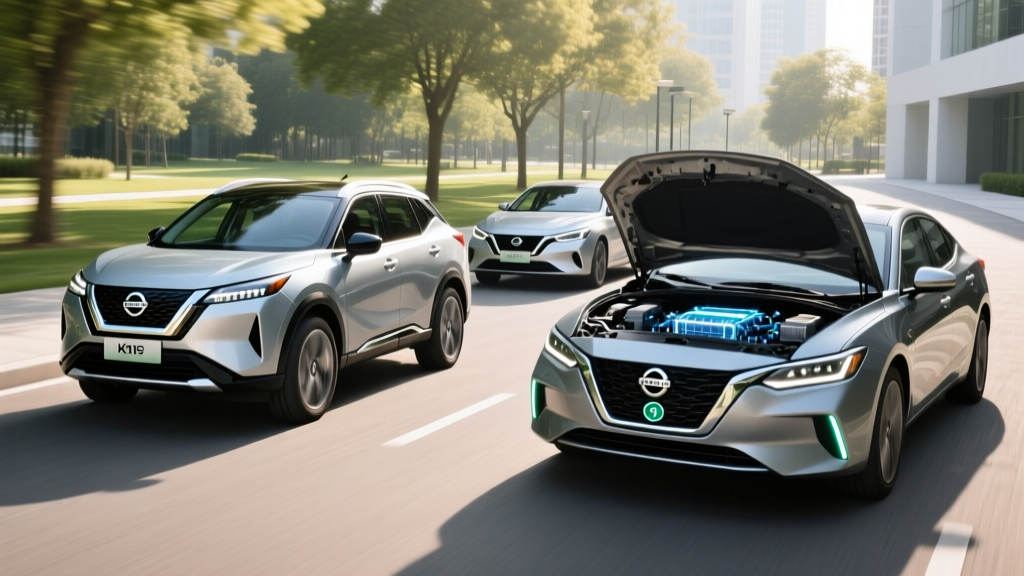
Nissan's hybrid strategy in 2026 centers on conventional hybrids (HEVs) — vehicles that pair a gasoline engine with an electric motor and small battery but never require plugging in. If you've been searching for a Nissan hybrid, the current lineup spans the Rogue compact SUV, the Kicks subcompact crossover, and the Altima sedan, each using Nissan's e-POWER or parallel-hybrid architecture to deliver meaningful fuel savings without lifestyle changes.
This guide breaks down every Nissan hybrid available for the 2026 model year, with exact EPA MPG figures, real-world expectations, battery warranty coverage, pricing, and a framework for deciding whether a Nissan HEV, a plug-in hybrid, or a full EV fits your driving pattern.
HEV vs PHEV: What Nissan Actually Offers in 2026
Before diving into specific models, it's critical to understand the distinction — because Nissan's US lineup does not currently include a plug-in hybrid (PHEV).
Conventional Hybrid (HEV)
- No plug required. The battery charges through regenerative braking and the gasoline engine.
- Small battery (typically 1–2 kWh usable) — assists the engine but cannot drive the car on electric power alone for meaningful distances.
- No federal tax credit under IRS §30D, which is reserved for plug-in vehicles with ≥7 kWh batteries.
- Fuel savings: 25–40% better MPG than a comparable gas-only model, especially in city driving.
Plug-In Hybrid (PHEV)
- Requires plugging in to realize full benefit. Larger battery (typically 12–25 kWh) provides 20–50 miles of electric-only range.
- Gas engine acts as backup for longer trips.
- May qualify for the §30D federal tax credit (up to $7,500) if battery sourcing, MSRP caps, and buyer income limits are met.
- Nissan does not sell a PHEV in the US market for 2026. Competitors like the Toyota RAV4 Prime and Hyundai Tucson PHEV fill this segment.
Every Nissan hybrid sold in the US for 2026 is a conventional HEV. You fuel it like any other car, and the hybrid system works invisibly in the background.
2026 Nissan Rogue Hybrid: MPG, Specs, and Real-World Economy
The Rogue is Nissan's best-selling SUV, and the hybrid variant pairs a 1.5-liter VC-Turbo three-cylinder engine with an electric motor integrated into the transmission. The result is improved low-speed efficiency and smoother stop-start behavior without sacrificing the cargo space or ground clearance buyers expect.
| Spec | Value |
|---|---|
| Powertrain | 1.5L VC-Turbo I-3 + electric motor (parallel hybrid) |
| Combined Horsepower | 201 hp |
| Combined Torque | 225 lb-ft |
| Transmission | Xtronic CVT |
| Drivetrain | FWD or AWD |
| EPA MPG (FWD) | 37 city / 34 highway / 36 combined |
| EPA MPG (AWD) | 36 city / 33 highway / 35 combined |
| Hybrid Battery | ~1.5 kWh lithium-ion (not plug-in) |
| Cargo Volume | 36.5 cu ft (rear seats up) |
| Base MSRP (S Hybrid FWD) | $33,490 |
| Battery Warranty | 8 years / 100,000 miles |
Real-World MPG vs. EPA Sticker
Conventional hybrids typically outperform their EPA city estimates in stop-and-go traffic because regenerative braking recovers energy that a gas-only car wastes as heat. On the Rogue Hybrid, expect:
- City driving: 36–40 MPG real-world — the electric motor handles low-speed crawling, and regen captures frequent stops.
- Highway driving: 31–34 MPG real-world — at sustained 70–80 mph speeds, the gasoline engine does most of the work, and aerodynamic drag dominates. Hybrids lose their advantage here.
- Cold weather: Expect a 5–10% MPG drop in winter. The engine runs more often to provide cabin heat, and the battery is less efficient at low temperatures.
Data from fueleconomy.gov confirms the Rogue Hybrid's combined rating, and owner-reported averages on the EPA site trend slightly above the city estimate for drivers with commute-heavy patterns.
2026 Nissan Kicks Hybrid: Subcompact Efficiency
Redesigned for 2025, the Kicks entered its second generation with an available hybrid powertrain. For 2026, the Kicks Hybrid uses Nissan's e-POWER series-hybrid system in some markets — where the gasoline engine acts solely as a generator and the electric motor always drives the wheels — though the US-spec model uses a conventional parallel-hybrid configuration similar to the Rogue.
| Spec | Value |
|---|---|
| Powertrain | 1.6L I-4 + electric motor (parallel hybrid) |
| Combined Horsepower | 141 hp |
| Transmission | Xtronic CVT |
| Drivetrain | FWD (AWD available) |
| EPA MPG (FWD) | 40 city / 36 highway / 38 combined |
| EPA MPG (AWD) | 38 city / 34 highway / 36 combined |
| Hybrid Battery | ~1.2 kWh lithium-ion (not plug-in) |
| Cargo Volume | 25.3 cu ft (rear seats up) |
| Base MSRP (S Hybrid) | $26,990 |
| Battery Warranty | 8 years / 100,000 miles |
The Kicks Hybrid is one of the most fuel-efficient non-plug-in crossovers in its class. Its lighter curb weight and smaller frontal area give it an edge over the Rogue in city MPG. For urban commuters covering 15–30 miles daily in stop-and-go traffic, the Kicks Hybrid's real-world city economy can touch 42 MPG.
2026 Nissan Altima Hybrid: Sedan Efficiency
The Altima Hybrid continues into 2026 with a 2.5-liter four-cylinder paired with Nissan's hybrid system. While the midsize sedan market has contracted, the Altima Hybrid remains a strong option for buyers who want a comfortable commuter with low running costs and no charging hassle.
| Spec | Value |
|---|---|
| Powertrain | 2.5L I-4 + electric motor (parallel hybrid) |
| Combined Horsepower | 202 hp |
| Transmission | Xtronic CVT |
| Drivetrain | FWD |
| EPA MPG | 42 city / 38 highway / 40 combined |
| Hybrid Battery | ~1.4 kWh lithium-ion (not plug-in) |
| Trunk Volume | 15.4 cu ft |
| Base MSRP (S Hybrid) | $30,490 |
| Battery Warranty | 8 years / 100,000 miles |
The Altima Hybrid's 42 MPG city rating makes it the most efficient vehicle Nissan sells in the US. On a 12-gallon tank, real-world range can exceed 480 miles in mixed driving — fewer fuel stops and lower annual fuel cost than any gas-only Nissan.
Side-by-Side: Nissan Hybrid Fuel Economy Comparison
| Model | City MPG | Highway MPG | Combined MPG | Base MSRP |
|---|---|---|---|---|
| Kicks Hybrid (FWD) | 40 | 36 | 38 | $26,990 |
| Altima Hybrid (FWD) | 42 | 38 | 40 | $30,490 |
| Rogue Hybrid (FWD) | 37 | 34 | 36 | $33,490 |
| Rogue Hybrid (AWD) | 36 | 33 | 35 | $35,090 |
Annual fuel cost estimate: At $3.40/gallon and 15,000 miles/year, the Altima Hybrid costs roughly $1,275 per year in fuel. A comparable gas-only Altima (32 MPG combined) costs about $1,594 — a savings of ~$320/year with the hybrid. Over a 5-year ownership period, that's ~$1,600 in fuel savings, partially offsetting the hybrid's higher MSRP.
Battery Warranty, Reliability, and Replacement Cost
Nissan Hybrid Battery Warranty — 2026 Models
Coverage: 8 years or 100,000 miles (whichever comes first) on the hybrid battery pack and related hybrid-system components.
What's covered: Defects in materials/workmanship and capacity loss below a defined threshold (typically 60–70% of original capacity, per Nissan's warranty documentation).
California-emissions states: Some states with CARB-emissions adoption may offer extended hybrid-component coverage (10 years/150,000 miles). Check your state's specific rules with your dealer.
How Long Do Nissan Hybrid Batteries Actually Last?
Nissan's hybrid batteries are far smaller than full-EV packs (1–2 kWh vs. 60–100 kWh), and they operate within a narrow state-of-charge window — typically 40–80% SoC. This shallow-cycling strategy dramatically reduces degradation. Based on industry data from hybrid models across manufacturers:
- Expected lifespan: 10–15 years or 150,000–200,000 miles before significant capacity loss.
- Failure rate: Low. Most hybrid battery failures occur due to manufacturing defects (covered under warranty) rather than wear-out.
- Replacement cost (out of warranty): $2,000–$4,000 for a Nissan hybrid battery pack, depending on model and whether you choose OEM new, refurbished, or aftermarket. Labor adds $300–$600.
This is a fraction of full-EV battery replacement costs ($8,000–$20,000+), because the pack is much smaller. For context, the Nissan New Vehicle Limited Warranty covers 3 years/36,000 miles bumper-to-bumper, with the hybrid-specific warranty extending well beyond that.
General Reliability
Nissan's hybrid systems are mechanically simpler than traditional automatic transmissions — the CVT and electric motor have fewer moving parts than a multi-gear automatic. However, Nissan's CVT transmissions have historically drawn mixed reliability reviews. The hybrid-integrated CVT in current models uses a different design than older Nissan CVTs and has not shown the same failure patterns, but long-term data on the newest powertrains is still accumulating.
Tax Credits and Incentives for Nissan Hybrids
Here's the straightforward answer: conventional hybrids do not qualify for the federal §30D Clean Vehicle Credit. That credit, which offers up to $7,500 for new vehicles, requires a plug-in vehicle with a battery capacity of at least 7 kWh. Nissan's HEVs carry batteries of 1–2 kWh and cannot be plugged in.
Federal Tax Credit Eligibility — Nissan Hybrids
- §30D New Clean Vehicle Credit: Not eligible. Requires plug-in capability and ≥7 kWh battery.
- §25D Used Clean Vehicle Credit: Not eligible. Same plug-in requirement.
- State incentives: A small number of states offer rebates or HOV-lane access for conventional hybrids, but most state incentive programs have shifted to prioritize PHEVs and BEVs. Check your state's energy office or AFDC state incentive database for current programs.
- Employer or utility rebates: Some utilities offer rebates for hybrid purchases, though these are increasingly rare. Check with your local utility.
If tax-credit eligibility is a priority, you'll need to look at plug-in alternatives from other brands — or consider Nissan's own all-electric Ariya and Leaf, which may qualify depending on battery sourcing and your income level under current IRS §30D rules.
Hybrid vs. PHEV vs. Full EV: Which Fits Your Life?
Choose a Nissan Hybrid (HEV) If:
- You cannot charge at home (apartment, street parking, no garage outlet).
- You want fuel savings with zero behavioral change — just drive and refuel normally.
- Your budget is under $35,000 and you need a new vehicle with a full warranty.
- You drive 10,000–15,000 miles/year in mixed city/highway conditions.
- You live in an area with limited public charging infrastructure.
Choose a Plug-In Hybrid (PHEV) If:
- You can install a Level 2 charger at home and have a short commute (under 30 miles).
- You want electric-only daily driving but need gas flexibility for road trips.
- You want to qualify for the §30D federal tax credit (up to $7,500).
- You're willing to pay a higher upfront price ($38,000–$50,000) for long-term fuel savings.
- Note: Nissan does not currently offer a PHEV in the US. Consider the Toyota RAV4 Prime, Hyundai Tucson PHEV, or Chrysler Pacifica PHEV.
Choose a Full EV (BEV) If:
- You can charge at home and your daily driving is under 250 miles.
- You want zero tailpipe emissions and the lowest per-mile fuel cost (~$0.04–$0.06/mile on residential electricity vs. ~$0.12–$0.15/mile on gasoline).
- You want the strongest tax-credit eligibility and lowest maintenance costs (no oil changes, fewer moving parts).
- You're comfortable with a higher upfront price and planning to keep the vehicle 5+ years.
- Nissan's EV options: Leaf (starting ~$30,000) and Ariya (starting ~$40,000).
Pros and Cons of Nissan's 2026 Hybrid Lineup
Pros
- No charging infrastructure needed — works for apartment dwellers and street parkers
- 36–40 MPG combined across the lineup; real-world city MPG often exceeds EPA estimates
- Lower starting price than PHEV or EV competitors ($26,990–$33,490)
- 8-year/100,000-mile hybrid battery warranty provides long-term peace of mind
- Familiar refueling — no range anxiety, no charging-curve planning on road trips
- AWD available on Rogue and Kicks for snow-belt buyers
Cons
- No federal tax credit eligibility — full $7,500 §30D credit goes to PHEV/BEV buyers
- No plug-in option from Nissan in the US — if you want PHEV, you must shop other brands
- Highway MPG advantage over gas models is modest (2–4 MPG) — hybrid benefits concentrate in city driving
- Hybrid battery replacement ($2,000–$4,000 out of warranty) is a future cost to budget for
- CVT driving feel may not suit enthusiasts — acceleration is smooth but not sporty
- Altima Hybrid limited to FWD — no AWD option for sedan buyers in snowy climates
Frequently Asked Questions
How many MPG does a Nissan hybrid get?
It depends on the model. The 2026 Altima Hybrid leads at 42 city / 38 highway / 40 combined MPG. The Kicks Hybrid achieves 40/36/38 MPG (FWD), and the Rogue Hybrid delivers 37/34/36 MPG (FWD). In real-world city driving, expect to match or slightly exceed EPA city estimates. Highway MPG may fall 2–4 MPG below the sticker at sustained 75+ mph speeds.
Does any Nissan hybrid go on electric only?
No. Nissan's US-market hybrids are conventional HEVs with small (~1–2 kWh) batteries. They can creep short distances (a few hundred feet) on electric power at very low speeds, but they cannot sustain electric-only driving. If you want meaningful electric-only range (20–40 miles), you need a plug-in hybrid, which Nissan does not currently sell in the US.
Is the Nissan hybrid reliable, and what does battery replacement cost?
Nissan's hybrid system is mechanically straightforward, and the small battery pack cycles within a narrow range, reducing wear. The hybrid battery is warranted for 8 years/100,000 miles. Out-of-warranty replacement costs $2,000–$4,000 including labor — far less than a full EV battery. Most hybrid batteries outlast 150,000 miles based on industry-wide data.
Does a Nissan hybrid qualify for any tax credit?
No. The federal §30D Clean Vehicle Credit requires a plug-in vehicle with at least 7 kWh of battery capacity. Nissan's hybrids have 1–2 kWh batteries and no plug, so they are ineligible. Some states or utilities may offer minor incentives for hybrids, but these are increasingly rare. Check the AFDC state incentive database for your area.
Should I buy a Nissan hybrid or just get a full EV?
If you can charge at home and your daily driving is under 200 miles, a full EV (like the Nissan Ariya or Leaf) offers lower per-mile fuel costs, stronger tax-credit eligibility, and near-zero drivetrain maintenance. If you cannot charge at home, drive long highway routes regularly, or want a lower purchase price with no behavioral change, the Nissan hybrid lineup makes practical sense. The hybrid is the right bridge for buyers who aren't ready to commit to plugging in.
Do Nissan hybrids require special maintenance?
No. Maintenance is similar to a conventional gas car — oil changes, brake fluid, tire rotations. In fact, brake pads often last longer on hybrids because regenerative braking reduces friction-brake usage. The hybrid battery and inverter require no routine maintenance. Nissan recommends standard service intervals outlined in the owner's manual.