The Mitsubishi Outlander PHEV has carved out a distinct niche as one of the few plug-in hybrid SUVs offering standard all-wheel drive, three-row seating, and genuine DC fast-charging capability. For 2026, Mitsubishi continues to refine the formula that has made this SUV a top seller in the electrified family-hauler segment. If you need the flexibility of electric-only commuting without the range constraints of a full battery-electric vehicle, the 2026 Mitsubishi Outlander PHEV deserves a serious look — but it's not without trade-offs.
In this guide, we break down the real-world range, fuel economy, charging logistics, powertrain specs, pricing, and tax-credit eligibility so you can decide whether this PHEV fits your driving life.
HEV vs. PHEV: Where the Outlander PHEV Fits
Before we get into the numbers, it's worth clarifying the difference between a conventional hybrid (HEV) and a plug-in hybrid (PHEV), because Mitsubishi sells both versions of the Outlander in some markets.
Conventional Hybrid (HEV)
A standard hybrid uses a small battery (typically 1-2 kWh) that recharges through regenerative braking and the gasoline engine. You never plug it in. It improves fuel economy — especially in city driving — but cannot travel any meaningful distance on electricity alone.
Plug-In Hybrid (PHEV)
A plug-in hybrid like the 2026 Outlander PHEV carries a much larger battery pack — 20.4 kWh usable — that you charge by plugging into a wall outlet, Level 2 charger, or DC fast charger. This enables 38 miles of EPA-rated electric-only driving before the gasoline engine kicks in. Once the battery is depleted, it operates like a conventional hybrid.
If your daily commute is under 35 miles round-trip and you can charge at home, you may go weeks without burning a drop of gasoline. That's the core PHEV advantage: EV-like daily driving with a gas-engine safety net for road trips.
Electric-Only Range and Total Range
EPA Electric-Only Range: 38 miles
Real-World Expectation: 30-35 miles in mixed driving; as low as 25-28 miles in cold weather (below 35°F) or sustained highway speeds above 70 mph. In warm city driving with regen braking, some owners report hitting 40+ miles.
EPA Combined Range (Electric + Gas): Approximately 420 miles total with a full tank and full battery.
The 38-mile electric range is competitive within the PHEV SUV segment. The Toyota RAV4 Prime offers 42 miles, while the Hyundai Tucson PHEV manages around 33 miles. For most American commuters — the average one-way trip is roughly 16 miles, according to FHWA data — 38 miles covers a round-trip commute with margin.
The gasoline tank holds 14.8 gallons. Once the battery depletes, the Outlander PHEV operates as a series-parallel hybrid, delivering an EPA-rated 26 MPG combined in charge-sustaining (hybrid) mode. That figure is respectable for a 4,700-pound AWD SUV but trails the RAV4 Prime's 38 MPG in hybrid mode — a meaningful gap on long road trips.
Fuel Economy and MPGe Breakdown
The EPA measures PHEV efficiency two ways: MPGe (miles per gallon equivalent) when operating on electricity, and conventional MPG when the engine is running. Here's the full picture for the 2026 Outlander PHEV:
| Metric | City | Highway | Combined |
|---|---|---|---|
| MPGe (Electric Mode) | 74 | 57 | 64 MPGe |
| MPG (Hybrid/Charge-Sustaining) | 25 | 27 | 26 MPG |
Real-world MPG note: PHEVs reward city driving and punish highway cruising. In hybrid mode, expect closer to 28-30 MPG in stop-and-go traffic where regenerative braking recaptures energy, but 23-24 MPG at sustained 75-80 mph highway speeds. Cold weather further reduces both electric range and hybrid MPG — plan for 15-20% losses below freezing.
Compared to the gas-only Outlander (which rates around 24 MPG combined), the PHEV delivers substantial fuel savings if you charge regularly. If you never plug in, you're carrying 500+ pounds of extra battery weight for minimal hybrid benefit.
Powertrain, Battery, and Charging Specs
| Specification | 2026 Outlander PHEV |
|---|---|
| Gasoline Engine | 2.4L 4-cylinder Atkinson-cycle (126 hp) |
| Front Electric Motor | 114 hp / 188 lb-ft |
| Rear Electric Motor | 134 hp / 144 lb-ft |
| Combined System Output | 248 hp / 332 lb-ft |
| Battery (Usable Capacity) | 20.4 kWh (Lithium-ion, NMC chemistry) |
| Drivetrain | S-AWC (Super All-Wheel Control) — standard |
| 0-60 mph | ~6.7 seconds |
| Towing Capacity | 1,500 lbs |
The dual-motor AWD system is a genuine full-time setup — the rear motor provides real torque vectoring, not just slip-reactive engagement. This gives the Outlander PHEV confident traction in rain and light snow without the efficiency penalty of a mechanical AWD system.
Charging Speeds and Times
| Charging Level | Power | Time (0-100%) | Miles of Range/Hour |
|---|---|---|---|
| Level 1 (120V household) | ~1.4 kW | ~16-18 hours | ~2-3 mi/hr |
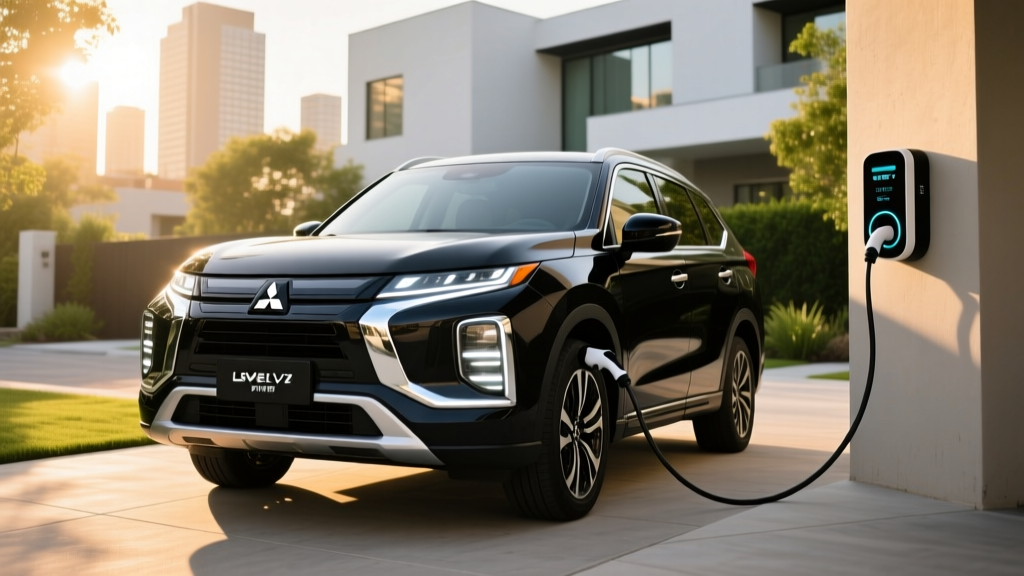
| Level 2 (240V home/public) | ~7.2 kW (J1772) | ~3.5 hours | ~11 mi/hr |
| DC Fast Charge (CHAdeMO) | ~50 kW peak | ~38 min (0-80%) | N/A (timed session) |
CHAdeMO reality check: The Outlander PHEV remains one of the few non-Nissan vehicles still using the CHAdeMO DC fast-charging connector. Most new public DC fast-charging infrastructure in the U.S. is deploying CCS and NACS connectors. While CHAdeMO stations still exist (particularly older Electrify America and EVgo locations), the network is shrinking. Before buying, verify that CHAdeMO chargers are available along your regular routes. A Level 2 home charger is by far the most practical daily charging method for this vehicle.
Pricing, Trims, and Tax Credit Eligibility
The 2026 Mitsubishi Outlander PHEV is offered in multiple trims. Pricing starts around $41,640 (ES trim, including destination) and climbs to approximately $51,000+ for the top SEL Touring trim with premium packages. Key trims include:
- ES (~$41,640): Base trim with S-AWC, 8-inch display, heated front seats, smartphone integration
- SE (~$44,640): Adds synthetic leather, power liftgate, 360° camera, upgraded safety tech
- SEL (~$47,640): Genuine leather, panoramic sunroof, Bose audio, head-up display
- SEL Touring (~$51,000+): Nappa leather, quilted interior, advanced driver-assist, premium wheels
Federal Tax Credit (§30D) Eligibility
Does the 2026 Outlander PHEV qualify for the $7,500 federal tax credit? Under current IRS §30D rules, PHEVs can qualify — but eligibility depends on several factors that change annually:
- MSRP cap: SUVs/vans must have an MSRP at or below $80,000 — the Outlander PHEV clears this easily.
- Buyer income cap: Modified AGI must not exceed $150,000 (single) / $300,000 (joint).
- Battery sourcing: Critical minerals and battery components must meet escalating domestic/free-trade-agreement sourcing percentages. This is where many PHEVs lose partial or full credit eligibility.
- Point-of-sale transfer: As of 2024, eligible buyers can transfer the credit to the dealer for an immediate price reduction at purchase.
The Outlander PHEV's credit eligibility has fluctuated year-to-year as sourcing rules tighten. Check the latest IRS clean vehicle credit page and confirm with your dealer before purchasing. State-level incentives may also apply — consult your state's energy office or fueleconomy.gov for details.
Battery Warranty, Reliability, and Replacement Cost
PHEV Battery Warranty: 10 years / 100,000 miles (whichever comes first), covering defects and capacity loss below a defined threshold. This is consistent with the industry standard set by federal emissions warranty requirements and matches competitors like Toyota and Hyundai.
Powertrain Warranty: Mitsubishi offers a 10-year / 100,000-mile powertrain warranty on the engine, motors, and transmission.
Reliability: Mitsubishi's PHEV system has been in production since 2013 (first in the original Outlander PHEV), giving it over a decade of real-world refinement. The 2.4L Atkinson-cycle engine is a proven, low-stress design. Owner forums and reliability surveys generally report few major powertrain issues, though some owners note that the infotainment system and interior build quality lag behind competitors like Toyota and Honda.
Battery replacement cost: If the traction battery fails out of warranty, replacement costs are estimated between $8,000 and $12,000 including labor, based on current dealer pricing and third-party estimates. However, PHEV batteries are smaller and less stressed than full-EV packs, and degradation data from earlier Outlander PHEV models suggests most packs retain 85-90% capacity after 100,000 miles under normal use.
Who Should Buy the Outlander PHEV vs. a Full EV or Gas SUV
Choose the 2026 Outlander PHEV if:
- You can charge at home (Level 1 or Level 2) and your daily driving is under ~35 miles
- You need AWD for snow/rain but don't want a full EV's cold-weather range loss
- You take road trips beyond charging-infrastructure comfort zones (rural areas, national parks)
- You want three-row seating in an electrified vehicle (very few PHEV competitors offer this)
- You want DC fast-charging capability, even on the shrinking CHAdeMO network
Choose a full BEV (e.g., Tesla Model Y, Hyundai Ioniq 5) if:
- You have reliable home charging and rarely drive more than 250 miles without stopping
- You want minimal maintenance (no oil changes, no gasoline engine)
- You want access to the expanding NACS/Supercharger network
- You prioritize lower running costs and stronger acceleration
Choose a conventional HEV (e.g., Toyota Highlander Hybrid) if:
- You cannot charge at home or at work
- You want better highway fuel economy than the Outlander PHEV's 26 MPG hybrid mode
- You want a lower purchase price and don't need electric-only driving
Pros
- 38-mile electric range covers most commutes
- Standard AWD with genuine torque vectoring
- Three-row seating (rare in PHEV SUVs)
- DC fast charging (CHAdeMO)
- 10-year/100k-mile battery + powertrain warranty
- Comfortable ride quality, quiet cabin at low speeds
Cons
- 26 MPG hybrid mode trails RAV4 Prime significantly
- CHAdeMO connector is a shrinking network
- 1,500-lb towing capacity is low for the class
- Infotainment and interior materials feel dated vs. competitors
- Third row is tight — best for small children only
- Tax credit eligibility uncertain due to sourcing rules
Real-World Ownership: What the EPA Sticker Doesn't Tell You
After spending time with the Outlander PHEV platform across multiple model years, here are the practical realities that spec sheets don't capture:
Charging discipline is everything. If you don't plug in nightly, the Outlander PHEV becomes a heavy, 26-MPG hybrid. The math only works when you charge. A standard 120V outlet (Level 1) delivers about 2-3 miles of range per hour — enough to replenish 38 miles overnight in roughly 16 hours, which is tight. A Level 2 home charger at 240V is strongly recommended and refills the pack in about 3.5 hours.
Winter cuts range hard. In sub-freezing temperatures, expect electric-only range to drop to 25-28 miles. The gasoline engine will engage more frequently to provide cabin heat unless you precondition the vehicle while still plugged in. Always precondition — it warms the battery and cabin using grid power, preserving your electric range.
The engine engages under hard acceleration even in EV mode. Mitsubishi's system will fire up the gasoline engine if you floor it, even with a full battery. This is normal PHEV behavior but surprises some new owners. For pure electric driving, keep inputs moderate.
Highway efficiency is the weak point. At 75+ mph, the Outlander PHEV's boxy shape and 4,700-lb weight work against it. Electric range drops faster on the highway, and hybrid MPG dips below the EPA's 27 MPG highway rating. For road-trip-heavy buyers, the Toyota RAV4 Prime's superior hybrid-mode efficiency (38 MPG) is a meaningful advantage.
Frequently Asked Questions
How many MPG does the 2026 Mitsubishi Outlander PHEV get?
The Outlander PHEV rates at 64 MPGe when operating on electricity and 26 MPG combined (25 city / 27 highway) once the battery is depleted and it runs as a conventional hybrid. Real-world hybrid MPG varies: expect 28-30 MPG in city traffic and 23-24 MPG at sustained highway speeds.
How far can the Outlander PHEV go on electric only?
The EPA rates it at 38 miles of electric-only range. In real-world mixed driving, plan for 30-35 miles. Cold weather (below 35°F) can reduce this to 25-28 miles. Gentle city driving in warm conditions may yield 40+ miles.
Can the Outlander PHEV use DC fast chargers?
Yes — it supports DC fast charging at up to approximately 50 kW via the CHAdeMO connector, reaching 0-80% in roughly 38 minutes. However, CHAdeMO infrastructure is declining in the U.S. as the industry shifts to NACS and CCS. Verify charger availability in your area before relying on DC fast charging.
Does the 2026 Outlander PHEV qualify for the $7,500 federal tax credit?
It may, depending on current-year IRS §30D battery sourcing requirements, your income level, and MSRP thresholds. The Outlander PHEV's MSRP is well under the $80,000 SUV cap. However, critical-mineral and battery-component sourcing rules have tightened annually and can reduce or eliminate credit eligibility. Always verify on irs.gov and with your dealer before purchasing.
Is the Outlander PHEV reliable, and what does battery replacement cost?
The Outlander PHEV powertrain has been in production since 2013 and is generally regarded as reliable. Mitsubishi backs the battery with a 10-year/100,000-mile warranty. Out-of-warranty battery replacement is estimated at $8,000-$12,000, though most PHEV packs retain strong capacity well past 100,000 miles given the smaller pack size and moderate cycling.
How does the Outlander PHEV compare to a full EV like the Tesla Model Y?
The Model Y offers ~310 miles of range, access to the Supercharger network, faster acceleration, and lower running costs — but requires commitment to charging infrastructure and acceptance of cold-weather range loss. The Outlander PHEV offers gas-engine backup for road trips, standard AWD, and three rows, making it more practical for buyers who can't reliably charge away from home or who frequently travel to areas with sparse charging infrastructure.
Do I need to install a home charger for the Outlander PHEV?
You don't need one — a standard 120V outlet will charge the battery overnight — but a Level 2 (240V) home charger is strongly recommended. It cuts charge time from ~16 hours to ~3.5 hours and makes daily top-ups effortless. Expect Level 2 installation to cost $500-$2,000 depending on your electrical panel's capacity and the distance from panel to charger location.