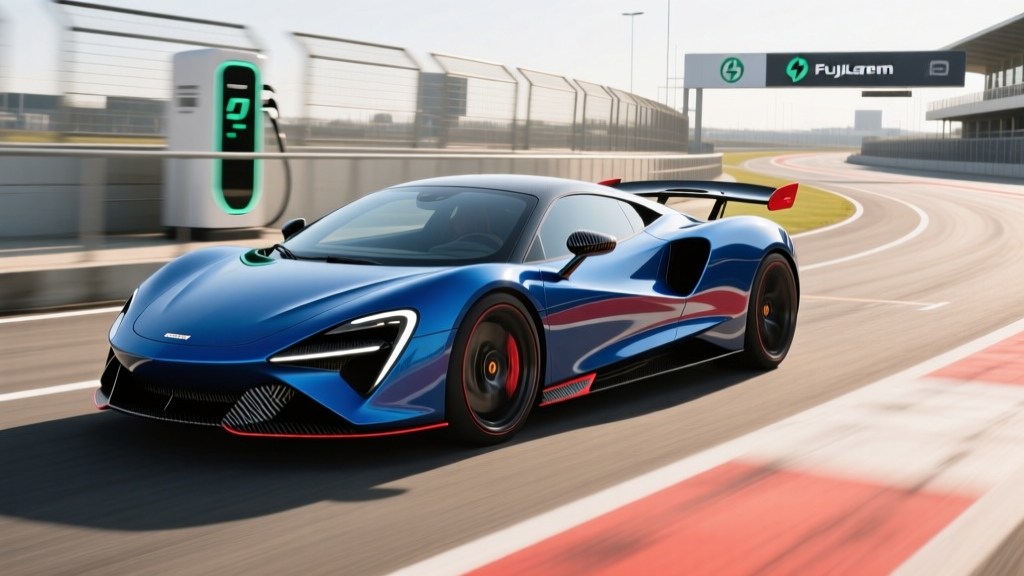
The 2026 McLaren Artura represents something rare in the supercar world: a plug-in hybrid that actually delivers measurable efficiency gains without sacrificing the visceral performance McLaren is known for. Built on the McLaren Carbon Lightweight Architecture (MCLA) and powered by a twin-turbocharged 3.0-liter V6 paired with an axial-flux electric motor, the Artura borrows engineering philosophy from Formula 1 hybrid systems — the kind of energy-recovery technology that dominates the F1 grid. If you've searched for "rss formula hybrid x 2026 mclaren" hoping to understand how racing-derived hybrid tech translates to a road car, this is your guide.
But the Artura isn't a Prius with a body kit. It's a $250,000+ mid-engine supercar that happens to offer an electric-only driving mode, regenerative braking, and a small battery you can charge from a wall outlet. Let's break down exactly what that means for real-world MPG, electric range, charging logistics, and whether hybrid supercar ownership makes sense in 2026.
HEV vs PHEV: Where the Artura Fits
Before diving into specs, it's critical to understand the distinction between conventional hybrids and plug-in hybrids, because the Artura is firmly a PHEV.
| Feature | Conventional Hybrid (HEV) | Plug-in Hybrid (PHEV) | McLaren Artura (PHEV) |
|---|---|---|---|
| Plug-in charging | No — charges via regen & engine | Yes — external charging required for EV mode | Yes — Level 2 AC charging |
| Electric-only range | 0–2 miles (low-speed assist) | 15–50+ miles typical | ~11 miles EPA (est.) |
| Battery size | 1–2 kWh | 8–30 kWh typical | 7.4 kWh usable |
| Fuel economy benefit | Moderate (city-heavy) | Significant if charged regularly | Marginal — performance-focused |
| Regenerative braking | Yes | Yes | Yes — F1-derived ERS |
A conventional hybrid (HEV) like the Toyota Prius never plugs in. Its small battery charges exclusively through regenerative braking and the gasoline engine. A plug-in hybrid (PHEV) like the Artura has a larger battery and a more powerful electric motor, allowing genuine electric-only driving for a limited distance. You charge a PHEV from a wall outlet or charging station to unlock that EV range.
The Artura's hybrid system is closer in philosophy to a Formula 1 power unit than a commuter hybrid. Its axial-flux E-motor (developed with input from motorsport hybrid suppliers) integrates directly into the transmission bell housing, providing instant torque fill while the turbos spool. This is energy-recovery-system (ERS) thinking applied to a road car.
2026 McLaren Artura Powertrain & Performance Specs
| Specification | 2026 McLaren Artura |
|---|---|
| Engine | 3.0L twin-turbo V6 (120° "hot-vee") |
| Engine output | 577 hp / 431 lb-ft torque |
| Electric motor | Axial-flux E-motor, 94 hp / 166 lb-ft |
| Combined system output | 671 hp / 531 lb-ft torque |
| Transmission | 8-speed SSG (no reverse gear — E-motor handles reversing) |
| 0–60 mph | 3.0 seconds (manufacturer) |
| Top speed | 205 mph |
| Drivetrain | Rear-wheel drive |
| Curb weight | ~3,384 lbs (dry weight lighter) |
| Battery (usable) | 7.4 kWh, lithium-ion (NMC chemistry) |
| Electric-only range | ~11 miles EPA est. |
| EV top speed | 81 mph |
| Charge port | Level 2 AC only (no DC fast charge) |
| Level 2 charge time (0–80%) | ~2.5 hours at 7.4 kW |
| Base MSRP | ~$249,750 (Coupe); Spider ~$273,000 |
The Artura's 120-degree V6 is an engineering marvel in packaging. The "hot-vee" layout places the turbochargers inside the V of the engine, reducing exhaust runner length and improving throttle response. Combined with the axial-flux motor's instant torque, the result is a powertrain that pulls like a naturally aspirated V8 while meeting stricter emissions standards.
One detail worth noting: the Artura has no mechanical reverse gear. The electric motor handles all reversing duties, which saves weight and simplifies the transmission. This is a direct benefit of the PHEV architecture — the E-motor isn't just an efficiency add-on; it's structurally integrated into how the car operates.
Fuel Economy: EPA MPG and Real-World Expectations
| Driving Mode | City | Highway | Combined |
|---|---|---|---|
| Charge-sustaining (hybrid mode) | ~17 MPG | ~22 MPG | ~19 MPG |
| Electric-only (first 11 mi) | ~46 MPGe (est.) | ||
| Combined (charged + hybrid) | Varies by trip length & charge frequency | ||
Let's be direct: the Artura is not an efficiency champion. Its EPA combined fuel economy in charge-sustaining mode (battery depleted, engine doing the work) sits around 19 MPG. That's respectable for a 671-hp mid-engine supercar — a Lamborghini Huracán gets roughly 15 MPG combined — but nobody buys an Artura to save at the pump.
The real-world picture depends entirely on how you use it:
- Short urban trips with daily charging: You could run mostly on electricity for 11-mile commutes, rarely burning fuel. At 81 mph EV top speed, highway commuting in electric mode is viable.
- Long highway drives: Once the battery depletes (roughly 11 miles), you're operating as a conventional hybrid at ~22 MPG highway. Aerodynamic drag and the twin-turbo V6's thirst dominate.
- Track days: Expect single-digit MPG. The hybrid system's role here is performance augmentation (torque fill, ERS deployment), not efficiency.
The Artura's hybrid system recovers energy under braking and deceleration, replenishing the battery during spirited driving. In practice, you'll see the state of charge (SoC) fluctuate during a canyon run as the ERS harvests and deploys energy — much like watching an F1 car's battery bar on the steering wheel display.
Charging: Level 2 Only, No DC Fast Charge
The Artura supports Level 2 AC charging only. There is no DC fast-charge capability. Given the 7.4 kWh usable battery, this is sensible — DC fast charging infrastructure is designed for 50+ kWh batteries, and the cost/weight penalty of DC hardware in a supercar isn't justified.
| Charging Level | Power | Time (0–80%) | Availability |
|---|---|---|---|
| Level 1 (120V household) | ~1.4 kW | ~5+ hours | Any standard outlet |
| Level 2 (240V, 32A) | ~7.4 kW | ~2.5 hours | Home wallbox, public Level 2 stations |
| DC Fast Charge | Not supported | N/A | N/A |
For most Artura owners, a home Level 2 wallbox (like a ChargePoint Home Flex or Tesla Wall Connector with J1772 adapter) is the practical choice. Plug in overnight, wake up to a full battery, and your first 11 miles are electric. At roughly $0.15/kWh national average electricity cost, a full charge costs about $1.11 — trivial for a car in this price bracket.
Public charging is less relevant here. The Artura's ground clearance, width, and the fact that you're unlikely to park a $250K supercar at a grocery-store ChargePoint station make home charging the default scenario.
Battery Warranty, Lifespan & Replacement Cost
McLaren Artura Hybrid Battery Warranty
- Hybrid battery warranty: 6 years / 46,000 miles (McLaren standard)
- Vehicle warranty: 3 years / unlimited miles
- Battery chemistry: NMC (nickel manganese cobalt) lithium-ion
- Estimated replacement cost: $15,000–$25,000+ (out of warranty, dealer-sourced)
McLaren's hybrid battery warranty covers 6 years or 46,000 miles, whichever comes first. This is shorter than the 8-year/100,000-mile warranties mandated in California and adopted by most mainstream manufacturers for PHEV batteries. The lower mileage cap reflects the Artura's low-volume, high-performance positioning — most examples will cover far fewer miles than a commuter PHEV.
The 7.4 kWh battery uses NMC (nickel manganese cobalt) chemistry, chosen for its high energy density — critical when packaging into a carbon-fiber monocoque where every pound and cubic inch matters. NMC cells degrade faster than LFP (lithium iron phosphate) chemistry, but the Artura's battery management system (BMS) maintains conservative charge/discharge windows to minimize degradation.
Realistically, expect 10–15% capacity loss over 6–8 years of normal use based on NMC degradation data from similar performance PHEVs. That means your 11-mile EV range might become 9–10 miles by year eight. For a supercar, this is largely irrelevant — the performance impact is negligible because the E-motor's primary role is torque augmentation, not long-distance electric driving.
Out-of-warranty battery replacement is the wildcard. McLaren doesn't publish replacement pricing, but based on comparable low-volume PHEV battery packs, budget $15,000–$25,000+ if you need a new pack in year 10. Individual module replacement (if supported) could reduce this cost significantly.
Tax Credits: Does the Artura Qualify?
Under current IRS §30D Clean Vehicle Credit rules for 2026, the McLaren Artura faces several eligibility barriers:
- MSRP cap: PHEV cars (non-SUVs/vans/trucks) must have an MSRP ≤ $55,000. The Artura starts at ~$249,750. Not eligible.
- Battery capacity: Must be ≥ 7 kWh. The Artura's 7.4 kWh usable battery meets this threshold, but MSRP disqualifies it.
- Critical minerals & battery sourcing: Must meet escalating domestic-content requirements. Irrelevant given MSRP disqualification.
- Buyer income cap: AGI limits ($150K single / $300K joint). Most Artura buyers exceed this.
Verdict: The Artura does not qualify for the federal §30D tax credit. The MSRP cap alone disqualifies it. No state-level incentives we're aware of cover supercars in this price range either. If tax incentives matter to your purchase decision, this isn't the vehicle for that strategy. Consult a tax professional for your specific situation.
Who Should Choose the Artura Hybrid?
Decision Framework
Choose the Artura if:
- You want supercar performance (3.0s 0–60, 205 mph) with cutting-edge hybrid F1-derived technology
- You value the ability to drive silently on electric power through residential neighborhoods or low-emission zones
- You want a mid-engine McLaren that's more daily-drivable than the 720S/750S thanks to EV-mode creep capability
- You have home Level 2 charging and short commutes where EV mode is practical
Choose a full EV (e.g., Porsche Taycan, Tesla Model S Plaid) if:
- Efficiency and running costs are genuine priorities
- You want 200+ miles of range without a gas engine
- You want access to DC fast charging for road trips
- You want to qualify for federal tax credits (income/MSRP permitting)
Choose a conventional gas supercar (e.g., Ferrari 296 GTB, Lamborghini Temerario) if:
- You don't want to deal with plug-in charging logistics
- You want maximum simplicity and proven V8/V12 architectures
Artura vs. Rival Hybrid & PHEV Supercars
| Spec | 2026 McLaren Artura | Ferrari 296 GTB | Lamborghini Temerario |
|---|---|---|---|
| Powertrain | Twin-turbo V6 + E-motor (PHEV) | Twin-turbo V6 + E-motor (PHEV) | Twin-turbo V8 + 3 E-motors (PHEV) |
| Combined HP | 671 hp | 819 hp | 907 hp |
| 0–60 mph | 3.0s | 2.9s | 2.7s |
| EV range | ~11 mi | ~16 mi | ~6 mi |
| Battery | 7.4 kWh | 7.45 kWh | ~3.8 kWh |
| Base MSRP | ~$249,750 | ~$350,000 | ~$400,000+ |
| DC Fast Charge | No | No | No |
The supercar segment has converged on PHEV architecture almost universally. The Ferrari 296 GTB uses a similar V6 + E-motor layout with slightly more power and EV range. The Lamborghini Temerario triples down with three electric motors but a smaller battery. None of these vehicles are efficiency play — the hybrid systems exist for performance enhancement (instant torque, torque vectoring, ERS deployment) with emissions compliance as a secondary benefit.
The Artura's advantage is price. At roughly $100,000 less than the 296 GTB and $150,000+ less than the Temerario, it's the most accessible PHEV supercar in 2026 — if "accessible" is a word you can apply to a quarter-million-dollar McLaren.
Pros & Cons
Pros
- F1-derived hybrid powertrain with genuine torque-fill performance benefit
- Carbon-fiber monocoque keeps weight relatively low (~3,384 lbs)
- Electric-only mode enables silent neighborhood driving and low-emission zone access
- 8-speed transmission with E-motor reverse eliminates mechanical reverse gear weight
- Most affordable PHEV supercar in its class
- Regenerative braking recovers energy during spirited driving
Cons
- Only ~11 miles of EV range — limited practical benefit
- No DC fast charging (irrelevant for battery size, but limits flexibility)
- Fuel economy (~19 MPG combined) is poor, even by supercar standards
- No federal tax credit eligibility due to MSRP
- Hybrid battery warranty shorter than mainstream PHEV standards
- Out-of-warranty battery replacement cost potentially $15K–$25K+
- McLaren dealership network is sparse — service access can be limited
Frequently Asked Questions
How many MPG does the 2026 McLaren Artura get?
In charge-sustaining (hybrid) mode, the Artura returns approximately 17 MPG city, 22 MPG highway, and 19 MPG combined per EPA estimates. In electric-only mode for the first ~11 miles, it achieves roughly 46 MPGe. Real-world figures vary significantly based on driving style — aggressive driving will drop MPG into the low teens or single digits.
How far can the Artura go on electric power only?
The EPA-estimated electric-only range is approximately 11 miles, with an EV top speed of 81 mph. This is enough for short commutes or navigating low-emission zones silently. Once depleted, the V6 engine engages and the car operates as a conventional hybrid.
Is the McLaren Artura a hybrid or a plug-in hybrid?
The Artura is a plug-in hybrid (PHEV). It can be charged from an external power source (Level 1 or Level 2 AC) and offers genuine electric-only driving range. A conventional hybrid (HEV) like a Toyota Prius cannot plug in and has virtually no electric-only range.
Is the Artura hybrid system reliable?
McLaren's hybrid system is relatively new (introduced with the Artura in 2023), so long-term reliability data spanning 10+ years doesn't yet exist. The axial-flux E-motor is a proven design used in motorsport applications. The NMC lithium-ion battery pack is expected to retain 85–90% capacity over 6–8 years of normal use. McLaren covers the hybrid battery for 6 years / 46,000 miles. The broader concern is McLaren's dealership and service network, which is thin in many U.S. markets — factor in potential transport costs for major service.
What does it cost to replace the Artura's hybrid battery?
McLaren does not publish official battery replacement pricing. Based on comparable low-volume performance PHEV battery packs, expect $15,000–$25,000+ for a complete dealer-sourced replacement out of warranty. Individual module repair may be possible at lower cost, depending on failure mode.
Does the 2026 Artura qualify for any federal tax credit?
No. Under the IRS §30D Clean Vehicle Credit rules, the Artura's MSRP (~$249,750) far exceeds the $55,000 cap for passenger cars. It also likely exceeds most buyers' income eligibility thresholds. No federal or state tax incentives currently apply to supercars in this price range.
Can I charge the Artura at public charging stations?
Yes, but only at Level 2 AC stations using the standard J1772 connector. The Artura does not support DC fast charging (CCS, NACS, or CHAdeMO). Given the 7.4 kWh battery and the impracticality of parking a low-clearance supercar at most public charging locations, home Level 2 charging is the realistic default.
Hybrid vs PHEV vs full EV — which makes sense for a supercar buyer?
For supercar buyers in 2026, the PHEV architecture (Artura, 296 GTB, Temerario) is becoming the standard. It offers performance benefits (instant electric torque, torque vectoring) that neither pure ICE nor current pure-EV supercars fully match. Full EVs (Rimac Nevera, Lotus Evija) offer extraordinary performance but at $2M+ price points and with range/charging compromises on track days. The PHEV supercar is the current sweet spot for performance and emerging-emissions compliance.
Sources: EPA Fuel Economy (fueleconomy.gov), IRS §30D Clean Vehicle Credit rules, McLaren Automotive official specifications.