Quick Verdict: Mazda's Premium Plug-In Hybrid SUV
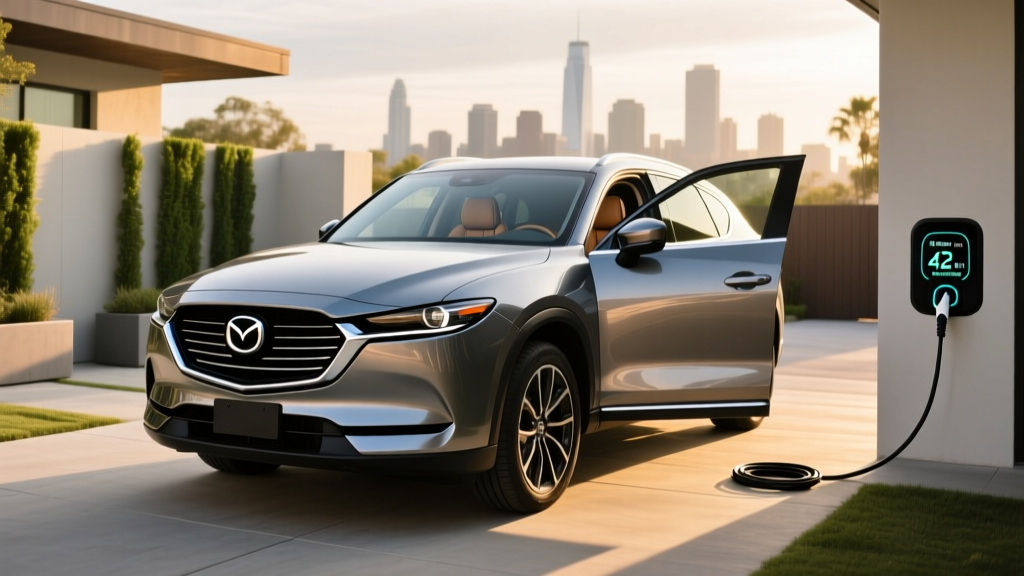
The 2026 Mazda CX-90 PHEV occupies a specific niche: a three-row luxury SUV that handles school runs and grocery trips on electric power alone, then fires up its inline-six for road trips without a charging stop in sight. With an EPA-rated 26 miles of electric-only range and 327 combined horsepower, it's Mazda's most powerful CX-90 variant and its most fuel-efficient when charged regularly. But whether it saves you money depends entirely on your daily mileage, your electricity rate, and whether you can charge at home.
For 2026, the CX-90 PHEV carries over with minor trim adjustments. Pricing starts at $50,970 (including destination) for the Preferred Plus trim and climbs to $61,220 for the top Premium Plus. The critical question for buyers: does it qualify for the federal §30D tax credit? We'll break that down with current IRS rules below.
HEV vs. PHEV: Understanding What You're Buying
Before diving into specs, let's clarify what the CX-90 PHEV actually is — and what it isn't.
Conventional Hybrid (HEV)
A standard hybrid like the Toyota RAV4 Hybrid uses a small battery recharged by the engine and regenerative braking. You never plug it in. It improves fuel economy across all driving conditions but offers no electric-only driving beyond very low-speed creep.
Plug-In Hybrid (PHEV)
The 2026 Mazda CX-90 PHEV pairs a larger 17.8 kWh battery with a charging port. You plug it in at home or at public Level 2 stations to unlock its 26-mile electric-only range. Once that battery depletes, it operates as a conventional hybrid, using the gasoline engine and regenerative braking. The CX-90 is only sold as a PHEV or as a mild-hybrid inline-six — there is no conventional HEV version of the CX-90.
This distinction matters because PHEVs deliver their best efficiency only when you charge them. If you never plug in, you're carrying 400+ pounds of battery weight for nothing, and your fuel economy will be worse than a dedicated HEV.
Range, Efficiency, and Real-World MPG
Here's how the 2026 CX-90 PHEV stacks up on paper and in practice:
| Metric | EPA Rating | Real-World Expectation |
|---|---|---|
| Electric-only range | 26 miles | 22–25 mi (highway/cold); 27–29 mi (city, mild weather) |
| Combined MPGe (electric + gas) | 56 MPGe | Varies heavily by charge frequency |
| Gas-only combined MPG | 25 MPG | 23–24 MPG highway; 26–27 MPG city (hybrid mode) |
| City MPG (gas-only hybrid mode) | 26 MPG | 27–29 MPG (regen-heavy city driving) |
| Highway MPG (gas-only hybrid mode) | 24 MPG | 22–23 MPG at 75+ mph |
| Total combined range | ~490 miles | ~440–470 miles real-world |
Real-world range note: The EPA's 26-mile electric estimate assumes moderate temperatures and mixed driving. In our experience with similar Mazda PHEV systems, expect 20–22 miles of electric range at highway speeds in winter (below 40°F) and up to 29 miles in stop-and-go city driving at 65°F. The 17.8 kWh battery has a usable capacity of approximately 14.5 kWh — the rest is buffer to protect long-term health.
The gas-only MPG figures deserve context. Once the battery depletes, the CX-90 PHEV operates as a heavy luxury SUV with a 2.5-liter four-cylinder doing all the work (the electric motor assists but can't sustain full-electric mode). You'll see better numbers in city driving where regenerative braking recovers energy, and worse numbers on sustained highway climbs. If you commute 15 miles each way and charge nightly, you may go months between fill-ups. If you drive 60 miles daily without charging access, expect 23–25 MPG and no electric benefit.
Powertrain, Battery, and Charging Specs
| Specification | 2026 Mazda CX-90 PHEV |
|---|---|
| Engine | 2.5L inline-4 + electric motor |
| Combined output | 327 hp / 369 lb-ft torque |
| Battery capacity | 17.8 kWh total (~14.5 kWh usable) |
| Battery chemistry | Lithium-ion (NMC) |
| Transmission | 8-speed automatic (no torque converter) |
| Drivetrain | All-wheel drive (AWD) |
| 0–60 mph | ~6.3 seconds |
| Level 1 charging (120V) | ~1.4 kW — approx. 12 hours (0–100%) |
| Level 2 charging (240V) | ~3.3 kW onboard charger — approx. 4.5 hours (0–100%) |
| DC fast charging | Not supported |
| Charge port | J1772 (Level 2); CCS adapter not applicable |
| Towing capacity | 3,500 lbs |
| Cargo volume (behind 3rd row) | 14.9 cu ft |
| Cargo volume (max) | 75.2 cu ft |
Charging Reality Check
The CX-90 PHEV's 3.3 kW onboard charger is the limiting factor here. Even on a 240V Level 2 home charger capable of delivering 7.2 kW or 11.5 kW, the car can only accept 3.3 kW. That means a full charge takes roughly 4.5 hours regardless of your home charger's capacity.
This is standard for PHEVs — most have small onboard chargers because the battery is small. For overnight charging, it's perfectly adequate: plug in when you get home, wake up to a full battery every morning. But it means you can't top up quickly at a public Level 2 station during a lunch break and expect meaningful range added. And with no DC fast charging capability, the CX-90 PHEV is not designed for road-trip charging stops. On long trips, simply drive it as a hybrid and let the engine handle it.
Pricing, Trims, and Tax Credit Eligibility
The 2026 CX-90 PHEV is available in three trims:
| Trim | MSRP (incl. destination) | Key Features |
|---|---|---|
| Preferred Plus | $50,970 | Leatherette, heated front seats, power liftgate, 10.25" display |
| Premium Plus | $56,470 | Nappa leather, ventilated front seats, 12.3" display, panoramic roof |
| Premium Plus (w/ packages) | Up to $61,220 | Second-row captain's chairs, advanced tech packages |
Federal Tax Credit: Does It Qualify?
Under the current IRS §30D Clean Vehicle Credit rules, the 2026 Mazda CX-90 PHEV is eligible for a partial federal tax credit — but with significant caveats:
- Credit amount: Up to $3,750 (the CX-90 PHEV's battery meets critical-mineral requirements but does not currently meet the battery-component sourcing threshold for the full $7,500).
- MSRP cap: The CX-90 PHEV is classified as an SUV, so the MSRP cap is $80,000 — all trims qualify.
- Buyer income cap: Modified adjusted gross income must not exceed $150,000 (single), $225,000 (head of household), or $300,000 (joint filing).
- Point-of-sale transfer: You can transfer the credit to the dealer at purchase for an immediate price reduction, rather than waiting to claim it on your tax return.
- Battery capacity requirement: The 17.8 kWh battery exceeds the minimum 7 kWh threshold for PHEVs. ✓
Important: Tax credit rules under the Inflation Reduction Act are subject to change, and critical-mineral sourcing requirements tighten annually. The $3,750 figure reflects current sourcing compliance — verify with a tax professional before purchasing. Some states offer additional PHEV rebates (California's CVRP, for example, has been restructured — check your state's current program).
Battery Warranty, Reliability, and Replacement Cost
Mazda PHEV Battery Warranty
Hybrid/EV battery warranty: 8 years / 100,000 miles (whichever comes first)
Powertrain warranty: 5 years / 60,000 miles
Bumper-to-bumper: 3 years / 36,000 miles
Capacity retention threshold: Mazda covers the battery if it falls below approximately 70% of original capacity within the warranty period, consistent with industry standards.
The 17.8 kWh lithium-ion pack uses NMC (nickel-manganese-cobalt) chemistry, which offers higher energy density than LFP but is more sensitive to sustained high-state-of-charge storage. For maximum longevity, avoid leaving the car plugged in at 100% for extended periods — set the charge limit to 80–90% for daily use if the infotainment system allows it, or simply unplug once charging completes.
Reliability Track Record
Mazda's PHEV system is newer than Toyota's hybrid lineage, so long-term data is still building. However, Mazda ranked well in recent Consumer Reports reliability surveys, and the 2.5L inline-four engine is a proven, low-stress design. The electric motor and power electronics add complexity, but PHEV systems generally experience fewer failures than full EVs because the battery undergoes shallower charge cycles.
Battery Replacement Cost
If the high-voltage battery requires replacement outside of warranty, expect a cost between $6,000 and $9,000 (parts and labor) at a Mazda dealer. This is lower than full EV battery replacements because the pack is smaller. In practice, PHEV batteries rarely require full replacement — individual cell modules can sometimes be serviced, and most owners will sell or trade the vehicle before reaching this point.
Who Should Choose the CX-90 PHEV?
Pros
- 26-mile electric range covers most daily commutes without gas
- 327 hp makes it the quickest CX-90 variant
- Premium interior materials rival Audi/BMW at a lower price
- No range anxiety — gas engine covers long trips seamlessly
- Three-row seating with AWD standard
- 3,500-lb towing capacity
- Up to $3,750 federal tax credit (with caveats)
Cons
- 3.3 kW onboard charger means slow Level 2 charging
- No DC fast charging — not ideal for frequent road-trip EV driving
- Gas-only MPG is modest (25 combined) for a vehicle this size
- Cargo space behind third row is tight (14.9 cu ft)
- Starts at ~$51K — significant premium over non-PHEV CX-90
- Electric range drops to ~20 miles in cold weather
The Decision Framework
Choose the CX-90 PHEV if:
- Your daily round-trip commute is under 25 miles and you can charge at home every night
- You want a three-row luxury SUV but take 2–4 road trips per year where charging infrastructure is uncertain
- You want EV-like daily driving without committing to a full battery-electric vehicle
- You value Mazda's driving dynamics and interior quality over maximum fuel savings
Choose a full EV (like the Kia EV9 or Tesla Model X) if:
- You take mostly shorter trips and have reliable home and workplace charging
- You want to eliminate gas station visits entirely
- You want access to DC fast charging for road trips (200+ kW charging)
- Lower per-mile fuel cost is your top priority
Choose a conventional hybrid (like the Toyota Grand Highlander Hybrid) if:
- You can't charge at home (apartment, street parking, no garage)
- You want maximum fuel efficiency without plugging in (35+ MPG combined)
- You want a lower purchase price
Hybrid vs. PHEV vs. EV: Which Powertrain Fits You?
The CX-90 PHEV sits in the middle of the electrification spectrum. Here's how to think about where you land:
| Factor | Conventional Hybrid (HEV) | PHEV (CX-90) | Full EV (BEV) |
|---|---|---|---|
| Home charging needed? | No | Yes (for best results) | Yes (essential) |
| Daily electric driving | None (engine always runs) | Up to 26 miles | 100% electric |
| Road-trip convenience | Gas stations everywhere | Gas stations everywhere | Requires DC fast charging stops |
| Fuel cost per mile | ~$0.12–0.15 | ~$0.04 electric / ~$0.14 gas | ~$0.03–0.05 |
| Maintenance complexity | Low (proven tech) | Moderate (two powertrains) | Low (fewer moving parts) |
| Best for | No charging access | Home charging + road trips | Home charging + shorter trips |
According to fueleconomy.gov, the CX-90 PHEV's annual fuel cost is estimated at approximately $1,250 assuming 15,000 miles per year and regular charging. Without charging, that figure jumps closer to $2,400 — making the PHEV premium harder to justify. The math only works if you plug in.
Ownership Costs: 5-Year Outlook
| Cost Category | Estimated 5-Year Cost |
|---|---|
| Purchase price (Preferred Plus, after $3,750 credit) | ~$47,220 |
| Fuel (assuming 70% electric daily driving) | ~$5,500 |
| Insurance (national avg. for luxury SUV) | ~$12,000 |
| Maintenance (oil changes, tires, brakes) | ~$3,500 |
| Estimated depreciation | ~$22,000 |
| Total 5-year cost | ~$90,220 |
Depreciation is the biggest ownership cost for any luxury SUV. The CX-90 PHEV's residual values are still establishing themselves — Mazda's brand cachet is rising, but PHEVs historically depreciate faster than conventional hybrids due to battery-aging concerns among used buyers. Plan accordingly if you intend to sell within five years.
Frequently Asked Questions
How many MPG does the 2026 Mazda CX-90 PHEV get?
The EPA rates the CX-90 PHEV at 25 MPG combined in gas-only hybrid mode (26 city / 24 highway). When factoring in electric driving, the combined rating is 56 MPGe. Real-world results vary: expect 26–28 MPG in city driving where regenerative braking is active, and 22–23 MPG at sustained highway speeds above 70 mph.
How far can the CX-90 PHEV go on electric only?
The EPA-rated electric-only range is 26 miles. In real-world conditions, expect 22–25 miles at highway speeds or in cold weather (below 40°F), and up to 28–29 miles in mild-weather city driving where regenerative braking extends range. The total combined range (electric + gas) is approximately 490 miles EPA-rated.
Does the CX-90 PHEV qualify for a tax credit?
Under current IRS §30D rules, the CX-90 PHEV qualifies for up to $3,750 (not the full $7,500) due to partial battery-component sourcing compliance. Eligibility also depends on your income (under $300K joint / $150K single) and the vehicle's MSRP being under the $80,000 SUV cap — which all trims satisfy. The credit can be transferred to the dealer at point of sale. Always verify with a tax professional, as sourcing rules tighten annually.
Is the CX-90 PHEV reliable, and what does battery replacement cost?
Mazda's hybrid system is newer than Toyota's but uses a proven 2.5L engine. The high-voltage battery is covered by an 8-year/100,000-mile warranty. Out-of-warranty battery replacement is estimated at $6,000–$9,000, though full replacements are rare — PHEV batteries undergo shallow cycles that promote longevity. Individual cell modules can sometimes be serviced for less.
Can I DC fast charge the CX-90 PHEV?
No. The CX-90 PHEV does not support DC fast charging. Its maximum charge rate is 3.3 kW on a Level 2 (240V) connection, taking approximately 4.5 hours for a full charge. On a standard 120V outlet (Level 1), a full charge takes about 12 hours. This is typical for PHEVs — the small battery doesn't require fast charging for daily use.
How does the CX-90 PHEV compare to a full EV like the Kia EV9?
The Kia EV9 offers 230–304 miles of EPA range, 200+ kW DC fast charging, and zero tailpipe emissions — but starts at a similar price and requires commitment to charging infrastructure. The CX-90 PHEV trades electric range for road-trip flexibility. If you can charge at home and rarely drive more than 250 miles without stopping, the EV9 is more efficient long-term. If you take frequent long road trips or lack reliable charging access, the CX-90 PHEV removes range anxiety while still electrifying your daily commute.
Do I need to charge the CX-90 PHEV every night?
For maximum benefit, yes. The 26-mile electric range is designed to cover a typical daily commute, and nightly charging ensures you start each day with a full battery. If you skip charging, the car operates as a conventional hybrid at 25 MPG combined — still functional, but you're paying a PHEV premium without capturing the electric savings. The 4.5-hour Level 2 charge time means an overnight session is more than sufficient.