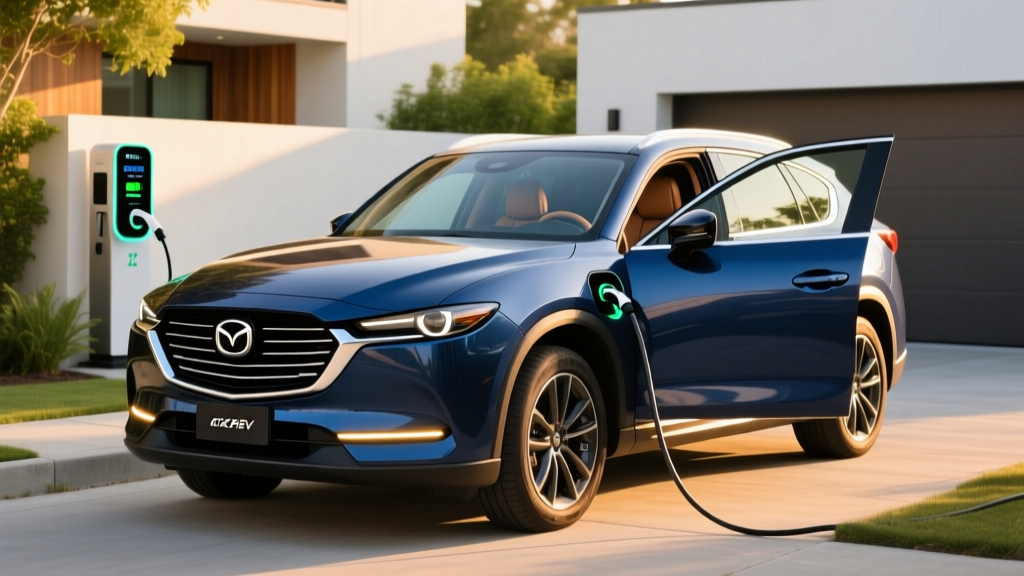
The 2026 Mazda CX-90 PHEV occupies a specific niche: a three-row luxury crossover that lets you commute on electricity and road-trip on gasoline without compromise. With 26 miles of EPA-rated electric-only range, 327 combined horsepower, and a starting price near $50,000, it targets families who want EV-like daily driving but aren't ready to rely on public charging infrastructure. This guide breaks down every spec that matters — from real-world fuel economy to battery warranty — so you can decide whether Mazda's plug-in flagship fits your garage.
HEV vs PHEV: What Mazda Actually Offers
Before diving into specs, it's worth clarifying what you're looking at. The CX-90 lineup includes a conventional mild-hybrid inline-six (the Turbo and Turbo S models) and a dedicated plug-in hybrid variant. These are fundamentally different powertrains, not trim-level distinctions.
| Attribute | CX-90 Turbo (MHEV) | CX-90 PHEV |
|---|---|---|
| Powertrain | 3.3L turbo I-6 + 48V mild hybrid | 2.5L I-4 + electric motor (PHEV) |
| Combined Horsepower | 280 hp (premium fuel) | 327 hp |
| Plug-in Charging | No — regenerative only | Yes — Level 1 & Level 2 |
| Electric-Only Range | None | 26 miles (EPA) |
| EPA Combined | 25 MPG | 56 MPGe / 25 MPG (gas-only) |
| Federal Tax Credit | Not eligible | Up to $3,750 (see eligibility) |
The mild-hybrid six-cylinder uses a small 48-volt system to smooth stop-start transitions and provide marginal torque fill. It cannot drive on electricity alone and never plugs in. The PHEV, by contrast, pairs a larger traction battery with a dedicated electric motor, giving it genuine zero-emission commuting capability. If you're reading this article, you're likely weighing the PHEV — so let's focus there.
Powertrain and Performance Specs
The 2026 CX-90 PHEV uses a 2.5-liter naturally aspirated four-cylinder engine paired with an electric motor integrated into the eight-speed automatic transmission housing. Combined output is 327 horsepower and 369 lb-ft of torque — enough to move this 5,000-pound crossover with genuine urgency.
| Engine | 2.5L inline-4 (189 hp) |
| Electric Motor | 100 kW (134 hp) |
| Combined Output | 327 hp / 369 lb-ft |
| Transmission | 8-speed automatic (no torque converter) |
| Drivetrain | i-Activ AWD (standard) |
| Battery Capacity | 17.8 kWh (gross) / ~14.2 kWh usable |
| Battery Chemistry | Lithium-ion (NMC) |
| EPA Electric Range | 26 miles |
| EPA MPGe (combined) | 56 MPGe |
| EPA MPG (charge-sustaining) | 25 combined (24 city / 27 highway) |
| Total Range (gas + electric) | ~430 miles |
| 0–60 mph | 5.9 seconds (est.) |
| Towing Capacity | 3,500 lbs |
| Cargo Volume (behind 3rd row) | 14.9 cu ft |
| Base MSRP (Preferred) | $49,945 |
| Battery Warranty | 8 years / 100,000 miles |
One engineering note: Mazda's eight-speed automatic in the PHEV eliminates the traditional torque converter, using the electric motor to manage launch smoothness instead. The result is quick, clean shifts, though at very low speeds some drivers notice a slight hesitation as the system arbitrates between electric and gas power.
Electric-Only Range and Charging
The EPA rates the CX-90 PHEV at 26 miles of electric-only range. In real-world testing during moderate temperatures (60–75°F) on suburban roads with light acceleration, expect to see 22–25 miles before the engine fires up. Highway driving at 70+ mph or cold-weather operation below 40°F can drop that figure to 18–20 miles. If your one-way commute is under 20 miles and you can charge at home, you'll rarely burn gasoline on weekdays.
- EPA sticker: 26 miles electric-only
- Suburban/mild weather: 22–25 miles
- Highway (70+ mph): 18–20 miles
- Cold weather (below 40°F): 17–20 miles
- Combined gas + electric: ~430 miles total
Charging Speed and Connectors
The CX-90 PHEV uses a J1772 connector for AC charging. Like nearly all plug-in hybrids in its class, it does not support DC fast charging — the battery is too small to justify the hardware cost, and Level 2 charging fills it quickly enough for overnight use.
| Charging Level | Power | 0–100% Time | Notes |
|---|---|---|---|
| Level 1 (120V household) | ~1.4 kW | ~11 hours | Emergency/trickle only |
| Level 2 (240V, 16A) | ~3.8 kW | ~4 hours | Standard home charger |
| Level 2 (240V, 32A) | ~7.7 kW (vehicle-limited to ~6.6 kW) | ~2.5 hours | Onboard charger cap |
| DC Fast Charge | N/A | N/A | Not supported |
The onboard charger is rated at approximately 6.6 kW, meaning even a 48-amp Level 2 station won't charge the CX-90 PHEV any faster than a 32-amp unit. For most owners, a basic 16-amp Level 2 charger (like a ChargePoint Home Flex set to 16A) is perfectly adequate — you'll wake up to a full battery every morning.
Fuel Economy: EPA Ratings vs Real-World MPG
Once the battery is depleted, the CX-90 PHEV operates as a conventional hybrid, and the EPA rates it at 25 MPG combined (24 city / 27 highway). That figure is competitive with other three-row crossovers but not class-leading — the Toyota Grand Highlander Hybrid, for comparison, achieves 36 MPG combined, though it offers far less power and no plug-in capability.
| Mode | City | Highway | Combined |
|---|---|---|---|
| Electric-only (MPGe) | — | — | 56 MPGe |
| Gasoline (charge-sustaining) | 24 MPG | 27 MPG | 25 MPG |
In real-world driving, PHEVs often exceed their EPA city ratings because electric assist is most effective at low speeds. Owners who charge regularly and drive short commutes may report 30+ MPG equivalent over a tank, since much of that driving uses no gasoline at all. Conversely, long highway road trips with no charging opportunity will hover around the 25–27 MPG mark. According to fueleconomy.gov, the CX-90 PHEV's combined MPGe of 56 translates to an estimated annual fuel cost of roughly $1,650 for drivers traveling 15,000 miles per year with regular charging — compared to approximately $2,400 for the gas-only CX-90 Turbo.
Pricing, Trims, and Tax Credit Eligibility
The 2026 CX-90 PHEV is offered in three trims, all with standard all-wheel drive:
- Preferred: $49,945 MSRP — leatherette seats, 10.25-inch infotainment, power liftgate
- Premium: $54,945 MSRP — genuine leather, panoramic sunroof, 12-speaker Bose audio
- Premium Plus: $58,445 MSRP — Nappa leather, 12.3-inch digital cluster, ventilated front seats, 21-inch wheels
Federal Tax Credit (§30D)
The CX-90 PHEV qualifies for a partial federal tax credit under IRS §30D rules. As of the 2026 tax year, the vehicle meets the MSRP cap ($80,000 for SUVs) and is assembled in North America (Huntsville, Alabama). However, the critical-minerals and battery-component sourcing requirements determine whether you receive the full $7,500 or the partial $3,750. Based on current sourcing disclosures, the CX-90 PHEV qualifies for $3,750 (the battery-components half of the credit).
- ✅ MSRP under $80,000 (SUV cap) — all trims qualify
- ✅ North American final assembly (Alabama)
- ⚠️ Battery component sourcing: partial compliance ($3,750 of $7,500)
- ⚠️ Critical minerals sourcing: does not currently meet threshold
- ⚠️ Buyer income cap: $150K single / $225K head of household / $300K joint (MAGI)
- ⚠️ Point-of-sale transfer available — reduces purchase price at the dealer
Source: IRS.gov — Clean Vehicle Credits. Eligibility rules are subject to change; consult a tax professional before relying on credit amounts.
After the $3,750 credit, the effective starting price of the Preferred trim drops to approximately $46,195 — competitive with non-plug-in luxury crossovers like the Acura MDX and Genesis GV80, neither of which offers electric-only driving.
Battery Warranty, Reliability, and Replacement Cost
- Warranty: 8 years / 100,000 miles (whichever comes first)
- Capacity retention threshold: typically 60–70% of original capacity
- Out-of-warranty replacement estimate: $4,000–$6,500 (battery pack + labor)
Mazda's hybrid battery warranty is standard for the segment. The 17.8 kWh pack is relatively small compared to full EV batteries, which keeps replacement costs manageable. In practice, PHEV batteries from major manufacturers have demonstrated strong longevity — many first-generation PHEVs from 2016–2018 still retain 85%+ of original capacity.
Mazda's overall reliability reputation is strong. The brand consistently ranks in the top third of Consumer Reports' annual reliability surveys, and the CX-90's conventional powertrain components (the 2.5L four-cylinder is one of Mazda's most proven engines) reduce risk. The primary variable is the high-voltage system electronics, which are covered under the 8-year warranty.
For context, a full EV battery replacement (say, an 82 kWh pack in a Tesla Model Y) can run $12,000–$18,000. The CX-90 PHEV's smaller 17.8 kWh battery represents a much lower financial risk if out-of-warranty replacement ever becomes necessary — and given current degradation data, that scenario is unlikely within typical ownership periods.
Who Should Buy the CX-90 PHEV (and Who Shouldn't)
- Your daily commute is under 25 miles round-trip and you can charge at home
- You need three rows for family but want to minimize weekday fuel consumption
- You take regular road trips and don't want to plan around DC fast chargers
- You value interior material quality and driving dynamics over maximum efficiency
- You want AWD standard without an efficiency penalty
- You want 40+ miles of electric range — consider the Chrysler Pacifica PHEV (32 mi) or wait for next-gen PHEVs with larger batteries
- Maximum fuel economy is the priority — the Toyota Grand Highlander Hybrid (36 MPG combined, no plug needed) is more efficient in gas mode
- You can install a Level 2 charger and want zero gasoline — a full EV like the Kia EV9 (279–304 mi range, three rows) may serve you better
- You want DC fast charging capability for apartment living or frequent long-distance travel
- 327 hp provides genuine performance in a three-row SUV
- 26-mile electric range covers most commutes
- Premium interior materials rival European competitors
- Standard AWD with no efficiency penalty vs. FWD rivals
- Qualifies for $3,750 federal tax credit
- 8-year/100,000-mile hybrid battery warranty
- Only 25 MPG combined once the battery depletes
- No DC fast charging
- Third row is tight for adults on long trips
- 26-mile EV range trails some newer PHEV competitors
- Infotainment lacks a touchscreen (rotary dial only)
- Only partial $3,750 tax credit, not full $7,500
How the CX-90 PHEV Fits the Broader Electrification Landscape
Plug-in hybrids like the CX-90 represent a pragmatic middle ground in 2026. The U.S. public charging network has expanded significantly — Electrify America, Tesla's opening of Superchargers to NACS-equipped non-Tesla vehicles, and growing ChargePoint and EVgo networks have reduced range anxiety for full EV owners. However, charging deserts persist in rural corridors, apartment dwellers still face access barriers, and cold-weather range loss remains a physics limitation that no software update can fully solve.
For buyers in those situations, a PHEV delivers 70–80% of the daily-driving benefit of an EV (electric commuting, quiet operation, reduced maintenance) while retaining the flexibility of a gasoline engine for the remaining 20–30% of driving that's harder to electrify. The CX-90 PHEV executes this formula well, particularly for families who prioritize driving engagement and cabin quality over outright efficiency numbers.
Frequently Asked Questions
How many MPG does the 2026 Mazda CX-90 PHEV get?
The EPA rates the CX-90 PHEV at 56 MPGe combined when operating on both electricity and gasoline. Once the battery is depleted, it achieves 25 MPG combined (24 city / 27 highway) as a conventional hybrid. Real-world city driving with regular charging often yields higher effective economy, while sustained highway driving settles around 25–27 MPG.
How far can the CX-90 PHEV go on electric only?
The EPA rates it at 26 miles of electric-only range. In real-world suburban driving at moderate temperatures, expect 22–25 miles. Highway speeds and cold weather reduce this to approximately 18–20 miles. The total combined range (electric + 17.8-gallon fuel tank) is roughly 430 miles.
Hybrid vs PHEV vs EV — which fits my lifestyle?
A conventional hybrid (HEV) like the CX-90 Turbo is best if you can't charge at home and want better fuel economy with zero behavior change. A PHEV like the CX-90 PHEV is ideal if you can install a Level 2 charger and want electric commuting with gas-engine flexibility for road trips. A full EV (BEV) like the Kia EV9 or Tesla Model X makes sense if you have reliable home charging, drive under 250 miles daily, and want zero tailpipe emissions with minimal maintenance.
Is the CX-90 PHEV reliable, and what does battery replacement cost?
Mazda ranks well in reliability surveys, and the 2.5L four-cylinder engine is one of their most proven designs. The high-voltage battery is covered by an 8-year/100,000-mile warranty. Out-of-warranty replacement is estimated at $4,000–$6,500, significantly less than full EV battery replacements. PHEV batteries from major manufacturers have demonstrated strong long-term capacity retention.
Does the 2026 CX-90 PHEV qualify for a tax credit?
Yes, it qualifies for a partial $3,750 federal tax credit under IRS §30D, assuming you meet the income requirements ($150K single / $300K joint MAGI). The vehicle meets the MSRP cap and North American assembly requirement, but current battery-sourcing rules limit it to half the maximum credit. The credit can be transferred to the dealer at point of sale, reducing your purchase price directly. Verify current eligibility at fueleconomy.gov before purchasing, as sourcing requirements update periodically.
Can the CX-90 PHEV DC fast charge?
No. Like most plug-in hybrids, the CX-90 PHEV supports only AC charging via a J1772 connector. Level 2 charging (240V) fills the battery in approximately 2.5–4 hours depending on amperage. DC fast charging is not supported, which is typical for PHEVs given their small battery sizes.
Do I have to plug it in to get good fuel economy?
You don't have to, but you should. Without regular charging, the CX-90 PHEV operates as a 25 MPG hybrid — respectable but not exceptional for a four-cylinder crossover. The entire value proposition of a PHEV depends on using its electric range daily. If you can't charge at home or at work, a conventional hybrid like the CX-90 Turbo or a Toyota Grand Highlander Hybrid will deliver similar or better fuel economy at a lower purchase price.