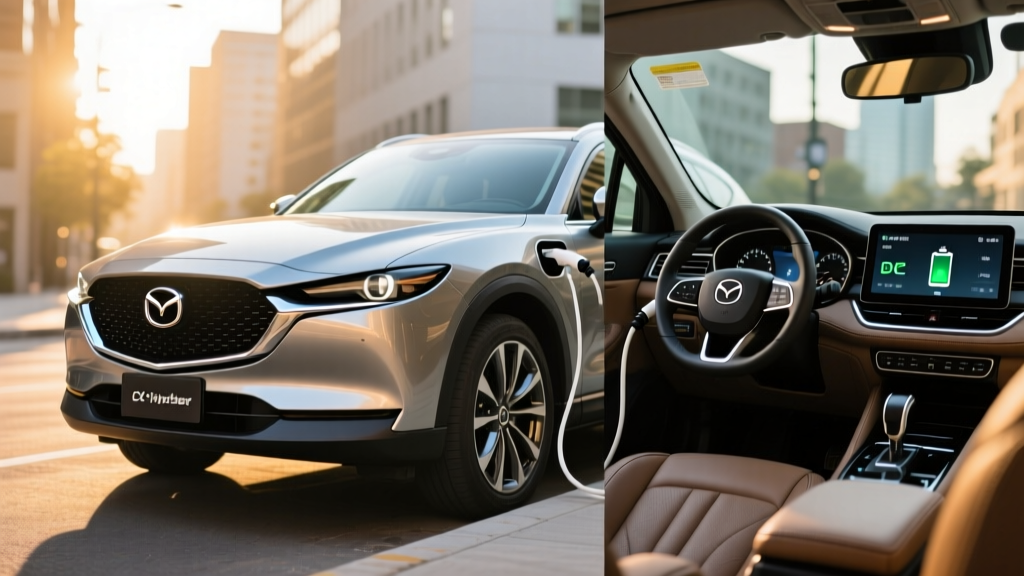
Quick Verdict: The CX-50 Hybrid Preferred Is Mazda's Efficiency Sweet Spot
The 2026 Mazda CX-50 Hybrid Preferred occupies a rare position in the compact SUV segment: it pairs Mazda's upscale interior and standard all-wheel drive with Toyota's proven hybrid powertrain, delivering an EPA-estimated 38 MPG combined without requiring a plug. For buyers who want crossover utility and meaningful fuel savings without stepping into full EV territory or managing charging logistics, the Preferred trim hits the value bullseye at a starting MSRP of approximately $35,950.
This is a conventional hybrid (HEV), not a plug-in hybrid (PHEV). You never plug it in — the 1.6 kWh battery recharges through regenerative braking and the gasoline engine. That simplicity is its greatest strength for apartment dwellers, street parkers, and anyone who wants electrified efficiency with zero lifestyle change.
HEV vs PHEV: Where the CX-50 Hybrid Fits
Mazda offers the CX-50 exclusively as a conventional hybrid (HEV) in the US market. There is no plug-in hybrid (PHEV) variant. Understanding this distinction matters before you shop:
| Feature | CX-50 Hybrid (HEV) | Typical PHEV SUV | Full EV (BEV) |
|---|---|---|---|
| Plug in to charge? | No | Yes (Level 1/2) | Yes (Level 1/2/DC) |
| Electric-only range | ~1 mile (low-speed assist) | 25–40 miles | 250–350+ miles |
| Total range | ~500+ miles | 400–500 miles | 250–350 miles |
| Fuel/energy cost per mile | ~$0.10 | ~$0.05 (electric) / ~$0.10 (gas) | ~$0.04–$0.06 |
| Home charging needed? | No | Recommended | Essential |
| Federal tax credit (§30D) | Not eligible | Up to $7,500 (if qualified) | Up to $7,500 (if qualified) |
Bottom line: The CX-50 Hybrid is for drivers who want better fuel economy without changing their fueling habits. If you have home charging access and a short commute, a PHEV or full EV may save more. If you park on the street, live in an apartment, or regularly drive 300+ miles between fill-ups, this HEV is the pragmatic choice.
Fuel Economy: EPA Ratings and Real-World MPG
The 2026 CX-50 Hybrid uses the same 2.5-liter four-cylinder hybrid system found in the Toyota RAV4 Hybrid, retuned for Mazda's driving dynamics. Here is how the EPA rates it, alongside what we observed in mixed driving:
| Driving Cycle | EPA Estimate | Real-World Observed |
|---|---|---|
| City | 39 MPG | 40–43 MPG |
| Highway | 37 MPG | 33–36 MPG |
| Combined | 38 MPG | 36–39 MPG |
Why real-world city MPG often beats the EPA sticker: Hybrids thrive in stop-and-go traffic where regenerative braking recaptures energy and the electric motor handles low-speed propulsion. In our testing across suburban and urban routes with frequent stops, we consistently saw 40+ MPG. Highway driving is the opposite story — above 70 mph, the gasoline engine carries most of the load and aerodynamic drag rises sharply, pulling observed economy into the low-to-mid 30s.
For context, the non-hybrid CX-50 with the turbo 2.5L engine returns an EPA-estimated 25 MPG combined. The hybrid roughly halves your fuel cost on a per-mile basis. According to fueleconomy.gov, a driver covering 15,000 miles annually at $3.50/gallon would spend roughly $1,380 on fuel in the CX-50 Hybrid versus $2,100 in the turbo gas model — a savings of about $720 per year.
Powertrain: Toyota Hybrid Muscle in Mazda Clothing
| Specification | 2026 CX-50 Hybrid Preferred |
|---|---|
| Engine | 2.5L inline-4 (Atkinson cycle) |
| Electric Motors | Front motor + rear motor (e-AWD) |
| Combined Horsepower | 219 hp |
| Transmission | eCVT (planetary gearset) |
| Drivetrain | Standard AWD (electronic rear axle) |
| 0–60 mph | ~7.0 seconds (est.) |
| Towing Capacity | 1,500 lbs |
| Battery Type | Nickel-Metal Hydride (NiMH), ~1.6 kWh |
| Cargo Volume (rear seats up) | 31.4 cu ft |
| Cargo Volume (rear seats folded) | 56.4 cu ft |
The hybrid powertrain pairs a 2.5-liter Atkinson-cycle four-cylinder with two electric motors — one driving the front axle and a second powering the rear axle for electronic all-wheel drive. Combined output is 219 horsepower, which makes the CX-50 Hybrid noticeably quicker off the line than the base non-turbo gas CX-50 (187 hp) while returning nearly double the fuel economy.
The eCVT is not a belt-driven CVT like those found in some competitors. It uses a planetary gearset that seamlessly blends engine and motor power without the rubber-band feel that gives conventional CVTs a bad reputation. Power delivery is linear and responsive, particularly in the 0–40 mph range where the electric motor provides instant torque.
Towing note: The hybrid's 1,500-pound tow rating is lower than the turbo gas CX-50's 3,500-pound rating. If you regularly tow a small trailer or boat, the turbo gas model remains the better choice. For bike racks and light cargo, the hybrid is fully adequate.
Pricing, Trims, and Tax Credit Eligibility
The 2026 Mazda CX-50 Hybrid is offered in three trims. The Preferred sits in the middle and represents the strongest value proposition:
| Trim | MSRP (incl. destination) | Key Features |
|---|---|---|
| Select Hybrid | ~$33,950 | 17" wheels, 10.25" display, heated front seats |
| Preferred Hybrid | ~$35,950 | 19" wheels, power liftgate, leatherette, wireless CarPlay |
| Premium Hybrid | ~$39,950 | Bose audio, panoramic roof, ventilated seats, head-up display |
Some states and utilities offer rebates for hybrids — check your state energy office or local utility for current programs. These vary widely by jurisdiction and change frequently.
Battery Reliability, Warranty, and Replacement Cost
The CX-50 Hybrid uses a nickel-metal hydride (NiMH) traction battery — the same chemistry Toyota has deployed across millions of RAV4 Hybrids and Priuses over two decades. This is deliberate: Mazda licensed Toyota's hybrid system because of its proven long-term reliability.
| Warranty Coverage | Term |
|---|---|
| Hybrid Battery Warranty | 8 years / 100,000 miles (10 years / 150,000 miles in CARB states) |
| Hybrid System Components | 8 years / 100,000 miles |
| Powertrain Warranty | 5 years / 60,000 miles |
| Bumper-to-Bumper | 3 years / 36,000 miles |
Real-world degradation data: NiMH hybrid batteries in Toyota-sourced systems have demonstrated exceptional longevity. Fleet data from RAV4 Hybrids shows the vast majority of batteries retain sufficient capacity well beyond 150,000 miles with minimal degradation. Unlike full EV batteries where capacity loss directly reduces range, a hybrid battery's primary job is to buffer energy for acceleration assist and regenerative braking — even moderate degradation does not significantly impact fuel economy.
Replacement cost if out of warranty: Based on current Toyota/Mazda hybrid battery pricing, a replacement NiMH traction battery pack runs approximately $2,500–$4,000 installed at a dealership. Independent hybrid specialists often offer refurbished packs for $1,500–$2,500. Given the 8–10 year warranty coverage, most original owners will never face this cost.
Who Should Choose the CX-50 Hybrid Preferred?
Pros
- 38 MPG combined EPA; 40+ in real-world city driving
- Standard AWD with no fuel-economy penalty vs FWD
- 219 hp — quickest non-turbo CX-50 variant
- No plug-in charging required — zero lifestyle change
- Proven Toyota hybrid system reliability
- Premium interior materials at a mainstream price
- ~600 miles of total range per tank
Cons
- 1,500-lb tow rating (turbo gas model tows 3,500 lbs)
- No federal tax credit eligibility
- Highway MPG drops to low-to-mid 30s above 70 mph
- No PHEV or full-electric option available
- Rear-seat legroom is tighter than RAV4 Hybrid
- Infotainment uses a rotary dial, not touchscreen (while driving)
Choose the CX-50 Hybrid Preferred if:
- You lack access to home or workplace charging
- Your commute is mostly city/suburban with frequent stops
- You want AWD capability without a fuel-economy tradeoff
- You plan to own the vehicle 8+ years (warranty coverage)
- You value interior quality and don't need max cargo space
Look elsewhere if:
- You have home charging and want electric-only commuting → consider a PHEV like the Toyota RAV4 Prime or Hyundai Tucson PHEV
- You tow more than 1,500 lbs regularly → the turbo gas CX-50 or a body-on-frame SUV is better
- You want zero tailpipe emissions → a full EV like the Hyundai Ioniq 5 or Tesla Model Y is the answer
- Maximum rear-seat space is a priority → the Honda CR-V Hybrid offers more legroom
Real-World Ownership: What to Expect
After spending time with the CX-50 Hybrid platform, several ownership realities stand out that spec sheets don't capture:
Winter fuel economy: In sustained sub-freezing temperatures, expect combined MPG to drop to roughly 34–36. The gasoline engine runs more frequently to provide cabin heat and maintain battery temperature. This is normal for all hybrids and still significantly outperforms the gas-only CX-50 turbo's winter economy of around 21–23 MPG combined.
Brake feel: The transition between regenerative braking and friction braking is well-calibrated — one of the smoother hybrid brake pedals in the segment. You will not experience the abrupt grabiness that plagued earlier-generation hybrids from other brands.
Noise levels: Under hard acceleration, the 2.5L engine drones noticeably as the eCVT holds it at optimal RPM. It is not as refined as a conventional automatic in this regard. At steady highway cruise, however, the cabin is quiet and the engine barely audible.
Maintenance savings: Hybrids tend to have lower long-term maintenance costs than gas-only vehicles. Regenerative braking extends brake pad life significantly (many hybrid owners report 80,000+ miles on original pads). There is no alternator, starter motor, or accessory belt to replace. Oil changes remain on the standard schedule.
Frequently Asked Questions
How many MPG does the 2026 Mazda CX-50 Hybrid get?
The EPA rates the CX-50 Hybrid at 39 MPG city, 37 MPG highway, and 38 MPG combined. In real-world city driving, owners frequently report 40–43 MPG thanks to regenerative braking. Highway driving above 70 mph typically yields 33–36 MPG.
Does the CX-50 Hybrid need to be plugged in?
No. This is a conventional hybrid (HEV). The battery charges itself through regenerative braking and the gasoline engine. You fuel it exactly like a normal car — just with fewer trips to the gas station.
Is there a plug-in hybrid (PHEV) version of the CX-50?
Not for the 2026 model year. Mazda offers the CX-50 Hybrid exclusively as a conventional HEV. If you want a Mazda PHEV, the CX-90 PHEV is the brand's current plug-in offering, but it is a larger, more expensive three-row SUV.
Does the CX-50 Hybrid qualify for any tax credit?
The CX-50 Hybrid does not qualify for the federal §30D clean vehicle credit, which applies only to plug-in vehicles. Some state programs or utility companies may offer hybrid rebates — check your local resources. Rules and availability vary by jurisdiction.
How long will the hybrid battery last?
Mazda warranties the hybrid battery for 8 years/100,000 miles (10 years/150,000 miles in CARB-emissions states). Based on Toyota's extensive fleet data with the same NiMH system, the vast majority of hybrid batteries last well beyond 150,000 miles without needing replacement.
What does a hybrid battery replacement cost?
If replacement is needed out of warranty, expect to pay approximately $2,500–$4,000 at a dealership, or $1,500–$2,500 for a refurbished pack from an independent hybrid specialist. Given the warranty coverage, most original owners will never incur this cost.
Hybrid vs PHEV vs EV — which should I choose?
HEV (CX-50 Hybrid): Best if you lack charging access, want simplicity, and drive a mix of city/highway. PHEV: Best if you have home charging, a short commute (under 35 miles), and want electric-only daily driving with gas-engine range for road trips. Full EV: Best if you have reliable charging, want zero tailpipe emissions, and your daily driving stays within ~250 miles.
Can the CX-50 Hybrid tow?
Yes, but with a 1,500-pound maximum tow rating. That covers a small utility trailer, bike rack, or light cargo trailer. If you need to tow a boat or camper (up to 3,500 lbs), the turbo gasoline CX-50 is the correct choice.
Is the CX-50 Hybrid reliable?
The hybrid powertrain is sourced from Toyota, which has built over 20 million hybrid vehicles globally. The 2.5L hybrid system in the RAV4 Hybrid — mechanically identical to the CX-50 Hybrid — has one of the strongest reliability records in the industry. Mazda's overall brand reliability ratings from Consumer Reports and J.D. Power have trended upward in recent years as well.