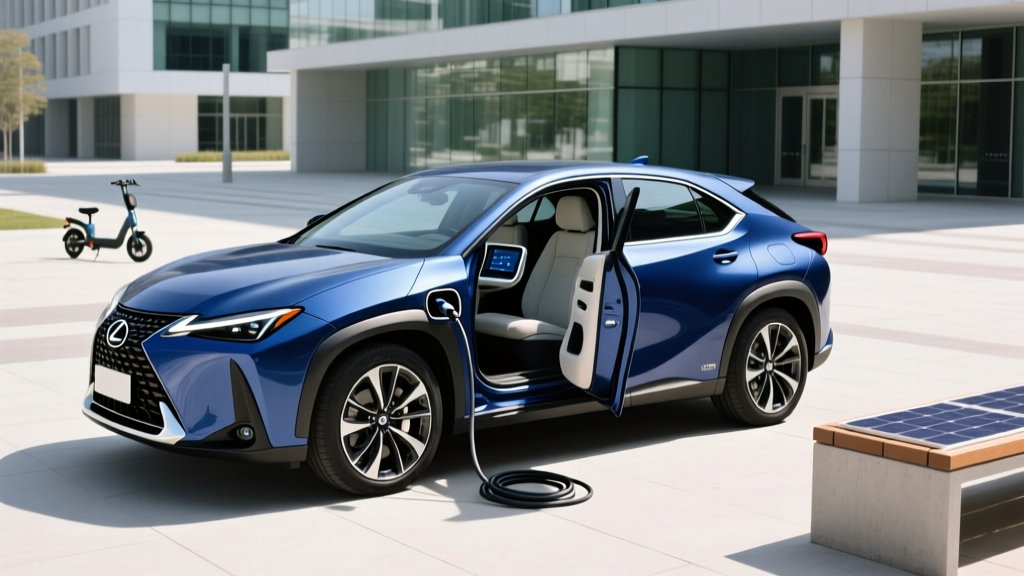
The 2026 Lexus UX Hybrid (officially the UX 300h) occupies a specific niche: a luxury subcompact crossover that sips fuel without requiring a plug, a charging routine, or any behavioral change from its owner. For buyers cross-shopping premium crossovers who want electrified efficiency without the infrastructure demands of a plug-in hybrid (PHEV) or battery-electric vehicle (BEV), the UX 300h remains one of the most compelling options in its class. This guide breaks down exactly what the 2026 model delivers — and where its limitations lie.
HEV vs PHEV: What the UX 300h Actually Is
Before examining specs, it's critical to distinguish between hybrid types, because the UX 300h is a conventional hybrid electric vehicle (HEV) — not a plug-in hybrid.
| Feature | HEV (UX 300h) | PHEV (e.g., Lexus NX 450h+) | BEV (e.g., Tesla Model Y) |
|---|---|---|---|
| Plugs in? | No | Yes | Yes |
| Electric-only range | ~1 mile at low speed | 30–40 miles typical | 250–330 miles |
| Battery size | ~1.4 kWh (small) | 14–18 kWh | 60–82 kWh |
| Home charger needed? | No | Recommended | Essential |
| Federal tax credit (§30D) | No | Up to $7,500 (if eligible) | Up to $7,500 (if eligible) |
| Best for | No-plug convenience | Short electric commutes + long road trips | Full electric with home charging |
The UX 300h captures energy through regenerative braking and the gasoline engine, storing it in a small nickel-metal-hydride (NiMH) battery. The electric motor assists the gas engine during acceleration and can propel the car solo at very low speeds for brief distances — but you never plug it in, and there is no meaningful electric-only driving range. This is a deliberate trade-off: maximum convenience in exchange for less electrified driving than a PHEV or BEV offers.
Fuel Economy: EPA Ratings and Real-World MPG
The 2026 Lexus UX 300h carries over the fifth-generation Toyota Hybrid System (THS) that debuted with the UX 250h refresh. EPA fuel economy figures remain among the best in the luxury subcompact segment.
| Trim / Drivetrain | City MPG | Highway MPG | Combined MPG |
|---|---|---|---|
| UX 300h FWD | 43 | 44 | 43 |
| UX 300h AWD (E-Four) | 41 | 41 | 41 |
Source: EPA Fuel Economy
Real-World MPG vs. EPA Sticker
Toyota's hybrid system excels in city driving, where the electric motor handles low-speed propulsion and regenerative braking recaptures energy at every stop. In real-world urban commuting, many UX Hybrid owners report matching or even slightly exceeding the EPA city rating — 44–46 MPG is achievable with moderate driving habits.
Highway driving tells a different story. At sustained speeds above 70 mph, the 2.0-liter four-cylinder engine does most of the work, and aerodynamic drag reduces efficiency. Expect 38–40 MPG on extended highway trips with the AWD model. In cold weather (below 35°F), fuel economy typically drops 3–5 MPG as the engine runs longer to heat the cabin and the battery operates less efficiently.
For a 13.2-gallon fuel tank, that translates to roughly 530–570 miles of real-world range on the FWD model — enough for most drivers to visit a gas station once every two weeks.
Powertrain Specs: Engine, Motor, and Combined Output
| Specification | 2026 Lexus UX 300h |
|---|---|
| Engine | 2.0L inline-4 (Atkinson cycle) |
| Engine output | 150 hp / 139 lb-ft torque |
| Front electric motor | 109 hp / 152 lb-ft |
| Rear electric motor (AWD only) | 41 hp / 89 lb-ft |
| Combined system horsepower | 196 hp (FWD) / 196 hp (AWD) |
| Transmission | eCVT (planetary gearset, no belt) |
| 0–60 mph | ~7.9 seconds (FWD) / ~7.6 seconds (AWD) |
| Hybrid battery | ~1.4 kWh NiMH |
| Drivetrain | FWD or E-Four electronic AWD |
The combined 196 hp is a meaningful upgrade over the previous-generation UX 250h's 181 hp. The eCVT is not a traditional continuously variable transmission with a steel belt — it's a planetary gearset that seamlessly blends engine and motor power. It's one of the most durable transmission designs in the industry, with no friction materials to wear out.
The E-Four AWD system uses a dedicated rear electric motor rather than a mechanical driveshaft, engaging only when traction is needed. This means no parasitic drivetrain loss during normal cruising — a key reason the AWD model's fuel economy penalty is only about 2 MPG.
Reliability and Battery Warranty: What Owners Need to Know
Lexus consistently ranks at or near the top of J.D. Power and Consumer Reports reliability surveys, and the UX Hybrid's powertrain is one of the most proven in the Toyota/Lexus lineup. The THS hybrid system has been in production since 1997, with tens of millions of units on the road globally.
Hybrid Battery Warranty
- Coverage: 10 years / 150,000 miles (whichever comes first)
- What's covered: Hybrid battery pack, hybrid control module, inverter, and related hybrid-system components
- Transferable: Yes — warranty transfers to subsequent owners at no cost
- Replacement cost (out of warranty): Approximately $3,000–$4,500 for a new hybrid battery pack, including labor
The NiMH battery in the UX 300h is far less stressed than the large lithium-ion packs in BEVs. It operates within a narrow state-of-charge window (roughly 40–80%), which dramatically reduces degradation. Toyota/Lexus hybrid batteries routinely last 150,000–200,000+ miles before significant capacity loss. Many first-generation Prius taxis surpassed 300,000 miles on the original battery.
Beyond the hybrid battery, the 2026 UX 300h carries Lexus's standard new-vehicle warranty: 4 years/50,000 miles bumper-to-bumper and 6 years/70,000 miles powertrain. The eCVT, being a simple planetary gearset, is effectively maintenance-free.
Pricing, Trims, and Tax Credit Eligibility
The 2026 Lexus UX 300h is available in several trims, with pricing that positions it competitively against the Audi Q3, BMW X1, and Mercedes-Benz GLA — none of which offer a hybrid variant.
| Trim | Drivetrain | MSRP (est.) |
|---|---|---|
| UX 300h Base | FWD | $38,700 |
| UX 300h Premium | FWD | $41,200 |
| UX 300h Premium | AWD | $42,600 |
| UX 300h F SPORT Handling | AWD | $45,800 |
| UX 300h Luxury | AWD | $47,500 |
Destination charge (~$1,195) not included. Prices are estimated based on current model-year trends; verify with your local Lexus dealer.
Does the UX 300h Qualify for a Federal Tax Credit?
No. Under current IRS §30D Clean Vehicle Credit rules, only plug-in electric vehicles (PHEVs and BEVs) with a battery capacity of at least 7 kWh qualify. The UX 300h's ~1.4 kWh NiMH battery does not meet this threshold. It is classified as a conventional hybrid, which has not been eligible for the federal purchase credit since the original Hybrid Tax Credit expired for Toyota/Lexus vehicles years ago.
Some states and municipalities offer rebates or HOV-lane access for conventional hybrids, but these vary widely by jurisdiction. Check your state's energy office or department of environmental quality for current programs. Do not rely on dealer assurances — verify eligibility with a tax professional before purchase.
Who Should Choose the UX 300h Hybrid vs. a PHEV or Full EV?
Choose the UX 300h Hybrid (HEV) if:
- You have no access to home or workplace charging (apartment, street parking, condo without EV infrastructure)
- You want maximum fuel efficiency with zero routine behavioral change
- You drive 10,000–15,000 miles/year and want to minimize fuel costs without a plug
- You value Lexus reliability and low maintenance costs over electric-only driving
- Your budget is under $45,000 and you want a luxury badge with strong resale value
Consider a PHEV (e.g., Lexus NX 450h+) if:
- You can charge at home (Level 2, 240V) and have a commute under 35 miles
- You want electric-only daily driving but gas-engine flexibility for road trips
- You may qualify for the $7,500 federal tax credit (subject to MSRP, income, and battery-sourcing limits)
Consider a full BEV (e.g., Tesla Model Y, Hyundai Ioniq 5) if:
- You have reliable home Level 2 charging
- You want zero tailpipe emissions and the lowest per-mile energy cost
- You qualify for the federal tax credit and your daily driving is under 250 miles
- You're willing to plan around DC fast charging on road trips
The UX 300h's ideal buyer lives in an area where home charging installation is impractical or expensive — think older urban neighborhoods, condos, or apartments. It's also the right call for buyers who simply don't want to think about charging. You fuel it like any gas car; it just visits the station far less often.
Pros and Cons at a Glance
Pros
- 43 MPG combined (FWD) — best in luxury subcompact class
- No plug-in charging required; zero infrastructure dependency
- Proven THS hybrid system with exceptional reliability record
- 10-year / 150,000-mile hybrid battery warranty
- Strong Lexus resale value and low cost of ownership
- 196 hp is adequate for merging and highway passing
- Quiet, refined cabin with Lexus Safety System+ 3.0 standard
Cons
- No federal tax credit eligibility (HEV, not PHEV/BEV)
- Rear seat and cargo space are tight vs. competitors (17.1 cu ft cargo)
- Not available as a PHEV — Lexus offers no UX plug-in variant
- Highway MPG drops to ~38–40 real-world at 75+ mph
- eCVT drone under hard acceleration (common to all Toyota hybrids)
- Base price approaching $39K for a subcompact crossover
Frequently Asked Questions
How many MPG does the 2026 Lexus UX Hybrid get?
The EPA rates the UX 300h FWD at 43 city / 44 highway / 43 combined MPG. The AWD model is rated at 41/41/41 MPG. In real-world city driving, owners commonly match or slightly exceed these numbers. Highway-only driving at high speeds typically yields 38–40 MPG.
Can I plug in the Lexus UX 300h to charge?
No. The UX 300h is a conventional hybrid (HEV), not a plug-in hybrid (PHEV). It charges its small battery exclusively through regenerative braking and the gasoline engine. There is no charging port and no electric-only driving range beyond very low-speed maneuvering.
Is the Lexus UX Hybrid reliable, and what does battery replacement cost?
Yes. Lexus/Toyota hybrid systems are among the most reliable powertrains in the automotive industry, backed by over 25 years of production data. The hybrid battery is warrantied for 10 years / 150,000 miles. Out-of-warranty replacement costs approximately $3,000–$4,500 including labor, though most batteries last well beyond the warranty period.
Does the 2026 Lexus UX 300h qualify for any federal tax credit?
No. The IRS §30D Clean Vehicle Credit applies only to plug-in vehicles (PHEVs and BEVs) with battery capacity of at least 7 kWh. The UX 300h's ~1.4 kWh battery does not qualify. Check your state's incentive programs for any local hybrid rebates, and consult a tax professional for personalized guidance.
How does the UX 300h compare to the Lexus NX Hybrid?
The NX 350h is a larger compact crossover with more rear-seat room, more cargo space (31.5 cu ft), and a combined 240 hp from its hybrid powertrain. It achieves 37 MPG combined — less than the UX 300h but still strong. The NX is also available as a PHEV (NX 450h+, 37 miles electric-only range, ~$59,000 MSRP), which does qualify for the federal tax credit if eligibility requirements are met. Choose the UX if budget and maximum MPG are priorities; choose the NX if space and optional plug-in capability matter more.
What's the difference between the UX 300h and the old UX 250h?
The UX 300h designation reflects the updated fifth-generation hybrid system with 196 combined horsepower (up from 181 hp in the UX 250h), improved throttle response, and updated infotainment with a standard 12.3-inch touchscreen running the latest Lexus Interface software. The exterior design and platform remain largely unchanged.
Is AWD worth it on the UX 300h?
The E-Four electronic AWD system costs roughly $1,400 extra and reduces fuel economy by about 2 MPG combined. It provides meaningful traction improvement in rain and light snow but is not a substitute for a dedicated off-road or heavy-snow vehicle. If you live in a region with mild winters, the FWD model's 43 MPG combined is the better value. If you regularly encounter snow or wet mountain roads, the AWD system's instant rear-motor torque is worth the small efficiency trade-off.
For official EPA fuel economy data, visit fueleconomy.gov. For federal tax credit rules, consult the IRS Clean Vehicle Credits page. Safety ratings can be reviewed at NHTSA and IIHS. Always verify current pricing and incentive eligibility with your dealer and a qualified tax professional before purchasing.