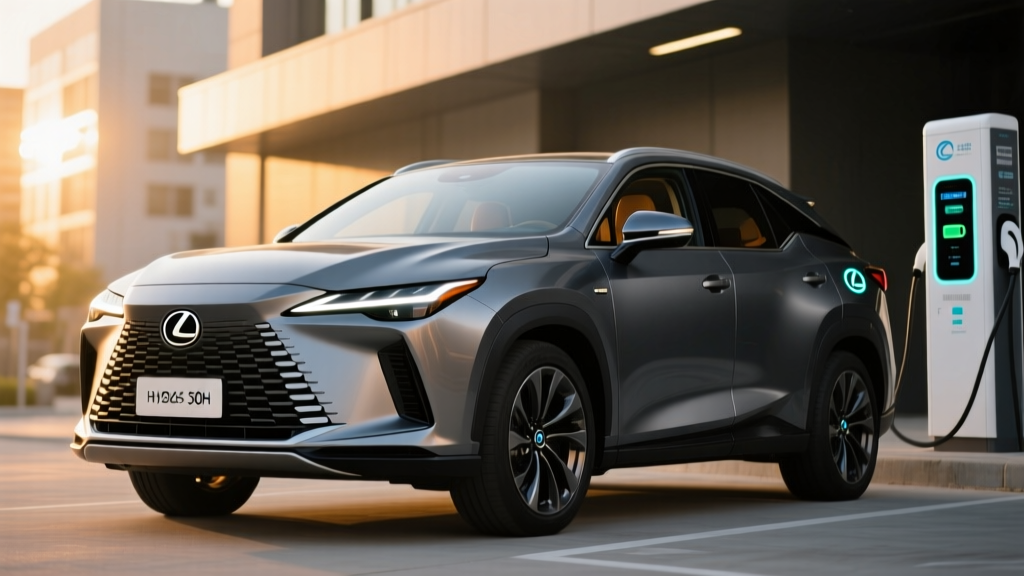
The 2026 Lexus TX 500h hybrid occupies a specific niche: a three-row luxury SUV that prioritizes fuel efficiency without asking you to plug in, sacrifice horsepower, or downsize your family. As Lexus's largest hybrid crossover, the TX 500h pairs a turbocharged four-cylinder with an electrified rear axle to produce 366 horsepower while returning an EPA-estimated 27 MPG combined. For buyers weighing the 2026 Lexus TX 500h hybrid against fully electric alternatives or conventional gas rivals, the math comes down to daily driving patterns, charging access, and how much you value the simplicity of a self-charging powertrain.
In this guide, we dissect the TX 500h's hybrid system, break down its real-world fuel economy versus the EPA sticker, clarify what tax credits apply, and help you decide whether this HEV, a plug-in hybrid, or a full battery-electric vehicle fits your garage.
2026 Lexus TX 500h Hybrid Fuel Economy: EPA Numbers and Real-World MPG
Fuel economy is the headline reason buyers cross-shop the TX 500h against the gas-only TX 350. The hybrid powertrain delivers measurable gains, particularly in city driving where regenerative braking recaptures energy that would otherwise be lost as heat.
| Metric | EPA Estimate |
|---|---|
| City MPG | 27 |
| Highway MPG | 27 |
| Combined MPG | 27 |
| Fuel Tank Capacity | 17.9 gallons |
| Total Range | ~483 miles |
Source: fueleconomy.gov
Real-World MPG vs. the EPA Sticker
Conventional hybrids like the TX 500h often exceed their EPA city rating in stop-and-go traffic because regenerative braking is most effective at lower speeds. On mixed suburban commutes, owners of the mechanically similar RX 500h report 28–30 MPG. Highway-only driving at 75+ mph, however, can pull the number down to 24–25 MPG as aerodynamic drag dominates and the engine shoulders more of the load. In cold weather (below 30°F), expect a 5–8% drop due to reduced battery efficiency and increased engine warm-up cycles.
Compared to the gas-only TX 350 (EPA 20 city / 26 highway / 22 combined), the TX 500h hybrid saves roughly 110 gallons of fuel per year at 15,000 miles — approximately $385 annually at $3.50/gallon. Over a five-year ownership cycle, that's nearly $1,925 in fuel savings, partially offsetting the hybrid's higher MSRP.
Powertrain and Performance: 366 HP from a Turbo-Hybrid System
The TX 500h uses Lexus's DIRECT4 all-wheel-drive hybrid architecture, which pairs a front-mounted engine and motor with a dedicated rear-axle electric motor. This eliminates the mechanical driveshaft and allows torque to be distributed front-to-rear in milliseconds.
| Component | Specification |
|---|---|
| Engine | 2.4L turbocharged inline-4 |
| Engine Output | 271 hp / 317 lb-ft |
| Front Electric Motor | Integrated in hybrid transaxle |
| Rear Electric Motor (DIRECT4) | 101 hp / 192 lb-ft |
| Combined Net Output | 366 hp / 406 lb-ft |
| 0–60 mph | 5.9 seconds |
| Transmission | 6-speed automatic |
| Drivetrain | DIRECT4 AWD (standard) |
| Hybrid Battery | ~1.4 kWh (NiMH, self-charging) |
| Towing Capacity | 5,000 lbs |
The 6-speed automatic is a deliberate choice over a CVT. Lexus uses a traditional geared transmission in the TX 500h for more natural acceleration feel and better highway passing response, at a small cost to low-speed efficiency. The result is a hybrid that drives like a conventional luxury SUV rather than one that drones under hard throttle.
Pricing, Trims, and Tax Credit Eligibility
The 2026 TX 500h is offered in three trims, all with DIRECT4 AWD standard. Pricing reflects Lexus's positioning as an entry-luxury alternative to German three-row SUVs.
| Trim | MSRP (incl. destination) |
|---|---|
| TX 500h Premium | $66,990 |
| TX 500h Luxury | $72,390 |
| TX 500h F SPORT Handling | $73,690 |
Federal Tax Credit: Does the TX 500h Qualify?
No. The TX 500h is a conventional hybrid (HEV), not a plug-in electric vehicle. Under IRS §30D rules, only battery-electric vehicles (BEVs) and plug-in hybrids (PHEVs) with at least 7 kWh of battery capacity qualify for the federal clean vehicle credit. The TX 500h's ~1.4 kWh battery does not meet that threshold.
For buyers specifically seeking a tax-credit-eligible Lexus SUV with three rows, the TX 550h+ plug-in hybrid (PHEV) starts around $75,590 and may qualify for partial federal credit depending on battery sourcing and your income. We address the PHEV comparison below.
TX 500h (HEV) vs. TX 550h+ (PHEV) vs. Full EV: Which Fits You?
Lexus offers the TX in three powertrain flavors. Choosing between them depends on your daily mileage, charging access, and whether you want to engage with plug-in infrastructure at all.
| Attribute | TX 350 (Gas) | TX 500h (HEV) | TX 550h+ (PHEV) |
|---|---|---|---|
| Powertrain Type | Gas Turbo | Self-Charging Hybrid | Plug-In Hybrid |
| Combined MPG / MPGe | 22 MPG | 27 MPG | 33 mi EV / 64 MPGe |
| Combined Horsepower | 275 hp | 366 hp | 406 hp |
| Battery Capacity | N/A | ~1.4 kWh | ~18.1 kWh |
| Electric-Only Range | N/A | N/A | ~33 miles |
| Plug Required? | No | No | Yes (Level 2) |
| Federal Tax Credit | None | None | Up to $7,500* |
| Starting MSRP | $57,990 | $66,990 | $75,590 |
*TX 550h+ tax credit eligibility depends on battery sourcing, buyer income, and MSRP caps. Verify at fueleconomy.gov.
- You have no home charging access (apartment, street parking)
- Your daily commute exceeds 30 miles and you don't want to plug in
- You want AWD and 366 hp without a luxury-gas fuel bill
- You tow up to 5,000 lbs and value range over EV mode
- You can install a Level 2 home charger
- Your daily round-trip commute is under 30 miles (covers most errands on electric)
- You want to qualify for a potential federal tax credit
- You want the option of zero-emission school runs with gas-engine road-trip range
- You have reliable home and/or workplace Level 2 charging
- You want zero tailpipe emissions and minimal drivetrain maintenance
- Your typical trips are under 250 miles or you're comfortable with DC fast-charging stops
- You want to maximize the $7,500 federal credit
Hybrid Battery Warranty, Lifespan, and Replacement Cost
Battery longevity is the most common concern among first-time hybrid buyers. Lexus addresses this with one of the strongest hybrid battery warranties in the industry.
• Coverage: 10 years / 150,000 miles (whichever comes first)
• What's covered: Hybrid battery pack, hybrid control module, inverter, and related high-voltage components
• Capacity guarantee: Lexus warrants the hybrid battery against defects and abnormal loss of function. Unlike BEVs, HEVs do not have a publicly stated minimum capacity-retention percentage because the battery is never deeply cycled.
• Powertrain warranty: 6 years / 70,000 miles
• Basic warranty: 4 years / 50,000 miles
How Long Does a Lexus Hybrid Battery Actually Last?
The TX 500h uses a small nickel-metal hydride (NiMH) battery pack that operates within a narrow state-of-charge window — typically between 40% and 80%. This shallow cycling dramatically reduces degradation compared to a BEV battery that routinely cycles from 10% to 90%.
Based on long-term data from the RX 400h (introduced in 2006) and RX 450h, Lexus hybrid batteries commonly last 150,000–200,000+ miles before requiring service. Many first-generation RX hybrids are still running on their original battery packs at 18+ years old.
Replacement Cost if Out of Warranty
If the hybrid battery fails outside the 10-year/150,000-mile window, replacement costs for a Lexus hybrid battery pack typically range from $3,000 to $5,000 (parts and labor). This is substantially less than a BEV battery replacement ($8,000–$20,000+) because the HEV pack is physically small (~1.4 kWh vs. 80+ kWh in a BEV). Refurbished and aftermarket cells are also available for $1,500–$2,500 from third-party specialists.
Reliability and Safety Ratings
Lexus consistently ranks at or near the top of J.D. Power and Consumer Reports reliability surveys, and the TX line benefits from Toyota's hybrid system maturity — this architecture has been in continuous production since 1997 with the Prius.
The 2026 TX carries the Lexus Safety System+ 3.0 suite, which includes:
- Pre-Collision System with pedestrian/cyclist detection
- Lane Tracing Assist and Lane Departure Alert
- Dynamic Radar Cruise Control (full-speed adaptive)
- Road Sign Assist
- Proactive Driving Assist (low-speed gentle braking/steering)
The TX earned an IIHS TOP SAFETY PICK designation (2025 model year; 2026 testing pending at time of publication). NHTSA ratings for the 2026 model year are expected to carry over at 5 stars overall.
Interior, Cargo, and Technology
The TX is Lexus's first purpose-built three-row SUV for the North American market, designed to address the cargo and passenger limitations of the smaller RX L. Key interior specs:
- Seating: 6-passenger (captain's chairs) or 7-passenger (bench second row)
- Cargo volume: 14.0 cu ft (behind 3rd row) / 51.1 cu ft (3rd row folded) / 89.2 cu ft (max)
- Infotainment: 14.0-inch touchscreen with wireless Apple CarPlay and Android Auto
- Charging: 6 USB-C ports across all three rows, wireless phone charging pad
- Audio: Available 21-speaker Mark Levinson surround system (Luxury and F SPORT trims)
The hybrid battery pack is mounted under the rear seats, so cargo volume is identical to the gas-only TX 350 — no trunk-floor compromise as in some older hybrid SUVs.
Pros and Cons of the 2026 Lexus TX 500h
- 27 MPG combined in a 5,000-lb three-row SUV
- 366 hp with smooth DIRECT4 AWD torque vectoring
- No plug-in required — works for apartment dwellers
- 10-year/150,000-mile hybrid battery warranty
- 5,000-lb towing capacity matches the gas model
- Proven Lexus/Toyota hybrid reliability track record
- Spacious third row and flat cargo floor (battery under seats)
- No federal tax credit (HEV, not PHEV or BEV)
- $9,000 premium over the gas TX 350 base
- Highway MPG drops to ~24–25 at 75+ mph
- No electric-only driving mode (unlike PHEV TX 550h+)
- 6-speed auto can feel less refined than 8/10-speed rivals at low speed
- Base Premium trim lacks ventilated rear seats and HUD
Frequently Asked Questions
How many MPG does the 2026 Lexus TX 500h hybrid get?
The EPA rates the TX 500h at 27 MPG city, 27 MPG highway, and 27 MPG combined. In real-world mixed suburban driving, owners of similar Lexus hybrids often achieve 28–30 MPG. Highway-only trips at 75+ mph may return 24–25 MPG. Cold weather can reduce efficiency by 5–8%.
Does the TX 500h need to be plugged in?
No. The TX 500h is a conventional hybrid (HEV). Its small battery charges automatically through regenerative braking and the gasoline engine. There is no charging port and no electric-only driving mode. If you want plug-in capability with ~33 miles of electric range, look at the TX 550h+ PHEV.
How far can the TX 550h+ PHEV go on electric only?
The TX 550h+ plug-in hybrid offers an EPA-estimated 33 miles of electric-only range on its ~18.1 kWh battery. Combined with the gas engine, total range exceeds 420 miles. Level 2 charging (240V) replenishes the battery in approximately 3 hours. The TX 550h+ does not support DC fast charging.
Is the TX 500h hybrid reliable and what does battery replacement cost?
Lexus hybrid systems have a two-decade reliability track record. The hybrid battery is warranted for 10 years / 150,000 miles. Real-world data from similar Lexus hybrids shows battery packs lasting 150,000–200,000+ miles. Out-of-warranty replacement runs $3,000–$5,000 — far less than a BEV battery swap.
Does the 2026 Lexus TX 500h qualify for a federal tax credit?
No. The TX 500h is a conventional hybrid and does not qualify for the IRS §30D clean vehicle credit. Only plug-in vehicles (PHEVs and BEVs) with at least 7 kWh of battery capacity are eligible. The TX 550h+ PHEV may qualify depending on battery sourcing and buyer income. Check IRS.gov for current rules.
How does the TX 500h compare to a fully electric three-row SUV?
Compared to a BEV like the Rivian R1S (EPA 352 miles, 106 MPGe), the TX 500h has lower fuel cost per mile only if electricity prices in your area exceed ~$0.20/kWh and gas stays under $3.50/gallon. The BEV wins on maintenance (no oil changes, fewer moving parts), emissions, and potential tax credits. The TX 500h wins on upfront cost, no charging infrastructure requirement, and unrestricted road-trip range without charging stops.