Quick Verdict: The 2026 Lexus RX 350h at a Glance
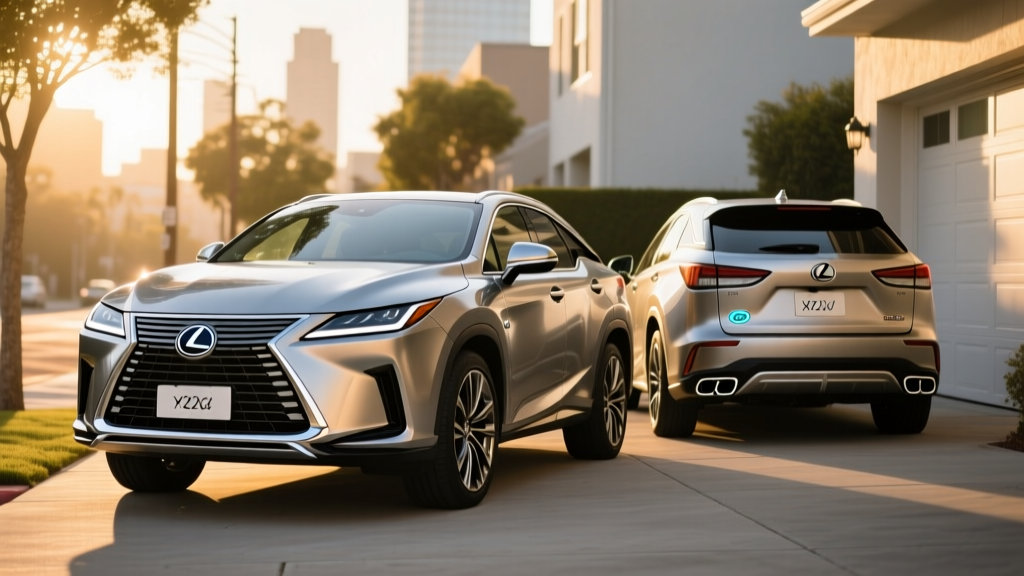
The 2026 Lexus RX 350h occupies a specific niche: buyers who want luxury-SUV refinement and genuine fuel savings without plugging in. This is a conventional hybrid (HEV), not a plug-in hybrid (PHEV) or battery-electric vehicle (BEV). You fuel it with gasoline, and its hybrid system recovers energy during braking and low-speed driving to boost efficiency. The result is a midsize luxury crossover that returns an EPA-estimated 36 MPG combined — roughly 60% better than a comparable turbocharged gas-only RX 350.
For 2026, the RX 350h continues with the proven 2.5-liter four-cylinder hybrid powertrain introduced with the current generation. It isn't the fastest RX in the lineup (that title belongs to the RX 500h F Sport Performance), but it is by far the most efficient and arguably the most practical for daily commuting and long road trips alike.
HEV vs PHEV vs EV: Where Does the RX 350h Fit?
Before examining the numbers, it helps to understand what the RX 350h is — and what it isn't. Lexus offers multiple electrified RX variants, and confusing them is common.
| Attribute | RX 350h (HEV) | RX 450h+ (PHEV) | RX 500h (Performance HEV) |
|---|---|---|---|
| Type | Conventional Hybrid | Plug-in Hybrid | Performance Hybrid |
| Plug-in Charging? | No | Yes (Level 2) | No |
| Combined MPG / MPGe | 36 MPG | 35 MPG gas / 83 MPGe electric | 29 MPG |
| Electric-Only Range | N/A | ~37 miles | N/A |
| Combined HP | 246 hp | 302 hp | 366 hp |
| 0-60 mph | 7.4 sec | 6.2 sec | 5.5 sec |
| Starting MSRP | ~$53,600 | ~$64,300 | ~$63,900 |
| Federal Tax Credit | Not eligible | Up to $7,500 (§30D) | Not eligible |
The RX 350h is the efficiency-focused conventional hybrid. It requires no charging infrastructure, no behavior change — just fill up with gas and drive. The RX 450h+ is the plug-in variant with a larger battery, an electric-only driving mode, and federal tax credit eligibility. The RX 500h prioritizes performance over efficiency. This review focuses on the RX 350h.
Fuel Economy: EPA Ratings and Real-World MPG
The headline number for the 2026 RX 350h is its EPA-estimated fuel economy. Here's the full breakdown:
| Drivetrain | City | Highway | Combined |
|---|---|---|---|
| AWD (standard on 350h) | 37 MPG | 34 MPG | 36 MPG |
Source: EPA Fuel Economy
Real-World MPG Expectations
EPA Combined: 36 MPG
Expected Real-World Average: 33–38 MPG depending on driving mix
City-Heavy Driving: Often 37–40 MPG (hybrids excel in stop-and-go traffic where regenerative braking recovers the most energy)
Highway-Cruising: 32–35 MPG (the gas engine does more work at sustained high speeds)
Cold Weather Penalty: Expect 3–5 MPG reduction in sub-40°F conditions due to engine running longer for cabin heat and reduced battery efficiency
Hybrids typically exceed their EPA city rating in real-world stop-and-go driving, where the electric motor handles low-speed propulsion and regenerative braking recaptures energy. Highway driving is where the RX 350h's advantage narrows — at 75 mph, aerodynamic drag dominates and the gas engine carries most of the load. On a 400-mile highway road trip at 75 mph with A/C running, plan for roughly 33 MPG.
For context, the gas-only RX 350 AWD returns an EPA-estimated 24 MPG combined. That's a 12 MPG gap — translating to roughly 65 fewer gallons per year at 12,000 miles, or about $200–$250 in annual fuel savings depending on local gas prices.
Powertrain and Performance Specs
| Engine | 2.5L inline-4 Atkinson-cycle |
| Hybrid System | Series-parallel with front + rear electric motors (AWD) |
| Combined System Output | 246 hp |
| Transmission | Electronically controlled CVT (eCVT) |
| Drivetrain | Electronic AWD (e-AWD) — standard |
| 0-60 mph | 7.4 seconds |
| Towing Capacity | 3,500 lbs (with tow prep package) |
| Cargo Volume | 29.6 cu ft (behind 2nd row) / 46.2 cu ft (seats folded) |
| Fuel Tank | 17.2 gallons |
| Total Driving Range | ~619 miles (EPA combined) |
The RX 350h pairs a 2.5-liter four-cylinder engine running the Atkinson cycle (optimized for efficiency over peak power) with two electric motors — one driving the front axle, one driving the rear. The rear motor provides electronic AWD without a mechanical driveshaft, engaging on demand for traction. The eCVT isn't a traditional belt-driven CVT; it's a planetary gearset that blends engine and motor power seamlessly. There are no fixed "gears," but acceleration is linear and free of the rubber-band feel some CVTs produce.
At 7.4 seconds to 60 mph, the RX 350h is adequate for merging and passing but not quick. If acceleration matters, the RX 500h cuts that to 5.5 seconds — at the cost of 7 MPG combined. For most buyers prioritizing efficiency and comfort, the 350h's powertrain is well-matched to its luxury-cruiser character.
Pricing, Trims, and Tax Credit Eligibility
The 2026 Lexus RX 350h is offered across several trim levels. Pricing starts in the low $50,000s and climbs with premium packages:
| Trim | MSRP (est.) |
|---|---|
| Premium | ~$53,600 |
| Premium+ | ~$56,600 |
| Luxury | ~$60,200 |
| F Sport Handling | ~$58,600 |
Pricing is estimated based on carryover from the 2025 model year. Confirm with your local Lexus dealer for final 2026 MSRP and destination charges.
Federal Tax Credit: Not Eligible
The RX 350h is a conventional hybrid (HEV), not a plug-in vehicle. Under IRS §30D rules, only plug-in electric vehicles (BEVs and PHEVs with sufficient battery capacity) qualify for the federal clean vehicle credit. The RX 350h does not qualify for any federal tax credit.
- The RX 450h+ (PHEV) may qualify for up to $7,500 under §30D, subject to MSRP caps ($80,000 for SUVs), buyer income limits ($150K single / $300K joint), and critical-mineral/battery-component sourcing requirements.
- Check current eligibility at IRS.gov before purchasing any plug-in vehicle.
- Some states offer separate rebates for conventional hybrids — check your state energy office or AFDC state incentive database.
Battery Warranty, Reliability, and Replacement Cost
Hybrid Battery Warranty
Coverage: 10 years / 150,000 miles (whichever comes first)
What's Covered: Hybrid battery pack, hybrid control module, and related hybrid-system components
Threshold: Lexus warrants the battery against defects and abnormal capacity loss. Normal gradual degradation is expected but typically minimal on Toyota/Lexus hybrid systems.
Lexus (and parent company Toyota) has built more hybrid vehicles than any other automaker — over 25 million globally since the 1997 Prius. The RX 350h's nickel-metal hydride (NiMH) hybrid battery pack is small (approximately 1.6 kWh usable) and operates within a conservative state-of-charge window, which dramatically reduces stress and degradation. Unlike large BEV battery packs, this hybrid battery isn't deep-cycled; it buffers energy in short bursts.
Real-world longevity: Toyota/Lexus hybrid batteries routinely last 150,000–200,000+ miles before needing replacement. Some first-generation Prius batteries exceeded 300,000 miles. Failures within the warranty period are uncommon.
Replacement cost (out of warranty): If the hybrid battery does need replacement after 10 years or 150,000 miles, expect to pay approximately $3,000–$5,000 for a refurbished or new OEM pack including labor at a Lexus dealership. Independent hybrid specialists often offer refurbished packs for $2,000–$3,500. This is a fraction of BEV battery replacement costs, which can exceed $15,000.
The broader hybrid powertrain — the eCVT, electric motors, and power control unit — is also covered under Lexus's 6-year/70,000-mile powertrain warranty, with hybrid-specific components covered under the 10-year hybrid warranty.
Who Should Choose the RX 350h — And Who Shouldn't
Pros
- 36 MPG combined with no plug-in requirement — zero behavior change
- ~619-mile total range eliminates refueling stops on long trips
- Standard AWD for all-weather confidence
- Proven Toyota/Lexus hybrid reliability with 10-year battery warranty
- Quiet, refined cabin with Lexus Safety System+ 3.0 standard
- Strong resale value — Lexus hybrids hold value well
Cons
- 7.4-second 0-60 is leisurely for a luxury SUV
- No federal tax credit (unlike the PHEV RX 450h+)
- Premium fuel recommended for optimal performance
- Infotainment learning curve for some users
- Towing limited to 3,500 lbs
- Higher starting price than the gas RX 350 (~$4,000 premium)
Choose the RX 350h If:
- You want maximum fuel efficiency without installing a home charger or changing your fueling habits
- You drive 12,000–20,000 miles per year with a mix of city and highway
- You live in an apartment or lack reliable access to plug-in charging
- You value proven long-term reliability and strong resale value
- You take frequent road trips and want 600+ mile range between fill-ups
Consider the RX 450h+ (PHEV) Instead If:
- You can install a Level 2 home charger and have a commute under 37 miles
- You want to drive on electricity most weekdays and use gas only for road trips
- You qualify for the §30D federal tax credit (up to $7,500), which narrows the price gap significantly
Consider a Full BEV (e.g., Tesla Model X, Genesis GV80 EV) If:
- You want zero tailpipe emissions and the lowest per-mile fuel cost
- You have reliable home charging and access to DC fast chargers for road trips
- You're willing to accept range planning on long trips and cold-weather range loss
Frequently Asked Questions
How many MPG does the 2026 Lexus RX 350h get?
The EPA rates the RX 350h AWD at 37 MPG city, 34 MPG highway, and 36 MPG combined. In real-world city-heavy driving, owners often report 37–40 MPG thanks to regenerative braking. Highway cruising at 75 mph typically yields 32–35 MPG.
Does the RX 350h need to be plugged in?
No. The RX 350h is a conventional hybrid (HEV). Its small battery recharges through regenerative braking and the gas engine. You never plug it in — just fill up at any gas station.
How far can the RX 350h go on a full tank?
With a 17.2-gallon fuel tank and 36 MPG combined, the EPA-estimated total range is approximately 619 miles. Real-world range of 550–650 miles is typical depending on driving conditions.
Is the Lexus RX 350h reliable?
Lexus consistently ranks at or near the top of J.D. Power and Consumer Reports reliability surveys. The hybrid system is Toyota's fourth-generation architecture with millions of units in service globally. The hybrid battery carries a 10-year/150,000-mile warranty, and real-world data shows these batteries routinely lasting 150,000–200,000+ miles.
What does a Lexus RX hybrid battery replacement cost?
Out of warranty, expect $3,000–$5,000 for a new OEM hybrid battery pack with dealer installation. Refurbished packs from independent specialists run $2,000–$3,500. This is far less than a full EV battery replacement.
Does the 2026 RX 350h qualify for a tax credit?
No. The RX 350h is a conventional hybrid, not a plug-in vehicle, so it does not qualify for the federal §30D clean vehicle credit. The plug-in RX 450h+ may qualify for up to $7,500 depending on your income, the vehicle's battery sourcing, and MSRP caps. Some states offer hybrid-specific rebates — check your local programs.
How does the RX 350h compare to the gas-only RX 350?
The gas RX 350 AWD returns about 24 MPG combined versus the 350h's 36 MPG — a 50% improvement. The hybrid costs roughly $4,000 more upfront but saves approximately $200–$250 per year in fuel at 12,000 miles. The payback period is around 16–20 years on fuel alone, but the hybrid's stronger resale value and lower emissions narrow the real-world gap. Most buyers choose the 350h for the driving refinement and environmental benefit as much as the fuel savings.
Is the RX 350h good in snow and rain?
Yes. The electronic AWD system uses a dedicated rear electric motor that engages automatically when front-wheel slip is detected. Combined with Lexus's Vehicle Stability Control and available all-season or winter tires, the RX 350h performs well in moderate winter conditions. It is not a dedicated off-roader, but it handles snowy commutes and wet highways with confidence.