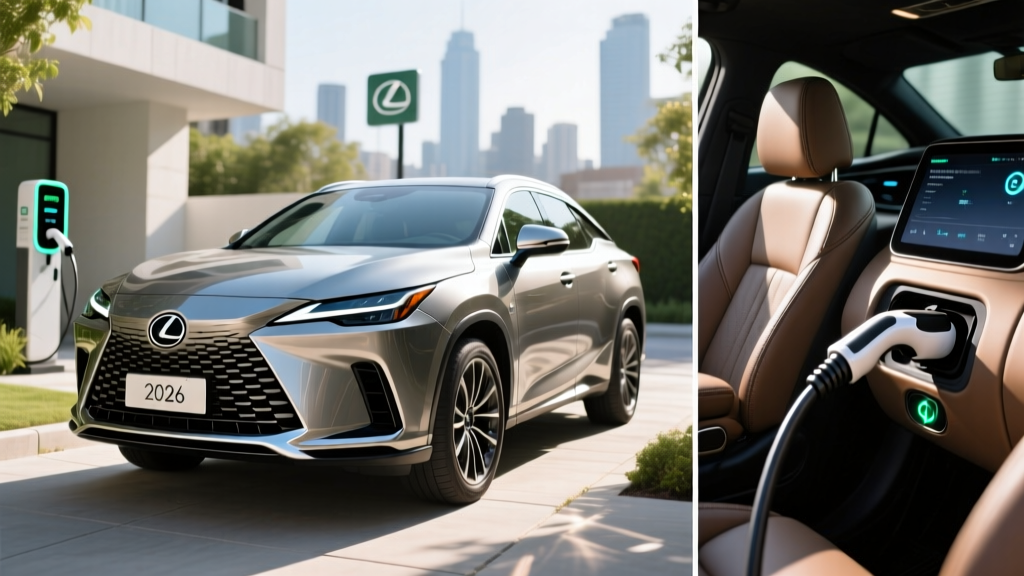
The Lexus RX has been the best-selling luxury SUV in America for years, and for 2026, buyers face a genuine choice at the dealership: do you want the self-charging RX 350h hybrid, or do you plug in with the RX 450h+? The 2026 Lexus RX plug-in hybrid (badged RX 450h+) occupies a specific niche — a luxury midsize SUV that handles most daily commutes on electricity alone while keeping a gas engine for longer trips. If you have home charging but aren't ready to commit to a full battery-electric vehicle, this is one of the most practical bridges available.
But the RX 450h+ carries a premium over the standard hybrid, and it does not qualify for the full federal EV tax credit. This review breaks down exactly what you get for the money, how the PHEV compares to the HEV, and whether the plug-in math works for your driveway.
HEV vs PHEV: Understanding the 2026 Lexus RX Lineup
Before diving into specs, it's essential to separate the two electrified RX models, because they behave very differently day to day.
| Feature | RX 350h (HEV) | RX 450h+ (PHEV) |
|---|---|---|
| Powertrain | 2.5L 4-cyl + 2 electric motors | 2.5L 4-cyl + 2 electric motors + larger battery |
| Needs to plug in? | No — self-charging via regen & engine | Yes — plug in for electric-only driving |
| Electric-only range | None (EV mode limited to ~1 mi at low speed) | 37 miles EPA |
| Battery capacity | 1.6 kWh (small buffer) | 18.1 kWh (usable) |
| Combined output | 246 hp | 302 hp |
| EPA combined MPG/MPGe | 36 MPG | 35 MPG (gas) / 83 MPGe (electric) |
| Starting MSRP | ~$52,000 | ~$62,000 |
The conventional HEV (RX 350h) never needs a plug. It captures energy from braking and the engine to charge a small battery, providing electric assist at low speeds and improving fuel economy. The PHEV (RX 450h+) has a much larger battery that you charge from a wall outlet or public charger, enabling genuine electric-only highway driving for a meaningful distance.
Powertrain, Horsepower, and Driving Impressions
The 2026 Lexus RX 450h+ pairs a 2.5-liter Atkinson-cycle four-cylinder engine with front and rear electric motors, delivering a combined 302 horsepower through Lexus's E-Four all-wheel-drive system. That's a substantial 56-hp advantage over the 350h, and you feel it — the RX 450h+ hits 0–60 mph in approximately 6.2 seconds, which is brisk for a 4,700-lb luxury SUV.
In EV mode, the powertrain is smooth and nearly silent, with enough torque for confident highway merging. Once the battery depletes, the transition to hybrid operation is seamless — most drivers won't notice the engine engaging unless they're watching the energy flow display. The rear motor provides on-demand AWD traction without a mechanical driveshaft, improving packaging efficiency.
| Specification | 2026 Lexus RX 450h+ (PHEV) |
|---|---|
| Engine | 2.5L inline-4 Atkinson cycle |
| Combined horsepower | 302 hp |
| Drivetrain | E-Four AWD (electric rear motor) |
| 0–60 mph | ~6.2 seconds |
| Battery capacity (usable) | 18.1 kWh, lithium-ion |
| EPA electric-only range | 37 miles |
| Total combined range | ~440 miles |
| EPA combined MPG (hybrid mode) | 35 MPG |
| MPGe (electric + gas combined) | 83 MPGe |
| On-board charger (Level 2) | 6.6 kW |
| DC fast charging | Not available |
| Level 2 charge time (0–100%) | ~2.5 hours |
Fuel Economy: EPA Numbers vs Real-World MPG
How many MPG does the 2026 Lexus RX plug-in hybrid get? The EPA rates the RX 450h+ at 35 MPG combined when operating as a hybrid after the battery is depleted. Here's the full breakdown, per fueleconomy.gov:
| Driving Condition | EPA Rating | Real-World Expectation |
|---|---|---|
| City (hybrid mode) | 37 MPG | 36–40 MPG (hybrids excel in stop-and-go) |
| Highway (hybrid mode) | 33 MPG | 30–33 MPG (aerodynamic drag at 75+ mph) |
| Combined (hybrid mode) | 35 MPG | 33–37 MPG depending on route mix |
| Electric-only (MPGe) | 83 MPGe | 75–90 MPGe depending on climate |
A key insight for hybrid buyers: conventional hybrids and PHEVs in hybrid mode often exceed their EPA city ratings in real-world stop-and-go traffic, because regenerative braking recovers energy that gas cars waste as heat. Highway driving is where you'll see the biggest drop from the sticker, especially above 70 mph or in cold weather.
For daily driving within the 37-mile electric range, your effective fuel cost drops dramatically. If your commute is 25 miles round-trip and you charge nightly, you could go months between fill-ups.
Electric-Only Range, Charging, and Battery Details
How far can the 2026 Lexus RX 450h+ go on electric only? The EPA rates it at 37 miles of all-electric range. In real-world conditions:
EPA Electric Range: 37 miles
Real-World Expectation: 30–35 miles in moderate weather; 22–28 miles in freezing temperatures (battery chemistry is less efficient in cold, and cabin heating draws significant power).
The 18.1 kWh (usable) lithium-ion battery charges via a J1772 inlet (standard for non-Tesla PHEVs). The on-board charger accepts up to 6.6 kW on Level 2, meaning a full charge from empty takes roughly 2.5 hours on a 240V home charger. On a standard 120V household outlet (Level 1 at ~1.4 kW), expect about 12–14 hours for a full charge — adequate for overnight top-ups if you don't fully deplete the battery daily.
Critical limitation: The RX 450h+ does not support DC fast charging. This is typical for PHEVs with smaller batteries — the cost and weight of DC fast-charge hardware rarely justify the benefit when the battery can fill on Level 2 in under three hours. If you need road-trip fast charging, you're looking at a full BEV.
Pricing, Trims, and Tax Credit Eligibility
The 2026 Lexus RX 450h+ starts at approximately $62,000 MSRP for the Premium trim, with the Luxury and F SPORT Handling trims climbing to $67,000–$71,000. That's roughly a $10,000 premium over the RX 350h.
Does the 2026 Lexus RX 450h+ qualify for a federal tax credit?
- §30D Federal Credit: Up to $3,750 (partial credit — the RX 450h+ typically qualifies for the critical-minerals portion but may not meet the full battery-component sourcing requirement under current IRS rules). Exact eligibility depends on the vehicle's VIN-specific battery sourcing for the 2026 model year.
- MSRP Cap: The RX 450h+ is under the $80,000 SUV cap for §30D eligibility.
- Buyer Income Cap: Modified AGI must not exceed $150,000 (single) / $300,000 (joint) to claim the credit.
- Point-of-Sale Transfer: Under current rules, you can transfer the credit to the dealer at purchase for an immediate price reduction — but only if you meet income requirements.
- State Incentives: Varies widely. States like California, Colorado, and New York offer additional rebates for PHEVs. Check your state energy office or AFDC incentive database.
Disclaimer: Tax credit rules change frequently. Consult a tax professional and verify VIN eligibility on the IRS Clean Vehicle portal before purchasing.
Reliability, Battery Warranty, and Replacement Cost
Is the Lexus RX plug-in hybrid reliable? Lexus consistently ranks at or near the top of J.D. Power and Consumer Reports reliability surveys, and the RX nameplate has decades of proven durability. The hybrid powertrain in particular is one of Toyota/Lexus's most battle-tested systems — the planetary gearset e-CVT has no clutch packs or bands to wear, and the electric motors have far fewer moving parts than a conventional transmission.
Hybrid Battery Warranty: Lexus covers the RX 450h+ traction battery for 10 years or 150,000 miles (whichever comes first) against defects and excessive capacity loss. This applies to all 50 states.
Powertrain Warranty: 6 years / 70,000 miles.
Battery Replacement Cost (out of warranty): Based on current Lexus hybrid battery pricing, a replacement pack for the RX 450h+ would likely cost $8,000–$12,000 including labor. However, Lexus hybrid batteries have an excellent longevity track record — many first-generation RX 400h and RX 450h units have exceeded 200,000 miles on the original pack. The larger PHEV battery has more thermal management overhead, but degradation is typically gradual (loss of a few miles of EV range over years) rather than catastrophic failure.
2026 Lexus RX 450h+ vs the Alternatives
The RX 450h+ doesn't exist in a vacuum. Here's how it stacks up against key competitors:
| Model | Type | EV Range | Combined MPG/MPGe | Starting MSRP |
|---|---|---|---|---|
| Lexus RX 450h+ | PHEV | 37 mi | 35 MPG / 83 MPGe | ~$62,000 |
| BMW X5 xDrive50e | PHEV | 38 mi | 30 MPG / 78 MPGe | ~$68,000 |
| Volvo XC90 Recharge | PHEV | 32 mi | 27 MPG / 66 MPGe | ~$72,000 |
| Lexus RX 350h | HEV | None | 36 MPG | ~$52,000 |
| Tesla Model Y LR | BEV | 320 mi | 122 MPGe | ~$47,000 |
The BMW X5 PHEV is the closest competitor, offering similar electric range but at a higher price and lower fuel economy once the battery depletes. The RX 350h makes sense if you can't charge at home — you get nearly identical gas MPG without the plug-in premium. The Tesla Model Y is the value and efficiency leader but requires full commitment to electric driving and public charging for road trips.
Pros
- 37-mile EV range covers most daily commutes
- Seamless transition between electric and hybrid modes
- Lexus reliability and 10-year battery warranty
- 302 hp provides confident acceleration
- No range anxiety — gas engine for long trips
- Quiet, refined cabin with strong build quality
Cons
- ~$10,000 premium over the RX 350h HEV
- No DC fast charging capability
- Federal tax credit likely limited to $3,750 (not full $7,500)
- EV range drops significantly in cold weather
- Cargo space slightly reduced vs gas RX (battery packaging)
- Infotainment learning curve for new Lexus interface
Who Should Buy the 2026 Lexus RX Plug-In Hybrid?
Choose the RX 450h+ PHEV if:
- You have access to Level 2 home charging (garage or driveway with 240V outlet)
- Your daily round-trip commute is under 35 miles
- You want electric daily driving but take road trips where charging infrastructure is uncertain
- You value Lexus reliability and don't want the maintenance complexity of a European PHEV
Choose the RX 350h HEV instead if:
- You cannot charge at home (apartment, street parking, no garage)
- You want hybrid efficiency without the $10k plug-in premium
- Your daily driving is mostly highway (where the PHEV's EV advantage diminishes)
Choose a full BEV (like the Tesla Model Y or upcoming Lexus RZ) if:
- You want zero tailpipe emissions and the lowest per-mile fuel cost
- You have reliable home charging and access to DC fast chargers for road trips
- You want to maximize federal tax credit eligibility ($7,500 on qualifying BEVs)
Frequently Asked Questions
How many MPG does the 2026 Lexus RX 450h+ get?
The EPA rates the RX 450h+ at 37 MPG city, 33 MPG highway, and 35 MPG combined when running on gasoline after the battery is depleted. In real-world city driving with frequent stops, many owners report 36–40 MPG thanks to aggressive regenerative braking.
How far can the RX 450h+ drive on electric only?
The EPA-rated electric-only range is 37 miles. Expect 30–35 miles in moderate weather and 22–28 miles in freezing temperatures. The vehicle will automatically switch to hybrid mode once the battery is depleted or under heavy acceleration.
Does the 2026 Lexus RX plug-in hybrid qualify for a tax credit?
The RX 450h+ may qualify for up to $3,750 under the IRS §30D clean vehicle credit, depending on battery sourcing compliance for the specific model year. It does not typically qualify for the full $7,500. Buyer income caps ($150K single / $300K joint) and the $80,000 MSRP cap for SUVs apply. Verify eligibility on the IRS Clean Vehicle portal before purchase.
How long does it take to charge the RX 450h+?
On a Level 2 (240V) charger at 6.6 kW, a full charge takes approximately 2.5 hours. On a standard 120V outlet (Level 1), expect 12–14 hours. The RX 450h+ does not support DC fast charging.
Is the Lexus RX hybrid reliable? What about battery replacement?
Lexus hybrid systems are among the most reliable in the industry, with proven track records spanning two decades. The RX 450h+ battery is warrantied for 10 years / 150,000 miles. Out-of-warranty replacement is estimated at $8,000–$12,000, but most Lexus hybrid batteries last well beyond the warranty period with gradual, manageable degradation.
What's the difference between the RX 350h and RX 450h+?
The RX 350h is a conventional hybrid (HEV) that never needs plugging in and gets 36 MPG combined. The RX 450h+ is a plug-in hybrid (PHEV) with a larger 18.1 kWh battery providing 37 miles of electric-only range, plus 302 hp vs 246 hp. The 450h+ costs about $10,000 more but can drive on electricity for daily commutes.
Can I charge the RX 450h+ at a Tesla Supercharger?
No. The RX 450h+ uses a J1772 connector for Level 1 and Level 2 AC charging. It does not support DC fast charging of any kind, including Tesla Superchargers or CCS stations. For home charging, any standard Level 2 EVSE with a J1772 plug will work.