Quick Verdict: The 2026 Lexus NX Hybrid Lineup at a Glance
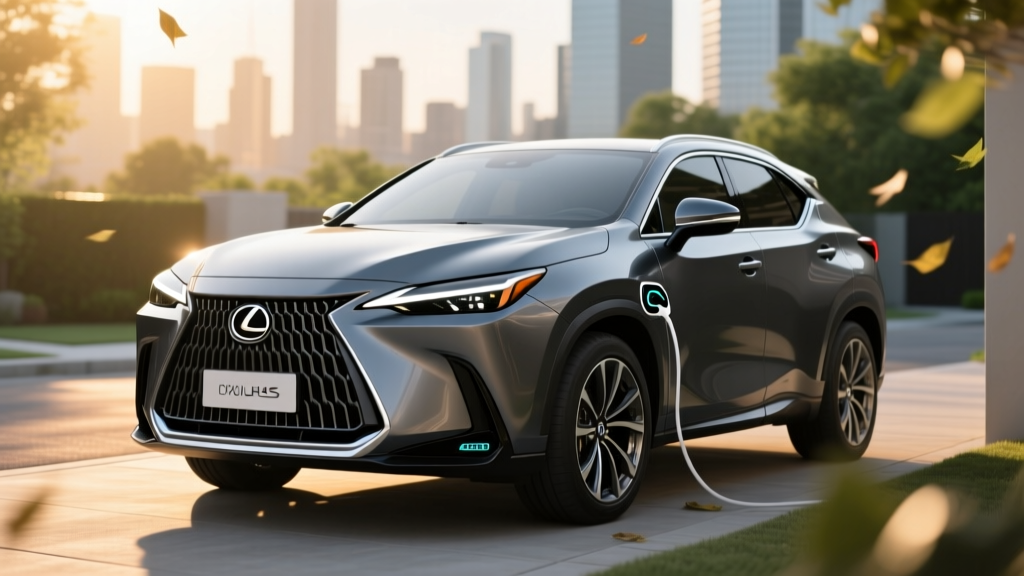
The 2026 Lexus NX continues to offer two distinct electrified paths: the NX 350h conventional hybrid (HEV) and the NX 450h+ plug-in hybrid (PHEV). If you want maximum fuel savings without changing your habits, the NX 350h delivers an EPA-estimated 39 MPG combined with no plug required. If you have home charging access and a short commute, the NX 450h+ can cover up to 37 miles on electricity alone before its gasoline engine ever starts. Both sit on Toyota's TNGA-K platform, share Lexus Safety System+ 3.0, and carry the brand's reputation for long-term reliability. But they serve very different buyers — and the pricing gap between them is substantial.
HEV vs PHEV: Which 2026 Lexus NX Hybrid Is Which?
| Feature | NX 350h (HEV) | NX 450h+ (PHEV) |
|---|---|---|
| Plug-in Required? | No — charges via regenerative braking & engine | Yes — plug in to access electric-only range |
| Electric-Only Driving | Limited to ~1 mile at low speed | Up to 37 miles at highway speeds |
| Battery Size | 1.6 kWh (NiMH) | 18.1 kWh (lithium-ion) |
| Combined HP | 240 hp | 304 hp |
| EPA Combined MPG/MPGe | 39 MPG | 84 MPGe (combined) / 36 MPG (gas-only) |
| Federal Tax Credit | Not eligible | Up to $7,500 (§30D, subject to eligibility) |
| Base MSRP (2026) | ~$43,615 | ~$60,715 |
2026 Lexus NX 350h: MPG, Powertrain, and Real-World Efficiency
The NX 350h pairs a 2.5-liter four-cylinder Atkinson-cycle engine with two electric motors (one front, one rear for electronic Awd) through Toyota's e-CVT transmission. Total system output is 240 horsepower. The setup prioritizes seamless efficiency over sportiness — 0-60 mph arrives in approximately 7.2 seconds, which is adequate for merging but won't thrill anyone coming from a turbocharged gas SUV.
| Spec | NX 350h (HEV) |
|---|---|
| Engine | 2.5L I4 Atkinson + 2 electric motors |
| Combined Horsepower | 240 hp |
| Transmission | e-CVT |
| Drivetrain | Electronic AWD (eAWD) |
| Battery | 1.6 kWh NiMH |
| EPA City MPG | 41 MPG |
| EPA Highway MPG | 37 MPG |
| EPA Combined MPG | 39 MPG |
| Fuel Tank | 14.5 gallons |
| Total Range | ~565 miles |
| 0-60 mph | ~7.2 sec |
| Towing Capacity | 2,000 lbs |
| Cargo Volume | 22.7 cu ft (rear seats up) |
Real-World MPG vs. EPA Estimates
Like most Toyota-based hybrids, the NX 350h tends to match or exceed its EPA city rating in stop-and-go driving because regenerative braking recaptures energy that a gas car wastes as heat. In mixed suburban driving, owners commonly report 40-43 MPG. Highway efficiency drops to roughly 34-36 MPG at sustained 75 mph speeds, where the electric motors contribute less and aerodynamic drag dominates. In cold weather (below 30°F), expect a 2-4 MPG reduction due to increased engine idling for cabin heat and reduced battery efficiency. Overall, the NX 350h's real-world combined fuel economy lands near the 38-41 MPG range for most drivers — slightly above the EPA's 39 MPG combined estimate.
2026 Lexus NX 450h+: PHEV Electric Range, Charging, and MPGe
The NX 450h+ is the plug-in hybrid variant, using a larger 18.1 kWh lithium-ion battery pack paired with the same 2.5-liter engine but higher-output electric motors for a combined 304 horsepower. The result: 37 miles of EPA-rated electric-only range, enough to cover most daily commutes without burning a drop of gasoline. Once the battery depletes, the NX 450h+ operates as a conventional hybrid, returning an EPA-estimated 36 MPG combined.
| Spec | NX 450h+ (PHEV) |
|---|---|
| Engine | 2.5L I4 Atkinson + 2 high-output electric motors |
| Combined Horsepower | 304 hp |
| Battery Capacity | 18.1 kWh (lithium-ion) |
| EPA Electric-Only Range | 37 miles |
| EPA MPGe (EV mode) | 84 MPGe |
| EPA MPG (gas-only hybrid mode) | 36 combined (38 city / 33 highway) |
| Total Combined Range | ~550 miles (EV + gas) |
| Level 1 Charging (120V) | ~12 hours (full) |
| Level 2 Charging (240V, 6.6 kW) | ~3 hours (full) |
| DC Fast Charging | Not supported |
| Charge Port | J1772 (Level 2) |
| 0-60 mph | ~6.0 sec |
| Towing Capacity | 2,000 lbs |
| Cargo Volume | 22.7 cu ft (rear seats up) |
Charging the NX 450h+ at Home: What You Need to Know
The NX 450h+ accepts up to 6.6 kW on Level 2 (240V) AC charging. It does not support DC fast charging — a limitation shared with most PHEVs, since the 18.1 kWh battery is small enough that Level 2 replenishes it in roughly three hours. On a standard 120V household outlet (Level 1), a full charge takes about 12 hours, which works if you park overnight but won't fully replenish the battery during a quick stop.
For daily use, most PHEV owners install a Level 2 home charger (typically a 240V/32A or 40A circuit). Equipment costs $300-$700, and electrician installation runs $500-$2,000 depending on panel proximity and permit requirements. If your electrical panel is at capacity, a panel upgrade can add $1,500-$3,000 — a cost many buyers overlook. A licensed electrician should evaluate your home before committing to a charger purchase.
Battery Warranty & Replacement Cost
Lexus covers the NX hybrid battery with a 10-year/150,000-mile warranty (whichever comes first) in all 50 states, up from the previous 8-year/100,000-mile standard. This applies to both the NX 350h's NiMH pack and the NX 450h+'s lithium-ion pack. If the battery drops below approximately 70% of its original capacity within the warranty period, Lexus will repair or replace it at no cost.
Out-of-warranty replacement costs vary: the NX 350h's smaller NiMH pack typically runs $2,000-$3,500 (parts and labor), while the NX 450h+'s larger lithium-ion pack can cost $6,000-$9,000. However, Toyota/Lexus hybrid batteries have an excellent longevity track record — many exceed 200,000 miles without significant degradation. Real-world data from Toyota RAV4 Hybrids (which share the same powertrain architecture) shows average capacity loss of roughly 10-15% after 150,000 miles.
Pricing, Trims, and Federal Tax Credit Eligibility
The 2026 Lexus NX 350h starts at approximately $43,615 (including destination) for the base trim, rising to roughly $52,000 for a well-equipped Luxury or F Sport Handling model. The NX 450h+ commands a significant premium, starting around $60,715 and reaching $68,000+ in top trims.
Federal Tax Credit: Does the 2026 NX Hybrid Qualify?
Only the NX 450h+ (PHEV) is potentially eligible for the federal §30D clean vehicle tax credit, which can provide up to $7,500. The NX 350h, as a conventional hybrid, does not qualify for any federal EV/PHEV credit.
- MSRP Cap: The NX 450h+ must have an MSRP at or below $80,000 (SUV threshold). Most trims qualify.
- Buyer Income Cap: Modified AGI must not exceed $150,000 (single), $225,000 (head of household), or $300,000 (joint filers).
- Battery Sourcing: The full $7,500 requires meeting both critical-minerals and battery-component requirements under current IRS rules. Partial credit ($3,750) applies if only one requirement is met. Sourcing rules tighten annually — verify current-year compliance on IRS.gov.
- Point-of-Sale Transfer: As of 2024+, you can transfer the credit to the dealer at purchase for an immediate price reduction, rather than waiting to claim it on your tax return.
Important: Tax credit eligibility depends on your individual tax situation, the vehicle's specific build date and battery sourcing, and current-year IRS rules. Consult a tax professional before relying on the credit in your purchase decision.
Who Should Choose the NX 350h, NX 450h+, or a Full EV?
NX 350h (HEV) — Pros
- No plug required; works with existing habits
- 41 MPG city is outstanding for a luxury compact SUV
- Lower entry price (~$43,615)
- Proven Toyota hybrid reliability
- 10-year/150,000-mile hybrid battery warranty
Nx 350h (HEV) — Cons
- No federal tax credit
- No meaningful electric-only driving
- 240 hp feels modest in a luxury SUV
- e-CVT drones under hard acceleration
Nx 450h+ (PHEV) — Pros
- 37 miles EV range covers most commutes gas-free
- 304 hp is genuinely quick (6.0 sec 0-60)
- Falls back to 36 MPG hybrid when battery depletes
- Potential $7,500 federal tax credit
- No range anxiety on road trips
Nx 450h+ (PHEV) — Cons
- $17,000+ premium over the NX 350h
- Requires home charging to realize EV benefits
- No DC fast charging
- Cargo space slightly reduced by larger battery
- Tax credit eligibility not guaranteed
The Decision Framework
Choose the NX 350h if: You don't have reliable home charging access, your commute exceeds 40 miles, you want luxury-SUV comfort with minimal fuel cost, and you prefer a lower purchase price. The 39 MPG combined saves roughly $800-$1,200/year versus a comparable gas-only luxury SUV at 25 MPG (assuming 12,000 miles/year and $3.50/gallon).
Choose the NX 450h+ if: You can install a Level 2 charger at home, your daily driving is under 35 miles (meaning you'll rarely use gas on weekdays), you want the performance bump to 304 hp, and you qualify for the federal tax credit — which narrows the effective price gap to roughly $9,500-$13,000 over the NX 350h.
Choose a full EV (like the Lexus RZ 450e or Tesla Model Y) if: You want zero gasoline expenses, have reliable home and workplace charging, rarely drive more than 250 miles in a single day, and are ready to plan road trips around DC fast-charging infrastructure. A full EV eliminates oil changes and reduces brake wear (thanks to aggressive regenerative braking), but requires more lifestyle adaptation than either NX hybrid.
Reliability, Safety, and Long-Term Ownership
Lexus consistently ranks at or near the top of J.D. Power and Consumer Reports reliability surveys, and the NX's Toyota-sourced hybrid powertrain is one of the most proven electrified systems on the road. The 2.5-liter Atkinson-cycle engine is under-stressed (it doesn't produce peak power alone), and the e-CVT has no traditional gears or clutch packs to wear out. The NX 350h and NX 450h+ share the architecture used in the RAV4 Hybrid and RAV4 Prime, which have accumulated millions of real-world miles with minimal powertrain-related failures.
Safety ratings are strong: the 2026 NX carries the IIHS Top Safety Pick+ designation and includes Lexus Safety System+ 3.0 as standard — featuring adaptive cruise control, lane-tracing assist, pre-collision braking with pedestrian detection, and road-sign assist. Note that these are SAE Level 2 driver-assistance features: you must keep your hands on the wheel and eyes on the road at all times.
For long-term ownership costs, Edmunds and Kelley Blue Book project the NX 350h will retain approximately 52-55% of its value after five years — strong for a luxury compact SUV. The NX 450h+ retains slightly less (~48-51%) due to its higher initial price and the faster depreciation typical of PHEVs as EV technology advances. Insurance premiums for both run 10-15% higher than the gas-only NX 250, primarily due to costlier collision repairs involving high-voltage components.
Frequently Asked Questions
How many MPG does the 2026 Lexus NX 350h get?
The EPA rates the NX 350h at 41 city / 37 highway / 39 combined MPG. In real-world driving, city-heavy commuters often see 40-43 MPG thanks to regenerative braking, while sustained highway driving at 75 mph yields roughly 34-36 MPG. Cold weather reduces efficiency by 2-4 MPG.
How far can the NX 450h+ drive on electric only?
The EPA rates the NX 450h+ at 37 miles of electric-only range. Real-world results vary: gentle city driving in mild weather can stretch this to 39-41 miles, while aggressive acceleration, cold temperatures, or sustained highway speeds may reduce it to 28-33 miles. The vehicle seamlessly switches to hybrid mode when the battery depletes.
Does the 2026 Lexus NX Hybrid need to be plugged in?
Only the NX 450h+ (PHEV) benefits from plugging in. The NX 350h (conventional hybrid) charges its small battery entirely through regenerative braking and the gasoline engine — you never plug it in. If you buy the NX 450h+ and never plug it in, it will still function as a hybrid getting 36 MPG, but you'll miss the entire point of the PHEV premium.
Is the hybrid battery reliable, and what does replacement cost?
Lexus hybrid batteries are among the most reliable in the industry. The 10-year/150,000-mile warranty provides long-term protection. Out-of-pocket replacement runs $2,000-$3,500 for the NX 350h (NiMH) and $6,000-$9,000 for the NX 450h+ (lithium-ion). In practice, many Toyota/Lexus hybrid batteries last well beyond 200,000 miles with less than 15% capacity loss.
Does the 2026 Lexus NX Hybrid qualify for a tax credit?
The NX 350h does not qualify for any federal tax credit. The NX 450h+ (PHEV) may qualify for up to $7,500 under IRS §30D, subject to buyer income limits ($150K single / $300K joint), the $80K MSRP cap for SUVs, and battery-sourcing requirements that tighten each year. Check the IRS qualified vehicles list for the most current eligibility. Some states offer additional PHEV rebates — check your state's energy office for details.
How long does it take to charge the NX 450h+?
On a 240V Level 2 charger (6.6 kW), the NX 450h+ reaches a full charge in approximately 3 hours. On a standard 120V outlet (Level 1), it takes roughly 12 hours. DC fast charging is not supported — this is typical for PHEVs, whose smaller batteries don't warrant the added cost and weight of DC fast-charge hardware.
Hybrid vs PHEV vs full EV — which should I choose?
A conventional hybrid (NX 350h) is best if you lack home charging or want zero lifestyle changes. A PHEV (NX 450h+) is ideal if you can charge at home and commute under 35 miles — you get EV-like daily driving with gas-engine backup for road trips. A full EV (like the Lexus RZ or Tesla Model Y) makes sense if you want the lowest operating costs, have reliable charging access, and are comfortable planning longer trips around DC fast chargers. The NX lineup covers the first two scenarios well; Lexus's EV offerings are better suited to buyers ready to go fully electric.