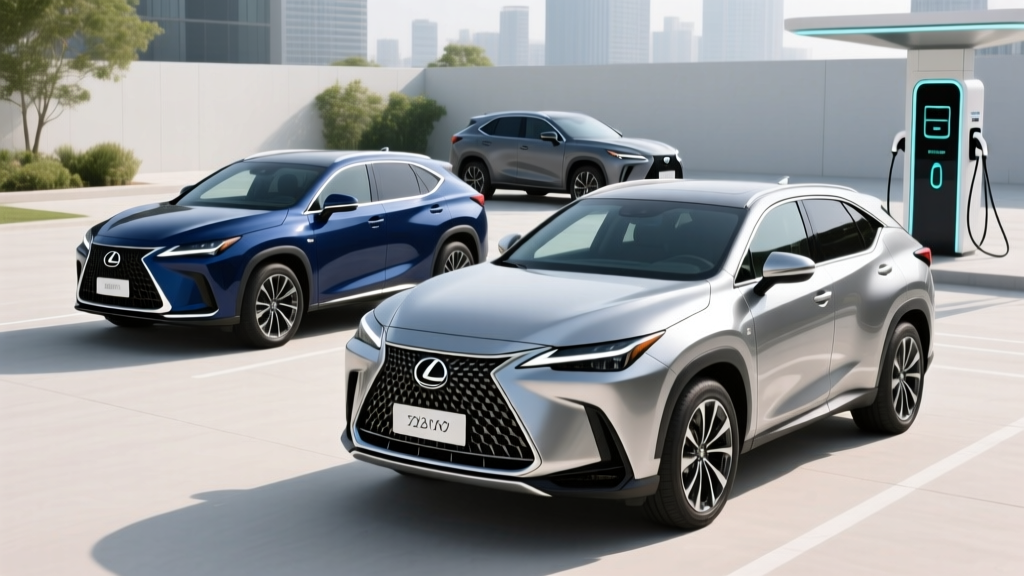
Lexus offers one of the broadest hybrid SUV lineups in the luxury segment for 2026, spanning three model families and both conventional hybrid (HEV) and plug-in hybrid (PHEV) powertrains. Whether you're eyeing the three-row TX, the midsize RX, or the compact NX, understanding the exact fuel economy, electric-only range, pricing, and tax-credit picture is essential before you visit the dealership.
This guide covers every 2026 Lexus hybrid SUV with precise EPA figures, real-world expectations, powertrain specs, and a clear framework for choosing between HEV, PHEV, and a full battery-electric vehicle (BEV).
2026 Lexus Hybrid SUV Lineup at a Glance
Lexus currently offers hybrid and plug-in hybrid variants across three SUV nameplates for the 2026 model year. Here's how they stack up on paper:
| Model | Type | Powertrain | Combined HP | EPA Combined MPG / MPGe | Electric-Only Range | Starting MSRP |
|---|---|---|---|---|---|---|
| NX 450h+ | PHEV | 2.5L I4 + dual motors, AWD | 304 hp | 84 MPGe combined / 37 MPG gas-only | 37 miles | ~$51,500 |
| RX 450h+ | PHEV | 2.5L I4 + dual motors, AWD | 304 hp | 83 MPGe combined / 35 MPG gas-only | 37 miles | ~$63,500 |
| RX 500h F SPORT Performance | HEV | 2.4L turbo I4 + hybrid, AWD | 366 hp | 27 MPG combined | N/A | ~$62,500 |
| RX 350h | HEV | 2.5L I4 + hybrid, AWD | 246 hp | 36 MPG combined | N/A | ~$54,000 |
| TX 500h F SPORT Performance | HEV | 2.4L turbo I4 + hybrid, AWD | 366 hp | 27 MPG combined | N/A | ~$71,000 |
| TX 350h | HEV | 2.5L I4 + hybrid, AWD | 246 hp | 35 MPG combined | N/A | ~$62,000 |
Pricing is approximate base MSRP including destination for 2026 model year. Verify exact figures with your dealer and Lexus.com.
HEV vs PHEV: What's the Real Difference?
Before choosing a specific model, it's critical to understand the two types of hybrid systems Lexus uses:
Conventional Hybrid (HEV) — NX 350h, RX 350h, RX 500h, TX 350h, TX 500h
- No plug required. The battery recharges through regenerative braking and the gasoline engine.
- Small battery (~1.6 kWh usable). Electric-only driving is limited to very low speeds for short distances.
- Benefit: Better fuel economy than a gas-only equivalent — typically 10-15 MPG improvement — with zero change to your fueling habits.
- No federal tax credit. HEVs do not qualify for the IRS §30D clean vehicle credit.
Plug-In Hybrid (PHEV) — NX 450h+, RX 450h+
- Requires plugging in to access full benefits. Uses an 18.1 kWh lithium-ion battery pack.
- 37 miles of EPA-rated electric-only range — enough for most daily commutes without burning gas.
- Once the battery depletes, it operates as a conventional hybrid at 35-37 MPG combined.
- Total combined range exceeds 450 miles (electric + gas tank).
- May qualify for federal tax credits depending on sourcing, income, and MSRP rules.
Fuel Economy Deep Dive: EPA vs Real-World MPG
Hybrid fuel economy varies significantly depending on driving conditions. Here's the EPA breakdown alongside what you can expect in practice:
| Model | EPA City | EPA Highway | EPA Combined | Real-World Expectation |
|---|---|---|---|---|
| NX 450h+ (PHEV, gas-only mode) | 38 MPG | 36 MPG | 37 MPG | 34-38 MPG; excels in city stop-and-go |
| RX 450h+ (PHEV, gas-only mode) | 37 MPG | 34 MPG | 35 MPG | 32-36 MPG; highway cruising drops efficiency |
| RX 350h (HEV) | 37 MPG | 34 MPG | 36 MPG | 34-38 MPG; city-heavy drivers may beat EPA |
| RX 500h (HEV) | 27 MPG | 28 MPG | 27 MPG | 25-28 MPG; performance-tuned, less regen benefit |
| TX 350h (HEV) | 36 MPG | 34 MPG | 35 MPG | 32-36 MPG; three-row weight hurts highway slightly |
| TX 500h (HEV) | 27 MPG | 28 MPG | 27 MPG | 25-28 MPG; turbo hybrid prioritizes power |
Why hybrids often beat EPA in the city: Conventional and plug-in hybrids recapture energy during braking and low-speed driving through regenerative braking. The more stop-and-go traffic you encounter, the more the electric motor assists and the less fuel the engine burns. On sustained highway drives at 75+ MPH, the gasoline engine does most of the work, so the advantage over a gas-only vehicle narrows.
PHEV real-world tip: The 37-mile electric-only range in the NX 450h+ and RX 450h+ assumes moderate temperatures and mixed driving. In winter conditions below 30°F, expect electric-only range to drop to roughly 28-32 miles due to cabin heating demands and reduced battery efficiency. Source: fueleconomy.gov.
PHEV Charging: Battery Size, Charge Times, and the DC Fast-Charge Question
Both the NX 450h+ and RX 450h+ use an 18.1 kWh lithium-ion battery pack. Here's what charging looks like in practice:
| Charging Method | Power | 0-100% Time | Notes |
|---|---|---|---|
| Level 1 (120V household outlet) | ~1.4 kW | ~12-13 hours | Feasible for overnight if daily driving is under 30 miles |
| Level 2 (240V home charger) | ~3.3 kW (vehicle-limited) | ~5.5 hours | Standard J1772 connector; full charge overnight |
| DC Fast Charging | Not available | N/A | Lexus PHEVs do not support DC fast charging |
Critical detail: Neither Lexus PHEV supports DC fast charging. The onboard charger maxes out at approximately 3.3 kW, meaning even a high-power Level 2 station will charge at the vehicle's limited rate. This is typical for PHEVs with smaller batteries — the use case assumes overnight home charging rather than mid-day top-ups.
If you cannot charge at home or at work reliably, a PHEV loses much of its advantage. You'll be driving a slightly heavier HEV and paying a price premium for battery capacity you never use.
Powertrain Specs: What's Under the Hood
Lexus uses two primary hybrid architectures across the 2026 SUV lineup:
The Efficiency Architecture (350h models)
A naturally aspirated 2.5-liter inline-four paired with electric motors and a nickel-metal hydride (NiMH) or lithium-ion traction battery, depending on model. Combined output is 246 horsepower with standard electronic AWD (eAWD) using a rear-axle motor. These prioritize fuel economy and smoothness over acceleration — expect 0-60 MPH times in the 7.5-8.0 second range.
The Performance Architecture (500h models)
A turbocharged 2.4-liter inline-four mated to a hybrid system and DIRECT4 all-wheel drive. Combined output reaches 366 horsepower and 406 lb-ft of torque. The RX 500h and TX 500h hit 0-60 MPH in approximately 5.7-6.0 seconds. The trade-off is fuel economy: 27 MPG combined vs. 35-36 for the 350h variants.
The PHEV Architecture (450h+ models)
The 2.5-liter inline-four with dual electric motors producing 304 combined horsepower and standard eAWD. The larger 18.1 kWh battery enables 37 miles of electric-only driving at speeds up to roughly 80 MPH. Once depleted, the system defaults to hybrid operation. 0-60 MPH clocks in around 6.0-6.5 seconds.
Pricing, Tax Credits, and Total Cost Considerations
Here's where the purchase decision gets nuanced. Federal tax credit eligibility for PHEVs is governed by IRS §30D rules, which impose several requirements:
Federal §30D Clean Vehicle Credit — PHEV Eligibility Checklist (2026):
- Battery capacity: Must be ≥7 kWh — both Lexus PHEVs qualify at 18.1 kWh ✓
- MSRP cap: SUVs must not exceed $80,000 MSRP — NX 450h+ and RX 450h+ base trims qualify ✓ (loaded RX 450h+ trims may approach the cap)
- Buyer income cap: AGI must not exceed $150,000 (single), $225,000 (head of household), or $300,000 (joint)
- Critical minerals & battery component sourcing: Percentages must meet annual thresholds set by the IRS — this is where eligibility may change year-to-year; verify current-year rules before purchase
- Point-of-sale transfer: You can transfer the credit to the dealer for an immediate price reduction, or claim it on your tax return
- HEV models (350h, 500h): Do NOT qualify for §30D — they are not plug-in vehicles
The credit amount is not guaranteed. Depending on battery-sourcing compliance in 2026, the credit may be $3,750 (meeting one sourcing requirement) or up to $7,500 (meeting both critical-mineral and battery-component thresholds). Always confirm eligibility with your tax professional and cross-reference the latest IRS guidance before relying on the credit in your budget.
State incentives vary widely. Some states (California, Colorado, New York, among others) offer additional rebates for PHEVs. Check your state energy office or DMV for current programs. HEVs generally do not qualify for state EV incentives.
Battery Warranty, Reliability, and Replacement Costs
Lexus Hybrid Battery Warranty (2026 models):
- Hybrid battery: 10 years / 150,000 miles (whichever comes first) — covers capacity loss below a defined threshold
- Hybrid system components: 8 years / 100,000 miles — includes inverter, electric motors, control modules
- Basic vehicle warranty: 4 years / 50,000 miles
- Powertrain warranty: 6 years / 70,000 miles
Reliability: Lexus consistently ranks at or near the top of J.D. Power and Consumer Reports reliability surveys. The Toyota/Lexus hybrid synergy drive system has been in production since 1997, making it one of the most proven hybrid platforms in existence. Real-world data shows many Lexus/Toyota hybrid batteries lasting 150,000-200,000+ miles with minimal degradation.
Battery replacement cost if out of warranty:
- HEV (350h/500h): ~$3,000-$5,000 for the hybrid battery pack — smaller NiMH or lithium-ion packs are relatively affordable to replace
- PHEV (450h+): ~$8,000-$12,000 for the 18.1 kWh lithium-ion pack — significantly larger and more expensive
For context, most hybrid batteries outlast the vehicle's economic life. Lexus's 10-year/150,000-mile warranty provides substantial coverage, and many owners never face a replacement.
Hybrid vs PHEV vs Full EV: Which Lexus SUV Fits You?
Choose a Lexus HEV (350h or 500h) if:
- You cannot charge at home or work (apartment, street parking, no garage)
- You want better fuel economy with zero behavioral change
- You frequently take long road trips and don't want to plan charging stops
- You want lower upfront cost and don't need electric-only driving
- The RX 350h at 36 MPG combined and ~$54,000 is the value sweet spot of the lineup
Choose a Lexus PHEV (450h+) if:
- You have reliable home Level 2 charging (garage or driveway with 240V access)
- Your daily commute is under 35 miles round-trip — you'll rarely burn gas on weekdays
- You want electric driving for errands but gas flexibility for road trips
- You qualify for the federal tax credit, effectively reducing the PHEV premium by $3,750-$7,500
- The NX 450h+ offers the best value entry point; the RX 450h+ adds space and luxury
Consider a full BEV (e.g., Lexus RZ 450e) instead if:
- You want zero tailpipe emissions and minimal drivetrain maintenance
- Your daily driving is predictable and within the BEV's ~220-260 mile range
- You have reliable home and/or workplace charging
- You want the full §30D credit (up to $7,500) with fewer sourcing complications on some BEV models
- You're willing to plan DC fast-charging stops on road trips
Lexus Hybrid SUV Pros
- Proven hybrid reliability with 10-year/150K-mile battery warranty
- No range anxiety — HEVs need no plug; PHEVs have 450+ total miles
- Strong resale value — Lexus hybrids retain value well
- Premium interior quality and quiet cabin refinement
- Standard AWD across all hybrid trims
- PHEVs offer 37 miles of gas-free commuting
Lexus Hybrid SUV Cons
- PHEVs lack DC fast charging — Level 2 only at 3.3 kW
- 500h performance hybrids sacrifice MPG for power (27 combined)
- PHEV price premium over HEV is $5,000-$8,000 before credits
- Infotainment system still lags some German rivals in responsiveness
- No three-row PHEV option (TX is HEV only)
- Tax credit eligibility depends on sourcing rules that shift annually
Frequently Asked Questions
How many MPG does the 2026 Lexus RX 350h hybrid get?
The EPA rates the 2026 RX 350h at 37 city / 34 highway / 36 combined MPG. In real-world driving with a city-heavy commute, many owners report 36-39 MPG. Highway-dominant driving at speeds above 70 MPH typically yields 32-34 MPG. (fueleconomy.gov)
How far can the Lexus NX 450h+ and RX 450h+ go on electric only?
Both PHEVs deliver an EPA-rated 37 miles of electric-only range from the 18.1 kWh battery. In cold weather (below 30°F), expect 28-32 miles. At moderate temperatures with city driving, some drivers report 38-40 miles before the gasoline engine engages.
Does the 2026 Lexus RX 450h+ qualify for the $7,500 federal tax credit?
It may qualify for up to $7,500 under IRS §30D, depending on battery-component and critical-mineral sourcing compliance for the 2026 tax year, your adjusted gross income (must be under $150K single / $300K joint), and the vehicle's MSRP (must be under $80,000 for SUVs). The credit can be transferred to the dealer at point of sale for an immediate price reduction. Always verify with a tax professional and the latest IRS guidance.
Is the Lexus hybrid system reliable, and what does battery replacement cost?
Lexus's hybrid system is among the most proven in the industry, with over 25 years of continuous production. The hybrid battery is warranted for 10 years/150,000 miles. Out-of-warranty replacement runs $3,000-$5,000 for HEV models and $8,000-$12,000 for PHEV models. Most batteries last well beyond 150,000 miles based on long-term fleet data.
Do Lexus conventional hybrids (HEV) need to be plugged in?
No. Conventional Lexus hybrids (350h and 500h models) charge their small hybrid battery entirely through regenerative braking and the gasoline engine. You fuel them exactly like a gas car — at the pump. Only the 450h+ PHEV models require plugging in to access electric-only range.
Is there a three-row Lexus PHEV for 2026?
No. The three-row TX is available only as a conventional hybrid (TX 350h and TX 500h). If you need three rows and plug-in capability, you'll need to look outside the Lexus lineup — competitors like the Volvo XC90 Recharge offer PHEV three-row configurations, though with different trade-offs in reliability ratings and driving dynamics.
Which 2026 Lexus hybrid SUV is the best value?
For most buyers, the RX 350h at approximately $54,000 and 36 MPG combined offers the best balance of space, efficiency, and price. If you can charge at home and commute under 35 miles daily, the NX 450h+ at ~$51,500 (potentially $44,000-$47,750 after federal credits) delivers electric commuting with gas backup at the lowest effective cost in the lineup.