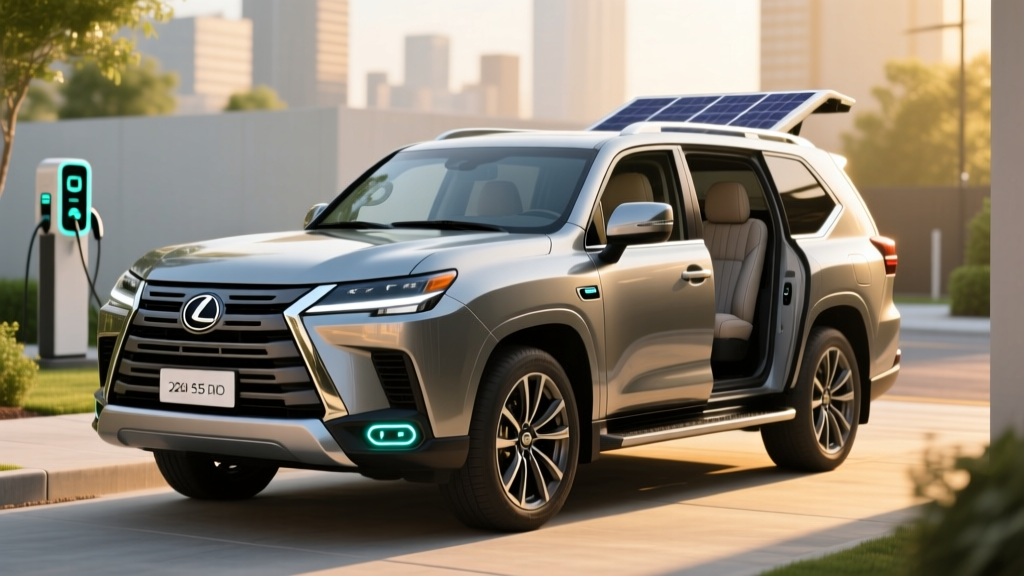
The 2026 Lexus GX 550 Hybrid pairs the body-on-frame ruggedness of the redesigned GX with Toyota's i-FORCE MAX hybrid powertrain, aiming to cut fuel costs without sacrificing the towing and off-road capability the nameplate is known for. For buyers weighing a three-row luxury SUV against full-electric alternatives like the Rivian R1S or BMW iX, the GX 550 Hybrid occupies a pragmatic middle ground: no plug required, no range anxiety, and meaningful MPG gains over the standard twin-turbo V6.
This guide breaks down the confirmed and estimated specifications for the 2026 model year, real-world fuel economy expectations, battery longevity data drawn from Toyota's hybrid track record, and whether any federal tax incentives apply.
HEV vs PHEV: What the GX 550 Hybrid Actually Is
Before evaluating the numbers, it is essential to classify the powertrain correctly. The 2026 Lexus GX 550 Hybrid is a conventional hybrid electric vehicle (HEV), not a plug-in hybrid (PHEV). That distinction carries real ownership implications:
| Attribute | HEV (GX 550 Hybrid) | PHEV (e.g., Toyota RAV4 Prime) | BEV (e.g., Rivian R1S) |
|---|---|---|---|
| Plug-in charging required? | No — self-charging via regen and engine | Yes — Level 1/2 for electric range | Yes — Level 2 + DC fast charging |
| Electric-only driving | Limited low-speed assist (~1 mi) | 25–42 miles typical | Full range (250–400+ mi) |
| Battery size | ~1.5–2.0 kWh (sealed NiMH/Li-ion) | 18–22 kWh usable | 90–150 kWh usable |
| Federal §30D tax credit | Not eligible | Up to $7,500 (if sourcing/income rules met) | Up to $7,500 (if sourcing/income rules met) |
| Fuel required | Gasoline (premium recommended) | Gasoline + electricity | Electricity only |
The GX 550 Hybrid uses a small battery pack that charges exclusively through regenerative braking and the gasoline engine. There is no charge port, no electric-only commute mode, and no eligibility for the federal §30D new clean vehicle credit. Buyers seeking plug-in electric range from a Lexus SUV should look at the Lexus RX 450h+ PHEV instead.
Powertrain: i-FORCE MAX Hybrid Specs
The 2026 GX 550 Hybrid is expected to carry over the i-FORCE MAX powertrain introduced with the current-generation GX and shared with the Toyota Sequoia and Tundra. Here is the spec breakdown based on the platform's confirmed output:
| Specification | 2026 Lexus GX 550 Hybrid (Est.) |
|---|---|
| Engine | 3.4L twin-turbo V6 + electric motor generator |
| Combined horsepower | ~463 hp |
| Combined torque | ~583 lb-ft |
| Transmission | 10-speed automatic |
| Drivetrain | Full-time 4WD (standard) |
| Hybrid battery type | Sealed lithium-ion, ~1.5–2.0 kWh |
| Towing capacity | Up to 9,095 lbs (est.) |
| 0–60 mph | ~5.9 seconds |
The electric motor is sandwiched between the engine and transmission, providing torque fill at low RPM and enabling engine-off coasting at steady highway speeds. Unlike a PHEV, the motor cannot propel the GX independently for meaningful distances — it supplements the V6 to reduce fuel consumption under load, particularly in stop-and-go traffic and during initial acceleration.
Fuel Economy: EPA MPG and Real-World Expectations
Official EPA figures for the 2026 model year are typically published on fueleconomy.gov closer to the on-sale date. Based on the current-generation i-FORCE MAX platform in the Sequoia (which shares this powertrain), here are the projected EPA ratings and how they compare to the non-hybrid GX 550:
| Model | City MPG | Highway MPG | Combined MPG |
|---|---|---|---|
| GX 550 Hybrid (projected) | 22 | 24 | 23 |
| GX 550 (non-hybrid, 4WD) | 15 | 21 | 17 |
| Toyota Sequoia Hybrid (4WD, EPA confirmed) | 19 | 22 | 20 |
Real-world MPG context: Toyota's hybrid systems consistently deliver city MPG at or above EPA estimates because regenerative braking recovers energy that conventional powertrains waste. On the Sequoia, owners report 21–23 MPG combined in mixed suburban driving. The GX 550 Hybrid, being lighter and more aerodynamic than the Sequoia, should meet or slightly exceed its EPA combined rating in typical city and suburban use.
Highway driving tells a different story. At sustained 75+ mph speeds, the hybrid system contributes less — the electric motor's advantage diminishes, and the twin-turbo V6 carries the load. Expect 20–22 MPG on long highway trips, roughly in line with the EPA highway figure. Cold weather (below 30°F) will reduce efficiency by 5–10% as the engine runs longer to generate cabin heat and the battery operates at reduced efficiency.
Hybrid Battery Warranty, Lifespan, and Replacement Cost
Hybrid battery longevity is consistently the top concern for HEV buyers. Lexus backs the GX 550 Hybrid battery with the same coverage applied across its hybrid lineup:
Toyota and Lexus have accumulated over two decades of real-world hybrid battery data. The nickel-metal hydride and lithium-ion packs used in models like the RX 400h, RX 450h, and LS 500h routinely exceed 150,000 miles without significant capacity loss. Failure before 100,000 miles is uncommon, and when it does occur, it is covered under warranty.
Out-of-warranty replacement cost: Based on current Lexus hybrid battery pricing (RX 450h, LS 500h), expect a replacement pack to cost between $3,000 and $5,000 including labor. Third-party refurbishment shops offer reconditioned packs for $1,500–$2,500. Given the GX 550 Hybrid's small battery (compared to a PHEV or BEV), replacement costs are far lower than the $10,000–$20,000+ associated with full EV battery packs.
Pricing, Trims, and Tax Credit Eligibility
The 2026 Lexus GX 550 Hybrid is expected to slot above the standard GX 550 in the lineup. Based on current-generation pricing trajectories:
| Trim (Projected) | Est. MSRP |
|---|---|
| GX 550 Hybrid Premium | $72,000–$75,000 |
| GX 550 Hybrid Premium+ | $78,000–$82,000 |
| GX 550 Hybrid Overtrail | $80,000–$84,000 |
| GX 550 Hybrid Luxury | $88,000–$92,000 |
Federal tax credit: Not eligible. The IRS §30D New Clean Vehicle Credit applies exclusively to plug-in electric vehicles (PHEVs and BEVs) with a minimum battery capacity of 7 kWh and the ability to charge from an external source. The GX 550 Hybrid's sealed, self-charging battery does not qualify. This is a common point of confusion — conventional hybrids, no matter how efficient, receive no federal purchase incentive under current law. Consult IRS.gov §30D guidelines for the latest rules.
Some states offer modest hybrid incentives (typically $500–$1,500 rebates through utility programs or state clean-air funds), but these vary by jurisdiction and are not guaranteed. Check your state energy office or utility provider for current programs.
Who Should Choose the GX 550 Hybrid vs. a PHEV or Full EV?
The right powertrain depends on your driving pattern, charging access, and how you use a three-row SUV:
Choose the GX 550 Hybrid (HEV) if:
- You lack reliable home or workplace charging access
- You regularly tow (hybrid towing capacity matches or exceeds PHEV equivalents)
- You want improved MPG without changing fueling habits
- You take frequent long road trips where charging infrastructure is sparse
- You prioritize proven reliability and low maintenance complexity
Choose a PHEV (e.g., Lexus RX 450h+, BMW X5 xDrive50e) if:
- You have Level 2 home charging and a commute under 35 miles
- You want electric-only daily driving with gas backup for long trips
- You want to capture the up-to-$7,500 federal tax credit
Choose a full BEV (e.g., Rivian R1S, BMW iX) if:
- You have reliable home charging and rarely tow over 5,000 lbs
- You want the lowest per-mile fuel cost and zero tailpipe emissions
- You're eligible for the full federal and state EV incentives
Ownership Costs: Fuel Savings vs. the Non-Hybrid GX 550
The hybrid premium over the standard GX 550 is justified primarily through fuel savings. Here is a five-year projection assuming 15,000 miles/year, $3.80/gallon premium fuel, and the projected MPG figures above:
| Cost Factor | GX 550 (Non-Hybrid) | GX 550 Hybrid | 5-Year Difference |
|---|---|---|---|
| Combined MPG | 17 | 23 | +6 MPG |
| Annual fuel (15k mi) | ~$3,353 | ~$2,478 | $875/year saved |
| 5-year fuel cost | ~$16,765 | ~$12,391 | $4,374 saved |
| Est. price premium (hybrid) | — | ~$4,000–$6,000 | Partially offset by fuel savings |
| Maintenance (5-yr est.) | ~$3,200 | ~$2,900 | Slightly lower (regen saves brakes) |
The hybrid's fuel savings cover a meaningful portion of its price premium within five years. Beyond fuel, the regenerative braking system extends brake pad life — many Toyota/Lexus hybrid owners report original brake pads lasting 80,000+ miles. Insurance costs are expected to be comparable between hybrid and non-hybrid GX trims.
Pros and Cons at a Glance
Pros
- ~6 MPG combined improvement over non-hybrid GX 550
- No plug-in charging required — zero lifestyle change
- Full 9,000+ lb towing capacity retained
- 10-year/150,000-mile hybrid battery warranty
- Strong low-end torque from electric motor assist
- Proven i-FORCE MAX platform with Toyota reliability data
Cons
- No federal tax credit (HEV exclusion)
- ~$4,000–$6,000 price premium over equivalent non-hybrid trim
- No meaningful electric-only driving capability
- Premium fuel recommended for optimal performance
- Highway MPG gains less dramatic than city gains
- Heavier than non-hybrid (battery and motor mass)
Frequently Asked Questions
How many MPG does the 2026 Lexus GX 550 Hybrid get?
Projected EPA ratings are approximately 22 city / 24 highway / 23 combined MPG. Real-world city driving often matches or slightly exceeds the EPA city figure thanks to regenerative braking. Highway driving at sustained speeds returns closer to 20–22 MPG. These figures represent a substantial improvement over the non-hybrid GX 550's 15/21/17 MPG.
Can the GX 550 Hybrid drive on electric power only?
Not in any practical sense. The hybrid system can move the vehicle at very low speeds (parking lots, stop-and-go creep) for short distances under a mile, but it is not designed for electric-only commuting. The battery is too small (~1.5–2.0 kWh) and there is no charge port. For meaningful electric-only range, consider a PHEV like the Lexus RX 450h+ (37 miles electric-only).
Does the 2026 Lexus GX 550 Hybrid qualify for any tax credit?
No. The federal §30D New Clean Vehicle Credit requires a plug-in vehicle with at least 7 kWh of battery capacity and an external charging port. The GX 550 Hybrid is a conventional HEV and does not meet these criteria. Some state or utility programs offer small hybrid rebates ($500–$1,500), but availability varies widely. Always verify current rules at IRS.gov and your state energy office.
Is the hybrid battery reliable and what does replacement cost?
Toyota and Lexus hybrid batteries have an exceptional reliability record spanning 20+ years of production. The GX 550 Hybrid battery is covered for 10 years / 150,000 miles. Out-of-warranty replacement runs $3,000–$5,000 at a dealership, or $1,500–$2,500 through third-party refurbishment. Most hybrid batteries outlast the vehicle's useful life without replacement.
How does the GX 550 Hybrid compare to a full electric SUV like the Rivian R1S?
They serve different needs. The Rivian R1S offers 350+ miles of EPA range, ~$0.04/mile fuel cost (home charging), and Level 2 driver assist — but requires home charging infrastructure, has lower towing capacity (7,700 lbs), and carries a higher starting price. The GX 550 Hybrid requires zero charging infrastructure, tows over 9,000 lbs, and eliminates range anxiety at the cost of higher per-mile fuel expense and no electric-only driving. If you can charge at home and rarely tow heavy loads, the R1S delivers lower operating costs. If you tow, road-trip frequently, or lack charging access, the GX Hybrid is the pragmatic choice.
Does the hybrid system affect off-road capability?
No. The GX 550 Hybrid retains the full-time 4WD system, locking center differential, and available rear locker found on non-hybrid trims. The Overtrail trim includes the same skid plates, all-terrain tires, and CRAWL control. The hybrid motor actually enhances low-speed off-road control by providing smooth, precise torque at crawl speeds without turbo lag.