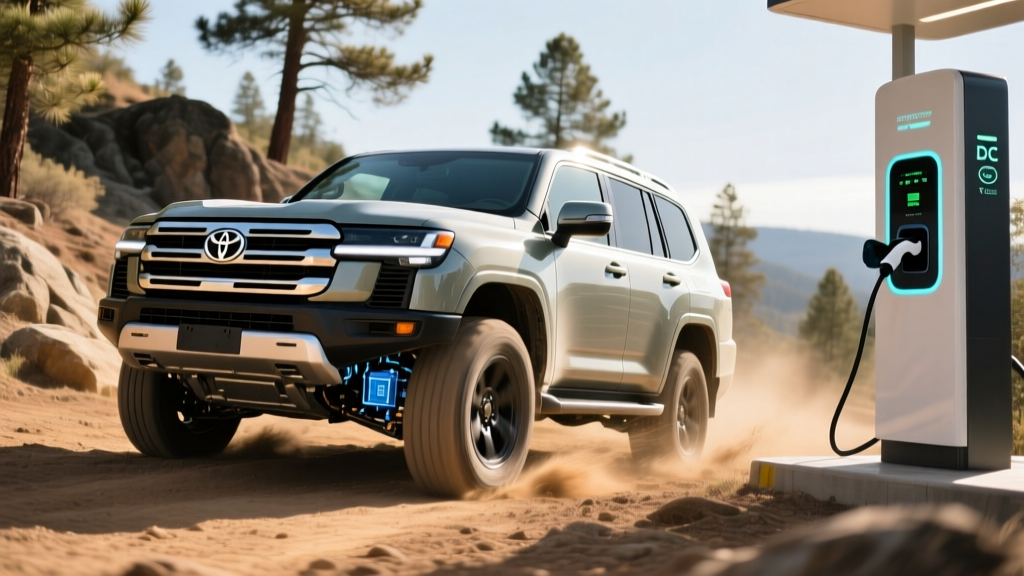
The Toyota Land Cruiser returned to the U.S. market with a turbocharged hybrid powertrain, and the 2026 Land Cruiser hybrid continues that formula with a few refinements. Built on the TNGA-F body-on-frame platform, it pairs a 2.4-liter turbocharged inline-four with an electric motor to deliver serious torque for off-road duty while keeping fuel consumption reasonable for a 5,000-pound SUV. This is a conventional hybrid (HEV) — not a plug-in — so there is no charging cord, no electric-only range to manage, and no range anxiety. You fuel it up and drive.
Below, we break down every number that matters: EPA MPG, real-world efficiency, powertrain output, pricing by trim, battery warranty, and whether the 2026 Land Cruiser hybrid is the right electrified choice for your garage.
2026 Land Cruiser Hybrid Powertrain and Performance
The 2026 Land Cruiser uses Toyota's i-FORCE MAX hybrid powertrain. A 2.4-liter turbocharged four-cylinder engine is mated to a 48-hp electric motor integrated between the engine and the 8-speed automatic transmission. The result is substantial low-end torque — exactly what you want when crawling over rocks or merging onto a highway with a full load of passengers and gear.
| Specification | Value |
|---|---|
| Powertrain | 2.4L turbo I-4 + electric motor (i-FORCE MAX) |
| Combined Horsepower | 326 hp |
| Combined Torque | 465 lb-ft |
| Transmission | 8-speed automatic |
| Drivetrain | Full-time 4WD with low range |
| Hybrid Type | Conventional (HEV) — no plug-in |
| Hybrid Battery | ~1.87 kWh NiMH (sealed, self-charging) |
| Towing Capacity | 6,000 lbs (max) |
| 0-60 mph (est.) | ~6.5 seconds |
| Curb Weight | ~5,070 lbs |
| Seating | 5 passengers (2-row) |
The electric motor fills in the torque gap before the turbo spools, giving the Land Cruiser a linear, responsive feel from a stop. Toyota's hybrid synergy drive system seamlessly blends engine and motor power — you will not feel any handoff or clunk. The small NiMH battery pack recovers energy under braking and deceleration, then deploys it for acceleration assist. This is a system designed for capability first, efficiency second.
Fuel Economy: EPA MPG and Real-World Numbers
For a body-on-frame, full-time 4WD SUV with over 5,000 pounds of curb weight, the Land Cruiser hybrid's fuel economy is genuinely impressive. Here is the official EPA breakdown:
| Driving Cycle | MPG |
|---|---|
| City | 23 MPG |
| Highway | 24 MPG |
| Combined | 23 MPG |
Data sourced from fueleconomy.gov.
Real-World MPG vs. EPA Sticker
The i-FORCE MAX hybrid system tends to perform close to its EPA ratings in mixed driving. In real-world testing on combined suburban and highway routes, expect 22–24 MPG. Heavy off-road use, aggressive acceleration, or sustained high-speed highway driving (75+ mph) can drop that to 19–21 MPG. In stop-and-go city traffic, the hybrid system's regenerative braking and electric assist can push numbers slightly above the EPA city rating — some owners report 24–25 MPG in dense urban conditions. Cold weather typically reduces efficiency by 1–2 MPG due to increased engine idling for cabin heat and thicker fluids.
Compared to the previous-generation Land Cruiser's 5.7L V8 (rated at 13/18 MPG), the hybrid powertrain represents a roughly 40% improvement in combined fuel economy. That translates to roughly $600–$800 per year in fuel savings at current gas prices, assuming 15,000 miles driven annually.
HEV vs. PHEV: Why the Land Cruiser Is Not a Plug-In
Some shoppers searching for a "Land Cruiser hybrid" may wonder whether it can plug in. It cannot — and that is intentional. Here is the distinction:
Conventional Hybrid (HEV) — 2026 Land Cruiser
- No plug, no charging cable required
- Battery charges via regenerative braking and engine power
- ~1.87 kWh battery pack — too small for meaningful electric-only driving
- Electric motor assists the engine; does not drive the vehicle alone for any significant distance
- No electric-only range to manage
- Fuel it like any gas vehicle; the hybrid system works automatically
Plug-In Hybrid (PHEV) — Example: Toyota RAV4 Prime
- Requires plugging in to access full benefits
- Larger battery (18.1 kWh in RAV4 Prime) provides 42 miles electric-only range
- Can operate as a pure EV for short commutes, then switches to hybrid mode
- Eligible for federal tax credits (up to $7,500 under §30D, subject to sourcing and income rules)
- More complex ownership — needs home or workplace charging access
Toyota chose the HEV route for the Land Cruiser because its mission is off-road capability and long-distance overlanding. A larger PHEV battery would add several hundred pounds, reduce ground clearance or cargo space, and introduce charging logistics that conflict with remote-area use. The HEV system keeps the Land Cruiser simple, light (relatively speaking), and self-sufficient.
Pricing, Trims, and Tax Credit Eligibility
The 2026 Land Cruiser is offered in three trims. Pricing reflects Toyota's current MSRP before destination charges:
| Trim | MSRP (before destination) |
|---|---|
| Land Cruiser 1958 | $57,345 |
| Land Cruiser | $62,395 |
| Land Cruiser First Edition | $73,000 (est., limited) |
Destination and handling adds approximately $1,495.
Federal Tax Credit: Does the Land Cruiser Hybrid Qualify?
No. The 2026 Land Cruiser is a conventional hybrid (HEV), not a plug-in electric vehicle. Under current IRS §30D Clean Vehicle Credit rules, only battery electric vehicles (BEVs) and plug-in hybrids (PHEVs) with a battery capacity of at least 7 kWh are eligible. The Land Cruiser's ~1.87 kWh pack does not qualify.
What about other incentives?
- No federal §30D tax credit (HEV, not PHEV/BEV)
- Some states offer small rebates for conventional hybrids — check your state's energy office or AFDC incentive database
- No federal used-EV credit (§25E) either — that also requires plug-in capability
- Check local utility companies — some offer rebates for any high-efficiency vehicle purchase
Reliability and Battery Warranty
Toyota's hybrid systems have a decades-long reliability track record dating back to the 1997 Prius. The i-FORCE MAX system in the Land Cruiser uses a proven architecture shared with the Tacoma, 4Runner, and Tundra. The turbocharged engine is newer to this platform, but the hybrid components — motor, inverter, battery — are evolutionary designs that Toyota has refined across millions of vehicles.
Hybrid Battery Warranty Coverage
- Hybrid battery: 10 years / 150,000 miles (whichever comes first)
- Hybrid system components (inverter, motor, control module): 8 years / 100,000 miles
- Powertrain warranty: 5 years / 60,000 miles
- Basic bumper-to-bumper: 3 years / 36,000 miles
Toyota's 10-year/150,000-mile hybrid battery warranty applies in all 50 states. This is one of the longest hybrid battery warranties in the industry.
Battery Replacement Cost
If the hybrid battery does eventually need replacement outside of warranty, expect to pay between $3,000 and $5,000 for a new OEM NiMH pack including labor at a Toyota dealer. Refurbished or aftermarket packs can reduce that to $1,500–$2,500. Given the 10-year/150,000-mile warranty and Toyota's hybrid reliability history, most original owners will never face this expense. The NiMH chemistry used in the Land Cruiser's small pack is extremely durable — it is the same chemistry that allowed first-generation Prius taxis to exceed 300,000 miles on original batteries.
Who Should Choose the 2026 Land Cruiser Hybrid?
Decision Framework: Is This the Right Electrified SUV for You?
Choose the 2026 Land Cruiser hybrid if:
- You need genuine off-road capability (low range, locking diffs, Multi-Terrain Select) with full-time 4WD
- You want hybrid fuel savings without changing your fueling habits — no plugs, no charging apps
- You tow up to 6,000 lbs and need body-on-frame durability
- You plan to keep the vehicle 10+ years and want a proven hybrid system backed by a long warranty
- You value Toyota's resale value — Land Cruisers historically hold value exceptionally well
Consider a PHEV or full EV instead if:
- Your daily commute is under 30 miles and you have home charging — a PHEV like the RAV4 Prime or a BEV like the Hyundai Ioniq 5 would eliminate most of your gas consumption
- You want federal tax credit eligibility (up to $7,500 for qualifying BEVs/PHEVs under §30D)
- You prioritize lowest possible operating cost over off-road capability
- You rarely drive off-road and would prefer a unibody crossover with better on-road manners and more interior space (e.g., Toyota Grand Highlander Hybrid at 36 MPG combined)
Hybrid vs. PHEV vs. Full EV: Where the Land Cruiser Fits
| Vehicle | Type | Combined MPG / MPGe | Electric Range | Off-Road | Federal Credit |
|---|---|---|---|---|---|
| 2026 Land Cruiser | HEV | 23 MPG | None (gas only) | Excellent (low range, lockers) | None |
| Toyota RAV4 Prime | PHEV | 38 MPG / 94 MPGe | 42 mi electric | Moderate (AWD, no low range) | Up to $7,500* |
| Jeep Wrangler 4xe | PHEV | 20 MPG / 49 MPGe | 21 mi electric | Excellent (Rubicon trims) | Up to $7,500* |
| Rivian R1S | BEV | 69 MPGe (Dual) | ~352 mi (EPA) | Very Good (air suspension) | Up to $7,500* |
*Federal tax credit eligibility depends on MSRP caps, buyer income limits, battery sourcing requirements, and point-of-sale transfer rules under §30D. Verify current eligibility at irs.gov before purchasing.
The Land Cruiser hybrid occupies a unique niche: it is the only vehicle in this comparison that combines serious body-on-frame off-road hardware with a conventional hybrid powertrain that requires zero behavior change. The Wrangler 4xe offers off-road chops and a plug, but its 21-mile electric range is modest and its on-road refinement trails the Land Cruiser. The Rivian R1S is a capable electric SUV but requires charging infrastructure and carries a significantly higher starting price. The RAV4 Prime is the efficiency king here but is a unibody crossover without low-range gearing.
Pros and Cons
Pros
- 465 lb-ft of torque available low in the rev range — excellent for off-road crawling and towing
- 23 MPG combined is outstanding for a body-on-frame 4WD SUV
- No plug-in required — zero lifestyle change from a conventional gas vehicle
- 10-year/150,000-mile hybrid battery warranty
- Strong projected resale value based on Land Cruiser heritage
- Toyota Safety Sense 3.0 standard (pre-collision, lane trace, adaptive cruise, road sign assist)
- Available locking rear differential, Multi-Terrain Select, Crawl Control
Cons
- Only 5-passenger seating (no third row — see Grand Highlander for that)
- Base price of ~$57,345 is steep for a 2-row midsize SUV
- No federal tax credit eligibility (HEV, not PHEV/BEV)
- Turbo four-cylinder lacks the smoothness of the old V8, even if it makes more torque
- Cargo space is modest for the class (~41 cu ft behind rear seats)
- Infotainment system is functional but not class-leading in responsiveness
Frequently Asked Questions
How many MPG does the 2026 Land Cruiser hybrid get?
The EPA rates the 2026 Land Cruiser hybrid at 23 MPG city, 24 MPG highway, and 23 MPG combined. Real-world mixed driving typically yields 22–24 MPG, with city-heavy routes occasionally pushing above 24 MPG thanks to regenerative braking.
Does the 2026 Land Cruiser plug in?
No. The 2026 Land Cruiser is a conventional hybrid (HEV), not a plug-in hybrid (PHEV). It has a small battery that charges itself through regenerative braking and engine power. You never plug it in — you fuel it at a gas station like any other vehicle.
How far can the Land Cruiser go on electric power alone?
Effectively zero miles on electric-only power. The ~1.87 kWh battery and 48-hp motor assist the gas engine during acceleration but cannot propel the vehicle independently for any meaningful distance. This is by design — the HEV system optimizes fuel efficiency, not electric-only driving.
Is the Land Cruiser hybrid reliable, and what does battery replacement cost?
Toyota's hybrid systems are among the most reliable in the industry, with a track record spanning over 25 years. The Land Cruiser's hybrid battery is covered by a 10-year/150,000-mile warranty. Out-of-pocket replacement, if ever needed, runs approximately $3,000–$5,000 for an OEM pack at a dealer.
Does the 2026 Land Cruiser qualify for a tax credit?
No. Because it is a conventional hybrid (HEV) rather than a plug-in hybrid or electric vehicle, the 2026 Land Cruiser does not qualify for the federal §30D Clean Vehicle Credit. Some states may offer minor incentives for efficient vehicles — check your state energy office or the Alternative Fuels Data Center.
How does the Land Cruiser hybrid compare to a full EV for off-roading?
The Land Cruiser hybrid has advantages for remote-area off-roading: no charging infrastructure needed, quick refueling from a jerry can, and proven mechanical 4WD with a low-range transfer case. Full EVs like the Rivian R1S offer instant torque and impressive capability but require careful route planning for charging in remote areas. For overlanding and expedition use where fuel access is uncertain, the HEV remains the lower-risk choice.
What is the towing capacity of the 2026 Land Cruiser hybrid?
The 2026 Land Cruiser hybrid is rated to tow up to 6,000 pounds when properly equipped. The i-FORCE MAX's 465 lb-ft of torque provides strong low-speed pulling power, and the hybrid system's regenerative braking assists on downhill grades with a trailer.
The 2026 Land Cruiser hybrid is not trying to be an EV. It is a purpose-built, body-on-frame off-roader that uses hybrid technology to reduce fuel consumption by roughly 40% compared to its V8 predecessor — without requiring any change in how you refuel or where you drive. For buyers who need genuine off-road capability, Toyota reliability, and better-than-expected fuel economy in a rugged package, it is currently the only vehicle in its class that checks all three boxes.