Quick Verdict: Which Kia PHEV Fits Your Garage?
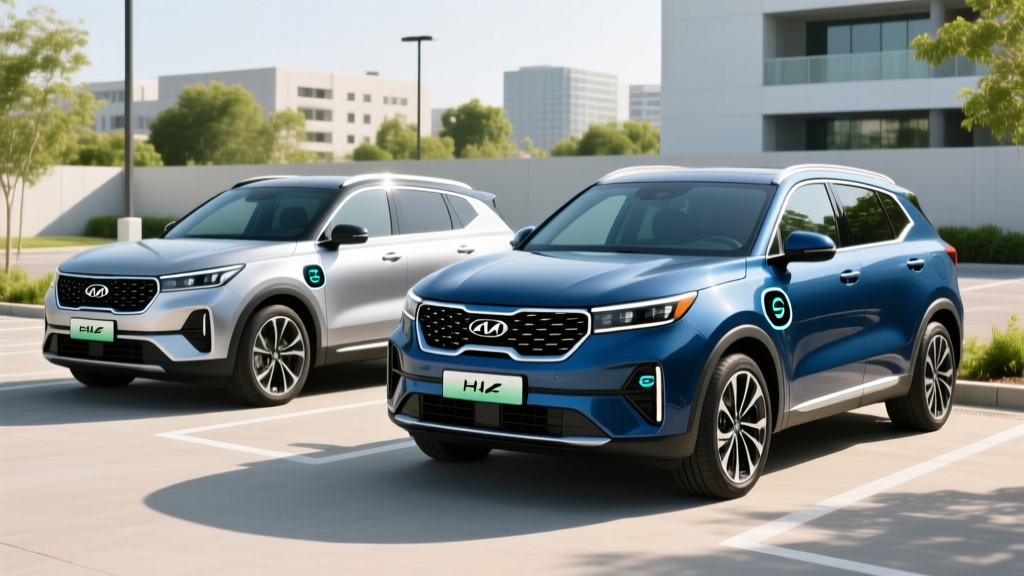
Kia currently sells two plug-in hybrid SUVs in the US: the compact 2026 Sportage PHEV and the midsize three-row 2026 Sorento PHEV. Both pair a 1.6-liter turbocharged four-cylinder with a permanent-magnet synchronous motor and a larger traction battery than their conventional hybrid siblings, giving each around 33–34 miles of electric-only driving before the gas engine wakes up. If you can charge at home most nights, either model lets you commute on electricity and road-trip on gasoline — without the range-anxiety calculus of a full battery-electric vehicle.
The Sportage PHEV is the value play: lower MSRP, slightly better MPGe, and a more usable cargo area for its footprint. The Sorento PHEV is the family hauler: third-row seating, more towing capacity, and a slightly longer electric range. Below, we break down every number that matters.
HEV vs PHEV: What Kia Actually Sells
Kia markets both conventional hybrids (HEV) and plug-in hybrids (PHEV) for the Sportage and Sorento. The distinction matters for your wallet and your driveway.
| Attribute | Sportage HEV | Sportage PHEV |
|---|---|---|
| Plug-in charging required? | No — regenerative braking + engine charges the small battery | Yes — plug in to unlock electric-only miles |
| Battery capacity (usable) | ~1.49 kWh | 13.7 kWh |
| Electric-only range | ~1 mi (low-speed assist only) | 34 mi (EPA) |
| Combined horsepower | 232 hp | 268 hp |
| EPA combined MPGe (charge-sustaining) | 43 MPG | 84 MPGe / 35 MPG gas-only |
| Drivetrain | AWD standard | AWD standard |
| Federal §30D credit eligible? | No | No (sourcing/income rules) |
A conventional hybrid never plugs in — it recovers energy through regenerative braking and the engine. A PHEV has a substantially larger battery and an onboard charger, so you plug it into a wall outlet or Level 2 station to replenish the electric range. Drive within that electric window and you burn zero gasoline; exceed it and the powertrain operates like a conventional hybrid.
Sportage PHEV: Specs, MPG, and Real-World Efficiency
| Spec | Value |
|---|---|
| EPA electric-only range | 34 miles |
| Total combined range (EV + gas) | ~430 miles |
| EPA MPGe (electric + gas) | 84 MPGe |
| EPA MPG (gas-only, charge-sustaining) | 35 combined (36 city / 35 highway) |
| Battery (usable) | 13.7 kWh, lithium-ion polymer |
| Onboard charger | 7.2 kW (Level 2 AC) |
| DC fast charging | Not supported |
| Level 2 charge time (0–100%) | ~2 hours |
| Level 1 (120V) charge time | ~11 hours |
| Powertrain | 1.6L turbo I-4 + 72 kW motor |
| Combined output | 268 hp / 258 lb-ft torque |
| Transmission | 6-speed automatic |
| 0–60 mph | ~7.4 seconds |
| Towing capacity | 2,000 lbs |
| Cargo volume (rear seats up / down) | 33.5 / 65.1 cu ft |
| Base MSRP (X-Line) | $40,490 |
| Battery / powertrain warranty | 10 yr / 100,000 mi |
Sorento PHEV: Specs, MPG, and Real-World Efficiency
| Spec | Value |
|---|---|
| EPA electric-only range | 33 miles |
| Total combined range | ~460 miles |
| EPA MPGe (electric + gas) | 79 MPGe |
| EPA MPG (gas-only, charge-sustaining) | 34 combined (33 city / 34 highway) |
| Battery (usable) | 13.8 kWh, lithium-ion polymer |
| Onboard charger | 7.2 kW (Level 2 AC) |
| DC fast charging | Not supported |
| Level 2 charge time (0–100%) | ~2 hours |
| Level 1 (120V) charge time | ~12 hours |
| Powertrain | 1.6L turbo I-4 + 72 kW motor |
| Combined output | 261 hp / 258 lb-ft torque |
| Transmission | 6-speed automatic |
| 0–60 mph | ~7.8 seconds |
| Towing capacity | 2,000 lbs |
| Cargo volume (behind 2nd / 3rd row) | 30.7 / 12.6 cu ft |
| Seating | 6 passengers (captain's chairs, 2nd row) |
| Base MSRP (SX Prestige) | $52,090 |
| Battery / powertrain warranty | 10 yr / 100,000 mi |
Fuel Economy Deep Dive: How Many MPG Do Kia PHEVs Actually Get?
| Metric | Sportage PHEV | Sorento PHEV |
|---|---|---|
| MPGe (EV + gas combined) | 84 MPGe | 79 MPGe |
| City MPG (gas-only) | 36 | 33 |
| Highway MPG (gas-only) | 35 | 34 |
| Combined MPG (gas-only) | 35 | 34 |
| Electric-only range | 34 mi | 33 mi |
| Total range | ~430 mi | ~460 mi |
| Fuel tank | 11.1 gal | 12.4 gal |
The PHEV MPG advantage is commute-dependent. If your round-trip commute is under 30 miles and you charge nightly, you may use almost no gasoline for daily driving. The MPGe figure (84 for the Sportage) reflects that blended electric-and-gas usage. Once the battery is depleted, you're driving a conventional hybrid getting 34–35 MPG — still excellent for an AWD SUV, but no longer exceptional.
Source: fueleconomy.gov — 2026 Kia Sportage PHEV.
Charging: Level 1, Level 2, and the No-DCFC Reality
Neither Kia PHEV supports DC fast charging. That's typical for plug-in hybrids — the batteries are small enough that a 7.2 kW Level 2 onboard charger replenishes them in roughly two hours, making DCFC infrastructure unnecessary.
| Level | Power | Time (0–100%) | Where |
|---|---|---|---|
| Level 1 (120V household) | ~1.4 kW | 11–12 hours | Standard outlet |
| Level 2 (240V) | 7.2 kW | ~2 hours | Home wallbox, public Level 2 |
| DC Fast Charge | N/A | N/A | Not supported |
Practical charging advice: A standard 120V outlet can handle overnight replenishment if your daily EV use is under 20 miles (it adds roughly 4–5 miles of range per hour). If you regularly deplete the full 33–34 miles, a Level 2 home charger is strongly recommended. A basic 240V/32A wallbox costs $300–$500 for the unit, plus $500–$1,500 for electrician installation depending on panel proximity. See fueleconomy.gov for the federal alternative-fuel infrastructure credit that may offset charger installation costs.
Tax Credit Eligibility: Does a Kia PHEV Qualify?
Short answer: As of 2026, neither the Sportage PHEV nor the Sorento PHEV qualifies for the federal §30D new clean vehicle credit.
The §30D credit offers up to $7,500 for qualifying PHEVs and BEVs, but vehicles must meet critical-mineral and battery-component sourcing requirements, and the buyer must fall under income caps ($150K single / $300K joint). Kia's PHEV battery supply chain does not currently satisfy the sourcing thresholds set by the IRS §30D rules.
What you can still claim:
- The Alternative Fuel Vehicle Refueling Property Credit (§30C) — up to $1,000 for home Level 2 charger installation, subject to census-tract eligibility.
- State and utility incentives — several states (CA, CO, NY, MA, and others) offer rebates for PHEV purchases. Check your state energy office or utility provider.
- Point-of-sale transfer does not apply here since the vehicle itself is ineligible for §30D.
Reliability, Battery Warranty, and Replacement Costs
- Hybrid/PHEV battery: 10 years / 100,000 miles (covers capacity loss below ~70% of original)
- Powertrain (engine, motor, transmission): 10 years / 100,000 miles
- Bumper-to-bumper: 5 years / 60,000 miles
- Roadside assistance: 5 years / 60,000 miles
Is it reliable? Kia's 1.6L turbo hybrid powertrain has been in service since the 2022 model year across the Sportage, Sorento, and Tucson (shared Hyundai platform). Long-term data is still accumulating, but the architecture is mature. The lithium-ion polymer battery pack is far smaller and less stressed than a full EV battery, meaning degradation is typically minimal — most PHEV owners report negligible capacity loss over 5+ years.
Battery replacement cost: Out of warranty, a PHEV battery replacement runs roughly $4,000–$7,000 including labor, based on current Hyundai/Kia parts pricing. That's significantly less than a full EV battery replacement ($10,000–$20,000+), because the pack is only ~13.7 kWh. Given the 10-year warranty, most original owners will never face this cost.
Kia's warranty is among the best in the industry and matches Hyundai's coverage. For comparison, Toyota covers hybrid batteries for 10 years / 150,000 miles on newer models.
Hybrid vs PHEV vs Full EV: Which Kia Fits You?
Choose the Sportage or Sorento PHEV if:
- You can charge at home (garage or driveway with a 120V or 240V outlet).
- Your daily commute is under 34 miles round-trip.
- You take road trips where charging infrastructure is sparse or unreliable.
- You want electric commuting without committing to a full EV.
Choose the conventional Sportage or Sorento HEV if:
- You have no access to home or workplace charging.
- You want maximum cargo flexibility (the PHEV battery slightly reduces under-floor storage).
- Lower purchase price is the priority (HEV trims start ~$5,000–$7,000 less).
Choose a full EV (e.g., Kia EV6 or EV9) if:
- You have reliable Level 2 home charging and access to DC fast chargers for road trips.
- Your daily driving exceeds 34 miles but you want zero gasoline use.
- You want lower per-mile fuel costs (electricity at $0.14/kWh ≈ $0.04/mi vs gasoline at $3.50/gal ≈ $0.12/mi at 30 MPG).
- You want to qualify for the §30D tax credit (the EV6 and EV9 may qualify depending on sourcing and your income).
Pricing and Trim Breakdown
| Model / Trim | MSRP | Federal Tax Credit | Effective Price (before state incentives) |
|---|---|---|---|
| Sportage PHEV X-Line | $40,490 | $0 | $40,490 |
| Sportage PHEV X-Line Prestige | $44,090 | $0 | $44,090 |
| Sorento PHEV SX | $52,090 | $0 | $52,090 |
| Sorento PHEV SX Prestige | $55,590 | $0 | $55,590 |
Destination charges add approximately $1,395 to each model. Dealer markups vary by region — the Sorento PHEV in particular has seen limited allocation, so negotiate carefully. Always verify pricing on Kia's official site for the latest MSRP and availability.
Pros and Cons
- 33–34 mi of electric range covers most commutes
- 268 hp (Sportage) provides confident passing power
- AWD standard on both models
- 10-year / 100K-mile battery and powertrain warranty
- No range anxiety — gas engine covers long trips
- Level 2 charge in ~2 hours is convenient overnight
- No DC fast charging capability
- No federal §30D tax credit eligibility
- PHEV premium of ~$5,000–$7,000 over HEV trims
- Sorento PHEV third row is tight for adults
- Real-world EV range drops to ~25 mi in cold weather
- 6-speed auto feels less refined than competitors' e-CVTs
Frequently Asked Questions
How many MPG does the Kia Sportage PHEV get?
The 2026 Sportage PHEV is EPA-rated at 84 MPGe when combining electric and gasoline driving, and 35 MPG combined (36 city / 35 highway) once the battery is depleted and the vehicle runs on gasoline alone. In real-world city driving with regenerative braking, some owners see 37–38 MPG in gas-only mode.
How far can the Kia Sorento PHEV go on electric only?
The EPA rates the 2026 Sorento PHEV at 33 miles of electric-only range. Real-world results vary: expect 27–30 miles at highway speeds and 22–25 miles in freezing temperatures. For commutes under 25 miles round-trip, you can operate almost entirely on electricity with nightly charging.
Do Kia PHEVs need to be plugged in?
To get the electric-only miles, yes — plug in to a 120V or 240V outlet. If you never plug in, the vehicle still operates as a conventional hybrid getting 34–35 MPG, but you lose the efficiency and cost advantage of electric driving. Think of it as optional but strongly recommended.
Is the Kia PHEV battery reliable, and what does replacement cost?
Kia covers the PHEV battery for 10 years or 100,000 miles against capacity loss below approximately 70%. Out-of-warranty replacement costs roughly $4,000–$7,000. The smaller battery and lower stress compared to a full EV pack mean degradation is typically minimal over the vehicle's life.
Does the Kia Sportage or Sorento PHEV qualify for a tax credit?
Neither qualifies for the federal §30D new clean vehicle credit (up to $7,500) due to battery-sourcing requirements. However, you may qualify for the §30C alternative fuel refueling credit (up to $1,000) for home charger installation, and various state or utility rebates may apply. Always verify current eligibility with the IRS clean vehicle credit page and your state energy office.
Can the Kia PHEV charge at a DC fast charger?
No. Neither the Sportage PHEV nor the Sorento PHEV has a DC fast-charge port. They charge via AC only — Level 1 (120V) or Level 2 (240V). The 13.7–13.8 kWh battery is small enough that Level 2 charging tops it up in about two hours.
Sportage PHEV vs Sorento PHEV — which should I buy?
Choose the Sportage PHEV if you want a lower price ($40,490 vs $52,090), slightly better efficiency, and don't need a third row. Choose the Sorento PHEV if you need seating for six, more cargo versatility, and don't mind the $11,600 price premium. Both share the same 1.6L turbo PHEV powertrain and 7.2 kW onboard charger.