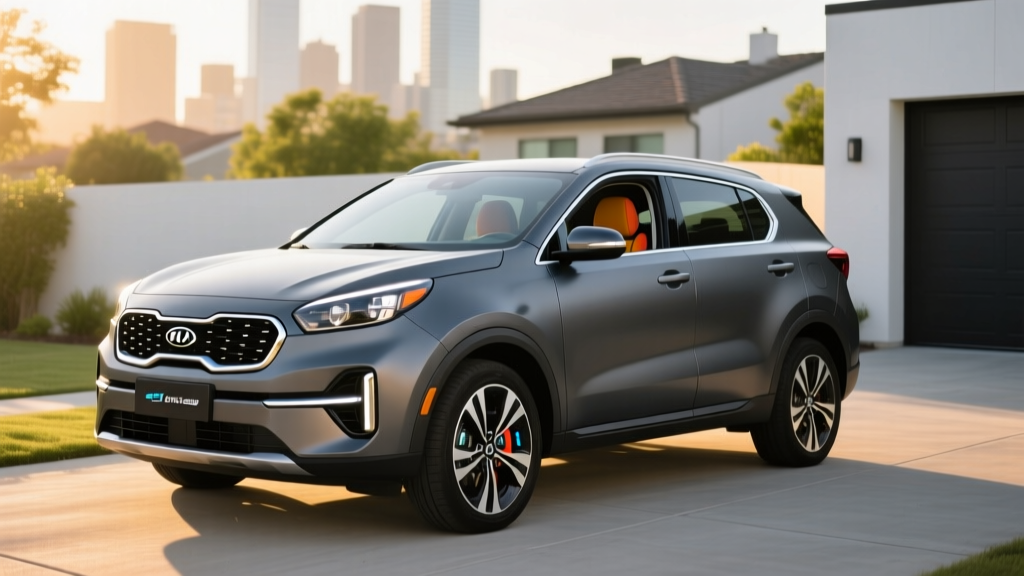
The 2026 Kia Sportage Hybrid X-Line occupies a specific niche: a compact SUV that pairs turbocharged hybrid power with rugged styling cues and standard all-wheel drive—without requiring a charging cable. For buyers weighing electrified options but lacking home charging access, the Sportage HEV (conventional hybrid) delivers meaningful fuel savings over its gas-only sibling while eliminating the plug-in complexity of a PHEV. Here's a data-driven breakdown of what the X-Line trim actually delivers.
HEV vs PHEV: Which Sportage Hybrid Is Right for You?
Before diving into specs, it's critical to distinguish the two electrified Sportage variants Kia offers. The conventional hybrid (HEV) and the plug-in hybrid (PHEV) operate very differently day to day.
| Feature | Sportage HEV (X-Line) | Sportage PHEV (X-Line) |
|---|---|---|
| Plugs in? | No — self-charging via regen & engine | Yes — 13.7 kWh battery, Level 1/2 charging |
| Electric-only range | N/A (motor assists engine) | EPA est. 34 miles |
| EPA combined MPG / MPGe | 48 MPG combined | 84 MPGe combined (36 MPG gas-only) |
| Combined HP | 232 hp | 261 hp |
| Federal tax credit (§30D) | Not eligible | Up to $7,500 if sourcing/income rules met |
| Starting MSRP (X-Line) | $33,590 | $40,490 |
Bottom line: If you can charge at home and your daily commute falls under 34 miles, the PHEV lets you drive most days on electricity alone. If you lack reliable charging access or want a lower purchase price, the HEV is the pragmatic pick—and that's the focus of this review.
Powertrain and Performance Specs
The 2026 Sportage Hybrid X-Line uses Kia's turbocharged hybrid powertrain, pairing a 1.6-liter turbocharged inline-4 gasoline engine with a 47.7 kW electric motor integrated into a 6-speed automatic transmission. Combined system output is 232 horsepower and 258 lb-ft of torque. All-wheel drive is standard on the X-Line via a conventional mechanical system (not the electric rear axle some competitors use).
| Specification | 2026 Sportage Hybrid X-Line |
|---|---|
| Engine | 1.6L turbocharged I-4 |
| Electric motor | 47.7 kW (64 hp) |
| Combined output | 232 hp / 258 lb-ft |
| Transmission | 6-speed automatic |
| Drivetrain | AWD (standard) |
| 0–60 mph | ~7.0 seconds (est.) |
| Towing capacity | 2,000 lbs |
| Cargo volume (behind 2nd row) | 39.5 cu ft |
The turbo gives the Sportage HEV a noticeable advantage over naturally aspirated hybrid competitors like the Toyota RAV4 Hybrid in passing power and highway merging confidence. The 6-speed automatic also feels more natural than the CVT or e-CVT transmissions found in most rival hybrids—there are actual gear shifts, not the rubber-band drone.
Fuel Economy: EPA Ratings and Real-World MPG
The EPA rates the 2026 Sportage Hybrid X-Line AWD at 43 city / 53 highway / 48 combined MPG per fueleconomy.gov. Those numbers place it near the top of the compact hybrid SUV segment, and notably, the highway figure exceeds the city figure—an unusual pattern for hybrids that reflects Kia's efficient turbo engine tuning at steady speeds.
| Driving Scenario | EPA Rating | Real-World Expectation |
|---|---|---|
| City | 43 MPG | 44–48 MPG (hybrids thrive in stop-and-go regen) |
| Highway (70 mph) | 53 MPG | 44–48 MPG (aero drag and turbo boost reduce efficiency) |
| Combined | 48 MPG | 43–47 MPG typical mixed driving |
| Cold weather (below 32°F) | N/A | 37–42 MPG (engine runs more for cabin heat) |
Real-world note: Like most hybrids, the Sportage HEV tends to exceed its EPA city rating because regenerative braking recaptures energy that gas cars waste as heat. Highway driving is where reality diverges from the sticker—sustained 75+ mph speeds, roof-rack cargo, and hot A/C use can pull combined economy into the low 40s. In cold weather, expect a 10–15% drop because the gasoline engine runs longer to provide cabin heat and warm up the catalytic converter.
For context, a comparable gas-only Sportage AWD rates at roughly 26 combined MPG. At $3.50/gallon and 12,000 miles/year, the hybrid saves approximately $1,050 annually in fuel costs—paying back the hybrid premium in roughly 2–3 years depending on trim and local fuel prices.
X-Line Trim: What You Get for the Price
The X-Line is the adventure-oriented trim in the Sportage Hybrid lineup, adding rugged exterior cladding, a matte-black grille, exclusive 19-inch alloy wheels, roof rails, and synthetic leather upholstery with unique stitching. For 2026, the X-Line AWD starts at $33,590 (including destination), placing it between the base HEV LX (~$29,590) and the top SX Prestige (~$38,590).
Standard equipment on the X-Line includes:
- 12.3-inch dual displays (instrument cluster + infotainment)
- Wireless Apple CarPlay and Android Auto
- Heated front seats and heated steering wheel
- Power liftgate
- Kia Drive Wise ADAS suite (see below)
- LED headlights and fog lights
An optional X-Line Technology Package (~$2,200) adds ventilated front seats, a panoramic sunroof, highway driving assist, and a 360-degree camera. Fully loaded, expect an out-the-door price around $37,000–$38,500 before dealer adjustments.
Federal and State Tax Credit Eligibility
The conventional Sportage Hybrid (HEV) does not qualify for the federal §30D Clean Vehicle Credit—that credit is reserved for plug-in electric vehicles and fuel-cell vehicles. This is a common point of confusion: despite the "hybrid" label, HEVs are not eligible for the up-to-$7,500 federal incentive.
If the tax credit is a priority, the Sportage PHEV may qualify, but eligibility depends on several IRS rules current for 2026 per irs.gov:
- Buyer AGI must not exceed $150,000 (single) / $300,000 (joint)
- Vehicle MSRP must not exceed $80,000 (SUVs/PHEVs)
- Battery critical minerals and component sourcing must meet annual thresholds
- Credit can be transferred to the dealer at point of sale as a purchase-price reduction
Some states offer separate hybrid rebates (Colorado, for example, has offered hybrid incentives), but these vary by jurisdiction and change annually. Check your state energy office or a tax professional for current local programs.
Driver Assistance and Safety Technology
The 2026 Sportage Hybrid X-Line comes standard with Kia's Drive Wise suite, which includes forward collision-avoidance assist with pedestrian detection, lane-keeping assist, blind-spot collision warning, rear cross-traffic alert, and driver attention warning. The X-Line Technology Package adds Highway Driving Assist (HDA), which combines adaptive cruise control with lane-centering on divided highways.
The Sportage earned top marks from the IIHS in previous model years, and the 2026 carries over the same reinforced platform. NHTSA ratings, when published at nhtsa.gov, should be checked for the latest crash-test results.
Battery Warranty, Reliability, and Replacement Costs
The Sportage Hybrid uses a relatively compact lithium-ion traction battery (approximately 1.5 kWh usable) positioned under the rear seats. Because this is a conventional hybrid, the battery cycles frequently but within a narrow state-of-charge window—typically 40–80%—which minimizes degradation stress.
Reliability outlook: Kia's 1.6T hybrid powertrain has been in production since the 2023 model year across the Sportage and Tucson platforms. Early data suggests solid reliability, though long-term (100,000+ mile) fleet data is still accumulating. The conventional hybrid architecture is inherently simpler than a PHEV—no onboard charger, no charging port hardware, and a smaller battery with less thermal management complexity.
Battery replacement cost: If the hybrid battery fails outside warranty, replacement costs typically range from $2,500 to $4,500 including parts and labor at a Kia dealer. However, hybrid battery failure before 150,000 miles is uncommon based on industry-wide data from similar systems. Individual module replacement (rather than the full pack) can reduce costs to $800–$1,500 at independent hybrid specialists.
Sportage Hybrid vs. the Competition
The compact hybrid SUV segment is crowded. Here's how the Sportage Hybrid X-Line stacks up against key rivals on the metrics that matter:
| Metric | 2026 Sportage HEV X-Line AWD | 2026 RAV4 Hybrid XLE AWD | 2026 Honda CR-V Hybrid Sport AWD |
|---|---|---|---|
| EPA combined MPG | 48 | 39 | 40 |
| Combined HP | 232 | 219 | 204 |
| 0–60 mph | ~7.0s | ~7.4s | ~7.8s |
| Cargo (behind 2nd row) | 39.5 cu ft | 37.6 cu ft | 36.3 cu ft |
| Starting MSRP (AWD) | $33,590 | $33,425 | $36,350 |
| Hybrid battery warranty | 10 yr / 100k mi | 10 yr / 150k mi | 8 yr / 100k mi |
| Transmission | 6-speed auto | e-CVT | e-CVT |
The Sportage HEV leads the trio in fuel economy, horsepower, and cargo volume. The RAV4 Hybrid counters with a longer battery warranty (150k miles) and Toyota's extensive hybrid reliability track record. The CR-V Hybrid trails on power and price but offers strong ride comfort. The Sportage's 6-speed automatic is a differentiator for drivers who dislike the CVT drone common in Toyota and Honda hybrids.
Pros
- Class-leading 48 MPG combined
- 232 hp — most powerful in segment
- 6-speed auto (no CVT drone)
- Generous 39.5 cu ft cargo space
- 10-year/100k-mile hybrid warranty
- Standard AWD on X-Line
Cons
- No federal tax credit (HEV)
- Real-world highway MPG falls short of EPA
- No hands-free driving assist option
- Firm ride on 19-inch X-Line wheels
- Hybrid premium over gas model (~$4,000)
- Cold-weather MPG drop is significant
Who Should Choose the Sportage Hybrid vs. a PHEV or Full EV?
Choose the Sportage HEV (X-Line) if:
- You lack access to home or workplace Level 2 charging
- You want fuel savings without changing your refueling habits
- Your budget caps around $35,000–$38,000
- You frequently drive in cold climates where EV range loss is a concern
- You tow occasionally (2,000-lb capacity)
Choose the Sportage PHEV if:
- You can install a Level 2 home charger (240V, 32A)
- Your daily commute is under 34 miles round-trip
- You qualify for the federal §30D credit (up to $7,500)
- You want to drive on electricity most days with gas as backup
Choose a full BEV (e.g., Kia EV6, Hyundai Ioniq 5) if:
- You have reliable home charging and want zero tailpipe emissions
- You want the lowest per-mile energy cost (~$0.04/mi vs ~$0.08/mi for the HEV)
- You qualify for the full $7,500 federal credit and state incentives
- Your daily driving stays within 250–300 miles and you're comfortable with road-trip DC charging
Frequently Asked Questions
How many MPG does the 2026 Kia Sportage Hybrid X-Line actually get?
The EPA rates it at 43 city / 53 highway / 48 combined MPG. In real-world mixed driving, expect 43–47 MPG combined. City driving often exceeds the EPA estimate thanks to regenerative braking, while sustained highway speeds above 70 mph and cold weather can pull numbers into the high 30s or low 40s.
Does the Sportage Hybrid need to be plugged in?
No. The conventional Sportage Hybrid (HEV) charges its battery entirely through regenerative braking and the gasoline engine. You refuel it exactly like a gas car—only at the pump. Only the Sportage PHEV variant requires (or benefits from) plug-in charging.
Is the hybrid battery reliable and what does replacement cost?
Kia covers the hybrid battery for 10 years/100,000 miles (15 years/150,000 miles in CARB states). Hybrid battery failure before 150,000 miles is statistically uncommon. Out-of-warranty replacement runs $2,500–$4,500 at a dealer, or $800–$1,500 for individual module replacement at a hybrid specialist.
Does the 2026 Sportage Hybrid qualify for any tax credit?
The conventional hybrid (HEV) does not qualify for the federal §30D Clean Vehicle Credit, which applies only to plug-in EVs and fuel-cell vehicles. Some states offer hybrid-specific rebates, but these vary widely. The Sportage PHEV may qualify for up to $7,500 in federal credits if buyer income, MSRP, and battery-sourcing requirements are met—consult a tax professional for your specific situation.
How does the X-Line differ from other Sportage Hybrid trims?
The X-Line adds adventure-oriented styling (matte-black grille, unique 19-inch wheels, roof rails, rugged body cladding), synthetic leather seats, heated front seats and steering wheel, and a power liftgate. It sits mid-range in the lineup above the LX and EX, below the SX Prestige, and includes AWD as standard equipment.
What's the real-world fuel cost savings vs. the gas Sportage?
At 12,000 miles/year and $3.50/gallon, the gas-only Sportage AWD (~26 MPG combined) costs roughly $1,615/year in fuel. The hybrid at ~45 MPG real-world costs about $933/year—saving approximately $680–$1,050 annually depending on your driving mix and local fuel prices.