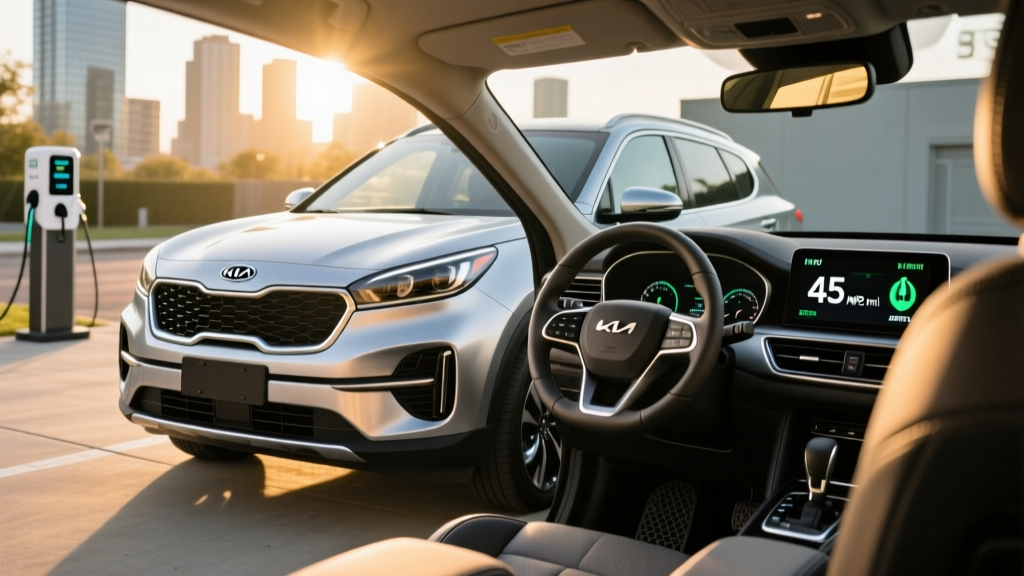
The 2026 Kia Sportage Hybrid S occupies a pragmatic middle ground: it delivers meaningful fuel savings over the gas-only Sportage without requiring a plug, a home charger, or a lifestyle change. As the mid-tier trim in Kia's hybrid lineup, the S adds desirable features over the base LX Hybrid while staying well under the top SX Prestige. For buyers who want electrified efficiency but lack reliable charging access, this conventional hybrid (HEV) makes a compelling case.
Below, we break down the exact EPA numbers, real-world efficiency expectations, powertrain specs, battery longevity, and how the Sportage Hybrid S stacks up against its plug-in sibling and full EVs.
2026 Kia Sportage Hybrid S: Key Specifications at a Glance
| Specification | 2026 Kia Sportage Hybrid S (HEV) |
|---|---|
| Powertrain | 1.6L turbocharged 4-cyl + electric motor |
| Combined Horsepower | 232 hp |
| Combined Torque | 258 lb-ft |
| Transmission | 6-speed automatic |
| Drivetrain | AWD (standard on Hybrid S) |
| EPA MPG (City / Hwy / Combined) | 40 / 44 / 42 |
| Fuel Tank Capacity | 13.7 gallons |
| Total Driving Range | ~575 miles (EPA est.) |
| Hybrid Battery | 1.49 kWh lithium-ion (not plug-in) |
| 0-60 mph | ~7.4 seconds |
| Cargo Volume (behind rear seats) | 39.5 cu ft |
| Starting MSRP | $33,090 (incl. destination) |
| Battery Warranty | 10 years / 100,000 miles |
Fuel Economy: EPA Ratings vs. Real-World MPG
The 2026 Kia Sportage Hybrid with AWD carries an EPA-estimated 40 city / 44 highway / 42 combined MPG according to fueleconomy.gov. These are strong figures for a compact SUV with all-wheel drive, putting the Sportage Hybrid ahead of the Toyota RAV4 Hybrid (41 combined) and on par with the Hyundai Tucson Hybrid (38-41 combined depending on trim).
Hybrids typically exceed their EPA city rating in stop-and-go traffic because regenerative braking recaptures energy that a gas car wastes as heat. Expect 42-46 MPG in urban driving. Highway driving is a different story — sustained 70-80 mph speeds reduce the hybrid system's advantage, so anticipate 38-41 MPG on the interstate. In cold weather (below 30°F), engine runtime increases for cabin heating, dropping combined MPG to roughly 36-38 until the engine reaches operating temperature. Over a mixed-driving year of 12,000 miles, most owners report averaging 40-43 MPG — closely matching the EPA combined figure.
The Sportage Hybrid's 13.7-gallon fuel tank translates to roughly 575 miles of total range on a fill-up. That's coast-to-coast territory with only a handful of stops — a practical advantage over many EVs that require 30-minute charging breaks every 250-300 miles on road trips.
HEV vs. PHEV: Which Sportage Hybrid Fits You?
Kia offers the Sportage in three electrified forms for 2026: the conventional Hybrid (HEV), the Plug-in Hybrid (PHEV), and the fully electric EV. The Hybrid S reviewed here is the HEV — it charges its small battery exclusively through regenerative braking and the gasoline engine. You never plug it in.
Sportage Hybrid (HEV)
- No plug-in required — ever
- 42 MPG combined EPA
- ~575 miles total range
- 1.49 kWh battery (self-charging)
- From $33,090
- No federal tax credit
Sportage Plug-in Hybrid (PHEV)
- Plug in for ~34 miles electric-only
- 84 MPGe combined (electric + gas)
- ~430 miles total range
- 13.8 kWh battery (Level 2 chargeable)
- From $39,590
- May qualify for partial §30D credit
The HEV is the simpler, lower-cost choice. It works identically to a gas car at the pump — you just fill up and go — while silently delivering 30-40% better fuel economy. The PHEV makes sense only if you can charge at home or work regularly; its 34-mile electric-only range covers most daily commutes, meaning you might burn zero gasoline on weekdays.
Powertrain Deep Dive: How the Hybrid System Works
The 2026 Sportage Hybrid pairs a turbocharged 1.6-liter inline-four engine (producing approximately 178 hp on its own) with a 47.7 kW (64 hp) electric motor integrated into the transmission. Combined system output is 232 horsepower and 258 lb-ft of torque — a substantial 51-hp advantage over the non-hybrid Sportage's 181-hp 2.5L engine.
The 6-speed automatic transmission is a deliberate choice over the continuously variable transmissions (CVTs) used by Toyota and Honda in their hybrids. The result is a more natural, stepped acceleration feel that avoids the "rubber-band" drone common to CVT hybrids. Power delivery is linear and confident for highway merging, and the electric motor fills in torque at low RPMs where the turbo is still spooling.
The 1.49 kWh lithium-ion hybrid battery sits beneath the rear seats. It's small by EV standards — a Tesla Model Y battery is roughly 50 times larger — but it's all the system needs. It buffers energy from regenerative braking and feeds the electric motor during acceleration, then recharges during deceleration and cruising. This small battery is also why replacement costs are far lower than a full EV battery.
Battery Longevity, Warranty, and Replacement Costs
Kia covers the Sportage Hybrid's battery and hybrid-specific components (inverter, electric motor, hybrid control unit) for 10 years or 100,000 miles, whichever comes first. The standard vehicle warranty is 5 years / 60,000 miles bumper-to-bumper and 10 years / 100,000 miles powertrain. In states that follow California Air Resources Board (CARB) emissions rules, hybrid components may carry extended coverage — check your state's specific terms.
Hybrid battery degradation is rarely the concern it is with full EVs. The Sportage Hybrid's 1.49 kWh battery operates within a narrow state-of-charge window (typically 40-60%), which dramatically reduces stress on the cells. Real-world data from Kia and Hyundai hybrids using similar battery packs shows minimal capacity loss over 100,000+ miles. The hybrid system compensates for minor degradation by adjusting charge/discharge parameters, so you're unlikely to notice any efficiency decline.
If the hybrid battery does need replacement outside of warranty, expect a cost between $2,000 and $3,500 for the battery pack itself, plus roughly $500-$800 in labor. This is substantially less than EV battery replacements ($8,000-$20,000+) because the pack is small and accessible. Third-party refurbishers also offer reconditioned hybrid batteries for $1,200-$1,800 for older vehicles.
Pricing, Trims, and Tax Credit Eligibility
The 2026 Kia Sportage Hybrid S starts at $33,090 including destination charges. Here's how the hybrid trims break down:
| Trim | MSRP | Key Additions Over Previous Trim |
|---|---|---|
| LX Hybrid | $30,590 | Base hybrid with 8-inch display, wireless CarPlay/Android Auto |
| S Hybrid | $33,090 | 12.3-inch dual displays, heated front seats, smart power liftgate, LED headlights, roof rails |
| X-Line Hybrid | $35,590 | Rugged styling, synthetic leather, panoramic sunroof, front skid plate |
| SX Prestige Hybrid | $38,790 | Nappa leather, ventilated seats, Harman Kardon audio, highway driving assist, 360° camera |
The S trim hits a sweet spot: the 12.3-inch infotainment cluster, heated seats, and LED lighting address daily comfort without pushing the price toward $40,000. Adding the $1,500 cargo package or $400 carpeted floor mats keeps a well-equipped S Hybrid around $35,000 before any incentives.
The conventional Sportage Hybrid (HEV) does not qualify for the federal §30D Clean Vehicle Credit. That credit applies only to plug-in vehicles (PHEVs and BEVs) that meet battery sourcing, critical mineral, MSRP cap, and buyer income requirements per IRS rules. The Sportage PHEV may be eligible for a partial credit (up to $3,750 depending on battery component sourcing), but eligibility changes frequently — consult a tax professional and verify current-year rules before purchasing.
Some states and utilities offer rebates for conventional hybrids. Check your state energy office and local utility for current programs.
Who Should Choose the Sportage Hybrid S — And Who Should Look Elsewhere
Choose the Sportage Hybrid S If:
- You want 40+ MPG without changing your fueling habits
- You lack access to home or workplace charging
- You frequently take long road trips and don't want charging stops
- You want AWD capability with strong fuel economy
- You want to keep total vehicle cost under $35,000
- You live in an area with extreme cold that reduces EV range significantly
Look at a PHEV or EV Instead If:
- You can install a Level 2 charger at home
- Your daily commute is under 35 miles (PHEV covers it on electricity)
- You want to minimize gasoline use, not just reduce it
- You qualify for the §30D federal credit, narrowing the price gap
- You want one-pedal driving and EV-style instant torque
- You're targeting near-zero tailpipe emissions for daily driving
The Sportage Hybrid S is fundamentally a no-compromise efficiency play. You sacrifice nothing in cargo space (39.5 cu ft), towing (2,000 lbs), or drivetrain capability (standard AWD) compared to the gas-only Sportage — you simply burn less fuel doing the same things. The trade-off is that you'll still visit gas stations regularly, and you won't experience the silent, instant-torque acceleration that defines full EVs.
Pros and Cons
Pros
- 42 MPG combined EPA — strong for an AWD compact SUV
- No charging infrastructure needed
- 232 hp provides confident acceleration
- 575+ mile total range eliminates road-trip stops
- 10-year / 100,000-mile hybrid battery warranty
- Generous cargo space (39.5 cu ft)
- 6-speed auto avoids CVT drone
Cons
- No federal tax credit for the HEV variant
- No electric-only driving mode (unlike PHEV)
- Highway MPG drops noticeably above 75 mph
- Cold-weather MPG penalty of 5-8%
- Hybrid battery replacement cost ($2,000-$3,500 out of warranty)
- S trim lacks premium features like ventilated seats or 360° camera
Frequently Asked Questions
How many MPG does the 2026 Kia Sportage Hybrid S get?
The EPA rates the AWD Sportage Hybrid at 40 city / 44 highway / 42 combined MPG. In real-world mixed driving, expect 40-43 MPG. City-heavy drivers often see 42-46 MPG thanks to regenerative braking, while sustained highway driving at 75+ mph can drop efficiency to 38-40 MPG.
Does the Sportage Hybrid need to be plugged in?
No. The Sportage Hybrid (HEV) is a self-charging conventional hybrid. Its 1.49 kWh battery charges through regenerative braking and the gasoline engine. You fuel it exactly like a standard gas car. Only the Sportage PHEV (Plug-in Hybrid) requires or benefits from plugging in.
How far can the Sportage PHEV go on electric only?
The 2026 Sportage Plug-in Hybrid delivers an EPA-estimated 34 miles of electric-only range on its larger 13.8 kWh battery. After that, it operates as a conventional hybrid. Total combined range (electric + gas) is approximately 430 miles. The PHEV can charge on a Level 2 (240V) home charger in about 3.5 hours. It does not support DC fast charging.
Is the Sportage Hybrid reliable, and what does battery replacement cost?
Kia's hybrid powertrain has proven reliable across the Hyundai/Kia platform, with the 1.6L turbo hybrid system now in its second generation. The hybrid battery is warrantied for 10 years / 100,000 miles. Out-of-warranty replacement runs $2,000-$3,500 for the battery pack plus labor — far less than EV battery replacement. The small battery operates within a conservative charge window, which extends its lifespan significantly.
Does the 2026 Sportage Hybrid qualify for any tax credit?
The conventional Sportage Hybrid (HEV) does not qualify for the federal §30D Clean Vehicle Credit, which is reserved for plug-in vehicles. The Sportage PHEV may qualify for a partial credit depending on current-year battery sourcing requirements and buyer income limits. Some states offer separate hybrid incentives — check IRS.gov and your state energy office for current eligibility. Always consult a tax professional before relying on credit availability.
Hybrid vs. PHEV vs. EV — which Sportage should I buy?
HEV (Hybrid S): Best if you can't charge at home, take frequent long trips, or want the lowest upfront cost. You'll save ~$600-$800/year in fuel vs. the gas Sportage.
PHEV: Best if you can charge at home and commute under 34 miles daily. You'll run mostly on electricity weekdays and use gas only for longer trips.
EV: Best if you have home charging, want zero tailpipe emissions, and your daily driving stays under 250 miles. Highest upfront cost but lowest per-mile energy cost and minimal maintenance.