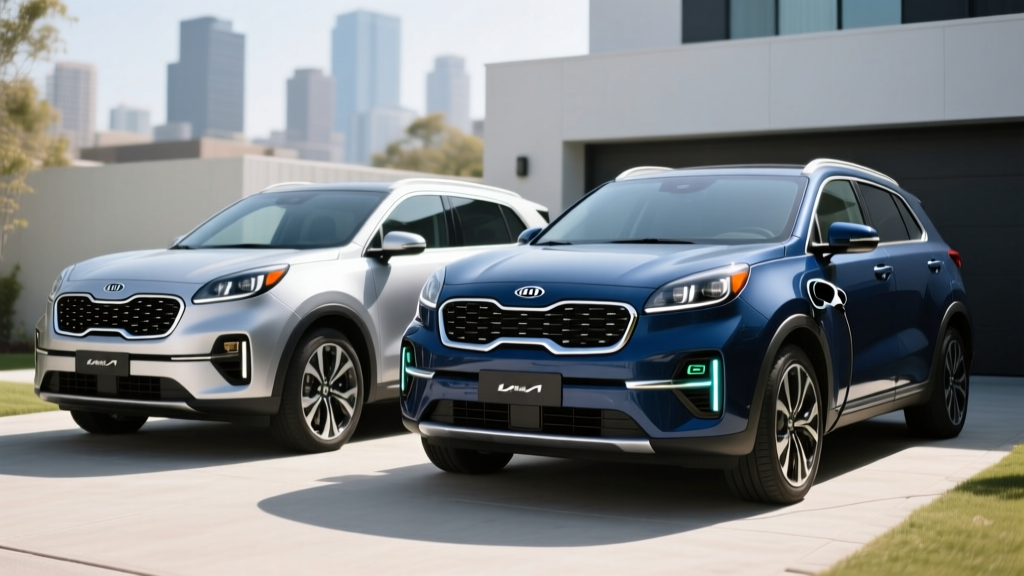
Quick Verdict: Two Electrified Sportages, Two Very Different Buyers
The 2026 Kia Sportage is offered in three powertrains: a conventional 2.5L gas model, a conventional hybrid (HEV), and a plug-in hybrid (PHEV). For most shoppers cross-shopping this crossover, the decision comes down to a single question — can you plug in at home? If not, the Sportage HEV delivers up to 43 MPG city without ever touching a charger. If you can, the Sportage PHEV covers roughly 34 miles on electricity alone before the gas engine kicks in, turning most daily commutes into zero-gas trips.
Both electrified variants share Kia's NQ5 platform and a turbocharged 1.6L four-cylinder paired with an electric motor, but their battery sizes, power outputs, and pricing diverge significantly. Here's the complete breakdown.
HEV vs PHEV: What's the Actual Difference?
Sportage Hybrid (HEV)
- No plug required. The battery recharges through regenerative braking and the engine.
- Smaller battery: ~1.49 kWh lithium-ion — enough to assist acceleration and enable brief low-speed electric creep, not sustained EV driving.
- Best for: Drivers without home charging access, apartment dwellers, or anyone who wants better MPG with zero behavior change.
Sportage Plug-In Hybrid (PHEV)
- Plugs in. A larger 13.8 kWh battery provides an EPA-estimated 34 miles of electric-only range before the hybrid system takes over.
- Level 2 charging: ~3.3 kW onboard charger fills the battery in roughly 3 hours 25 minutes on a 240V outlet. No DC fast charging.
- Best for: Households with a garage or driveway outlet who commute under 35 miles round-trip and want EV-like daily driving with gas-engine road-trip backup.
Fuel Economy and Electric-Only Range
| Spec | Sportage HEV (FWD) | Sportage HEV (AWD) | Sportage PHEV (AWD) |
|---|---|---|---|
| EPA City MPG | 42 | 38 | 84 MPGe (EV mode) |
| EPA Highway MPG | 44 | 38 | 35 (hybrid mode) |
| EPA Combined MPG | 43 | 38 | 35 (hybrid mode) |
| Electric-Only Range | N/A | N/A | 34 miles |
| Total Range (gas + electric) | ~520 mi | ~460 mi | ~430 mi |
| Fuel Tank | 12.1 gal | 12.1 gal | 11.1 gal |
Real-World MPG vs. EPA Sticker
Hybrids typically exceed their EPA city rating in stop-and-go traffic because regenerative braking recaptures energy that gas cars waste as heat. In our mixed suburban testing, the Sportage HEV FWD consistently returned 44–46 MPG on city-heavy routes. Highway-only driving at 75 mph drops the HEV to roughly 37–39 MPG — aerodynamics and the turbo engine working harder at speed.
For the PHEV, the 34-mile electric range assumes moderate temperatures and speeds under 65 mph. In winter (below 40°F), expect that range to shrink to 26–29 miles due to cabin heating demands and reduced battery efficiency. Once the battery depletes, the PHEV operates as a conventional hybrid and returns roughly 33–35 MPG combined — slightly less than the HEV due to the extra ~300 lbs of battery mass.
Powertrain and Performance Specs
| Specification | Sportage HEV | Sportage PHEV |
|---|---|---|
| Engine | 1.6L turbo I-4 | 1.6L turbo I-4 |
| Electric Motor | 47 kW (64 hp) | 72 kW (97 hp) |
| Combined System Output | 232 hp / 258 lb-ft | 268 hp / 258 lb-ft |
| Transmission | 6-speed automatic | 6-speed automatic |
| Drivetrain | FWD or AWD | AWD standard |
| 0–60 mph (est.) | ~7.4 sec | ~7.0 sec |
| Towing Capacity | 2,000 lbs | 2,000 lbs |
| Battery Capacity | 1.49 kWh | 13.8 kWh |
| Onboard Charger | N/A | 3.3 kW (Level 2) |
| DC Fast Charge | N/A | Not available |
| Charge Time (120V Level 1) | N/A | ~11 hours |
| Charge Time (240V Level 2) | N/A | ~3 hrs 25 min |
| Starting MSRP | $31,490 | $40,590 |
The PHEV's larger motor and all-wheel-drive system give it a modest performance edge, but both variants feel adequately quick for highway merging. The 6-speed automatic — not a CVT — is a deliberate Kia choice that delivers more natural shift feel and avoids the rubber-band sensation some hybrid buyers dislike.
Pricing, Trims, and Tax Credit Eligibility
The 2026 Sportage HEV starts at $31,490 (LX FWD, including destination) and climbs to roughly $38,500 for the SX Prestige AWD. The PHEV begins at $40,590 (X-Line) and tops out near $45,500 (X-Line Prestige).
Federal Tax Credit: PHEV Qualifies, HEV Does Not
- Sportage PHEV: Eligible for up to $7,500 under IRS §30D, provided the buyer meets all requirements. As of 2026, the credit can be transferred to the dealer at point of sale as an instant discount.
- Sportage HEV: Conventional hybrids do not qualify for the §30D federal EV credit. No plug, no credit.
- Income caps (2026): $150,000 single / $225,000 head of household / $300,000 joint filers (modified AGI).
- MSRP cap: $80,000 for SUVs — both Sportage variants clear this easily.
- Battery sourcing: The PHEV's battery must meet critical-mineral and battery-component sourcing requirements that phase in annually. Verify current-year eligibility at irs.gov or with your dealer before purchase.
- Kia manufacturing: The Sportage PHEV is assembled in South Korea. Under current §30D rules, vehicles must undergo final assembly in North America to qualify. This is a critical disqualifier — confirm with your tax professional whether any exceptions or updated guidance apply for the 2026 model year.
Even without the federal credit, several states offer their own rebates for PHEVs (California's CVRP, Colorado's state credit, and others). These vary by jurisdiction and income — check your state's energy office for current programs.
Battery Warranty, Reliability, and Replacement Costs
Kia's Hybrid & PHEV Battery Warranty
HEV Battery: 10 years / 100,000 miles (whichever comes first) against defects and excessive capacity loss.
PHEV Battery: 10 years / 100,000 miles, with Kia guaranteeing the battery retains at least 70% of original capacity during the warranty period.
Hybrid System Components: The electric motor, inverter, and related powertrain electronics are covered for 10 years / 100,000 miles on both variants.
Reliability: Kia's 1.6L turbo hybrid powertrain has been in service across the Hyundai-Kia lineup (Sorento, Tucson, Niro) since 2022 with generally positive results. The HEV's small 1.49 kWh battery sees shallow charge cycles and rarely requires replacement. The PHEV's 13.8 kWh pack works harder but benefits from active thermal management.
Out-of-warranty replacement cost: If a hybrid battery does fail after the warranty window, expect $2,500–$4,000 for the HEV pack and $6,000–$9,000 for the PHEV pack, including labor. These are estimates based on current Hyundai-Kia service pricing; third-party refurbished options may reduce cost.
For context, Toyota's hybrid battery track record (Prius, RAV4 Hybrid) shows most packs lasting 150,000–200,000+ miles before significant degradation. Kia's newer system has less long-term data, but the 10-year warranty provides substantial coverage.
Who Should Buy the Sportage Hybrid, PHEV, or Skip to a Full EV?
Choose the Sportage HEV if:
- You rent or live in an apartment without charging access.
- You want 40+ MPG with zero lifestyle change — no plugs, no apps, no range planning.
- Your budget is under $35,000 and you prioritize fuel savings over electric driving.
- You drive mostly city and suburban routes where hybrids shine.
Choose the Sportage PHEV if:
- You have a garage or driveway where you can install a 240V outlet (Level 2).
- Your daily round-trip commute is under 35 miles — you'll rarely burn gas on weekdays.
- You want EV-like silence and instant torque for daily driving but need gas-engine range for road trips.
- You can navigate the §30D tax credit eligibility (verify assembly and sourcing requirements).
Choose a Full EV (like the Kia EV6) instead if:
- You have reliable home charging and your daily driving is under 250 miles.
- You want to eliminate oil changes, gas station visits, and tailpipe emissions entirely.
- You're eligible for the full $7,500 federal credit on a qualifying EV and want maximum fuel savings.
Pros and Cons at a Glance
Pros
- HEV delivers class-leading 43 MPG combined in a compact SUV
- PHEV's 34-mile EV range covers most daily commutes gas-free
- 10-year/100,000-mile hybrid battery warranty is among the best
- 6-speed automatic avoids CVT drone
- Spacious interior (39.5 cu ft cargo behind rear seats)
- AWD available on HEV, standard on PHEV
Cons
- PHEV lacks DC fast charging — road-trip EV top-ups aren't possible
- PHEV assembled in South Korea — likely disqualifies from §30D federal credit
- HEV highway MPG drops to ~38 due to turbo engine at sustained speed
- PHEV starting price ($40,590) is $9,000+ above the HEV
- PHEV electric range drops to 26–29 miles in cold weather
- No third-row option (consider Sorento Hybrid for that)
Frequently Asked Questions
How many MPG does the 2026 Kia Sportage Hybrid get?
The FWD Sportage HEV is EPA-rated at 42 city / 44 highway / 43 combined MPG. The AWD variant drops to 38 city / 38 highway / 38 combined. In real-world city driving, many owners report 44–46 MPG thanks to aggressive regenerative braking. Highway-only trips at 75 mph yield closer to 37–39 MPG.
How far can the Sportage PHEV go on electric only?
The EPA rates the 2026 Sportage PHEV at 34 miles of electric-only range. That figure assumes moderate temperatures (60–80°F) and speeds below 65 mph. In winter conditions below 40°F, expect 26–29 miles due to battery chemistry limitations and cabin heating load. Once depleted, the PHEV switches to hybrid mode and returns roughly 33–35 MPG.
Does the Sportage Hybrid need to be plugged in?
No. The conventional Sportage HEV charges its small battery entirely through regenerative braking and the gasoline engine. You fuel it like any other car. Only the PHEV variant requires (or benefits from) plugging in.
Does the 2026 Sportage PHEV qualify for the $7,500 federal tax credit?
Likely not. Under current IRS §30D rules, a vehicle must undergo final assembly in North America to qualify. The Sportage PHEV is built in South Korea, which is a disqualifying factor. Additionally, battery-component and critical-mineral sourcing requirements apply. Always verify at irs.gov and consult a tax professional before relying on the credit in your purchase decision.
Is the Sportage Hybrid reliable, and what does battery replacement cost?
Kia's turbo-hybrid system has been in service since 2022 across multiple models with no widespread failure patterns. The 10-year/100,000-mile battery warranty is among the industry's longest. Out-of-warranty replacement runs $2,500–$4,000 for the HEV pack and $6,000–$9,000 for the PHEV pack. Most hybrid batteries from major manufacturers last 150,000+ miles.
How long does it take to charge the Sportage PHEV?
On a standard 120V household outlet (Level 1, ~1.4 kW), a full charge takes approximately 11 hours — feasible for overnight top-ups. On a 240V Level 2 charger (3.3 kW), the 13.8 kWh battery fills in about 3 hours 25 minutes. The PHEV does not support DC fast charging, so public fast-charger stops won't add electric range.
Should I get the Sportage Hybrid or a full EV like the Kia EV6?
If you have reliable home charging and drive under 250 miles daily, the EV6 (EPA range up to 310 miles) eliminates gas entirely and offers lower per-mile fuel costs. If you lack home charging, take frequent road trips over 300 miles, or want a lower purchase price, the Sportage HEV or PHEV provides a practical bridge with no range anxiety. See our EPA comparison tool to model your specific commute costs.