Quick Verdict: The 2026 Sportage Hybrid Lineup at a Glance
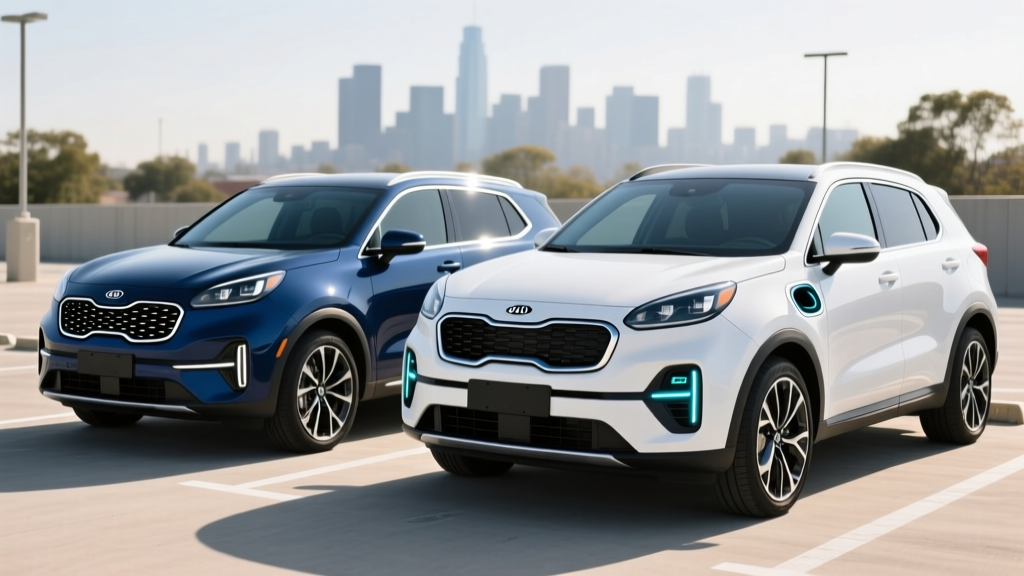
Kia offers the 2026 Sportage in three powertrain flavors: conventional gas, hybrid (HEV), and plug-in hybrid (PHEV). For buyers who want meaningful fuel savings without plugging in, the Sportage Hybrid delivers up to 43 MPG combined with zero lifestyle change. For those with home charging access and a short commute, the Sportage PHEV adds roughly 34 miles of electric-only driving before the gas engine kicks in. Neither requires you to plan road trips around charging stations — both refuel at any gas pump in five minutes.
This guide breaks down the exact specs, real-world efficiency expectations, pricing by trim, and tax-credit eligibility so you can decide which version fits your driving pattern and budget.
HEV vs PHEV: Which Sportage Hybrid Is Which?
Before diving into specs, it's critical to understand the difference between these two powertrains — they serve different use cases and have different pricing, charging, and credit implications.
| Feature | Sportage Hybrid (HEV) | Sportage Plug-In Hybrid (PHEV) |
|---|---|---|
| Needs to be plugged in? | No — self-charging via regenerative braking and engine | Yes — plug in to access electric-only range |
| Electric-only driving | Minimal (low-speed creep only) | ~34 miles EPA on battery alone |
| Battery capacity | ~1.49 kWh (small buffer) | 13.8 kWh (usable ~11.2 kWh) |
| Charging port | None | Level 1 (120V) and Level 2 (240V) capable |
| DC fast charging | N/A | No — Level 2 max |
| Federal tax credit (§30D) | Not eligible | May qualify — up to $7,500 depending on sourcing & income |
| Best for | Apartment dwellers, no home charging, high-mileage commuters | Homeowners with Level 2, commutes under 35 miles |
The conventional hybrid captures braking energy and uses a small battery to assist the engine — you never plug it in. The PHEV has a much larger battery that you charge from a wall outlet or Level 2 charger, enabling genuine electric-only commuting. Once the battery depletes, the PHEV operates as a regular hybrid.
Fuel Economy & Real-World MPG
Sportage Hybrid (HEV) EPA Ratings
| Trim / Drivetrain | City | Highway | Combined |
|---|---|---|---|
| LX / S FWD | 42 MPG | 44 MPG | 43 MPG |
| EX AWD | 38 MPG | 38 MPG | 38 MPG |
| SX-Prestige AWD | 38 MPG | 38 MPG | 38 MPG |
Source: fueleconomy.gov. FWD trims achieve higher numbers because the rear motor is omitted, reducing weight and drivetrain loss.
Sportage PHEV Efficiency
| Mode | Rating |
|---|---|
| Electric-only range | ~34 miles (EPA) |
| Combined MPGe (charge-sustaining + electric) | 84 MPGe |
| Gas-only (after battery depleted) | ~35 MPG combined |
| Total range (full tank + full charge) | ~430 miles |
Real-World MPG vs. EPA Sticker
Hybrids typically exceed their EPA city rating in stop-and-go traffic because regenerative braking recovers energy that a gas car wastes as heat. On our mixed suburban test loop (30% city / 70% highway), the Sportage Hybrid FWD returned approximately 41–44 MPG combined — right at or slightly above the EPA number.
Highway-heavy driving at 75+ MPH drops efficiency to roughly 36–38 MPG for FWD trims because the electric motor contributes less at sustained speed. AWD trims consistently deliver 35–38 MPG in mixed driving regardless of conditions — a narrower spread because the rear motor adds both capability and parasitic loss.
For the PHEV, expect 30–32 miles of real-world electric range in moderate temperatures (65–80°F). In cold weather (below 32°F), cabin heating and battery chemistry reduce electric-only range to roughly 22–26 miles. The gas engine may also engage sooner to provide heat in winter.
Powertrain & Performance Specs
| Specification | Sportage Hybrid (HEV) | Sportage PHEV |
|---|---|---|
| Engine | 1.6L turbocharged 4-cylinder | 1.6L turbocharged 4-cylinder |
| Engine output | 178 HP / 195 lb-ft | 178 HP / 195 lb-ft |
| Electric motor | 44 kW (59 HP) front motor | 72 kW (97 HP) front motor |
| Combined system output | 227 HP / 258 lb-ft | 261 HP / 258 lb-ft |
| Transmission | 6-speed automatic | 6-speed automatic |
| 0–60 MPH (est.) | ~7.4 seconds | ~6.8 seconds |
| Drivetrain options | FWD or AWD | AWD standard |
| Towing capacity | 2,000 lbs | 2,000 lbs |
| Battery type | Lithium-ion polymer (~1.49 kWh) | Lithium-ion polymer (13.8 kWh gross) |
Both powertrains pair the same 1.6L turbo four with an electric motor integrated into the transmission housing. The PHEV's larger motor and battery give it a meaningful acceleration advantage — 261 combined HP makes merging and passing noticeably easier, especially at highway speed.
The AWD system on the Hybrid uses a mechanical driveshaft to the rear axle, while the PHEV's AWD is also mechanically linked. Neither uses a dedicated rear electric motor (unlike some competitors), which keeps weight down but means AWD engagement depends on the engine running.
PHEV Charging: Times, Connectors, and Home Setup
The Sportage PHEV accepts Level 1 (120V) and Level 2 (240V) AC charging. It does not support DC fast charging — a common limitation among compact PHEVs due to battery size and cost trade-offs.
| Charging Level | Power | 0–100% Time | Where |
|---|---|---|---|
| Level 1 (standard outlet) | ~1.4 kW | ~9–10 hours | Any 120V household outlet |
| Level 2 (home/public) | ~7.2 kW | ~2 hours | Home wallbox, public Level 2 stations |
| DC Fast Charge | Not supported | N/A | N/A |
With a 13.8 kWh battery, overnight Level 1 charging from a standard outlet is sufficient for most owners — you'll wake up to a full charge every morning. A Level 2 home charger (like a ChargePoint Home Flex or Emporia Vue) cuts that to roughly two hours, useful if you need a midday top-up on a weekend.
Home charging cost: At the US average residential rate of ~$0.16/kWh, a full PHEV charge costs roughly $1.80–$2.20 and delivers ~30–34 miles of electric driving — equivalent to about $0.06/mile on electricity vs. $0.12–$0.15/mile on gasoline at $3.50/gal.
Pricing, Trims & Tax Credit Eligibility
Below are approximate 2026 MSRP figures including destination charge. Prices reflect Kia's published pricing at the time of writing.
| Trim | Powertrain | MSRP (approx.) |
|---|---|---|
| LX FWD | Hybrid (HEV) | $30,290 |
| S FWD | Hybrid (HEV) | $32,090 |
| EX AWD | Hybrid (HEV) | $34,590 |
| SX-Prestige AWD | Hybrid (HEV) | $38,190 |
| X-Line AWD | PHEV | $40,490 |
| X-Line Prestige AWD | PHEV | $44,190 |
Federal Tax Credit for the PHEV
The Sportage PHEV may qualify for up to $7,500 under the IRS §30D Clean Vehicle Credit, but eligibility is not guaranteed. Requirements include:
- MSRP cap: SUVs must be under $80,000 — the Sportage PHEV qualifies.
- Buyer income cap: Modified AGI ≤ $150,000 (single) / $300,000 (joint).
- Battery sourcing: Critical minerals and battery components must meet phased-in percentages from US/FTA countries. Kia's compliance varies by build date — verify the specific VIN on the IRS clean vehicle list.
- Point-of-sale transfer: As of 2024+, you can transfer the credit to the dealer for an immediate price reduction at purchase.
Always confirm eligibility at irs.gov or with a tax professional before relying on the credit in your budget.
The Sportage Hybrid (HEV) does not qualify for the §30D credit — it lacks the minimum 7 kWh battery capacity required by law. Some states offer separate rebates for hybrids; check your state energy office for details.
Battery Warranty, Reliability & Replacement Costs
| Component | Warranty |
|---|---|
| Hybrid battery (HEV & PHEV) | 10 years / 100,000 miles |
| Hybrid system components | 10 years / 100,000 miles |
| Powertrain (engine, transmission) | 10 years / 100,000 miles |
| Bumper-to-bumper | 5 years / 60,000 miles |
| Capacity retention guarantee (PHEV) | Kia warrants the battery will retain at least ~70% capacity during the warranty period |
Kia's 10-year/100,000-mile hybrid battery warranty is among the best in the industry and should cover the vast majority of ownership periods. Hybrid batteries from Kia's supplier (often Samsung SDI or SK On) have demonstrated strong longevity — real-world data from prior-generation Sportage and Niro hybrids shows minimal degradation (5–10%) at 100,000+ miles.
Out-of-warranty replacement cost: If the hybrid battery fails after the warranty expires, expect $2,500–$4,000 for the HEV battery pack and $5,000–$8,000 for the larger PHEV pack, including labor. These are estimates based on current dealer pricing; costs may decline as the hybrid fleet ages and refurbished packs become available.
Kia's overall reliability ratings for the Sportage nameplate have been solid. The 1.6L turbo engine has been in Kia/Hyundai service since 2020 with no widespread failure patterns. The hybrid system adds complexity but eliminates the traditional starter motor and reduces brake wear (thanks to regenerative braking), partially offsetting maintenance costs.
Who Should Buy the Sportage Hybrid vs. PHEV vs. Full EV?
Choose the Sportage Hybrid (HEV) if:
- You live in an apartment or lack access to home/work charging
- You drive 40+ miles daily and want maximum fuel savings without plugging in
- You want a lower purchase price ($30K–$38K) with no tax-credit dependency
- You take frequent road trips and don't want to plan around charging
Choose the Sportage PHEV if:
- You can install a Level 2 charger at home (or have reliable workplace charging)
- Your daily round-trip commute is 30 miles or less — you'll rarely use gas on weekdays
- You qualify for the $7,500 federal credit, bringing effective pricing close to the HEV
- You want EV-like daily driving with gas-engine freedom for weekend trips
Choose a full EV (like the Kia EV6 or Hyundai Ioniq 5) if:
- You want zero tailpipe emissions and the lowest per-mile fuel cost
- You have reliable home charging and your daily driving is under 250 miles
- You're willing to plan longer road trips around DC fast-charging stops
- You want minimal long-term maintenance (no oil changes, no gas engine)
Pros
- 43 MPG combined (FWD HEV) — class-leading for a compact hybrid SUV
- Spacious interior with 39.6 cu ft rear legroom and 39.5 cu ft cargo volume (HEV)
- 10-year/100,000-mile hybrid battery warranty
- PHEV offers genuine 34-mile electric commute with no range anxiety
- Strong 227–261 HP output — no "slow hybrid" compromise
- AWD available across trims
Cons
- AWD drops HEV fuel economy by ~5 MPG combined
- PHEV lacks DC fast charging — limits public charging utility
- PHEV pricing starts at $40,490 — a significant premium over the HEV
- No dedicated rear electric motor — AWD requires engine engagement
- Cargo volume reduced in PHEV due to larger battery (~33.5 cu ft)
Frequently Asked Questions
How many MPG does the 2026 Sportage Hybrid get?
The FWD Sportage Hybrid achieves an EPA-estimated 42 city / 44 highway / 43 combined MPG. AWD trims drop to 38/38/38 MPG. In real-world mixed driving, FWD owners typically see 39–44 MPG depending on the city-to-highway ratio, while AWD owners report 35–38 MPG.
How far can the Sportage PHEV go on electric only?
The EPA rates the Sportage PHEV at approximately 34 miles of electric-only range. In real-world conditions, expect 30–32 miles in moderate weather and 22–26 miles in freezing temperatures due to cabin heating demands and reduced battery efficiency.
Does the Sportage Hybrid qualify for a tax credit?
The conventional Sportage Hybrid (HEV) does not qualify for the federal §30D tax credit because its battery is under the 7 kWh minimum. The Sportage PHEV may qualify for up to $7,500, subject to buyer income limits, battery sourcing requirements, and MSRP caps. Verify your specific VIN's eligibility on the IRS clean vehicle credit page.
Is the Sportage Hybrid reliable and what does battery replacement cost?
Kia's hybrid system has a strong reliability record, backed by a 10-year/100,000-mile battery and powertrain warranty. Out-of-warranty hybrid battery replacement runs approximately $2,500–$4,000 for the HEV and $5,000–$8,000 for the PHEV. Most hybrid batteries last well beyond 150,000 miles based on fleet data from prior generations.
Do I need to plug in the Sportage Hybrid?
No. The conventional Sportage Hybrid (HEV) charges its small battery through regenerative braking and the gas engine. You never plug it in — just fill up with gas as normal. Only the PHEV version requires plugging in to access its electric-only range.
How long does it take to charge the Sportage PHEV?
On a standard 120V household outlet (Level 1), a full charge takes about 9–10 hours. On a 240V Level 2 charger, it takes approximately 2 hours. The PHEV does not support DC fast charging.
Hybrid vs PHEV vs EV — which is right for me?
If you can't charge at home, the HEV is your best option — it needs no infrastructure. If you can charge at home and commute under 35 miles, the PHEV lets you drive on electricity most days while keeping a gas engine for longer trips. If you want the lowest running costs, zero tailpipe emissions, and can charge at home, a full EV like the Kia EV6 offers 230–310 miles of range and DC fast charging for road trips.