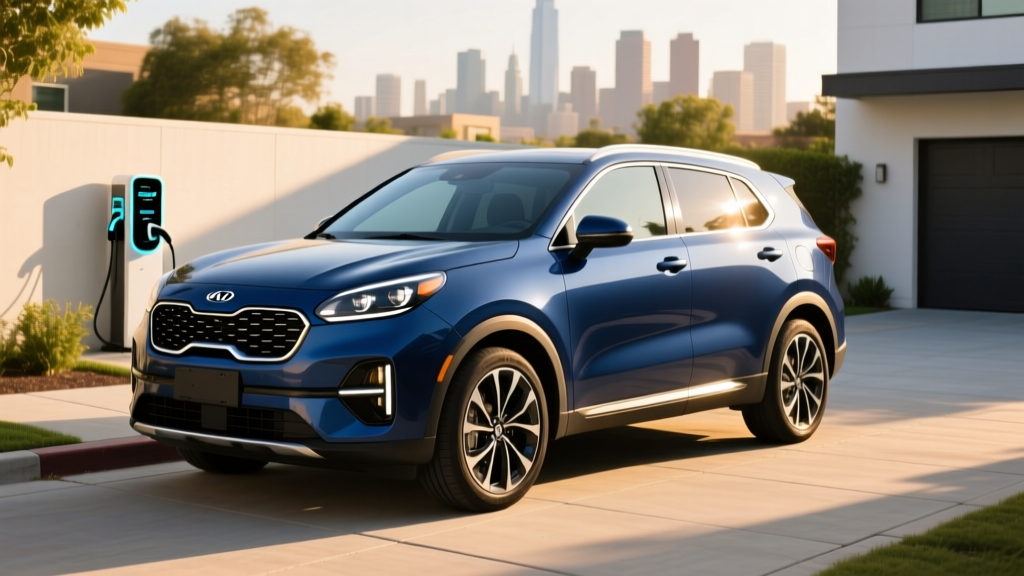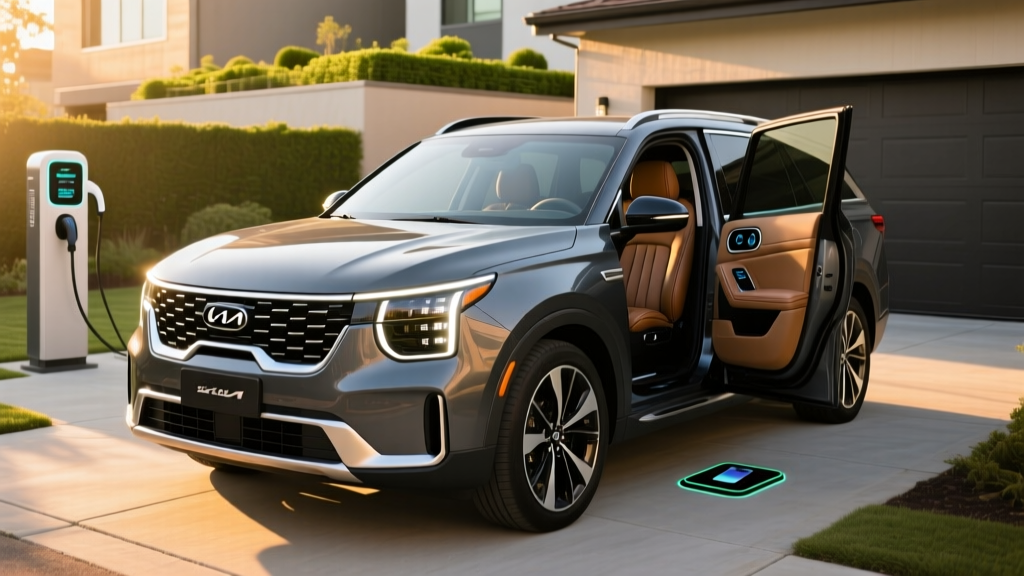
The 2026 Kia Sorento Hybrid SX Prestige sits at the top of Kia's three-row hybrid lineup, packing premium features into a midsize SUV that sips fuel without requiring a plug. For families weighing the practicality of a hybrid against the allure of a full EV or the familiarity of a gas-only crossover, the Sorento HEV makes a data-driven case: 34 MPG combined, 261 combined horsepower, and a well-appointed cabin — all without range anxiety or charging infrastructure concerns.
This review focuses on the SX Prestige trim, the most feature-rich variant in the Sorento Hybrid lineup. We'll also clarify where the Sorento Plug-in Hybrid (PHEV) fits for buyers who can charge at home and want electric-only commuting.
HEV vs PHEV: Which Sorento Hybrid Is Right for You?
Kia offers the Sorento in two electrified flavors, and confusing them is one of the most common buyer mistakes. Here's the critical distinction:
| Feature | Sorento Hybrid (HEV) | Sorento Plug-In Hybrid (PHEV) |
|---|---|---|
| Plug-in charging required? | No — self-charging via regenerative braking and engine | Yes — plug in to access electric-only driving |
| Electric-only range | Not applicable (motor assists engine only) | ~32 miles (EPA est.) |
| Combined horsepower | 261 hp | 261 hp |
| Engine | 1.6L turbocharged 4-cyl + electric motor | 1.6L turbocharged 4-cyl + electric motor |
| Battery capacity | ~1.49 kWh (small buffer) | ~13.8 kWh usable |
| EPA combined MPG/MPGe | 34 MPG | 79 MPGe (electric+gas) / 34 MPG (gas only) |
| Starting MSRP (SX Prestige) | ~$46,790 | ~$51,790 |
| Federal tax credit | Not eligible | Eligible — up to $7,500 (§30D, subject to sourcing/income rules) |
| Best for | No home charging access; want simplicity | Home charging available; short commute on electric |
Bottom line: If you can install a Level 2 charger at home and your daily commute is under 30 miles, the PHEV lets you drive on electricity most weekdays while keeping the gas engine for road trips. If you live in an apartment, lack garage access, or simply want zero behavior change from your gas car, the HEV is the pragmatic choice.
Fuel Economy: EPA Ratings and Real-World MPG
The 2026 Sorento Hybrid SX Prestige carries EPA ratings of 34 MPG city / 34 MPG highway / 34 MPG combined, according to fueleconomy.gov. That consistency between city and highway is a hallmark of Kia's hybrid system — the electric motor smooths out stop-and-go inefficiency that plagues gas-only engines.
| Driving Condition | EPA Rating | Real-World Expectation |
|---|---|---|
| City | 34 MPG | 34–37 MPG (hybrids often exceed EPA in city due to regen braking) |
| Highway (70+ mph) | 34 MPG | 30–33 MPG (aerodynamic drag reduces hybrid advantage at speed) |
| Combined | 34 MPG | 32–35 MPG (varies with terrain, climate, driving style) |
| Cold weather (below 30°F) | — | 28–31 MPG (engine runs more often for cabin heat) |
Why hybrids often beat EPA in the city: Conventional hybrids recapture kinetic energy during braking and low-speed deceleration, feeding it back into the battery. In dense urban traffic with frequent stops, this regenerative cycle is maximized. On sustained highway runs, the electric motor contributes less and the 1.6L turbo does the heavy lifting, so real-world highway MPG tends to dip slightly below the EPA sticker.
For a midsize three-row SUV, 34 MPG combined is competitive. The Toyota Highlander Hybrid returns 35 MPG combined but offers less cargo versatility. The Hyundai Santa Fe Hybrid — a corporate cousin sharing the same powertrain — posts 34 MPG combined as well.
Powertrain and Performance Specs
| Specification | 2026 Sorento Hybrid SX Prestige |
|---|---|
| Engine | 1.6L turbocharged inline-4 |
| Engine output | 178 hp / 195 lb-ft torque |
| Electric motor output | 47.7 kW (~64 hp) / 195 lb-ft torque |
| Combined system output | 261 hp / 271 lb-ft torque |
| Transmission | 6-speed automatic (torque-converter, not CVT) |
| Drivetrain | AWD (standard on SX Prestige) |
| 0–60 mph (est.) | ~7.5 seconds |
| Towing capacity | 2,000 lbs (braked) |
| Battery (traction) | ~1.49 kWh lithium-ion (NMC chemistry) |
| Fuel tank | 14.8 gallons |
| Total driving range (est.) | ~503 miles (at combined MPG) |
Kia's decision to pair the hybrid system with a conventional 6-speed automatic rather than a CVT is a meaningful differentiator. The result is more natural-feeling acceleration without the rubber-band drone that CVTs produce under hard throttle. The AWD system uses a rear-mounted electric motor to power the rear axle when traction demands it — there's no mechanical driveshaft connecting the engine to the rear wheels, which improves packaging and reduces parasitic loss.
The 261 combined horsepower is more than adequate for merging, passing, and climbing grades with a full load of passengers. It's noticeably quicker than the Toyota Highlander Hybrid's 243 hp and feels responsive around town where the electric motor's instant torque fills in before the turbo spools.
SX Prestige Trim: What You Get for the Money
The SX Prestige is the top-tier trim for the Sorento Hybrid, and it carries a 2026 MSRP of approximately $46,790 (including destination). That positions it roughly $5,000 above the mid-range EX Hybrid and $8,000 above the base S Hybrid.
Key SX Prestige features include:
- Synthetic leather (Sofino) seating surfaces with heated and ventilated front seats
- Heated steering wheel
- 12.3-inch digital instrument cluster + 12.3-inch infotainment touchscreen
- Wireless Apple CarPlay and Android Auto
- Harman Kardon premium audio (12 speakers)
- Highway Driving Assist 2 (HDA2) — Level 2 driver assistance with lane-centering and adaptive cruise
- Blind-spot view monitor and rear cross-traffic collision-avoidance assist
- Surround-view monitor (360° camera)
- Power liftgate with smart open
- 19-inch alloy wheels
- LED projection headlights with auto-leveling
Pros
- 34 MPG combined in a three-row SUV — no plug needed
- 6-speed automatic avoids CVT drone
- SX Prestige loaded with premium tech at a reasonable price
- AWD standard with electric rear axle
- Strong hybrid battery warranty (10 yr/100k mi)
Cons
- Third row tight for adults on longer trips
- 2,000-lb towing limit is modest for the class
- No federal tax credit for HEV variant
- Highway MPG dips in real-world 70+ mph driving
- Cargo space behind 3rd row is limited (12.6 cu ft)
Tax Credit and Incentive Eligibility
The conventional Sorento Hybrid (HEV) does not qualify for the federal §30D Clean Vehicle Credit. That credit applies only to plug-in electric vehicles (BEVs and PHEVs) meeting battery sourcing, MSRP cap, and buyer income requirements.
If you're considering the Sorento Plug-In Hybrid (PHEV) instead, it may qualify for up to $7,500 under current IRS rules, but eligibility is not automatic. Here's the checklist:
- MSRP cap: SUVs must be under $80,000 — the Sorento PHEV qualifies
- Buyer income cap: AGI must not exceed $150,000 (single), $225,000 (head of household), or $300,000 (joint) — check your tax situation
- Battery sourcing: Critical minerals and battery components must meet phased-in percentage thresholds per IRS guidance; verify current-year compliance at irs.gov
- Point-of-sale transfer: Since 2024, buyers can transfer the credit to the dealer for an upfront price reduction — confirm dealer participation
State-level incentives vary widely. Some states offer rebates for hybrids or PHEVs that stack with federal credits. Check your state's energy or environmental agency for current programs. A tax professional can confirm your specific eligibility — never assume credit availability based on MSRP alone.
Battery Warranty, Reliability, and Replacement Cost
Kia Hybrid Battery Warranty
Coverage: 10 years / 100,000 miles (whichever comes first)
Applies to: Hybrid battery pack, hybrid control unit, and related hybrid-system components
Capacity threshold: Kia replaces or repairs the battery if it falls below approximately 70% of original capacity during the warranty period (confirm with dealer for exact threshold)
Kia's 10-year/100,000-mile hybrid battery warranty is among the best in the industry, matching Hyundai's coverage and exceeding Toyota's 10-year/150,000-mile hybrid battery warranty (note: Toyota extended coverage to 150k miles starting with 2020+ models).
Real-world degradation: The Sorento HEV's 1.49 kWh traction battery is small and operates in a narrow state-of-charge window (typically 40–80%), which dramatically reduces stress on the cells. Hybrid batteries rarely require replacement within the first 150,000–200,000 miles when the thermal management system functions properly. This is fundamentally different from a full EV's large pack, which cycles through deeper charge ranges daily.
Replacement cost (out of warranty): If the hybrid battery does need replacement beyond the warranty window, expect $2,500–$4,500 for the Sorento HEV's relatively small pack, including labor. This is substantially less than a full EV battery replacement ($8,000–$20,000+). The PHEV's larger 13.8 kWh pack would cost more — roughly $6,000–$9,000 out of warranty.
Kia's overall reliability track record for the Sorento Hybrid has been solid since the current generation launched. The 1.6L turbo engine and 6-speed automatic are proven components shared across Hyundai-Kia products. For the latest safety ratings, check NHTSA and IIHS when test results are published.
Who Should Buy the Sorento Hybrid SX Prestige?
Choose the Sorento HEV (this car) if:
- You lack access to home or workplace charging
- You want a three-row SUV under $50,000 with premium features
- Your driving mix includes significant highway miles where EVs lose efficiency advantage
- You tow occasionally (up to 2,000 lbs) and don't want to manage EV range while towing
- You want zero behavior change from your current gas-car routine
Choose the Sorento PHEV if:
- You can install a Level 2 home charger (240V, ~3.3 kW onboard charger fills the 13.8 kWh pack in ~3.5 hours)
- Your daily commute is under 32 miles round-trip — you'd rarely burn gas on weekdays
- You qualify for the §30D federal credit, effectively narrowing the ~$5,000 price gap with the HEV
Choose a full EV (e.g., Kia EV9, Hyundai Ioniq 5) if:
- You have reliable home charging and your daily driving is under 250 miles
- You want to eliminate fuel costs entirely and reduce maintenance (no oil changes, fewer moving parts)
- You're eligible for the full $7,500 federal credit, making EV price-competitive
The Sorento Hybrid SX Prestige occupies a specific niche: families who need three rows, want premium features, drive a mix of city and highway miles, and either can't or don't want to plug in. It's not the most fuel-efficient option in the midsize SUV segment (the Highlander Hybrid edges it by 1 MPG), but it offers more engaging driving dynamics, a more intuitive transmission, and Kia's strong warranty coverage.
Real-World Ownership Costs: 5-Year Estimate
| Cost Category | Sorento HEV SX Prestige | Gas-Only Competitor (avg. 24 MPG) |
|---|---|---|
| Purchase price (MSRP) | $46,790 | $44,000 |
| Fuel (75,000 mi, $3.40/gal avg) | $7,500 | $10,625 |
| Maintenance (5 yr) | $3,200 | $3,800 |
| Insurance (avg. national) | $8,400 | $7,800 |
| Federal tax credit | $0 | $0 |
| Estimated 5-yr depreciation | $21,000 | $20,500 |
| Total 5-yr cost of ownership | ~$64,890 | ~$66,725 |
The Sorento Hybrid saves roughly $1,800–$2,000 over five years compared to a similarly priced gas-only midsize SUV, primarily through fuel savings. The gap widens if gas prices rise or if you drive more than 15,000 miles annually. Insurance premiums for hybrids are marginally higher due to repair complexity, but the difference has narrowed significantly as hybrid adoption has grown.
Frequently Asked Questions
How many MPG does the 2026 Kia Sorento Hybrid SX Prestige get?
The EPA rates it at 34 MPG city, 34 MPG highway, and 34 MPG combined. In real-world city driving with frequent stops, owners often see 35–37 MPG thanks to regenerative braking. Sustained highway driving at 75+ mph typically returns 30–33 MPG.
Does the Sorento Hybrid need to be plugged in?
No. The conventional Sorento Hybrid (HEV) charges its small battery entirely through regenerative braking and the gasoline engine. You fuel it exactly like a gas car. Only the Sorento Plug-In Hybrid (PHEV) variant benefits from being plugged in.
How far can the Sorento PHEV go on electric only?
The Sorento Plug-In Hybrid delivers an EPA-estimated 32 miles of electric-only range on a full charge. That covers most daily commutes without engaging the gas engine. Once the battery depletes, it operates as a conventional hybrid at approximately 34 MPG combined.
Is the hybrid battery reliable and what does replacement cost?
Kia covers the hybrid battery for 10 years / 100,000 miles. Hybrid batteries in modern Kia vehicles typically last 150,000–200,000+ miles before significant degradation. Out-of-warranty replacement for the HEV's small pack runs $2,500–$4,500 — far less than a full EV battery swap.
Does the 2026 Sorento Hybrid qualify for any tax credit?
The conventional HEV does not qualify for the federal §30D credit (that's for plug-in vehicles only). The Sorento PHEV may qualify for up to $7,500, subject to buyer income limits, battery sourcing rules, and MSRP caps. Check IRS guidance and consult a tax professional.
How does the Sorento Hybrid compare to the Toyota Highlander Hybrid?
The Highlander Hybrid returns 35 MPG combined (1 MPG more) and offers a slightly larger third row. The Sorento Hybrid counters with more engaging driving dynamics (6-speed automatic vs. CVT), a more tech-forward interior at the SX Prestige level, and a lower starting price for equivalent trim content. Both are strong choices — test-drive both to compare seating comfort and cargo layout.
What is the towing capacity?
The 2026 Sorento Hybrid is rated for 2,000 pounds (braked trailer). That's sufficient for a small utility trailer, a pair of dirt bikes, or a light pop-up camper. If you need to tow heavier loads (boats, large campers), you'll need to look at body-on-frame SUVs or larger crossovers.