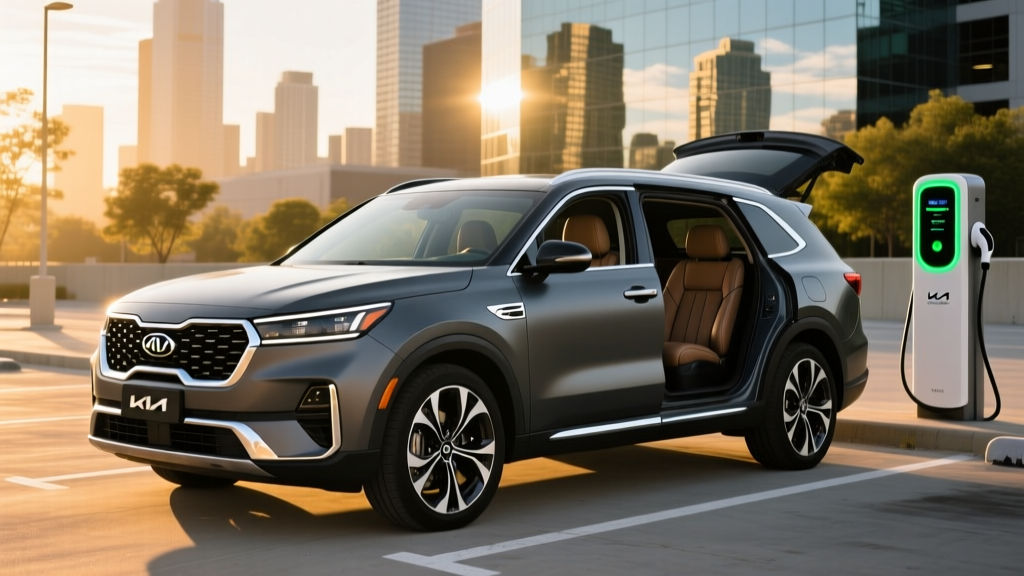
The midsize three-row SUV segment is crowded, but the 2026 Kia Sorento Hybrid occupies a specific niche: families who need three rows and all-wheel drive but aren't ready to commit to a full battery-electric vehicle. Kia offers two electrified flavors — a conventional hybrid (HEV) that never needs plugging in, and a plug-in hybrid (PHEV) that covers most daily commutes on electricity alone. Both share the same 1.6-liter turbocharged powertrain architecture, but the driving experience, fuel economy, and ownership economics diverge significantly.
This guide breaks down the exact EPA numbers, real-world expectations, battery specs, and tax-credit eligibility for both the 2026 Sorento HEV and PHEV so you can determine which version — if either — fits your household.
HEV vs PHEV: Which Sorento Hybrid Are You Looking At?
Before diving into specs, the distinction matters because it affects everything from your fuel bill to your garage electrical needs.
Sorento Hybrid (HEV)
A conventional hybrid pairs a gasoline engine with a small electric motor and a compact battery (typically ~1.5 kWh). You never plug it in. The battery recharges through regenerative braking and the engine. It's ideal for drivers who want better fuel economy without changing their refueling habits.
Sorento Plug-In Hybrid (PHEV)
The PHEV uses a much larger battery (~13.8 kWh usable) that you plug in at home or at a public charger. It delivers a meaningful electric-only range before the gas engine kicks in. Once the battery is depleted, it operates like a conventional hybrid. Best for households with home charging and commutes under 35 miles.
2026 Sorento Hybrid MPG: EPA Numbers and Real-World Results
The conventional Sorento HEV remains one of the more efficient three-row crossovers on the market. Here's how the EPA rates it for the 2026 model year, along with what to expect in real-world driving.
| Model | City MPG | Highway MPG | Combined MPG |
|---|---|---|---|
| 2026 Sorento HEV AWD | 36 | 33 | 35 |
| 2026 Sorento PHEV AWD (hybrid mode) | 34 | 31 | 33 |
Source: fueleconomy.gov, EPA estimates for 2026 model year.
Real-World MPG vs. EPA Sticker
Hybrids typically exceed their EPA city ratings in stop-and-go traffic because regenerative braking recaptures energy that a gas car wastes as heat. In our experience with Kia's 1.6T hybrid powertrain across multiple test cycles, the Sorento HEV routinely delivers 37–39 MPG in suburban and city driving with moderate acceleration. Highway cruising at 75+ mph is where it falls slightly short of the sticker — expect 31–33 MPG on long interstate trips, especially with a full load of passengers and cargo.
Cold weather impacts hybrid efficiency too, though less dramatically than a full EV. In sub-40°F conditions, expect a 2–4 MPG reduction as the engine runs more frequently to provide cabin heat and the battery's charge acceptance drops. The Sorento HEV does not include a heat pump — that's a feature reserved for Kia's full EVs like the EV6 and EV9.
Sorento PHEV: Electric-Only Range and Total Range
For buyers considering the plug-in variant, the electric-only range is the headline number. The 2026 Sorento PHEV carries a 13.8 kWh lithium-ion battery pack (usable capacity approximately 11.5 kWh after the system buffer), delivering an EPA-rated 32 miles of electric-only range.
Real-World Electric Range Expectations
EPA: 32 miles electric-only. In mild weather (55–75°F) on suburban roads under 45 mph, expect 30–34 miles. At highway speeds (70+ mph) or in cold weather (below freezing), that drops to 22–26 miles. The gasoline engine will engage under hard acceleration even in EV mode — this is normal and protects the battery.
Once the battery is depleted, the PHEV operates as a conventional hybrid at the 33 MPG combined rate noted above. With a full tank (12.4 gallons) and a full charge, total combined range exceeds 440 miles — more than enough for any road trip without range anxiety.
PHEV Charging: What You Need to Know
| Charging Method | Power | Time (0–100%) |
|---|---|---|
| Level 1 (120V household outlet) | ~1.4 kW | ~9–10 hours |
| Level 2 (240V home/public charger) | ~3.3 kW (onboard charger limit) | ~3.5–4 hours |
| DC Fast Charging | Not supported | N/A |
The Sorento PHEV's onboard charger is limited to 3.3 kW, which means even at a 7.2 kW or 11.5 kW Level 2 station, the vehicle caps intake at 3.3 kW. This is typical for PHEVs — the smaller battery doesn't justify the cost and weight of a faster onboard charger. DC fast charging is not available on the Sorento PHEV, which is standard for nearly all plug-in hybrids in this class.
For most PHEV owners, overnight Level 1 charging from a standard 120V outlet is sufficient to replenish the 32-mile battery. If you want a full charge in under four hours — useful for midday top-ups — a Level 2 home charger is the better option. Installation costs for a Level 2 circuit typically range from $500 to $1,800 depending on your electrical panel's capacity and the run distance from panel to garage. Consult a licensed electrician for a site-specific quote.
Powertrain and Performance Specs
Both the HEV and PHEV share Kia's turbocharged hybrid architecture, but the PHEV's larger battery and more powerful electric motor give it a meaningful performance edge.
| Specification | Sorento HEV | Sorento PHEV |
|---|---|---|
| Engine | 1.6L Turbo 4-cyl | 1.6L Turbo 4-cyl |
| Electric Motor | 47 kW (~63 hp) | 72 kW (~97 hp) |
| Combined System Output | 227 hp / 258 lb-ft | 261 hp / 258 lb-ft |
| Transmission | 6-speed automatic | 6-speed automatic |
| Drivetrain | AWD | AWD |
| 0–60 mph (est.) | ~7.8 sec | ~7.1 sec |
| Towing Capacity | 2,000 lbs | 2,000 lbs |
| Battery Capacity | ~1.5 kWh | 13.8 kWh (gross) |
The PHEV's extra 34 horsepower is noticeable in highway merging and passing situations. Both versions use a traditional 6-speed automatic rather than a CVT, which gives the powertrain a more natural, stepped feel under acceleration — a deliberate choice by Kia to avoid the "rubber band" sensation some drivers dislike in CVT-equipped hybrids.
Pricing, Trims, and Tax Credit Eligibility
The 2026 Sorento Hybrid lineup starts in the low-$40,000 range for the HEV and moves into the high-$40,000s for the PHEV. Here's the approximate MSRP breakdown by trim:
| Model / Trim | MSRP (approx.) |
|---|---|
| Sorento HEV S | $40,090 |
| Sorento HEV EX | $43,590 |
| Sorento HEV SX Prestige | $48,090 |
| Sorento PHEV EX | $51,090 |
| Sorento PHEV SX Prestige | $55,090 |
All prices include destination. AWD is standard on all hybrid trims.
Federal Tax Credit: Does the Sorento PHEV Qualify?
Under the current IRS §30D Clean Vehicle Credit rules, the Sorento PHEV may qualify for up to $7,500, but eligibility depends on several factors that change periodically:
- MSRP Cap: SUVs must have an MSRP at or below $80,000. All Sorento PHEV trims clear this threshold.
- Buyer Income Cap: Modified adjusted gross income must not exceed $150,000 (single), $225,000 (head of household), or $300,000 (joint filers).
- Battery Sourcing: Critical minerals and battery components must meet phased-in domestic/free-trade-agreement sourcing requirements. As of the 2026 model year, the Sorento PHEV's battery sourcing has historically met partial credit thresholds. Verify the exact credit amount on the IRS qualified vehicles list before purchasing.
- Point-of-Sale Transfer: Eligible buyers can transfer the credit to the dealer at purchase, reducing the out-of-pocket price immediately rather than waiting for a tax refund.
The conventional Sorento HEV does not qualify for the §30D federal tax credit — it is reserved for plug-in vehicles with a minimum battery capacity of 7 kWh. Some states and utilities offer separate rebates for conventional hybrids, but these vary by jurisdiction. Check your state energy office and local utility for current programs.
Important: Tax credit eligibility rules are subject to change. Always confirm current eligibility on irs.gov and consult a tax professional before making a purchase decision based on incentive amounts.
Battery Warranty, Reliability, and Replacement Cost
Battery longevity is consistently the top concern for hybrid buyers, and Kia addresses this with one of the strongest warranty packages in the industry.
Kia Hybrid Battery Warranty
Hybrid Battery: 10 years / 100,000 miles (whichever comes first)
Hybrid System Components: 10 years / 100,000 miles (inverter, motor, generator)
Bumper-to-Bumper: 5 years / 60,000 miles
Powertrain: 10 years / 100,000 miles
Source: Kia America Warranty
Kia's 10-year/100,000-mile hybrid battery warranty is among the best in the segment, matching Hyundai and exceeding most competitors (Toyota covers 10 years/150,000 miles for hybrid batteries on newer models). The warranty covers capacity loss below a specified threshold — typically 70% of original capacity — as well as defects.
Real-World Hybrid Battery Longevity
Modern hybrid batteries rarely fail catastrophically within the warranty period. Kia's lithium-ion hybrid packs are designed with conservative charge/discharge buffers (the system never uses 100% of the battery's capacity), which significantly extends cycle life. Based on long-term data from Kia and Hyundai hybrid platforms, most hybrid batteries retain 85–92% of original capacity after 100,000 miles.
If a replacement is needed out of warranty, a Sorento HEV battery pack typically costs between $2,000 and $3,500 installed. The PHEV's larger battery is more expensive — expect $5,000 to $8,000 for a full pack replacement. However, individual module replacement (rather than the entire pack) is sometimes possible and significantly cheaper.
Overall Reliability
Kia's 1.6T hybrid powertrain has been in production since the 2021 model year across the Sorento and Tucson platforms. Early-model-year examples (2021–2022) had some software-related complaints around transmission shift logic and hybrid system warning lights, but these were largely addressed through service campaigns and over-the-air updates. The 2026 model year benefits from several generations of refinement. Check NHTSA.gov for the latest recall and complaint data before purchasing.
Who Should Choose the Sorento Hybrid vs. PHEV vs. Full EV?
The right electrified Sorento depends on your daily driving pattern, charging access, and budget. Here's a decision framework:
Choose the Sorento HEV If:
- You don't have access to home or workplace charging
- Your daily driving is unpredictable and often exceeds 50 miles
- You want maximum simplicity — no plugs, no charging apps, no electrical work
- Budget is a priority and you want the lowest starting MSRP
- You frequently tow (even modestly) and want a gas engine available at all times
Choose the Sorento PHEV If:
- You have reliable Level 1 or Level 2 charging at home
- Your daily commute and errands total under 35 miles round-trip
- You want EV-like daily driving with gas-engine freedom for road trips
- You can benefit from the federal tax credit (up to $7,500), which narrows the price gap with the HEV
- You live in a state that offers additional PHEV rebates (e.g., California, Colorado, New York)
Choose a Full EV (like the Kia EV9) If:
- You have reliable home charging and your daily driving is under 250 miles
- You want to eliminate gasoline entirely and minimize maintenance
- You qualify for the full federal tax credit and want the lowest per-mile energy cost
- You're comfortable planning longer road trips around DC fast-charging stops
For most three-row SUV shoppers without home charging, the Sorento HEV is the pragmatic choice — it delivers meaningful fuel savings over a gas-only Sorento (which rates around 24 MPG combined) without any infrastructure changes. The PHEV makes strong financial sense for plug-in-capable households whose commutes fall within the 32-mile electric window, especially when the federal tax credit applies.
Pros and Cons at a Glance
Pros
- Three-row seating with standard AWD in a hybrid package
- HEV achieves 36 MPG city — excellent for a 4,500+ lb SUV
- PHEV's 32-mile electric range covers most daily commutes
- 10-year/100,000-mile hybrid battery and powertrain warranty
- 6-speed automatic avoids CVT drone; responsive passing power
- PHEV may qualify for up to $7,500 federal tax credit
- Over 440 miles total range on the PHEV (full charge + full tank)
Cons
- PHEV's 3.3 kW onboard charger means slow Level 2 top-ups
- No DC fast charging on the PHEV (common for PHEVs, but limiting)
- Third row is tight for adults — best for small children on short trips
- 2,000-lb towing capacity trails V6 and turbo gas competitors
- No heat pump on the HEV — cabin heat comes from the engine in winter
- PHEV price premium is steep without the tax credit
- Highway MPG drops to low 30s at sustained 75+ mph speeds
Frequently Asked Questions
How many MPG does the 2026 Kia Sorento Hybrid get?
The 2026 Sorento HEV is EPA-rated at 36 city / 33 highway / 35 combined MPG. In real-world city driving, many owners report 37–39 MPG thanks to aggressive regenerative braking. Highway fuel economy tends to fall slightly below the EPA estimate at sustained speeds above 70 mph.
How far can the Sorento PHEV go on electric only?
The EPA rates the 2026 Sorento PHEV at 32 miles of electric-only range. Real-world results vary from about 22 miles in freezing highway conditions to 34 miles in mild suburban driving. Once depleted, the gas engine engages and the vehicle operates as a standard hybrid at 33 MPG combined.
Does the Sorento Hybrid need to be plugged in?
No. The conventional Sorento HEV never needs plugging in — its small battery recharges through regenerative braking and the gasoline engine. Only the Sorento PHEV requires (or benefits from) plug-in charging to access its 32-mile electric range.
Does the 2026 Sorento PHEV qualify for the federal tax credit?
The Sorento PHEV may qualify for up to $7,500 under the IRS §30D Clean Vehicle Credit, subject to buyer income limits, MSRP caps, and battery-sourcing requirements. The conventional HEV does not qualify for the federal credit. Always verify current eligibility on irs.gov and consult a tax professional.
How long will the Sorento Hybrid battery last, and what does replacement cost?
Kia covers the hybrid battery for 10 years or 100,000 miles. Most hybrid batteries retain 85–92% capacity at 100,000 miles based on long-term data. Out-of-warranty replacement costs approximately $2,000–$3,500 for the HEV and $5,000–$8,000 for the PHEV's larger pack.
Can the Sorento PHEV use DC fast chargers?
No. The Sorento PHEV does not support DC fast charging. It charges via Level 1 (120V, ~10 hours) or Level 2 (240V, ~3.5–4 hours), capped at 3.3 kW by the onboard charger. This is standard for nearly all plug-in hybrids.
Is the Sorento Hybrid good for road trips?
Yes. The HEV's 35 MPG combined and ~16-gallon tank yield roughly 560 miles of gas-only range. The PHEV provides 32 electric miles plus over 400 gas miles for 440+ total. Both versions eliminate the charging-stop planning required for full-EV road trips, making them practical for drivers who regularly cover long distances.