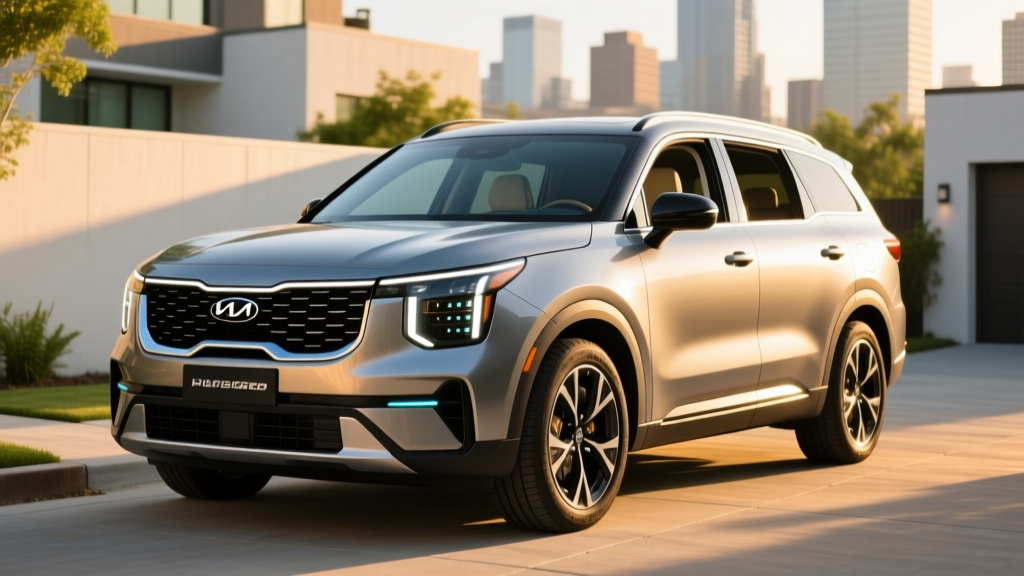
The Kia Sorento occupies a rare middle ground: a three-row midsize SUV that doesn't guzzle fuel. For 2026, Kia continues to offer the Sorento in two electrified flavors — a conventional hybrid (HEV) that requires no plug and a plug-in hybrid (PHEV) that can handle short commutes on electricity alone. If you've been searching for 2026 Kia Sorento Hybrid MPG figures, this guide breaks down every number that matters: EPA ratings, real-world expectations, PHEV electric range, and which version actually saves you more money.
HEV vs PHEV: What's the Difference in the 2026 Sorento?
Before examining fuel economy, it's essential to understand the two distinct powertrains Kia offers. The conventional Sorento Hybrid (HEV) uses a small battery and electric motor to assist the gas engine. It charges itself through regenerative braking and engine power — you never plug it in. The Sorento Plug-in Hybrid (PHEV) carries a much larger battery that you charge from a wall outlet or public station, enabling pure-electric driving for a meaningful distance before the gas engine engages.
Quick Comparison: Sorento HEV vs Sorento PHEV
| Feature | Sorento Hybrid (HEV) | Sorento Plug-in Hybrid (PHEV) |
|---|---|---|
| Plug-in required? | No — self-charging | Yes — plug in for electric range |
| Battery capacity | ~1.49 kWh | ~13.8 kWh |
| Electric-only driving | Brief low-speed assist only | Up to 32 miles (EPA) |
| Combined horsepower | 232 hp | 261 hp |
| Drivetrain | AWD standard | AWD standard |
| Federal tax credit | Not eligible | Eligibility varies by sourcing |
2026 Kia Sorento Hybrid MPG: EPA Ratings and Real-World Numbers
The Sorento HEV pairs a 1.6-liter turbocharged four-cylinder engine with a 47.7 kW electric motor and a six-speed automatic transmission. Combined system output is 232 horsepower and 262 lb-ft of torque, routed through standard all-wheel drive.
EPA Fuel Economy: Sorento Hybrid (HEV)
| Driving Cycle | EPA Rating |
|---|---|
| City | 34 MPG |
| Highway | 34 MPG |
| Combined | 34 MPG |
Source: fueleconomy.gov
Real-World MPG: What Owners Actually See
Hybrids traditionally overperform their EPA city ratings because regenerative braking recaptures energy in stop-and-go traffic. The Sorento HEV is no exception. In mixed suburban driving with frequent stops, owners regularly report 35–37 MPG. On sustained highway trips at 70–75 mph, expect a dip to roughly 30–32 MPG — the boxy three-row shape and AWD drivetrain create parasitic losses that electric assist can't fully offset at speed. In cold weather (below 35°F), the engine runs more often for cabin heat, knocking combined figures to approximately 30–31 MPG until the powertrain warms up.
The flat city/highway EPA split (34/34) is unusual and reflects the efficiency of Kia's hybrid system at maintaining momentum. If most of your driving is urban, the Sorento HEV will likely exceed its sticker number.
2026 Sorento Plug-in Hybrid: Electric Range and MPGe
The Sorento PHEV uses the same 1.6-liter turbo engine but pairs it with a more powerful 72 kW electric motor and a 13.8 kWh lithium-ion battery pack. Combined output rises to 261 horsepower and 271 lb-ft of torque.
EPA Efficiency: Sorento PHEV
| Metric | EPA Rating |
|---|---|
| Electric-only range | 32 miles |
| MPGe (electric + gas) | 79 MPGe |
| Gas-only (after battery depletes) | 33 MPG combined |
| Total combined range | ~420 miles |
Source: fueleconomy.gov
Charging the PHEV: Times and Hardware
The PHEV's 13.8 kWh battery charges via the standard J1772 connector (Level 1 and Level 2 AC). It does not support DC fast charging — a limitation common among PHEVs due to smaller battery sizes where DC infrastructure adds cost without proportional benefit.
| Charging Level | Power | Time (0–100%) |
|---|---|---|
| Level 1 (120V household) | ~1.4 kW | ~10 hours |
| Level 2 (240V, 32A) | ~7.2 kW | ~2 hours |
| DC Fast Charge | Not supported | N/A |
For most PHEV owners, overnight Level 1 charging from a standard outlet is sufficient to refill 32 miles of range. A Level 2 home charger cuts that to roughly two hours, which is useful if you want to top up mid-day.
Real-World Electric Range
The EPA's 32-mile electric estimate assumes moderate temperatures and mixed driving. In practice, expect 28–30 miles in warm weather with gentle acceleration. In cold conditions (below 40°F), battery efficiency drops and cabin heating draws from the pack, reducing usable electric range to roughly 22–25 miles. Highway-speed electric driving at 70 mph will also deplete the battery faster — plan on about 25 miles at sustained interstate speeds.
Powertrain and Performance Breakdown
2026 Kia Sorento Hybrid & PHEV Specifications
| Specification | Sorento HEV | Sorento PHEV |
|---|---|---|
| Engine | 1.6L turbo I-4 | 1.6L turbo I-4 |
| Electric motor | 47.7 kW | 72 kW |
| Combined horsepower | 232 hp | 261 hp |
| Combined torque | 262 lb-ft | 271 lb-ft |
| Transmission | 6-speed auto | 6-speed auto |
| Drivetrain | AWD | AWD |
| Battery capacity | 1.49 kWh | 13.8 kWh |
| 0–60 mph (est.) | ~7.8 sec | ~7.2 sec |
| Towing capacity | 2,000 lbs | 2,000 lbs |
| Seating | 6 passengers (3 rows) | 6 passengers (3 rows) |
Both powertrains deliver smooth, linear acceleration typical of hybrid systems. The electric motor fills in torque at low RPMs where the turbo four-cylinder would otherwise lag. The PHEV's stronger motor makes it noticeably quicker off the line and more confident during highway merging — particularly when the battery has charge.
Pricing, Trims, and Tax Credit Eligibility
Sorento Hybrid (HEV) Pricing
| Trim | MSRP (2026 est.) |
|---|---|
| S Hybrid | $40,090 |
| EX Hybrid | $43,390 |
| SX Prestige Hybrid | $47,490 |
Sorento Plug-in Hybrid (PHEV) Pricing
| Trim | MSRP (2026 est.) |
|---|---|
| EX PHEV | $51,090 |
| SX Prestige PHEV | $55,490 |
Federal Tax Credit: Does the Sorento PHEV Qualify?
Under IRS §30D Clean Vehicle Credit rules, plug-in hybrids with sufficient battery capacity can qualify for up to $7,500. However, eligibility for the 2026 Sorento PHEV depends on several factors that change frequently:
- MSRP cap: SUVs must be priced at or below $80,000 — the Sorento PHEV clears this easily.
- Buyer income cap: Modified AGI must not exceed $300,000 (joint), $225,000 (head of household), or $150,000 (single).
- Battery component sourcing: A percentage of battery components must be manufactured or assembled in North America. This threshold increases annually.
- Critical minerals: A percentage of critical minerals must be sourced from the U.S. or a free-trade-agreement country.
- Point-of-sale transfer: Eligible buyers can transfer the credit to the dealer at purchase, reducing the out-of-pocket price immediately.
The conventional Sorento HEV does not qualify for the §30D credit — it lacks the minimum battery capacity required. Some states offer separate hybrid incentives; check your state's energy office for current programs.
Battery Warranty and Long-Term Reliability
Kia backs both the Sorento HEV and PHEV hybrid battery packs with a 10-year / 100,000-mile warranty (in states that follow California emissions rules; in other states, 10 years/100,000 miles still applies to the hybrid battery specifically). This warranty covers defects and capacity loss below a defined threshold — typically around 70% of original capacity.
How Long Will the Hybrid Battery Last?
Modern lithium-ion hybrid batteries from Kia have proven durable. The HEV's small 1.49 kWh pack undergoes shallow charge cycles (it never fully depletes or fully charges), which dramatically extends cycle life. Expect 150,000–200,000+ miles before meaningful degradation. The PHEV's larger 13.8 kWh pack sees deeper cycles but benefits from active thermal management. Real-world data from earlier Kia PHEVs suggests 10–15 years of service before capacity loss becomes noticeable.
Battery Replacement Cost
Out-of-warranty replacement for the HEV battery typically runs $2,000–$3,500 including labor. The PHEV's larger pack is costlier — approximately $5,000–$8,000 depending on the service center. Given the 10-year warranty and observed longevity, most original owners will never face this expense.
Who Should Choose the HEV, PHEV, or a Full EV?
Decision Framework: Which Sorento Fits Your Life?
Choose the Sorento HEV if:
- You cannot charge at home (apartment, street parking, no garage)
- Your commute is long and mostly highway
- You want three rows, AWD, and 34 MPG with zero behavior change
- You want the lowest purchase price among electrified Sorentos
Choose the Sorento PHEV if:
- You can charge at home (even a standard 120V outlet works overnight)
- Your daily round-trip commute is under 30 miles
- You want electric driving for errands but gas flexibility for road trips
- You want 261 hp and the most refined driving experience in the lineup
Choose a full EV (like the Kia EV9) if:
- You have reliable home Level 2 charging
- You rarely drive more than 250 miles in a single day
- You want the lowest per-mile fuel cost and zero tailpipe emissions
- You're willing to plan around DC fast charging on road trips
The Sorento HEV's biggest advantage is simplicity — you drive it exactly like a gas car and it delivers 34 MPG without any infrastructure dependency. The PHEV makes sense for households with a predictable short commute and home charging: you'll burn almost no gasoline on weekdays and still have a 420-mile total range for weekend trips. If your daily driving regularly exceeds 32 miles, the PHEV's premium over the HEV takes longer to recoup, and the HEV may be the smarter financial choice.
Pros and Cons at a Glance
Pros
- 34 MPG combined (HEV) is exceptional for a three-row AWD SUV
- Standard AWD across all hybrid trims
- 10-year/100,000-mile hybrid battery warranty
- PHEV offers 32 miles of electric-only range for daily commutes
- Smooth, torque-rich acceleration from hybrid powertrain
- No range anxiety — gas engine provides unlimited range
Cons
- PHEV does not support DC fast charging
- Third row is tight for adults on longer trips
- HEV is not eligible for the federal §30D tax credit
- Highway MPG drops to ~30–32 real-world for both variants
- PHEV price premium (~$8,000 over HEV) requires high electric-utilization to justify
- 2,000-lb towing capacity trails some V6 competitors
Frequently Asked Questions
How many MPG does the 2026 Kia Sorento Hybrid get?
The Sorento HEV is EPA-rated at 34 MPG city, 34 MPG highway, and 34 MPG combined. Real-world testing shows many owners achieve 35–37 MPG in city and suburban driving, with highway figures closer to 30–32 MPG at sustained speeds above 70 mph.
How far can the Sorento PHEV go on electric only?
The EPA rates the Sorento PHEV at 32 miles of electric-only range. In warm weather with moderate driving, expect 28–30 miles. Cold weather and highway speeds reduce that to approximately 22–25 miles before the gas engine engages.
Do I need to plug in the Sorento Hybrid (HEV)?
No. The conventional Sorento Hybrid is self-charging — it recovers energy through regenerative braking and the engine. There is no plug and no electric-only driving mode of meaningful distance. Only the PHEV variant requires (and benefits from) plugging in.
Is the Sorento Hybrid reliable?
Kia's 1.6L turbo hybrid powertrain has been in service across multiple models since 2021 with generally positive reliability data. The hybrid battery carries a 10-year/100,000-mile warranty. Long-term owners of earlier Kia hybrid systems report battery lifespans exceeding 150,000 miles without significant degradation.
What does a Sorento hybrid battery replacement cost?
The HEV battery costs approximately $2,000–$3,500 to replace out of warranty. The PHEV battery runs $5,000–$8,000. Given Kia's 10-year/100,000-mile warranty coverage and the observed longevity of modern lithium-ion packs, most owners will sell the vehicle before facing this expense.
Does the 2026 Sorento Hybrid qualify for a tax credit?
The conventional Sorento HEV does not qualify for the federal §30D Clean Vehicle Credit. The Sorento PHEV may qualify for up to $7,500 depending on battery sourcing requirements, buyer income, and MSRP caps. Eligibility rules change annually — consult the IRS Clean Vehicle Credit page and a tax professional before purchasing.
How does the Sorento Hybrid compare to a full EV like the Kia EV9?
The EV9 offers 230–304 miles of EPA range, zero tailpipe emissions, and far lower per-mile fuel costs, but requires home charging infrastructure and planning for road trips. The Sorento Hybrid offers 34 MPG with no charging needed and unlimited range from gasoline. If you can't charge at home or regularly drive 300+ miles in a day, the Sorento Hybrid is the more practical choice. If you have Level 2 home charging and mostly drive under 200 miles daily, the EV9 will cost less to operate over time.