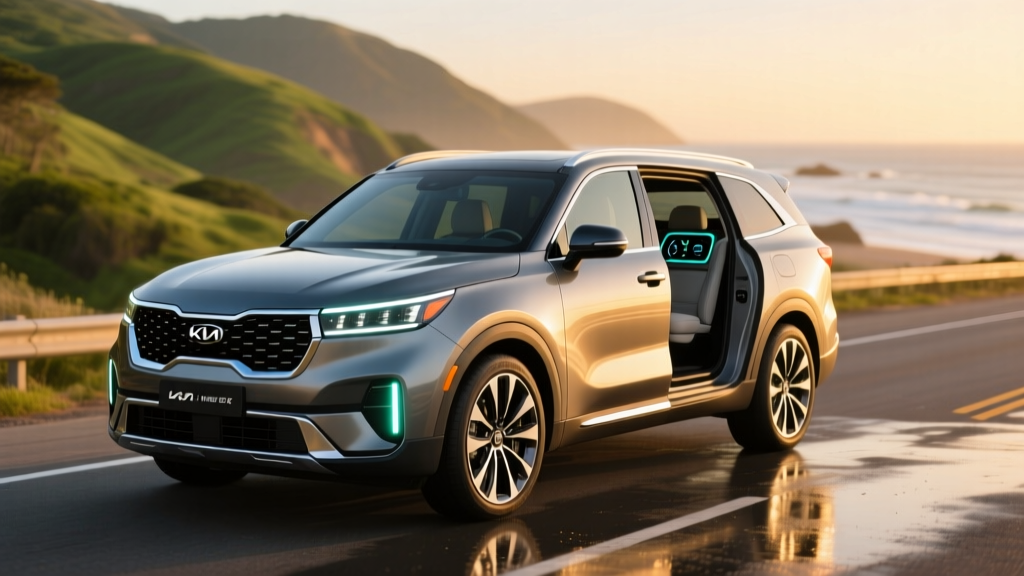
The midsize hybrid SUV segment is crowded, but the 2026 Kia Sorento Hybrid EX occupies a specific niche: three-row family hauling with genuine fuel savings, no plug required, and a starting price that undercuts many two-row competitors. After spending time with the powertrain specs, EPA data, and ownership economics, here's what buyers need to know before signing the paperwork.
The Sorento Hybrid comes in two distinct flavors — the conventional hybrid (HEV) covered here, and the plug-in hybrid (PHEV) variant. They share a platform but serve very different use cases. This guide focuses on the HEV model in the popular EX trim, while drawing clear comparisons to the PHEV where relevant so you can choose the right electrified Sorento for your garage.
2026 Kia Sorento Hybrid EX: Quick Specs at a Glance
| Specification | Value |
|---|---|
| Powertrain | 1.6L turbocharged 4-cylinder + electric motor (HEV) |
| Combined Horsepower | 261 hp |
| Combined Torque | 271 lb-ft |
| Transmission | 6-speed automatic |
| Drivetrain | AWD (standard on all Hybrid trims) |
| EPA Fuel Economy | 34 MPG combined (34 city / 34 highway) |
| Battery (traction) | ~1.49 kWh lithium-ion (HEV) |
| Seating | 6 passengers (3 rows) |
| Cargo (behind 3rd row) | 12.6 cu ft |
| Cargo (max, 2nd/3rd folded) | 75.5 cu ft |
| Towing Capacity | 2,000 lbs |
| Base MSRP (EX AWD) | $41,190 |
HEV vs PHEV: Which Sorento Hybrid Fits Your Life?
Before diving deeper into the EX, it's worth understanding the two Sorento Hybrid paths. The conventional hybrid (HEV) uses a small battery that charges through regenerative braking and the gasoline engine. You never plug it in — just fill up with gas and drive. The plug-in hybrid (PHEV) carries a much larger battery you charge from a wall outlet or public charger, giving you electric-only driving before the gas engine kicks in.
| Attribute | Sorento HEV (EX) | Sorento PHEV (SX Prestige) |
|---|---|---|
| Plug-in Required? | No — charges via regen + engine | Yes — plug in for electric range |
| Battery Capacity | ~1.49 kWh | 13.8 kWh (usable) |
| Electric-Only Range | N/A (motor assists engine) | 32 miles (EPA est.) |
| Combined HP | 261 hp | 261 hp |
| EPA MPG (gas only / combined) | 34 MPG combined | 34 MPG combined (after EV range depleted) |
| MPGe (PHEV with charge) | N/A | 79 MPGe |
| Level 2 Charge Time (0–100%) | N/A | ~3 hours 25 min (7.2 kW onboard) |
| DC Fast Charging | N/A | Not available |
| Starting MSRP | $41,190 (EX) | $52,090 (SX Prestige) |
| Federal Tax Credit (§30D) | Not eligible | Not eligible (2026 rules) |
Choose the HEV (this review) if: You don't have reliable access to a plug at home or work, you want lower upfront cost, and you mainly want fuel savings on road trips and commutes without changing your refueling habits.
Choose the PHEV if: You can charge at home nightly, your daily commute is under 30 miles round-trip, and you want to drive mostly on electricity while keeping a gas engine for long trips. The $10,900 price premium pays back through electricity savings only if you actually plug in regularly.
Choose a full BEV (e.g., Kia EV9) if: You have home Level 2 charging, rarely drive more than 250 miles in a day, and want zero tailpipe emissions with the lowest per-mile energy cost.
Fuel Economy: EPA Numbers and Real-World MPG
The 2026 Kia Sorento Hybrid EX carries an EPA rating of 34 MPG combined, split evenly at 34 city and 34 highway, according to fueleconomy.gov. That symmetry is typical of modern hybrids — the electric motor does heavy lifting in stop-and-go traffic, offsetting the city-driving penalty that gas-only SUVs suffer.
| Drive Cycle | EPA Rating | Real-World Expectation |
|---|---|---|
| City | 34 MPG | 33–37 MPG (hybrids often beat EPA in city) |
| Highway (70 mph cruise) | 34 MPG | 30–33 MPG (sustained speed reduces regen benefit) |
| Combined | 34 MPG | 31–35 MPG depending on driving mix |
| Cold Weather (below 30°F) | N/A | 28–31 MPG (engine runs more for cabin heat) |
In practice, the Sorento Hybrid tends to deliver slightly better than its EPA rating in suburban and city driving where regenerative braking recaptures energy at every stoplight. Highway-only road trips at 75–80 mph will see numbers dip to the low 30s. Cold weather is the great equalizer for all hybrids: the gasoline engine must run more frequently to provide cabin heat, reducing the electric motor's contribution. Expect a 10–15% efficiency drop in deep winter conditions.
For context, the gas-only 2026 Sorento with the 2.5L turbo AWD rates at 23 MPG combined. The hybrid's 34 MPG represents a 48% improvement — roughly $600–$800 per year in fuel savings for a driver covering 15,000 miles annually, depending on local gas prices.
Powertrain Deep Dive: 261 HP and How It's Delivered
The Sorento Hybrid's powertrain pairs a 1.6-liter turbocharged four-cylinder engine (producing 178 hp and 195 lb-ft on its own) with a 47.7 kW electric motor integrated into the transmission housing. Combined system output is 261 horsepower and 271 lb-ft of torque.
The electric motor fills in the torque gap at low RPM where the small turbo four would otherwise feel sluggish. The result is confident acceleration from a stop — 0–60 mph arrives in approximately 7.5 seconds, which is competitive with V6-powered midsize SUVs. The 6-speed automatic transmission shifts cleanly and avoids the rubber-band feel of the CVT transmissions found in some competitors like the Toyota Highlander Hybrid.
Standard all-wheel drive routes power to the rear wheels via a driveshaft connected to the transmission, not a separate rear motor. This is a traditional AWD layout adapted for hybrid duty, which means it's effective in rain and light snow but won't match the traction of dual-motor EV systems on ice.
Pricing, Trims, and Tax Credit Eligibility
The 2026 Kia Sorento Hybrid is offered in three trims, all with standard AWD:
- S Hybrid: $38,390 — 8-inch display, cloth/leatherette seats, basic ADAS suite
- EX Hybrid: $41,190 — 12.3-inch digital cluster, navigation, synthetic leather, power liftgate, Highway Driving Assist
- SX Prestige Hybrid: $45,290 — premium leather, ventilated front seats, Bose audio, head-up display, surround-view monitor
Federal Tax Credit (§30D): The 2026 Kia Sorento Hybrid (HEV) does not qualify for the federal §30D clean vehicle credit. That credit is reserved for battery electric vehicles and plug-in hybrids that meet battery sourcing and critical mineral requirements under current IRS rules. The Sorento PHEV also does not currently qualify for the full $7,500 credit due to battery component sourcing constraints — always verify current eligibility on the IRS website or with a tax professional before purchase.
State incentives: Some states offer rebates for conventional hybrids or PHEVs. Check your state energy office or the AFDC state incentive database for local programs.
Battery Warranty, Reliability, and Replacement Costs
Hybrid battery longevity is the number-one concern for first-time hybrid buyers. Here's the good news: Kia's hybrid battery warranty is among the strongest in the industry.
Hybrid Battery Warranty: 10 years / 100,000 miles (whichever comes first) for the original owner. This covers the lithium-ion traction battery against defects and excessive capacity loss.
Powertrain Warranty: 10 years / 100,000 miles — covers the engine, transmission, and electric motor.
Bumper-to-Bumper: 5 years / 60,000 miles.
Out-of-warranty replacement cost: If the hybrid battery fails after warranty expiration, expect a replacement cost of approximately $2,500–$4,000 for the HEV's smaller 1.49 kWh pack, plus labor. The PHEV's larger 13.8 kWh pack would cost significantly more — roughly $5,000–$8,000. For perspective, modern hybrid batteries routinely last 150,000–200,000+ miles before significant degradation, and many outlast the vehicle itself.
Kia's hybrid system is now in its third generation. The 1.6T hybrid powertrain has been in service across the Kia/Hyundai lineup since 2022 with no widespread battery failure campaigns reported by NHTSA. The small battery capacity in the HEV means shallow charge/discharge cycles, which is gentle on cell longevity. Unlike a full EV that cycles through large portions of its battery daily, the HEV's battery operates in a narrow state-of-charge window — typically between 40% and 70% — which dramatically extends cell life.
Interior, Technology, and Daily Practicality
The EX trim is the volume seller for good reason. You get a 12.3-inch digital instrument cluster that displays real-time energy flow (showing when the motor is assisting, when regen is charging the battery, and when the engine is running solo), a 12.3-inch touchscreen with wireless Apple CarPlay and Android Auto, and Kia's Highway Driving Assist — a Level 2 driver-assistance system combining adaptive cruise control with lane-centering on divided highways.
Third-row space is best suited for children or short trips; adults will find the rearmost seats cramped on longer drives. With all three rows in use, cargo space is a modest 12.6 cubic feet — enough for a few grocery bags or a couple of carry-ons. Fold the third row and you get 40.8 cu ft; fold both rear rows for a flat 75.5 cu ft of cargo volume.
The hybrid system adds no intrusion to the cabin. There's no hump in the cargo floor (the battery sits beneath the rear seats), and the transition between electric and gas power is nearly imperceptible at normal driving speeds.
Pros
- 34 MPG combined in a three-row AWD SUV — no plug required
- 261 hp provides confident highway merging and passing
- Industry-leading 10-year/100k-mile hybrid battery warranty
- EX trim well-equipped with dual 12.3-inch screens and Level 2 ADAS
- Traditional 6-speed automatic avoids CVT drone
- Competitive pricing vs. Toyota Highlander Hybrid and Mazda CX-90 PHEV
Cons
- Third row is tight for adults; cargo space limited with all seats up
- 2,000-lb towing capacity trails body-on-frame competitors
- No federal tax credit for the HEV; PHEV credit eligibility uncertain
- Highway MPG drops to low 30s at sustained 75+ mph speeds
- PHEV variant lacks DC fast charging — Level 2 only
Ownership Costs: 5-Year Total Cost Snapshot
To put the Sorento Hybrid EX's value in context, here's an estimated 5-year ownership comparison against the gas-only Sorento and a representative full EV:
| Cost Category | Sorento Hybrid EX ($41,190) | Sorento Gas AWD (~$39,090) | Kia EV9 Air RWD (~$54,900) |
|---|---|---|---|
| Purchase Price | $41,190 | $39,090 | $54,900 |
| Federal Tax Credit | $0 | $0 | Up to $7,500* |
| Fuel/Energy (75k miles) | ~$5,900 | ~$8,700 | ~$2,800** |
| Maintenance (5 yr) | ~$2,200 | ~$2,800 | ~$1,400 |
| Insurance (est. avg) | ~$8,500 | ~$8,200 | ~$9,800 |
| Est. Depreciation | ~$18,500 | ~$19,500 | ~$22,000 |
| Estimated 5-Yr Total | ~$76,290 | ~$78,290 | ~$88,900*** |
*EV9 credit eligibility depends on battery sourcing, buyer income, and MSRP caps — verify at irs.gov. **Based on $0.14/kWh national average home charging. ***Higher purchase price offset partly by credit and lower fuel/maintenance; total varies by electricity rate and credit eligibility.
The Sorento Hybrid EX saves roughly $2,000 over five years compared to its gas-only sibling, primarily through fuel savings. Against the EV9, the hybrid wins on upfront cost but loses on per-mile energy cost. The right choice depends on your charging access and budget.
Frequently Asked Questions
How many MPG does the 2026 Kia Sorento Hybrid EX get?
The EPA rates the Sorento Hybrid at 34 MPG combined (34 city / 34 highway). In real-world driving, city and suburban routes often yield 33–37 MPG thanks to regenerative braking. Sustained highway driving at 75+ mph typically returns 30–33 MPG. Cold weather below 30°F can reduce efficiency by 10–15%.
How far can the Sorento PHEV go on electric only?
The Sorento Plug-in Hybrid delivers an EPA-estimated 32 miles of electric-only range from its 13.8 kWh battery. That covers most daily commutes without using gasoline. Once the battery is depleted, it operates as a conventional hybrid at 34 MPG combined. Total range (electric + gas) exceeds 440 miles.
Do I need to plug in the Sorento Hybrid?
No. The conventional Sorento Hybrid (HEV) charges its small 1.49 kWh battery through regenerative braking and the gasoline engine. You simply fill it with gas like any other vehicle. Only the PHEV variant requires plugging in to access its electric-only range.
Is the Sorento Hybrid reliable, and what does battery replacement cost?
Kia's hybrid system is in its third generation with no widespread reliability concerns reported to NHTSA. The hybrid battery is covered by a 10-year / 100,000-mile warranty. Out-of-warranty replacement for the HEV battery runs approximately $2,500–$4,000. Modern hybrid batteries routinely last 150,000–200,000+ miles due to shallow charge cycling.
Does the 2026 Sorento Hybrid qualify for a federal tax credit?
No. The conventional hybrid (HEV) does not qualify for the §30D federal clean vehicle credit — that credit applies only to BEVs and qualifying PHEVs. The Sorento PHEV does not currently qualify for the full $7,500 credit due to battery component sourcing requirements under 2026 IRS rules. Some states may offer separate hybrid incentives — check the AFDC state incentive database for your area.
Hybrid vs PHEV vs EV — which Sorento should I buy?
If you lack home charging and want simplicity, the HEV is the right call — no behavior change, real fuel savings. If you can charge at home and commute under 30 miles, the PHEV lets you drive electric most days with a gas backup. If you have reliable home Level 2 charging and rarely exceed 250 miles daily, consider the all-electric Kia EV9 for the lowest operating costs and zero tailpipe emissions.
Can the Sorento PHEV DC fast charge?
No. The Sorento PHEV supports Level 2 AC charging only, at a maximum rate of 7.2 kW. A full charge from empty takes approximately 3 hours and 25 minutes on a 240V Level 2 home charger. DC fast charging is not available on this platform — a limitation worth noting if you expected quick public top-ups.
Final Verdict: Who Should Buy the Sorento Hybrid EX?
The 2026 Kia Sorento Hybrid EX is the right choice for families who need three rows and AWD, want meaningful fuel savings, and don't want to deal with plug-in charging infrastructure. At $41,190, it delivers 34 MPG combined, 261 hp, and a comprehensive warranty package at a price point that's hard to match in the segment.
It's not the answer for buyers who want electric-only commuting (look at the PHEV), maximum towing capacity (body-on-frame SUVs do better), or the lowest possible per-mile energy cost (a full BEV wins there). But as a do-everything family hauler that sips fuel and requires zero lifestyle adjustment, the Sorento Hybrid EX makes a compelling, data-backed case for itself.