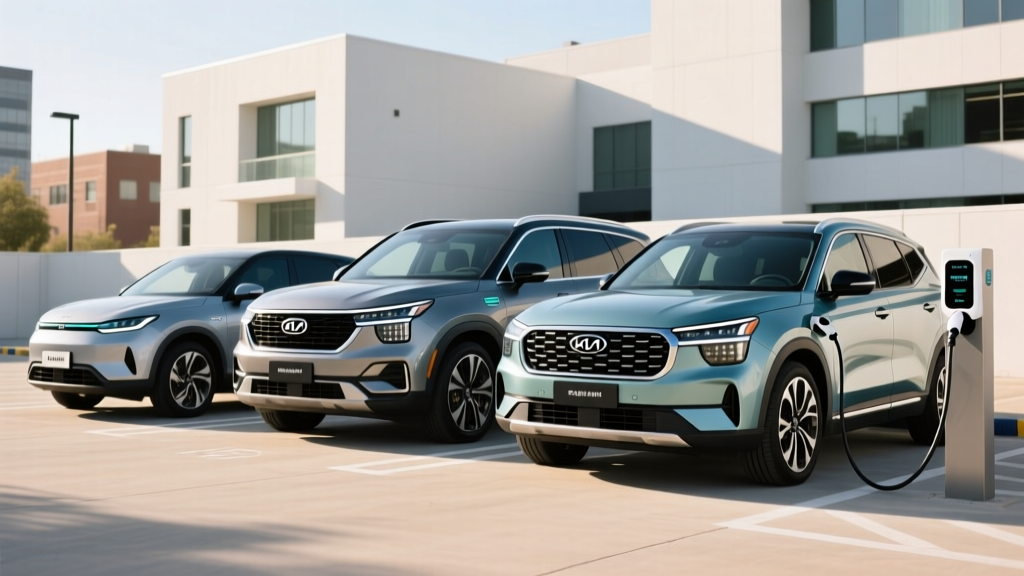
Kia offers three plug-in hybrid electric vehicles (PHEVs) in the U.S. for the 2026 model year: the compact Niro PHEV, the compact SUV Sportage PHEV, and the midsize three-row Sorento PHEV. Each pairs a turbocharged gasoline engine with a sizable traction battery and electric motor, delivering 30+ miles of electric-only driving before the hybrid powertrain takes over. If you've been searching for a Kia PHEV that fits your commute and family size, this guide breaks down every spec that matters — EPA range, real-world MPG, charging times, pricing, and federal tax credit eligibility — so you can pick the right one without guessing.
HEV vs PHEV: What Kia Buyers Need to Know
Before comparing models, it's worth clarifying the difference between Kia's conventional hybrids and its plug-in hybrids, because the badging can be confusing.
- HEV (Hybrid Electric Vehicle): A small battery (typically 1.5–2.0 kWh) recharges through regenerative braking and the engine. You never plug it in. Electric-only driving is limited to brief low-speed assists. Examples: Kia Sorento Hybrid, Sportage Hybrid, Niro Hybrid.
- PHEV (Plug-In Hybrid Electric Vehicle): A much larger battery (11–18 kWh) that you charge by plugging in. Provides 30–40+ miles of true electric-only driving at highway speeds. Once the battery depletes, the vehicle operates as a conventional hybrid. Examples: Kia Sorento PHEV, Sportage PHEV, Niro PHEV.
If your daily round-trip commute falls under 35 miles and you have access to a standard 120V or 240V outlet at home, a Kia PHEV lets you drive most days on electricity alone while retaining a gas engine for road trips — eliminating the range limitations of a battery-electric vehicle (BEV).
2026 Kia PHEV Lineup: Side-by-Side Spec Table
| Specification | 2026 Kia Niro PHEV | 2026 Kia Sportage PHEV | 2026 Kia Sorento PHEV |
|---|---|---|---|
| Body Style | Compact Crossover | Compact SUV | Midsize 3-Row SUV |
| Engine | 1.6L Turbo I4 | 1.6L Turbo I4 | 1.6L Turbo I4 |
| Electric Motor | 62 kW (83 hp) | 72 kW (97 hp) | 72 kW (97 hp) |
| Combined System Output | 180 hp / 195 lb-ft | 261 hp / 258 lb-ft | 261 hp / 258 lb-ft |
| Transmission | 6-Speed DCT (Auto) | 6-Speed Auto | 6-Speed Auto |
| Drivetrain | FWD | AWD | AWD |
| Battery Capacity (Usable) | 11.1 kWh (NMC) | 13.8 kWh (NMC) | 13.8 kWh (NMC) |
| EPA Electric-Only Range | 33 miles | 34 miles | 32 miles |
| Total Combined Range (est.) | ~430 miles | ~430 miles | ~420 miles |
| EPA MPGe (Electric + Gas) | 105 MPGe | 84 MPGe | 79 MPGe |
| EPA MPG (Charge-Sustaining) | 48 combined (53 city / 45 hwy) | 35 combined (36 city / 34 hwy) | 33 combined (34 city / 32 hwy) |
| Level 2 Charge Time (240V) | ~2 hrs 45 min (3.3 kW) | ~3 hrs 30 min (3.3 kW) | ~3 hrs 30 min (3.3 kW) |
| DC Fast Charging | Not available | Not available | Not available |
| 0–60 mph | ~7.6 sec | ~7.1 sec | ~7.4 sec |
| Cargo Volume (behind 2nd row) | 19.4 cu ft | 34.5 cu ft | 12.6 cu ft (30.9 behind 2nd row) |
| Starting MSRP | ~$35,390 | ~$40,490 | ~$51,090 |
| Battery / Powertrain Warranty | 10 yr / 100,000 mi | 10 yr / 100,000 mi | 10 yr / 100,000 mi |
Sources: fueleconomy.gov (EPA), Kia America official specifications. Pricing reflects 2026 model-year MSRP before destination; verify with your dealer as trims and packages change.
Electric-Only Range and Real-World MPG
All three Kia PHEVs deliver between 32 and 34 miles of EPA-rated electric-only range. In practice, expect that figure to hold fairly well in moderate temperatures and city driving, where regenerative braking extends range. On a 70-mph highway run in 35°F weather, however, plan for roughly 22–26 miles of electric range before the engine fires — cold temperatures reduce battery efficiency and cabin heating draws significant power.
Once the battery depletes, the powertrain operates as a conventional hybrid. Here's where the real-world numbers diverge from the EPA stickers in interesting ways:
| Model | EPA Combined MPG | EPA City MPG | EPA Highway MPG | Real-World City (Owner Reports) | Real-World Highway |
|---|---|---|---|---|---|
| Niro PHEV | 48 | 53 | 45 | 50–56 MPG | 40–44 MPG |
| Sportage PHEV | 35 | 36 | 34 | 34–38 MPG | 30–33 MPG |
| Sorento PHEV | 33 | 34 | 32 | 32–36 MPG | 28–31 MPG |
Hybrids routinely exceed their EPA city ratings in stop-and-go driving because regenerative braking recovers energy that a gas car wastes as heat. Highway MPG tends to land slightly below the EPA figure due to aerodynamic drag at sustained speed, where the electric motor contributes less. The Niro PHEV, being the lightest and most aerodynamic of the three, is the efficiency standout — owners regularly report 50+ MPG in city commuting once the battery is depleted.
Charging: What to Expect at Home
None of Kia's current PHEVs support DC fast charging. This is typical for the PHEV segment — the batteries are small enough that Level 2 charging fully replenishes them overnight, and adding DC fast-charge hardware would increase cost and weight for minimal benefit.
All three models accept up to 3.3 kW on Level 2 (240V) AC charging. Here's what that means in practice:
- Level 1 (120V standard outlet): Expect a full charge in approximately 9–12 hours depending on battery size. This is viable if you park near an outlet and drive under 30 miles daily.
- Level 2 (240V home charger): A full charge in 2:45 (Niro) to 3:30 (Sportage/Sorento). A basic 240V/16A home charger (3.3 kW) costs $250–$500 for the unit, plus $300–$800 for electrician installation on an existing 240V circuit. If your electrical panel needs an upgrade to 200A, budget $1,500–$3,000 additional.
Because PHEV batteries are small, you do not need a high-amperage Level 2 charger. A simple 16A/240V unit is sufficient to max out the 3.3 kW onboard charger. Spending extra on a 48A charger provides no benefit for these vehicles (though it may if you add a BEV later).
Battery Warranty, Longevity, and Replacement Cost
Kia PHEV Battery Warranty: 10 years / 100,000 miles (whichever comes first) on the high-voltage battery pack and all PHEV-specific powertrain components. This is one of the longest hybrid/PHEV warranties in the industry and applies to the original owner. For subsequent owners, coverage typically drops to 5 years / 60,000 miles — verify with your dealer.
Capacity Retention Threshold: Kia's warranty covers battery replacement or repair if capacity drops below approximately 70% of original capacity during the warranty period.
Kia's PHEV batteries use NMC (nickel-manganese-cobalt) lithium-ion chemistry, the same chemistry found in most long-range BEVs. Because PHEV batteries are smaller and typically cycled between 20% and 100% state of charge (rather than the 0–100% deep cycles that accelerate degradation), real-world longevity data from Hyundai/Kia's 1.6T PHEV platform shows modest degradation — typically 5–10% capacity loss over the first five years of ownership.
If a battery replacement is needed outside of warranty, expect a cost between $4,000 and $7,000 for the battery module, depending on the model and whether you use OEM or refurbished cells. However, out-of-warranty PHEV battery failures remain rare based on data from Hyundai/Kia's hybrid fleet now exceeding 10 years on the road.
Federal Tax Credit and Pricing Breakdown
Under current IRS §30D Clean Vehicle Credit rules, qualifying new PHEVs are eligible for up to $7,500 in federal tax credits — the same as battery-electric vehicles — provided they meet all requirements. Here's what determines eligibility for Kia's PHEVs:
- Battery capacity: Must be ≥ 7 kWh — all three Kia PHEVs qualify (11.1–13.8 kWh).
- MSRP cap: SUVs/vans/pickups ≤ $80,000; sedans/other ≤ $55,000. The Niro PHEV (classified as a car in some IRS interpretations, SUV in others — verify current classification) and Sportage/Sorento PHEVs (SUVs, $80K cap) all fall under their respective caps.
- Buyer income limits: Modified AGI ≤ $150,000 (single), $225,000 (head of household), $300,000 (joint). If your income exceeds these thresholds, you do not qualify.
- Battery component and critical mineral sourcing: The credit is split into two halves ($3,750 each) based on battery component manufacturing and critical mineral sourcing requirements. These rules tighten annually. For 2026, verify the exact credit amount each Kia PHEV qualifies for on the IRS's official eligible vehicle list — it may be $3,750 or $7,500 depending on supply chain compliance at time of purchase.
- Point-of-sale transfer: You can transfer the credit to the dealer at purchase to reduce your out-of-pocket cost, rather than waiting to claim it on your tax return.
Important: Tax credit eligibility rules change frequently and depend on battery sourcing, which can shift mid-model-year. Always confirm the current credit amount on irs.gov or with a tax professional before purchase.
| Model / Trim | MSRP (incl. destination est.) | Est. After Max Credit |
|---|---|---|
| Niro PHEV LX | $35,390 | ~$27,890 |
| Niro PHEV EX | $37,390 | ~$29,890 |
| Sportage PHEV X-Line | $40,490 | ~$32,990 |
| Sportage PHEV X-Line Prestige | $44,690 | ~$37,190 |
| Sorento PHEV SX | $51,090 | ~$43,590 |
| Sorento PHEV SX Prestige | $55,090 | ~$47,590 |
Who Should Buy a Kia PHEV vs. a Full EV or Gas Car?
Choose a Kia PHEV if:
- Your daily commute is 20–35 miles round-trip and you can charge at home overnight.
- You take road trips of 200+ miles several times per year and don't want to plan around DC fast chargers.
- You want EV-like commuting costs (roughly $0.04–$0.06 per mile on electricity vs. $0.12–$0.15 on gas) without committing to a full BEV.
- You need a three-row SUV (Sorento PHEV) but want to reduce fuel costs.
Choose a full BEV (like the Kia EV6 or EV9) if:
- You have reliable home Level 2 charging and rarely drive more than 250 miles in a single day.
- You want zero tailpipe emissions and minimal maintenance (no oil changes, no engine).
- You want DC fast charging for road trips (Kia EV6 charges at up to 240 kW, 10–80% in ~18 minutes).
Choose a conventional Kia HEV (non-plug-in hybrid) if:
- You cannot charge at home (apartment, street parking, no garage outlet).
- You want better fuel economy than a gas car without any change to your fueling habits.
- Your budget is tighter — Kia's HEVs start $3,000–$5,000 less than their PHEV counterparts.
Pros and Cons: Kia PHEV Ownership
Pros
- 30–34 miles of electric-only range covers most daily commutes
- 10-year / 100,000-mile battery and powertrain warranty
- AWD standard on Sportage and Sorento PHEVs
- Strong charge-sustaining MPG (33–48 combined depending on model)
- Eligible for up to $7,500 federal tax credit (subject to sourcing and income rules)
- No range anxiety — gas engine provides 400+ mile total range
- Sorento PHEV is one of very few three-row PHEVs available in the U.S.
Cons
- No DC fast charging on any model (3.3 kW max)
- Electric-only range drops significantly in cold weather (22–26 mi)
- Sorento PHEV starts above $50K before credits
- FWD only on Niro PHEV (no AWD option)
- Cargo space reduced vs. gas-only variants due to battery placement
- Tax credit eligibility may be partial ($3,750 vs $7,500) depending on battery sourcing
- 3.3 kW onboard charger means slower Level 2 charging than some competitors
Frequently Asked Questions
How many MPG does a Kia PHEV get?
After the battery is depleted, the Niro PHEV achieves 48 MPG combined (53 city / 45 highway), the Sportage PHEV gets 35 combined (36/34), and the Sorento PHEV returns 33 combined (34/32). In real-world city driving, owners often exceed these EPA numbers by 2–4 MPG thanks to aggressive regenerative braking.
How far can a Kia PHEV go on electric only?
The EPA rates the Niro PHEV at 33 miles, the Sportage PHEV at 34 miles, and the Sorento PHEV at 32 miles of electric-only range. In warm weather with moderate speeds, you may see 35–37 miles. In freezing temperatures at highway speed, expect 22–26 miles before the engine engages.
Does the Kia PHEV qualify for a tax credit?
Yes — Kia PHEVs are eligible for the federal §30D Clean Vehicle Credit of up to $7,500, subject to buyer income limits ($150K single / $300K joint), MSRP caps, and battery sourcing requirements. The exact credit amount ($3,750 or $7,500) depends on current-year battery component and critical mineral rules. Check the IRS eligible vehicle list before purchasing. Some states also offer additional PHEV rebates — check your state energy office.
Is the Kia PHEV reliable? What does a battery replacement cost?
Kia's 1.6L turbo PHEV powertrain has been in production since 2022 and shares architecture with Hyundai's well-established hybrid platform. The 10-year / 100,000-mile battery warranty is among the industry's best. Out-of-warranty battery replacements are estimated at $4,000–$7,000, though early fleet data suggests replacements are rarely needed within the first 10 years of typical use.
Can I charge a Kia PHEV at a public DC fast charger?
No. None of Kia's current PHEVs have DC fast-charge capability. They charge exclusively via AC — either a standard 120V outlet (Level 1) or a 240V home/public Level 2 station at up to 3.3 kW. A full Level 2 charge takes approximately 2:45 to 3:30 hours.
Do I need to install a home charger for a Kia PHEV?
You don't need one, but it's strongly recommended. A standard 120V outlet will fully recharge the battery overnight (9–12 hours), which works if your daily electric driving is under 30 miles. A 240V Level 2 charger cuts that to under 4 hours and ensures you always start with a full battery each morning. Installation on an existing 240V circuit typically costs $300–$800.
Hybrid vs PHEV vs EV — which Kia is right for me?
If you can charge at home and commute under 35 miles daily but take occasional long road trips, the PHEV is the sweet spot — you get electric commuting with gas-engine flexibility. If you can't charge at home, choose a conventional Kia HEV. If you have home charging, rarely drive over 250 miles in a day, and want the lowest operating cost and maintenance, consider a full BEV like the Kia EV6 or EV9.