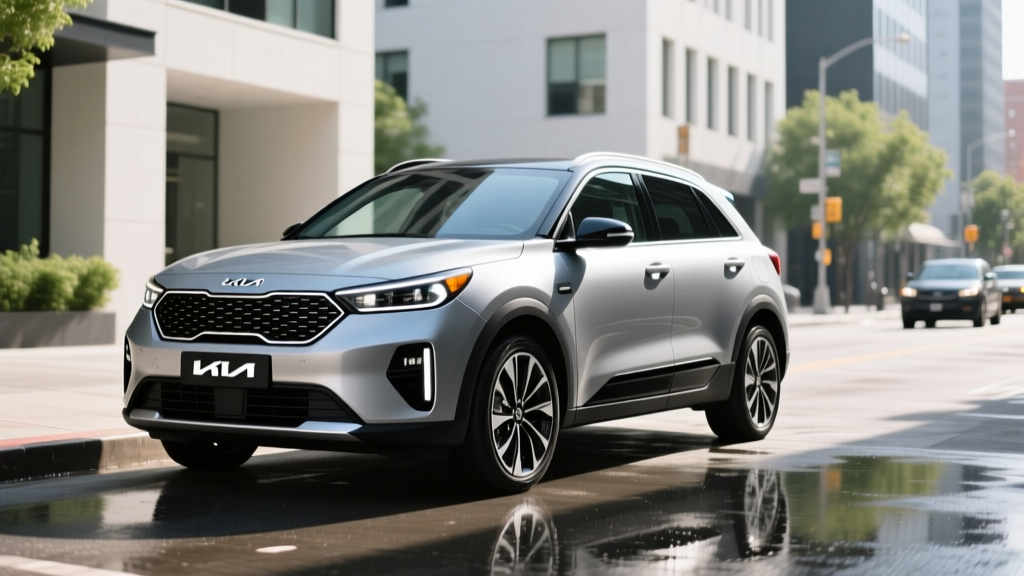
The 2026 Kia Niro Hybrid LX occupies a specific niche: a conventional hybrid crossover that requires no plug, no behavior change, and no range anxiety — just measurably better fuel economy than a comparable gas-only vehicle. With an EPA-estimated 53 MPG combined, it undercuts most compact crossovers on fuel cost while retaining the cargo practicality buyers expect from the segment. This review breaks down the LX base trim specifically — the most affordable entry point into the Niro Hybrid lineup — with exact specs, real-world efficiency expectations, and ownership costs that matter to research-driven buyers.
HEV vs PHEV: Which Niro Are You Actually Looking At?
Kia sells the Niro in three powertrain variants for 2026, and confusing them is the most common mistake shoppers make. The Niro Hybrid (HEV) — which includes the LX trim — is a self-charging conventional hybrid. It has a small 1.56 kWh lithium-ion battery that charges exclusively through regenerative braking and the gasoline engine. You never plug it in. The Niro Plug-In Hybrid (PHEV) carries a larger 11.1 kWh battery, delivers roughly 33 miles of electric-only driving, and requires plugging in to realize its efficiency advantage. Finally, the Niro EV is a fully electric vehicle with 239 miles of EPA range.
| Attribute | Niro Hybrid (HEV) | Niro PHEV | Niro EV |
|---|---|---|---|
| Plug-in Required? | No | Yes | Yes |
| Battery Capacity | 1.56 kWh | 11.1 kWh | 64.8 kWh |
| Electric-Only Range | N/A | ~33 miles | 239 miles (EPA) |
| EPA Combined | 53 MPG | 105 MPGe / 48 MPG (gas) | 113 MPGe |
| Combined HP | 139 hp | 180 hp | 201 hp |
| DC Fast Charge? | No | No (Level 2 only) | Yes (up to 77 kW) |
| Federal Tax Credit (§30D) | No | Up to $3,750* | Up to $7,500* |
*§30D credit eligibility depends on MSRP caps, buyer income limits, and battery-sourcing requirements. Verify current rules at IRS.gov.
This article focuses on the 2026 Kia Niro Hybrid LX — the HEV. If you can charge at home and want electric-only commuting, the PHEV deserves a separate look. If you want zero gas, see our Niro EV coverage.
Fuel Economy: EPA Ratings and Real-World MPG
The 2026 Kia Niro Hybrid LX carries EPA estimates of 53 MPG city / 54 MPG highway / 53 MPG combined, per fueleconomy.gov. These are class-leading numbers for a crossover-shaped vehicle. The LX's smaller 16-inch wheels and lighter curb weight give it a slight edge over higher trims (the EX and SX Touring drop to 49-50 MPG combined due to 18-inch wheels and added weight).
| Driving Scenario | EPA Estimate | Real-World Expectation |
|---|---|---|
| City | 53 MPG | 52–58 MPG (hybrids excel in stop-and-go) |
| Highway (70 mph) | 54 MPG | 44–49 MPG (aero drag dominates; hybrid advantage narrows) |
| Combined | 53 MPG | 47–53 MPG depending on driving mix |
| Cold Weather (below 32°F) | N/A | 40–46 MPG (engine runs more for cabin heat) |
The critical real-world caveat: hybrids actually outperform their EPA city estimates in genuine urban driving with frequent stops, where regenerative braking recovers the most energy. Highway driving is where the Niro Hybrid LX falls below its sticker — sustained 70+ mph speeds reduce the hybrid system's advantage. In cold weather, expect a 10–15% efficiency hit because the gasoline engine must run more frequently to provide cabin heat, reducing the electric motor's contribution.
At 53 MPG combined and a national average of $3.40/gallon (regular unleaded), the Niro Hybrid LX costs approximately $0.064 per mile in fuel. A comparable gas-only compact crossover at 30 MPG combined would cost $0.113 per mile — a difference of roughly $490 per year at 10,000 miles.
Powertrain: 139 HP From Engine and Motor Combined
The Niro Hybrid LX pairs a 1.6-liter GDI four-cylinder engine (104 hp, 107 lb-ft torque) with a 32 kW permanent-magnet synchronous electric motor (43 hp, 125 lb-ft torque) integrated into a 6-speed dual-clutch automatic transmission. Combined system output is 139 horsepower and 195 lb-ft of torque.
| Specification | 2026 Kia Niro Hybrid LX |
|---|---|
| Engine | 1.6L GDI 4-cylinder (Atkinson cycle) |
| Engine Output | 104 hp / 107 lb-ft |
| Electric Motor | 32 kW (43 hp / 125 lb-ft) |
| Combined System Output | 139 hp / 195 lb-ft |
| Transmission | 6-speed dual-clutch automatic (DCT) |
| Drivetrain | Front-wheel drive |
| Battery | 1.56 kWh lithium-ion (self-charging) |
| 0–60 mph | ~9.8 seconds (est.) |
| Curb Weight | ~3,100 lbs |
| Cargo Volume (rear seats up) | 22.8 cu ft |
| Cargo Volume (rear seats folded) | 63.7 cu ft |
The 6-speed DCT is a deliberate choice by Kia — unlike the continuously variable transmissions (CVTs) used in the Toyota Prius and Corolla Hybrid, the dual-clutch unit provides more natural-feeling gear shifts and avoids the "rubber band" drone under hard acceleration. The trade-off is marginally less seamless low-speed behavior, though Kia's calibration has improved substantially in the current generation.
Performance is adequate rather than quick. The 9.8-second 0–60 estimate places the Niro Hybrid LX behind the Toyota Prius (7.2 seconds for the 196-hp AWD variant) but on par with similarly positioned crossovers. This is a fuel-economy-first vehicle; passing power at highway speeds is confident but not eager.
Pricing, Trims, and Tax Credit Eligibility
The 2026 Kia Niro Hybrid LX starts at a MSRP of approximately $28,490 (including destination charge). This positions it as the value entry point in the Niro Hybrid range.
| Trim | MSRP (est.) | EPA Combined MPG | Key Additions Over LX |
|---|---|---|---|
| LX | $28,490 | 53 MPG | Base — 8" display, wireless CarPlay/Android Auto, 16" wheels |
| EX | $31,090 | 49 MPG | Smart power liftgate, heated seats, 10.25" cluster, 18" wheels |
| SX Touring | $35,490 | 49 MPG | Leather, Harman Kardon audio, sunroof, ventilated front seats |
Does the Niro Hybrid LX Qualify for a Federal Tax Credit?
No. The conventional Niro Hybrid (HEV) does not qualify for the federal §30D Clean Vehicle Credit. That credit is reserved for plug-in vehicles — battery-electric vehicles (BEVs) and plug-in hybrids (PHEVs) with at least 7 kWh of battery capacity. The Niro Hybrid's 1.56 kWh battery falls far below that threshold.
If the tax credit is a priority, consider the Niro PHEV, which may qualify for up to $3,750 under current §30D rules (subject to income caps of $150,000 single / $300,000 joint, MSRP cap of $80,000 for SUVs, and critical-mineral/battery-component sourcing requirements). Always verify current eligibility at IRS.gov or with a qualified tax professional before purchasing.
Some states offer separate incentives for conventional hybrids, though these are increasingly rare as programs shift focus to plug-in vehicles. Check your state energy office or Alternative Fuels Data Center for local programs.
Battery Warranty, Reliability, and Replacement Cost
Hybrid battery longevity remains a top concern for first-time hybrid buyers. The 2026 Kia Niro Hybrid's 1.56 kWh lithium-ion traction battery is covered by Kia's hybrid battery warranty: 10 years or 100,000 miles (whichever comes first) for the original owner, with capacity retention guaranteed above approximately 70%.
Kia Hybrid Battery Warranty Summary
- Coverage: 10 years / 100,000 miles (original owner)
- Transferable: Yes — drops to 8 years / 100,000 miles for subsequent owners
- Capacity Threshold: Coverage applies if battery drops below ~70% state of health
- Hybrid System Components: Motor, inverter, and related electronics — 10 yr / 100,000 mi
- Basic Vehicle Warranty: 5 years / 60,000 miles
- Powertrain Warranty: 10 years / 100,000 miles
In practice, the Niro Hybrid's small battery experiences relatively shallow charge-discharge cycles compared to a PHEV or BEV, which reduces degradation stress. Real-world data from earlier Niro Hybrid model years (2017–2023) shows that traction battery failures before 150,000 miles are uncommon. The battery is also smaller and less expensive to replace than a BEV pack — out-of-warranty replacement costs are estimated at $2,000–$3,500 (parts and labor), a fraction of the $8,000–$20,000+ that larger EV batteries can command.
Kia's overall reliability ratings have improved in recent years. The Niro platform benefits from a mature powertrain that has been in production since 2017. The 6-speed DCT, while more engaging than a CVT, has historically been a point of occasional low-speed shudder complaints — though not at rates suggesting systemic failure. Check NHTSA.gov for any active recalls or technical service bulletins before purchasing.
Who Should Buy the Niro Hybrid LX — And Who Shouldn't
Pros
- Class-leading 53 MPG combined for a crossover
- No plug-in required — zero lifestyle adjustment
- Strong 10-yr/100,000-mi hybrid battery warranty
- Competitive $28,490 starting price
- 22.8 cu ft cargo (63.7 with seats folded) is practical
- Wireless Apple CarPlay and Android Auto standard on LX
Cons
- No federal tax credit eligibility (HEV)
- Modest 139 hp — slower than Prius and some competitors
- FWD only — no AWD option (Prius offers AWD)
- Highway MPG drops noticeably vs. city
- Cabin noise under hard acceleration
- Base LX lacks heated seats and advanced driver display
Choose the Niro Hybrid LX If:
- You cannot charge at home (apartment, street parking, no garage outlet) and a PHEV or EV is impractical
- Your commute is a mix of city and suburban driving where the 53 MPG combined shines
- You want a crossover ride height and cargo space without the fuel cost penalty
- You plan to own the vehicle 8–10 years and want the security of Kia's long warranty
Look Elsewhere If:
- You want AWD — the Toyota Prius AWD or a PHEV SUV like the Toyota RAV4 Hybrid are better fits
- You have home charging access and can benefit from the §30D tax credit — the Niro PHEV or a BEV like the Chevrolet Equinox EV will deliver lower per-mile costs
- Performance matters — the Prius at 196 hp (AWD) is significantly quicker and still achieves 54 MPG combined
Hybrid vs PHEV vs EV: Which Powertrain Fits Your Life?
| Factor | Hybrid (HEV) | Plug-In Hybrid (PHEV) | Battery Electric (BEV) |
|---|---|---|---|
| Home Charging Needed? | No | Recommended (120V minimum) | Yes (Level 2 strongly recommended) |
| Fuel Cost Per Mile | ~$0.06–0.07 | ~$0.03 (electric) / ~$0.07 (gas) | ~$0.03–0.05 |
| Federal Tax Credit | None | Up to $3,750–$7,500* | Up to $7,500* |
| Maintenance Cost | Low (still has ICE) | Moderate (ICE + electric) | Lowest (no ICE) |
| Best For | No-charge-access buyers | Home chargers with short commutes | Home chargers, longer-term savings |
The decision framework is straightforward: if you have reliable access to a Level 2 charger at home (a 240V outlet or hardwired unit), a PHEV or BEV will almost always deliver lower total operating costs — especially with available tax credits. The Niro Hybrid LX is the right answer when plugging in isn't an option, or when you want to minimize upfront cost and complexity while still cutting fuel consumption roughly in half versus a gas-only equivalent.
Frequently Asked Questions
How many MPG does the 2026 Kia Niro Hybrid LX get?
The EPA rates the Niro Hybrid LX at 53 MPG city, 54 MPG highway, and 53 MPG combined. In real-world city driving with frequent stops, owners often match or slightly exceed the city rating (52–58 MPG). Sustained highway driving at 70+ mph typically yields 44–49 MPG. Cold weather can reduce combined efficiency to 40–46 MPG.
Does the Niro Hybrid need to be plugged in?
No. The conventional Niro Hybrid (HEV) charges its 1.56 kWh battery entirely through regenerative braking and the gasoline engine. You fuel it like any other car at a gas station. Only the Niro PHEV and Niro EV require plug-in charging.
Is the 2026 Niro Hybrid reliable, and what does a battery replacement cost?
The Niro Hybrid powertrain is mature, having been in production since 2017, and early failure rates for the traction battery are low based on historical data. Kia covers the hybrid battery for 10 years/100,000 miles. Out-of-warranty replacement is estimated at $2,000–$3,500 — significantly less than a full EV battery pack.
Does the Niro Hybrid LX qualify for any tax credit?
No. The conventional hybrid (HEV) does not qualify for the federal §30D Clean Vehicle Credit, which requires a plug-in vehicle with at least 7 kWh of battery capacity. The Niro PHEV may qualify for up to $3,750 depending on income, MSRP caps, and battery-sourcing rules. Check current eligibility at IRS.gov.
How does the Niro Hybrid LX compare to the Toyota Prius?
The 2026 Prius offers more power (196 hp AWD vs. 139 hp FWD), slightly better combined MPG (54 vs. 53), and available AWD, but it's a liftback, not a crossover. The Niro Hybrid LX provides 22.8 cu ft of cargo space with a taller ride height that many buyers prefer. If you prioritize cargo versatility and crossover styling, the Niro wins; if you want AWD and performance, the Prius is the stronger pick.
What is the total driving range on a full tank?
With a 11.1-gallon fuel tank and 53 MPG combined, the Niro Hybrid LX delivers approximately 588 miles of total range — more than sufficient for most road trips without a fuel stop. Highway-heavy driving at 46 MPG would still yield roughly 510 miles.