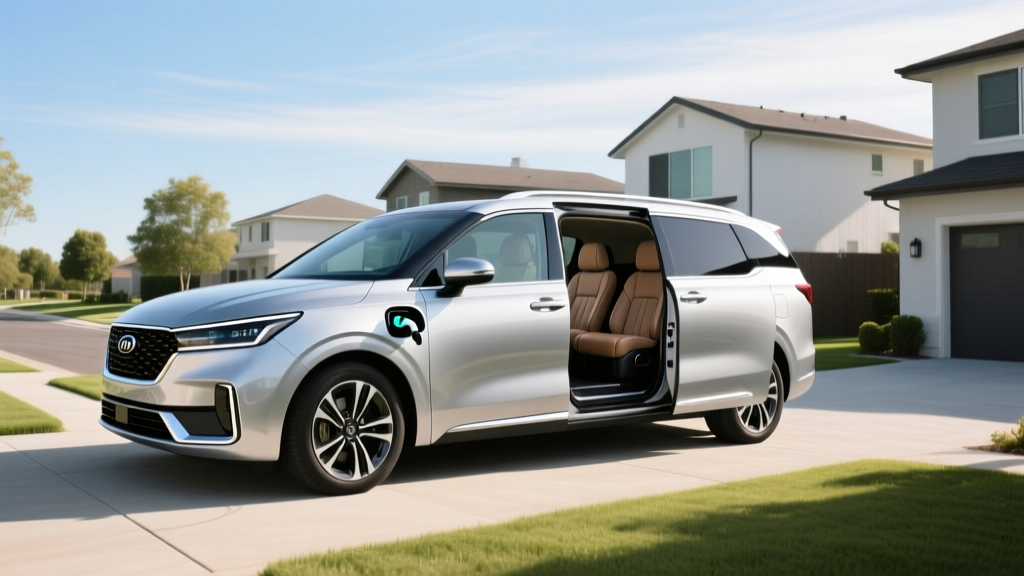
The 2026 Kia Carnival Hybrid LXS sits at the intersection of family practicality and fuel-cost sanity. As the base trim of Kia's hybrid minivan lineup, the LXS promises the same turbocharged hybrid powertrain found on higher trims — but at a price point that undercuts many three-row SUVs. With an EPA-estimated 34 MPG combined, it sips fuel at roughly half the rate of the outgoing V6-only Carnival while retaining the same cavernous interior that has made the nameplate a minivan staple.
This guide breaks down everything a buyer needs to know about the 2026 Kia Carnival Hybrid LXS: real-world fuel economy, the hybrid powertrain under the hood, battery warranty coverage, tax-credit eligibility, and how it stacks up against plug-in hybrid and fully electric alternatives for family hauling.
2026 Kia Carnival Hybrid LXS: Quick Specs at a Glance
| Specification | Value |
|---|---|
| Powertrain Type | Conventional Hybrid (HEV) — no plug-in required |
| Engine | 1.6L Turbocharged 4-cylinder + electric motor |
| Combined Horsepower | 242 hp |
| Combined Torque | 273 lb-ft |
| Transmission | 6-speed automatic |
| EPA Fuel Economy (City / Hwy / Combined) | 34 / 31 / 34 MPG |
| Fuel Tank Capacity | 16.9 gallons |
| Estimated Total Range | ~574 miles |
| Seating Capacity | 7 or 8 passengers |
| Cargo Volume (behind 3rd row) | 41.1 cu ft |
| Max Cargo Volume | 145.1 cu ft |
| Base MSRP (LXS trim) | ~$41,900 (est.) |
| Hybrid Battery Warranty | 10 years / 100,000 miles |
How Many MPG Does the Carnival Hybrid Actually Get?
Kia rates the 2026 Carnival Hybrid at 34 MPG city, 31 MPG highway, and 34 MPG combined across all trims including the LXS. The unusual city-higher-than-highway figure is a hallmark of conventional hybrid architecture: the electric motor handles low-speed stop-and-go driving where internal combustion engines are least efficient, while the gasoline engine shoulders more load at sustained highway speeds.
| Driving Condition | EPA Estimate | Real-World Expectation |
|---|---|---|
| City | 34 MPG | 33–36 MPG (hybrids often exceed EPA in city) |
| Highway | 31 MPG | 28–31 MPG (heavy loads and headwinds reduce efficiency) |
| Combined | 34 MPG | 30–34 MPG depending on driving mix |
In real-world driving, conventional hybrids like the Carnival HEV tend to exceed their EPA city estimates because regenerative braking recaptures energy in traffic that a gas-only vehicle wastes as heat. Owners running primarily suburban and city errands — the minivan's natural habitat — frequently report 35–37 MPG on the dashboard computer. Highway-heavy commutes loaded with passengers and cargo will pull figures closer to 28–30 MPG.
For context, the pre-2025 gasoline-only Carnival with its 3.5L V6 was rated at roughly 22 MPG combined. The hybrid nearly doubles that figure in city driving, translating to roughly $600–$800 in annual fuel savings for a family driving 15,000 miles per year at $3.50/gallon (based on fueleconomy.gov comparisons).
HEV vs PHEV vs EV: Which Minivan Fits Your Family?
The Carnival Hybrid is a conventional hybrid (HEV), meaning it generates all its electricity internally through regenerative braking and the gasoline engine. You never plug it in. This is fundamentally different from a plug-in hybrid (PHEV) or a battery-electric vehicle (BEV).
HEV vs PHEV — Key Distinction
HEV (Carnival Hybrid): No plug, no electric-only range. The small battery assists the gas engine for better MPG. Refuels only at the gas station.
PHEV (e.g., Chrysler Pacifica Hybrid): Plugs in for 30+ miles of electric-only driving, then operates as a hybrid once the battery depletes. Requires home or public charging access to realize its efficiency advantage.
BEV (e.g., Tesla Model X, Kia EV9): Fully electric — no gasoline engine. Lowest running costs but requires reliable charging infrastructure and involves higher upfront cost.
| Factor | HEV (Kia Carnival Hybrid) | PHEV (Chrysler Pacifica Hybrid) | BEV (Kia EV9) |
|---|---|---|---|
| Plug-in Required? | No | Yes (for max savings) | Yes (mandatory) |
| Electric-Only Range | 0 miles | ~32 miles | 243–304 miles (EPA) |
| Combined Efficiency | 34 MPG | 30 MPG + 82 MPGe | 83–89 MPGe |
| Home Charging Needed? | No | Recommended (Level 2) | Essential (Level 2) |
| Starting Price Range | ~$41,900 | ~$51,000 | ~$54,900 |
| Federal Tax Credit (§30D) | Not eligible | Up to $7,500* | Up to $7,500* |
*Federal tax credit eligibility under IRS §30D depends on buyer income caps, vehicle MSRP caps, battery sourcing requirements, and point-of-sale transfer availability. Always verify current rules at irs.gov and consult a tax professional.
Powertrain Deep Dive: The 1.6L Turbo Hybrid System
The 2026 Carnival Hybrid uses Kia's proven turbocharged hybrid architecture, pairing a 1.6-liter turbocharged inline-four gasoline engine with an electric motor integrated into the transmission housing. Combined output is 242 horsepower and 273 lb-ft of torque — a meaningful upgrade over the non-hybrid Carnival's naturally aspirated V6 in terms of low-end responsiveness.
The electric motor fills in the torque gap that turbocharged engines typically exhibit at low RPMs (turbo lag), giving the Carnival Hybrid surprisingly prompt acceleration from a stop. The 6-speed automatic transmission avoids the rubber-band feel of the continuously variable transmissions (CVTs) found in competitors like the Toyota Sienna hybrid, which some drivers find disconnected and droning under hard acceleration.
The hybrid battery pack is a relatively small lithium-ion unit (approximately 1.5 kWh) positioned under the cabin floor. It's important to understand that this battery is not designed for electric-only driving — it exists to buffer energy captured during braking, assist the gas engine during acceleration, and enable engine-off coasting at low speeds. Because the battery is small and the system never deeply cycles it, degradation is minimal over the vehicle's lifetime.
Pricing, Trims, and Tax Credit Reality
The 2026 Kia Carnival Hybrid LXS is positioned as the entry point into Kia's hybrid minivan lineup. Estimated pricing starts around $41,900 including destination charges, placing it several thousand dollars below a comparably equipped Chrysler Pacifica Hybrid (PHEV) and roughly in line with the Toyota Sienna LE hybrid.
Stepping up from the LXS to higher trims (EX, SX, SX Prestige) adds features like leather seating, dual-screen infotainment, premium audio, and advanced driver-assistance suites — but the powertrain and fuel economy remain identical across all trims.
Federal Tax Credit: Does the Carnival Hybrid Qualify?
No. The Kia Carnival Hybrid is a conventional HEV, and the federal §30D clean vehicle credit applies only to plug-in electric vehicles (PHEVs and BEVs) that meet battery-sourcing and critical-mineral requirements. Conventional hybrids are not eligible for the federal purchase credit.
Some states offer their own incentives for hybrid vehicles, though these are increasingly rare as state programs shift focus to plug-in vehicles. Check your state's energy or environmental agency website for any current hybrid rebates. The Carnival Hybrid's advantage is its lower upfront cost compared to PHEV and BEV alternatives — you don't need a tax credit to realize savings when you're already paying $10,000+ less than a Pacifica Hybrid or EV9.
Battery Warranty, Reliability, and Replacement Costs
Hybrid Battery Warranty Coverage
Kia's hybrid battery warranty: 10 years / 100,000 miles (whichever comes first)
Hybrid system components: 10 years / 100,000 miles
Basic vehicle warranty: 5 years / 60,000 miles
Powertrain warranty: 10 years / 100,000 miles
Kia's 10-year/100,000-mile hybrid battery warranty is among the longest in the industry and matches Toyota's coverage for the Sienna hybrid. The warranty covers the battery pack against defects and capacity loss below a specified threshold (typically 70% of original capacity), along with hybrid-specific components like the electric motor, inverter, and associated control modules.
How Long Will the Hybrid Battery Last?
Modern hybrid battery packs in vehicles like the Carnival Hybrid are engineered for the life of the vehicle. The battery is small (~1.5 kWh), never fully charged or fully depleted (the system maintains a buffer), and uses conservative charge/discharge rates. Data from Toyota's decades-long hybrid history — with millions of Prius and Sienna hybrids on the road — shows that most hybrid batteries outlast 150,000–200,000 miles without significant degradation.
If replacement is eventually needed outside of warranty, a hybrid battery for a minivan-class vehicle typically costs between $2,000 and $4,000 including labor. This is far less than a full EV battery replacement ($8,000–$20,000+) because the pack is small and the labor is less complex. Refurbished and aftermarket hybrid batteries are also increasingly available at lower cost.
Overall Reliability Outlook
Kia's turbocharged 1.6L hybrid powertrain has been in production across multiple models (Sorento Hybrid, Sportage Hybrid) since the early 2020s, giving it a multi-year track record. The conventional hybrid system adds complexity compared to a pure gas engine, but it eliminates other wear items: regenerative braking extends brake pad life significantly, and the electric motor reduces strain on the gasoline engine during the most demanding acceleration moments. According to owner surveys tracked by sources like IIHS and consumer reliability indexes, Kia's hybrid minivan platform has performed in line with or above segment averages.
Real-World Ownership: What the EPA Sticker Doesn't Tell You
The EPA's 34 MPG combined figure is a solid baseline, but your actual fuel costs will depend heavily on your driving profile:
- City-dominant driving (school runs, errands, stop-and-go): Expect 34–37 MPG. The hybrid system excels here, and you may consistently beat the EPA city estimate.
- Highway-dominant driving (long commutes, road trips): Expect 28–31 MPG. Aerodynamic drag and the weight of a loaded minivan work against efficiency at sustained speeds above 65 mph.
- Cold weather impact: Hybrid fuel economy drops 10–15% in freezing temperatures. The engine runs more often to provide cabin heat (unlike an EV with a heat pump, the HEV uses engine waste heat), and the battery is less efficient when cold.
- Full load (7-8 passengers + cargo): Add 2–4 MPG of consumption. The Carnival's 5,000+ lb curb weight with a full cabin means the engine works harder, though the electric motor's torque assist helps mitigate the penalty compared to a non-hybrid.
For a family driving 15,000 miles annually with a mix of city and highway, annual fuel costs in the Carnival Hybrid LXS work out to approximately $1,550–$1,750 at $3.50/gallon. That same mileage in the gas-only V6 Carnival would cost roughly $2,400–$2,600 — a savings of $700–$1,000 per year with the hybrid.
Who Should Choose the Carnival Hybrid LXS — And Who Shouldn't
Choose the Carnival Hybrid LXS if:
- You need three-row minivan space without plug-in charging hassle
- Your driving is primarily city and suburban (school, activities, errands)
- You want to reduce fuel costs without changing your refueling habits
- You're budget-conscious and don't want to pay a PHEV or BEV premium
- You lack access to home Level 2 charging (apartment, street parking)
- You value Kia's 10-year/100,000-mile warranty coverage
Look elsewhere if:
- You want electric-only driving for short commutes (consider the Pacifica PHEV)
- You want to eliminate gasoline entirely (consider the Kia EV9 or Tesla Model X)
- You need AWD — the Carnival Hybrid is front-wheel drive only
- You frequently tow heavy loads (the hybrid's towing capacity is reduced vs. the gas V6)
- You want the federal §30D tax credit (requires a PHEV or BEV)
The LXS trim specifically makes sense for buyers who prioritize value over luxury features. You get the full hybrid powertrain, the same fuel economy as the top-trim SX Prestige, and Kia's full suite of standard safety technology — without paying for leather, premium audio, or ventilated seats you may not need in a family workhorse.
Frequently Asked Questions
Does the 2026 Kia Carnival Hybrid need to be plugged in?
No. The Carnival Hybrid is a conventional hybrid (HEV). It charges its own small battery through regenerative braking and the gasoline engine. You refuel it at any gas station, exactly like a traditional vehicle. If you want a minivan that plugs in for electric-only driving, you'd need a PHEV like the Chrysler Pacifica Hybrid.
How does the Carnival Hybrid compare to the Toyota Sienna hybrid?
Both are conventional hybrids with similar combined MPG (the Sienna is rated at 36 MPG combined vs. the Carnival's 34). The Sienna comes standard with AWD availability, while the Carnival Hybrid is FWD only. The Carnival offers slightly more cargo volume and a more traditional automatic transmission (vs. the Sienna's CVT). Pricing is competitive, though the Sienna has a longer track record as a hybrid minivan.
Is the Carnival Hybrid slower than the gas V6 Carnival?
No — the hybrid's combined 242 hp and 273 lb-ft of torque, with instant electric motor torque, delivers comparable or slightly quicker acceleration than the gas-only V6 in real-world driving, especially from a stop. The hybrid may feel marginally less responsive at highway passing speeds above 60 mph where the turbo and smaller displacement engine work harder, but the difference is minimal for family driving.
What happens if the hybrid battery fails after the warranty expires?
Out-of-warranty hybrid battery replacement typically costs $2,000–$4,000 including labor. However, modern hybrid batteries routinely last 150,000+ miles, and Kia's 10-year/100,000-mile warranty provides coverage through the period when most owners will own the vehicle. The risk of a costly battery failure is significantly lower with a small HEV battery than with a large BEV pack.
Does the 2026 Carnival Hybrid qualify for any tax incentives?
The Carnival Hybrid does not qualify for the federal §30D clean vehicle credit, which is limited to plug-in vehicles (PHEVs and BEVs). Some states may offer minor hybrid incentives, but these are uncommon in 2026. The Carnival Hybrid's value proposition is its lower purchase price and strong fuel economy — not tax-credit-dependent savings. For current federal credit rules, see irs.gov.
Can the Carnival Hybrid run on electric power alone?
Only at very low speeds for very short distances (typically under 1 mile at parking-lot speeds). The battery is too small for meaningful electric-only driving. This is by design — the hybrid system's goal is to assist the gasoline engine for better MPG, not to replace it. For substantial electric-only range, a PHEV or BEV is required.