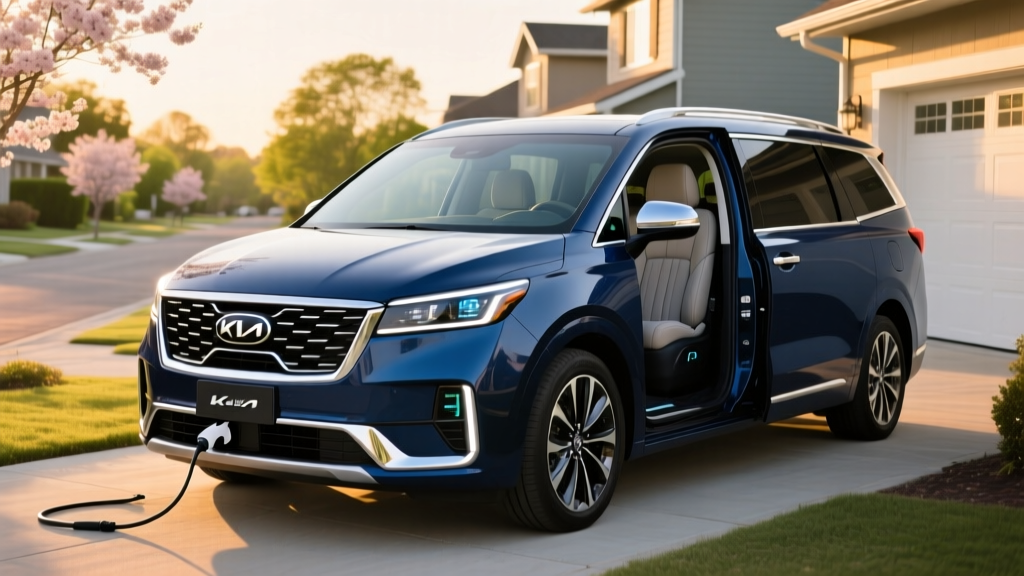
The 2026 Kia Carnival Hybrid EX occupies a rare niche: a three-row minivan that sips fuel like a compact sedan without asking you to plug in, change your driving habits, or sacrifice cargo space. Kia introduced the hybrid Carnival for the 2025 model year, and the 2026 version carries over the proven 1.6-liter turbocharged hybrid powertrain with incremental software refinements to the transmission mapping and regenerative braking calibration. For families weighing a minivan purchase, the Hybrid EX trim hits the sweet spot of features, efficiency, and price. Here is every number that matters.
HEV vs PHEV: What the Carnival Hybrid Actually Is
Conventional Hybrid (HEV): The 2026 Kia Carnival Hybrid is a standard hybrid — it charges its small battery through regenerative braking and the gasoline engine. You never plug it in. There is no electric-only driving range to manage. Think of it as a gas minivan that is significantly more efficient, especially in stop-and-go traffic.
Plug-in Hybrid (PHEV): Kia does not currently offer a Carnival PHEV in the US market. If you want plug-in capability in a Kia three-row, you would look at the Sorento PHEV (32 miles electric-only). The Carnival Hybrid is strictly a self-charging HEV.
This distinction matters because many shoppers confuse "hybrid" with "plug-in." The Carnival Hybrid has no charge port. You fuel it like any other gas vehicle and the hybrid system handles the rest. The trade-off versus a PHEV is that you get no zero-emission electric-only miles, but you also get no range-anxiety math, no home charger requirement, and a lower purchase price.
Fuel Economy: EPA Ratings and Real-World MPG
| Driving Cycle | EPA Estimate | Real-World Expectation |
|---|---|---|
| City | 34 MPG | 35–38 MPG (regenerative braking excels in traffic) |
| Highway | 31 MPG | 28–31 MPG (aerodynamic drag of a minivan hurts at 75+ mph) |
| Combined | 33 MPG | 30–35 MPG depending on driving mix |
The Carnival Hybrid's 33 MPG combined represents a roughly 40% improvement over the gas-only Carnival's 22 MPG combined. The gains are most dramatic in city driving, where the electric motor handles low-speed propulsion and the engine shuts off at stops. On a suburban school-run loop with frequent stops, owners routinely report 36–38 MPG.
Highway efficiency is where the physics of a 4,700-pound minivan works against you. At sustained 75–80 mph speeds, expect 28–30 MPG in warm weather and potentially 26–28 MPG in cold weather when the engine runs more frequently for cabin heat. These numbers still handily beat the gas Carnival's 19 MPG highway.
According to fueleconomy.gov, the annual fuel cost for the Carnival Hybrid (at 15,000 miles/year and $3.50/gallon) is approximately $1,590, compared to $2,450 for the gas model — a savings of roughly $860 per year.
Powertrain Specs: 245 Horsepower Turbo Hybrid
| Specification | 2026 Carnival Hybrid EX |
|---|---|
| Engine | 1.6L turbocharged 4-cylinder |
| Electric Motor | 47.7 kW (64 hp) permanent-magnet synchronous |
| Combined System Output | 245 hp / 271 lb-ft torque |
| Transmission | 6-speed automatic (torque converter) |
| Drivetrain | Front-wheel drive |
| Hybrid Battery | 1.49 kWh lithium-ion (self-charging, no plug) |
| 0–60 mph | ~7.9 seconds (estimated) |
| Towing Capacity | 3,500 lbs |
| Curb Weight | ~4,774 lbs |
The 1.6-liter turbo four-cylinder paired with a 47.7 kW electric motor delivers 245 combined horsepower — adequate for merging and passing even with a full load of passengers and cargo. Kia uses a conventional 6-speed automatic rather than the CVT or e-CVT found in competitors like the Toyota Sienna (which is hybrid-only and rated at 36 MPG combined but produces just 245 hp from a naturally aspirated setup).
The small 1.49 kWh battery pack is enough for brief electric-only assists at low speeds (typically under 15 mph in parking lots or heavy traffic) but is not designed for sustained electric driving. It recharges continuously through regenerative braking and engine power.
Pricing and Tax Credit Eligibility
The 2026 Kia Carnival Hybrid EX carries a base MSRP of approximately $41,900 (including destination). This positions it roughly $2,500 above the equivalent gas-only EX trim, a premium you can expect to recoup through fuel savings within 3–4 years at current gas prices and average mileage.
| Trim | MSRP (est.) |
|---|---|
| Carnival Hybrid LX | $39,900 |
| Carnival Hybrid EX | $41,900 |
| Carnival Hybrid SX | $46,500 |
| Carnival Hybrid SX Prestige | $52,900 |
Federal Tax Credit: The conventional hybrid Carnival does not qualify for the federal §30D clean vehicle credit (up to $7,500). That credit applies only to plug-in electric vehicles (BEVs and PHEVs) meeting battery-sourcing, critical-mineral, MSRP, and buyer-income requirements per IRS guidelines. Since the Carnival Hybrid is a self-charging HEV with no plug, it is ineligible.
Some states offer separate incentives for conventional hybrids, but these are increasingly rare as state programs shift focus to zero-emission vehicles. Check your state energy office for current programs.
EX Trim Features: What You Get
The EX trim is the volume seller in the Carnival Hybrid lineup and includes:
- Power-sliding rear doors and power liftgate
- Synthetic leather (SynTex) seating surfaces
- Heated front seats with 8-way power driver seat
- 12.3-inch touchscreen with wireless Apple CarPlay and Android Auto
- Smart power tailgate with hands-free open
- Highway Driving Assist (HDA) — adaptive cruise with lane centering (SAE Level 2)
- Blind-spot collision avoidance and rear cross-traffic alert
- Dual-zone automatic climate control
- Second-row captain's chairs with Slide-Flex seating
Notably, the Carnival Hybrid does not offer all-wheel drive on any trim. If AWD is a priority, the Toyota Sienna (hybrid-only, AWD available, 35 MPG combined AWD) or the Chrysler Pacifica (AWD available on gas models) remain alternatives, though neither matches the Carnival's cargo volume and interior flexibility.
Battery Warranty and Long-Term Reliability
Hybrid Battery Warranty: Kia covers the Carnival Hybrid's lithium-ion battery pack for 10 years / 100,000 miles (whichever comes first) in all 50 states. This is one of the strongest hybrid battery warranties in the industry and matches Hyundai's coverage.
Powertrain Warranty: The engine, transmission, and hybrid motor are covered for 10 years / 100,000 miles.
Limited Vehicle Warranty: 5 years / 60,000 miles bumper-to-bumper.
Hybrid battery replacement cost, should it be needed out of warranty, typically ranges from $3,000 to $5,000 including labor for a pack of this size. However, the 1.49 kWh battery in the Carnival Hybrid is small and under minimal stress compared to a PHEV or BEV pack. Toyota's track record with similarly sized hybrid batteries (Prius, Camry Hybrid, Sienna) shows that most last well beyond 150,000 miles with minimal capacity loss. Kia's hybrid system, derived from its Sorento Hybrid and Niro platform, has shown comparable durability in early data.
The conventional hybrid architecture also means fewer things to go wrong versus a PHEV: no onboard charger to fail, no charge port, no large high-voltage battery cooling system, and no DC fast-charge hardware. The 6-speed automatic transmission is a proven torque-converter unit, avoiding the long-term reliability questions that still surround some CVT designs.
Carnival Hybrid vs Sienna vs Pacifica: The Minivan Decision
| Attribute | 2026 Carnival Hybrid EX | 2026 Toyota Sienna XLE | 2026 Chrysler Pacifica Hybrid |
|---|---|---|---|
| Powertrain Type | HEV (no plug) | HEV (no plug) | PHEV (plug-in) |
| EPA Combined MPG | 33 MPG | 36 MPG (FWD) | 30 MPG (gas) / 82 MPGe |
| Electric-Only Range | N/A | N/A | 32 miles |
| Horsepower | 245 hp | 245 hp | 260 hp |
| AWD Available | No | Yes | No |
| Max Cargo (behind 1st row) | 145.1 cu ft | 101.0 cu ft | 140.5 cu ft |
| Towing Capacity | 3,500 lbs | 3,500 lbs | 3,600 lbs |
| Federal Tax Credit | None | None | Up to $7,500* |
| Starting MSRP (est.) | $41,900 | $42,500 | $51,000 |
*Pacifica Hybrid tax credit eligibility depends on current-year §30D battery-sourcing and income requirements. Verify on fueleconomy.gov.
Choose the Carnival Hybrid EX If:
- You want maximum cargo space (145.1 cu ft — class-leading)
- You don't have access to home or workplace charging
- You prefer a conventional automatic transmission over a CVT
- You want strong hybrid fuel economy with zero behavior change
- Second-row Slide-Flex seating (rotating, sliding, folding) matters for your family
Look Elsewhere If:
- You need AWD (get the Sienna)
- You have home charging and want electric-only commuting (get the Pacifica PHEV)
- You want the absolute highest MPG and don't mind a CVT (Sienna at 36 MPG)
- You want to qualify for the $7,500 federal tax credit (PHEV or BEV required)
Ownership Costs: 5-Year Outlook
Over five years and 75,000 miles, the Carnival Hybrid EX saves approximately $4,300 in fuel versus the gas-only Carnival at $3.50/gallon. The $2,500 hybrid premium is recovered in roughly 2.9 years. Insurance costs are comparable to the gas model — hybrid minivans do not carry the insurance premiums that some performance EVs do.
Depreciation for the Carnival Hybrid is expected to be favorable. Hybrid minivans hold value well because demand consistently exceeds supply in the used market. The Toyota Sienna hybrid has demonstrated strong residual values, and the Carnival Hybrid should follow a similar trajectory given Kia's warranty coverage and the segment's limited hybrid options.
Frequently Asked Questions
How many MPG does the 2026 Kia Carnival Hybrid get?
The EPA rates the 2026 Carnival Hybrid at 34 MPG city, 31 MPG highway, and 33 MPG combined. In real-world city driving with frequent stops, expect 35–38 MPG thanks to aggressive regenerative braking. Highway cruising at 75+ mph will return 28–30 MPG.
Does the Carnival Hybrid need to be plugged in?
No. The Carnival Hybrid is a conventional (self-charging) hybrid. Its 1.49 kWh battery charges through regenerative braking and the gasoline engine. There is no plug, no charge port, and no electric-only range to manage.
Is the Carnival Hybrid reliable?
Kia's 1.6L turbo hybrid powertrain has been in production since 2022 across the Sorento Hybrid and Niro lines, with no widespread reliability concerns reported. The hybrid battery is covered for 10 years/100,000 miles. Long-term data is still accumulating, but the architecture is proven and conservative.
What does it cost to replace the hybrid battery?
Out-of-warranty replacement for the Carnival Hybrid's 1.49 kWh battery pack is estimated at $3,000–$5,000 including labor. Given the 10-year/100,000-mile warranty and the small pack size under minimal stress, most owners will never face this cost.
Does the 2026 Carnival Hybrid qualify for a federal tax credit?
No. The federal §30D clean vehicle credit (up to $7,500) applies only to plug-in vehicles (BEVs and PHEVs). The Carnival Hybrid is a self-charging HEV and does not qualify. Check IRS.gov for current rules.
Hybrid vs PHEV vs EV — which minivan fits me?
Choose the Carnival Hybrid (HEV) if you lack home charging, want zero behavior change, and prioritize cargo space above all. Choose the Pacifica PHEV if you have home charging and a short commute (32 miles electric-only covers most daily trips, and you may qualify for the $7,500 tax credit). Choose a BEV minivan (like the upcoming Kia EV9 three-row SUV, if it fits your needs) only if you want zero gas, have reliable charging access, and can accept higher upfront cost.
Can the Carnival Hybrid tow?
Yes. The Carnival Hybrid is rated to tow up to 3,500 pounds when properly equipped, matching the gas-only Carnival. This is sufficient for a small boat trailer, utility trailer, or a pair of jet skis.