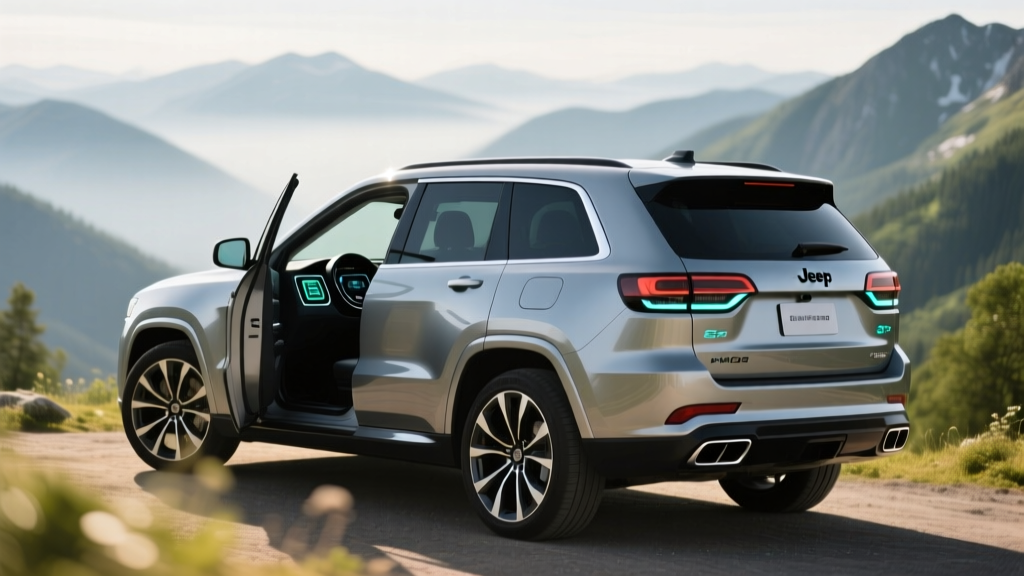
The 2026 Jeep Grand Cherokee 4xe remains one of the few plug-in hybrid midsize SUVs that pairs genuine off-road capability with a usable electric-only commute. For buyers who want to drive on electricity most weekdays but still tow a trailer or hit a trailhead on weekends without range anxiety, this PHEV occupies a specific and compelling niche. But with a starting price near $60,000 and real-world efficiency that depends heavily on your charging habits, the Grand Cherokee 4xe demands a closer look at the numbers before you sign.
In this guide, we cover the Grand Cherokee 4xe's powertrain, EPA efficiency, electric range, charging logistics, pricing, and federal tax credit eligibility — and we clarify how it stacks up against both a conventional hybrid and a full battery-electric vehicle.
HEV vs. PHEV: Which Grand Cherokee Hybrid Are We Talking About?
First, a critical distinction. Jeep currently offers the Grand Cherokee exclusively as a plug-in hybrid (PHEV) under the 4xe badge. There is no conventional hybrid (HEV) version of the current-generation Grand Cherokee in the U.S. market for 2026. That means every "Grand Cherokee hybrid" you see is a 4xe — a vehicle with a charge port, a larger battery, and the ability to drive on electricity alone for a limited distance.
| Feature | HEV (e.g., Toyota RAV4 Hybrid) | PHEV (Grand Cherokee 4xe) |
|---|---|---|
| Plug-in charging? | No — charges via regenerative braking and engine | Yes — plug in to access full electric range |
| Electric-only range | Typically <1 mile at low speed | EPA-estimated 25 miles |
| Battery size | ~1–2 kWh | 17.3 kWh (total) / ~14.9 kWh usable |
| Fuel economy when battery depleted | Strong — optimized for hybrid driving | Moderate — 23 MPG combined (heavy SUV) |
| Tax credit eligible? | No | Up to $3,750 (§30D, subject to eligibility) |
If you never plan to plug in, the 4xe still functions as a conventional hybrid once its battery is depleted — but you'll get only about 23 MPG combined, which is unremarkable for the segment. The value proposition of the 4xe is realized when you charge regularly.
Powertrain and Performance Specs
The 2026 Grand Cherokee 4xe pairs a 2.0-liter turbocharged inline-four engine with two electric motors integrated into an eight-speed automatic transmission. The result is a combined output that outmuscles most V6 competitors.
| Engine | 2.0L turbocharged I-4 |
| Electric motors | Two (one integrated into transmission, one engine-mounted) |
| Combined horsepower | 375 hp |
| Combined torque | 470 lb-ft |
| Battery (total / usable) | 17.3 kWh / ~14.9 kWh (NMC lithium-ion) |
| Electric-only range (EPA) | 25 miles |
| Total combined range | ~440 miles (electric + gas) |
| 0–60 mph | 6.0 seconds (estimated) |
| Towing capacity | 6,000 lbs (when properly equipped) |
| Drivetrain | 4WD (standard) |
| Transmission | 8-speed automatic (TorqueFlite) |
The 470 lb-ft of torque arrives instantly from the electric motors, which gives the 4xe a responsiveness off the line that the turbo-four alone couldn't deliver. In Electric mode, the vehicle is whisper-quiet and adequate for suburban errands. In Hybrid mode, the system blends power sources automatically. In eSave mode, it preserves battery charge for later — useful if you're driving into a city with low-emission restrictions or want electric power at your destination.
Fuel Economy and Electric Efficiency
| Metric | City | Highway | Combined |
|---|---|---|---|
| MPGe (charge-sustaining + electric) | — | — | 56 MPGe |
| MPG (gas only, battery depleted) | 23 | 24 | 23 |
| Electric energy consumption | 56 kWh/100 mi (combined) | ||
Real-world MPG vs. EPA: The 56 MPGe figure is meaningful only if you regularly plug in and drive within the 25-mile electric window. Owners with short commutes and consistent home charging routinely report using gasoline for fewer than 20% of their miles. However, once the battery depletes — on a long road trip, for example — you're hauling a 5,100-pound SUV with a four-cylinder engine, and 23 MPG combined is the reality. In city driving under hybrid mode, expect slightly better figures (around 24–25 MPG) thanks to regenerative braking. Highway cruising at 75+ mph can drop to 21–22 MPG.
Real-World Range Expectations: The EPA-estimated 25-mile electric range assumes moderate temperatures and mixed driving. In cold weather (below 32°F), expect a 20–30% reduction — roughly 17–20 electric miles. At sustained highway speeds above 70 mph, electric range also drops. For total range (electric + gas), the 4xe delivers approximately 440 miles on a full charge and full tank, though aggressive driving or towing will reduce this.
Charging: How, How Fast, and Where
The Grand Cherokee 4xe uses a standard J1772 connector for AC charging. Here's what to expect:
| Level | Power (kW) | Full Charge Time | Notes |
|---|---|---|---|
| Level 1 (120V household outlet) | ~1.4 kW | ~12 hours | Emergency/top-up only |
| Level 2 (240V home/public) | ~7.2 kW | ~2.5 hours | Recommended for daily use |
| DC fast charging | Not supported | N/A | No DCFC capability |
The lack of DC fast charging is a notable limitation. On road trips, you cannot top up the battery at Electrify America or Tesla Supercharger stations in 15 minutes. Instead, the gasoline engine takes over, and you can use eSave mode on the highway to preserve or slightly replenish the battery for city driving at your destination.
Home charging setup: A Level 2 home charger (240V, 32-amp circuit) will fully replenish the 4xe's battery in roughly 2.5 hours. Most owners plug in overnight and wake to a full charge every morning. Installation of a Level 2 home charger typically runs $800–$2,000 depending on your electrical panel's capacity and proximity to the parking spot — a licensed electrician should evaluate your setup.
Pricing, Trims, and Federal Tax Credit
The 2026 Grand Cherokee 4xe is offered across several trims, with pricing that positions it firmly in the premium midsize SUV segment:
| Trim | Starting MSRP |
|---|---|
| 4xe (base) | $59,495 |
| 4xe Trailhawk | $64,495 |
| 4xe Overland | $67,495 |
| 4xe Summit | $72,495 |
| 4xe Summit Reserve | $77,495 |
Federal tax credit (§30D): The Grand Cherokee 4xe qualifies for a partial federal tax credit of up to $3,750, reflecting its battery component and critical-mineral sourcing compliance under current IRS §30D rules. The full $7,500 credit requires meeting both critical-mineral and battery-component thresholds, and the 4xe currently satisfies one of the two requirements.
- MSRP cap: SUVs must have an MSRP at or below $80,000. All 4xe trims qualify (Summit Reserve at $77,495 clears the cap).
- Buyer income cap: Modified adjusted gross income must not exceed $150,000 (single), $225,000 (head of household), or $300,000 (joint).
- Point-of-sale transfer: As of 2024, eligible buyers can transfer the credit to the dealer at purchase, reducing the out-of-pocket price immediately — no need to wait for tax filing.
- Final assembly: Must be assembled in North America (the Grand Cherokee is built in Detroit, MI).
Consult a tax professional to confirm your personal eligibility, as sourcing requirements and income thresholds are subject to legislative change.
Battery Warranty, Reliability, and Replacement Cost
High-Voltage Battery Warranty: Jeep covers the 4xe's hybrid battery for 10 years or 100,000 miles (whichever comes first), with a capacity retention threshold of approximately 70%. The powertrain (engine, electric motors, transmission) is covered for 5 years / 60,000 miles. This is consistent with industry-standard PHEV battery coverage and meets the federal mandate for emissions-related components.
Reliability: The 4xe powertrain has been in production since the 2022 model year, giving it several years of real-world data. Early models (2022–2023) saw some software-related recalls and complaints around the transmission calibration and battery management system. Jeep has issued updates to address most of these. The 2.0L turbo engine itself is a proven Stellantis unit shared across multiple models. Check NHTSA recall listings for the specific VIN you're considering.
Battery replacement cost: If the high-voltage battery requires replacement outside of warranty, expect a cost in the range of $8,000–$12,000 including parts and labor. However, PHEV batteries in this class are designed to last the life of the vehicle under normal use, and the 10-year/100,000-mile warranty provides substantial coverage. Unlike full EVs with 80–100+ kWh packs, the 4xe's smaller 17.3 kWh battery is less expensive to replace.
Who Should Choose the Grand Cherokee 4xe?
Choose the Grand Cherokee 4xe if:
- Your daily commute is under 25 miles round-trip and you can charge at home
- You need towing capacity (6,000 lbs) that most EVs in this price range can't match
- You want off-road capability (Trailhawk trim with air suspension and skid plates)
- You take regular road trips where charging infrastructure is uncertain
- You want to reduce gasoline consumption without committing to a full EV
Choose a full EV (e.g., Rivian R1S, Tesla Model X) if:
- You want zero tailpipe emissions and lower per-mile fueling costs
- You have reliable home charging and your trips rarely exceed 250 miles
- You want minimal maintenance (no oil changes, no engine)
Choose a conventional hybrid (e.g., Toyota Grand Highlander Hybrid) if:
- You cannot plug in at home or work
- You prioritize fuel economy over electric-only driving (35+ MPG combined)
- You want a lower purchase price (starting ~$40,000)
Pros
- 375 hp / 470 lb-ft — genuinely quick for a midsize SUV
- 25-mile electric range covers most daily commutes
- 6,000-lb towing capacity
- Trailhawk trim offers real off-road hardware
- Eligible for up to $3,750 federal tax credit
- 10-year/100,000-mile battery warranty
Cons
- 23 MPG combined on gas is poor for a hybrid
- No DC fast charging
- Starting MSRP near $60K; well-equipped models push $75K+
- Heavy (5,100+ lbs) — impacts tire wear and braking distances
- Electric range drops significantly in cold weather
- Third-row seat unavailable on 4xe (battery packaging)
Frequently Asked Questions
How many MPG does the 2026 Grand Cherokee hybrid get?
The EPA rates the Grand Cherokee 4xe at 56 MPGe combined when factoring in electric driving, and 23 MPG combined when running on gasoline alone after the battery is depleted. Real-world gas-only MPG ranges from 21 on the highway at high speed to 25 in stop-and-go city traffic with regenerative braking.
How far can the Grand Cherokee 4xe go on electric only?
The EPA estimates 25 miles of electric-only range. In real-world conditions — particularly in cold weather or at highway speeds — expect 17–22 miles. This is sufficient for most daily commutes if you charge at home overnight.
Does the Grand Cherokee 4xe qualify for a federal tax credit?
Yes, it qualifies for up to $3,750 under IRS §30D, subject to buyer income limits ($150K single / $300K joint), the $80K MSRP cap for SUVs, and North American final assembly. The credit can be transferred to the dealer at the point of sale. Always verify current eligibility with the IRS or a tax professional before purchasing.
Is the Grand Cherokee 4xe reliable?
The powertrain has been in production since 2022. Early model years had software-related recalls, but the hardware is largely proven. The high-voltage battery is warrantied for 10 years / 100,000 miles. Check NHTSA for any open recalls on a specific VIN before buying.
What does it cost to replace the hybrid battery?
Out-of-warranty replacement runs approximately $8,000–$12,000. However, PHEV batteries of this size are engineered for the vehicle's lifespan, and the 10-year warranty covers premature degradation below 70% capacity.
Can I charge the Grand Cherokee 4xe at a DC fast charger?
No. The 4xe supports only AC charging (Level 1 at 120V and Level 2 at 240V). On road trips, the gasoline engine handles propulsion while the battery is reserved or replenished via regenerative braking and the engine-driven generator.
Hybrid vs. PHEV vs. EV — which should I choose?
If you can charge at home and your commute is under 25 miles, the 4xe PHEV offers the best of both worlds — electric daily driving and gas-powered road trips. A conventional hybrid makes more sense if you can't plug in. A full EV is ideal if you want the lowest operating costs and rarely drive more than 250 miles between stops.
Sources: EPA Fuel Economy — Jeep Grand Cherokee 4xe, IRS Clean Vehicle Credits (§30D), NHTSA Recalls Database.