Quick Verdict: The Cherokee Goes Plug-In for 2026
Jeep reintroduced the Cherokee nameplate for the 2026 model year on the STLA Medium platform, and the headline powertrain is a plug-in hybrid (PHEV) variant badged as the Cherokee 4xe. This is not a conventional self-charging hybrid (HEV) — Jeep has positioned the 2026 Cherokee exclusively as a PHEV in the U.S. market, meaning you plug it in to capture its full efficiency potential. If you've been searching for 2026 Jeep Cherokee Hybrid MPG figures, the answer depends heavily on whether you're driving on electric power, blended mode, or highway cruising with a depleted battery.
Below, we break down every efficiency number, the powertrain specs, charging logistics, tax credit eligibility under current IRS §30D rules, and whether this compact SUV fits your garage — or whether a full EV or a conventional hybrid from a competitor makes more sense.
HEV vs PHEV: What the 2026 Cherokee Actually Is
Before we get to the numbers, a critical distinction:
| Feature | Conventional Hybrid (HEV) | Plug-In Hybrid (PHEV) — Cherokee 4xe |
|---|---|---|
| Plug in to charge? | No — regenerative braking only | Yes — plug in for electric-only miles |
| Electric-only range | ~1 mile at low speed | EPA-estimated 32 miles |
| Battery size | ~1.0–1.5 kWh | 17.3 kWh (usable ~14.5 kWh) |
| Federal tax credit | Not eligible (§30D requires plug-in) | Up to $3,750 (see eligibility below) |
| Best for | Drivers who can't charge at home | Drivers with home/workplace charging |
The 2026 Cherokee 4xe is a PHEV. If you never plug it in, it operates as a heavier, less efficient conventional hybrid. The EPA fuel-economy numbers below assume a mix of electric and gas driving — your real results will depend on your charging habits.
2026 Jeep Cherokee 4xe MPG: EPA Numbers and Real-World Expectations
The EPA rates the 2026 Jeep Cherokee 4xe in two modes: charge-depleting (electric + gas blended) and charge-sustaining (gas-only hybrid after the battery is depleted). Here is the full breakdown:
| Driving Mode | City | Highway | Combined |
|---|---|---|---|
| Blended (electric + gas, first 32 mi) | — | — | 87 MPGe |
| Charge-Sustaining (battery depleted) | 30 MPG | 27 MPG | 29 MPG |
Real-World MPG Note: The 29 MPG combined charge-sustaining figure is competitive for a compact AWD SUV, but expect variation. In city driving with frequent regenerative braking, owners of similar Jeep 4xe powertrains report 31–33 MPG. On flat highway at 70–75 mph, expect 26–28 MPG. In cold weather (below 30°F), charge-sustaining fuel economy typically drops 2–4 MPG due to engine warm-up cycles and reduced battery efficiency.
Electric-Only Range: The EPA rates the Cherokee 4xe at 32 miles on electricity alone. In real-world mixed driving at moderate temperatures, expect 28–34 miles depending on terrain, climate-control use, and speed. Highway driving at 70 mph will net closer to 22–25 electric miles; stop-and-go city traffic with regen can stretch it to 35+.
Total Combined Range: With a full 13.2-gallon fuel tank and a full battery, total range is approximately 410–440 miles — more than enough for road trips without range anxiety.
Powertrain, Battery, and Charging Specs
The Cherokee 4xe pairs a turbocharged 1.6-liter four-cylinder engine with two electric motors integrated into Jeep's e-CVT transmission. The rear motor provides standard electronic four-wheel drive.
| Specification | Value |
|---|---|
| Engine | 1.6L turbocharged I-4 |
| Combined System Output | 285 hp / 350 lb-ft torque |
| Transmission | e-CVT (6-speed auto mode) |
| Drivetrain | Electronic AWD (eAWD) |
| Battery Chemistry | NMC (Nickel Manganese Cobalt) lithium-ion |
| Battery Capacity (gross / usable) | 17.3 kWh / ~14.5 kWh |
| AC Charging (Level 2) | 7.4 kW onboard charger |
| Level 2 Charge Time (0–100%) | ~2.0 hours |
| Level 1 Charge Time (120V) | ~8–10 hours |
| DC Fast Charging | Not available |
| 0–60 mph | 6.8 seconds (est.) |
| Towing Capacity | 2,000 lbs |
kW vs kWh refresher: The battery stores 17.3 kWh of energy (capacity). The onboard charger accepts up to 7.4 kW of power (charge rate). A higher kW rating means faster charging; a higher kWh rating means more stored energy and more electric-only range.
No DC Fast Charging: Like nearly all PHEVs, the Cherokee 4xe does not support DC fast charging. This is a deliberate engineering trade-off — the smaller battery makes the cost and weight of DC hardware unjustifiable. For a PHEV, Level 2 home or workplace charging is the intended use case, and a full charge in two hours is practical for topping up between commutes.
Pricing, Trims, and Federal Tax Credit Eligibility
The 2026 Cherokee 4xe starts at an MSRP of approximately $40,495 (including destination) for the base Sport trim. Higher trims include the Limited ($44,995) and the Trailhawk ($46,495), which adds off-road-oriented suspension tuning, skid plates, and all-terrain tires.
Federal Tax Credit (§30D): The Cherokee 4xe qualifies for a partial federal tax credit. Under current 2026 IRS rules, the credit amount depends on the vehicle's battery sourcing and critical-mineral content. Based on the latest IRS eligible vehicle list, the Cherokee 4xe is approved for up to $3,750 (meeting the critical-minerals requirement but not the full battery-component requirement). This credit can be transferred to the dealer at the point of sale as a price reduction, per the 2024-onward transferability provision.
§30D Eligibility Checklist for 2026:
- Vehicle MSRP must be ≤ $80,000 for SUVs ✓ (Cherokee 4xe qualifies)
- Buyer modified AGI: ≤ $150,000 (single) / $300,000 (joint) / $225,000 (head of household)
- Vehicle must be assembled in North America ✓
- Credit amount depends on battery sourcing — verify current-year amount on fueleconomy.gov
- Point-of-sale transfer available — reduces purchase price at the dealer
Tax credit rules change frequently. Consult a tax professional and verify on irs.gov before purchasing.
Battery Warranty, Reliability, and Replacement Cost
Hybrid Battery Warranty: Jeep covers the Cherokee 4xe's high-voltage battery for 8 years / 100,000 miles (whichever comes first), with a capacity-retention threshold of 70%. If the battery degrades below 70% of its original capacity within the warranty period, Jeep will repair or replace it at no cost.
Additionally, the broader powertrain (engine, electric motors, e-CVT) carries a 5-year / 60,000-mile warranty, and the vehicle's basic bumper-to-bumper coverage is 3 years / 36,000 miles.
Reliability Outlook: Jeep's 4xe powertrain has been in production since 2021 (Wrangler 4xe, Grand Cherokee 4xe), giving Stellantis meaningful field data. The Wrangler 4xe has been the best-selling PHEV in the U.S. for multiple years, and while early models had some software-related recalls (related to the hybrid control module), the mechanical powertrain has proven durable. The Cherokee 4xe uses an updated version of this architecture on the newer STLA Medium platform.
Battery Replacement Cost (Out of Warranty): Based on current Stellantis 4xe battery pricing, a full high-voltage battery replacement runs approximately $8,000–$12,000 including labor. However, PHEV batteries are smaller and undergo less stress than full-EV batteries (they rarely cycle to true 0% or 100% thanks to software buffers), and degradation data from the Wrangler 4xe fleet shows minimal capacity loss at 100,000+ miles. Most owners will never need a replacement.
Who Should Choose the Cherokee 4xe vs a Full EV or Gas Car
Choose the 2026 Cherokee 4xe if:
- You have access to Level 2 charging at home or work (to capture the 32-mile electric range daily)
- Your daily commute is under 35 miles round-trip (you'll rarely use gas on weekdays)
- You need AWD and light off-road capability but don't want a body-on-frame SUV
- You take road trips where EV charging infrastructure is sparse
- You want to reduce fuel consumption without committing to a full EV
Choose a full EV (e.g., Hyundai Ioniq 5, Tesla Model Y) if:
- You have reliable home charging and your daily driving is under 250 miles
- You want zero tailpipe emissions and lower per-mile energy costs (~$0.04/mi on electricity vs ~$0.14/mi on gas)
- You want to qualify for the full $7,500 federal tax credit (available on eligible BEVs)
- You prefer minimal maintenance (no oil changes, no engine)
Choose a conventional hybrid (e.g., Toyota RAV4 Hybrid) if:
- You cannot charge at home or at work
- You want simpler ownership with no plug-in routine
- You want proven reliability with a lower purchase price (~$32,000–$38,000)
- Your priority is maximizing MPG without behavioral changes
Pros and Cons
Pros
- 32-mile electric-only range covers most daily commutes gas-free
- 285 hp provides confident acceleration for a compact SUV
- Standard eAWD with Trailhawk off-road capability
- $3,750 federal tax credit (point-of-sale transfer available)
- 29 MPG charge-sustaining is solid for an AWD SUV of this size
- No range anxiety on road trips — 410+ miles total range
Cons
- No DC fast charging (limits utility of public charging stations)
- Partial tax credit only ($3,750 vs $7,500 for eligible BEVs)
- Heavier than a conventional hybrid due to PHEV battery and dual motors
- Real-world electric range drops significantly at highway speeds and in cold weather
- Starting MSRP above $40K — higher than competing non-plug-in hybrids
- Jeep brand reliability ratings lag Toyota/Honda historically
Frequently Asked Questions
How many MPG does the 2026 Jeep Cherokee Hybrid get?
The 2026 Cherokee 4xe is rated by the EPA at 87 MPGe in blended electric-gas mode and 29 MPG combined (30 city / 27 highway) once the battery is depleted and it operates as a conventional hybrid. Real-world city driving often yields 31–33 MPG thanks to regenerative braking, while sustained highway driving at 75 mph drops to around 26–28 MPG.
How far can the Cherokee 4xe go on electric only?
The EPA rates the Cherokee 4xe at 32 miles of electric-only range. In real-world conditions, expect 22–25 miles at highway speed, 28–34 miles in mixed driving, and up to 35+ miles in stop-and-go city traffic where regenerative braking recaptures energy.
Does the 2026 Cherokee Hybrid qualify for a tax credit?
Yes — the Cherokee 4xe qualifies for a partial federal tax credit of up to $3,750 under IRS §30D rules, depending on battery sourcing compliance. The credit can be transferred to the dealer at the point of sale, reducing your purchase price directly. Income caps apply: $150K single / $300K joint. Verify current eligibility on irs.gov before purchasing.
Is the Cherokee 4xe reliable, and what does a battery replacement cost?
The 4xe powertrain has been in production since 2021 with generally positive durability data, though Jeep's brand-level reliability scores trail Toyota and Honda. The high-voltage battery is warranted for 8 years / 100,000 miles at 70% capacity retention. Out-of-warranty replacement is estimated at $8,000–$12,000, but PHEV batteries experience minimal degradation due to software buffers that prevent deep cycling.
Do I need to plug in the Cherokee 4xe, or does it charge itself?
The Cherokee 4xe is a plug-in hybrid — you must plug it in to access the 32-mile electric-only range. It does regenerate some energy through braking, but that alone will not meaningfully recharge the 17.3 kWh battery. If you never plug it in, it operates as a conventional hybrid at 29 MPG combined, which is respectable but forfeits the PHEV's primary advantage. If you cannot charge at home or work, a conventional hybrid like the Toyota RAV4 Hybrid is a better fit.
How long does it take to charge the Cherokee 4xe?
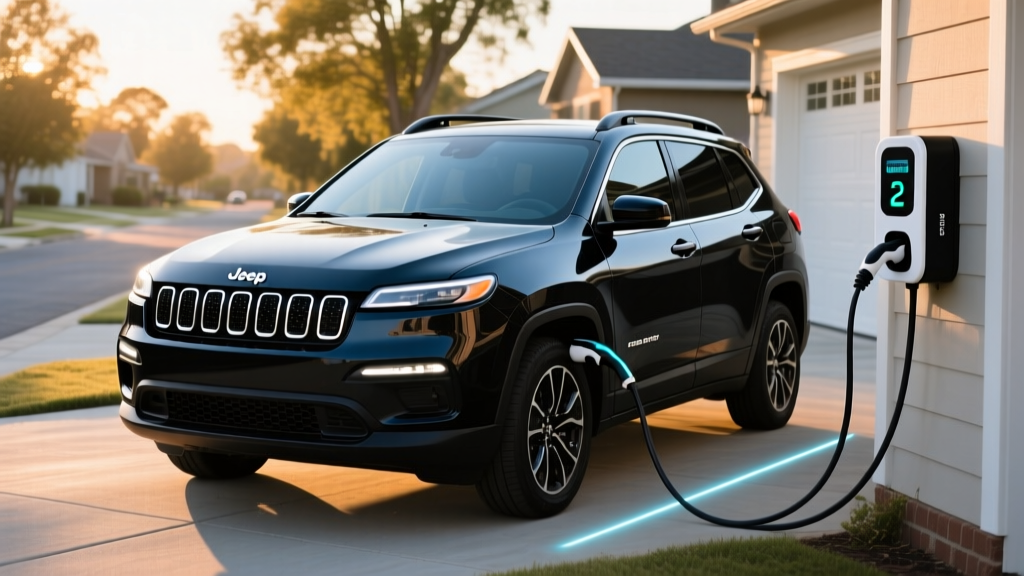
On a 240V Level 2 charger (7.4 kW), a full charge takes approximately 2 hours. On a standard 120V household outlet (Level 1), expect 8–10 hours — which works for overnight charging if your daily electric needs are modest. DC fast charging is not supported on this or any current Jeep PHEV.