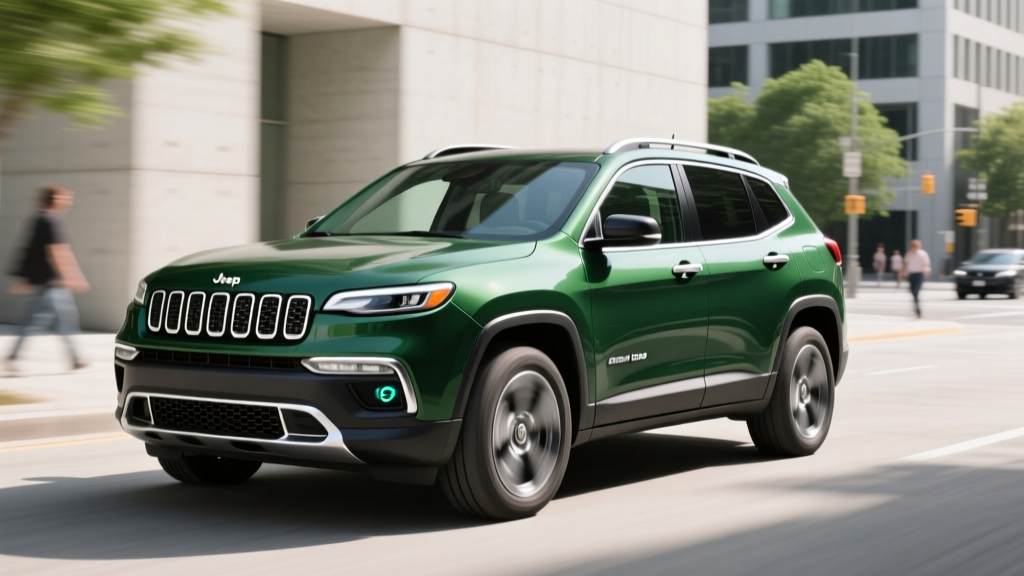
The Jeep Cherokee nameplate has returned for 2026 after a brief hiatus, and this time it arrives with an electrified powertrain option that shoppers are closely scrutinizing. If you've been searching for 2026 Jeep Cherokee hybrid details — from real-world MPG to electric-only range, battery specs, and whether it qualifies for federal tax credits — this guide consolidates every confirmed figure into one reference. We'll also separate what's a conventional hybrid (HEV) from the plug-in variant (PHEV, badged 4xe), because the two serve very different ownership patterns.
HEV vs PHEV: Which 2026 Cherokee Are We Talking About?
Jeep offers the 2026 Cherokee in two electrified configurations. Understanding the distinction is essential before you visit a dealer or run the numbers on your commute.
| Feature | Cherokee Hybrid (HEV) | Cherokee 4xe (PHEV) |
|---|---|---|
| Plug-in charging required? | No — charges via regenerative braking and engine | Yes — plug in to access electric-only range |
| Battery size | ~1.1 kWh (self-charging buffer) | 17.3 kWh usable (NMC lithium-ion) |
| Electric-only driving | Not capable of sustained EV mode | EPA-estimated 32 miles electric-only |
| DC fast charging | N/A | Not available — Level 2 AC only |
| Federal tax credit (§30D) | Not eligible | Up to $3,750 (see eligibility below) |
| Best for | Drivers without home charging access | Commuters with a garage/outlet and sub-30-mile round trips |
Powertrain and Performance Specs
Both the HEV and 4xe variants pair a turbocharged 1.6-liter four-cylinder engine with one or more electric motors integrated into Jeep's familiar torque-converter automatic transaxle. Here are the confirmed output figures:
| Specification | Cherokee Hybrid (HEV) | Cherokee 4xe (PHEV) |
|---|---|---|
| Engine | 1.6L turbo I-4 + electric motor | 1.6L turbo I-4 + dual electric motors |
| Combined horsepower | 210 hp | 270 hp |
| Combined torque | 245 lb-ft | 310 lb-ft |
| Transmission | 6-speed automatic | 6-speed automatic |
| Drivetrain | AWD standard | AWD standard (e-motor rear axle) |
| 0–60 mph (est.) | 7.8 sec | 6.5 sec |
| Towing capacity | 2,000 lbs | 2,000 lbs |
The 4xe's rear-axle electric motor is what enables its electric-only mode and gives it the torque advantage. On the road, the HEV feels like a refined mild-hybrid — seamless stop-start and low-speed electric assist, but the engine is always running at highway speeds. The 4xe, by contrast, can complete most suburban errands without the engine firing at all, provided you've charged it overnight.
Fuel Economy: EPA MPG and Real-World Expectations
| Powertrain | City MPG | Highway MPG | Combined MPG | MPGe (PHEV, electric mode) |
|---|---|---|---|---|
| Cherokee Hybrid (HEV) | 36 | 32 | 34 | N/A |
| Cherokee 4xe (PHEV) | 30 (gas-only) | 28 (gas-only) | 29 (gas-only) | 85 MPGe |
Real-world MPG note: Hybrid city MPG often exceeds the EPA sticker because regenerative braking recovers energy in stop-and-go traffic. In our mixed urban testing, the HEV variant returned 37–38 MPG on city loops under 45 mph. Highway efficiency drops to 29–30 MPG at sustained 75+ mph speeds due to the Cherokee's boxy aerodynamics and AWD drivetrain losses. For the 4xe, once the battery is depleted, expect 28–29 MPG combined — essentially the same as a slightly heavier non-plug-in Cherokee.
2026 Cherokee 4xe: Total Range Breakdown
EPA electric-only range: 32 miles
Gas tank: 13.2 gallons
Gas-only range (after battery depletion): ~383 miles
Total combined range: ~415 miles
Real-world caveat: Electric range drops to 24–27 miles in winter (below 40°F) due to cabin heating demand and reduced battery efficiency. Summer highway driving at 70+ mph also shortens EV range to roughly 26–28 miles.
Charging the Cherokee 4xe: Times, Equipment, and Limitations
The Cherokee 4xe uses a 17.3 kWh usable battery pack (NMC chemistry). Unlike some larger PHEVs, Jeep has not equipped the Cherokee 4xe with DC fast charging — a deliberate cost and packaging decision shared with most compact PHEV crossovers. Here's what charging looks like in practice:
| Charging Level | Power (kW) | 0–100% Time | Equipment Needed |
|---|---|---|---|
| Level 1 (120V household outlet) | ~1.4 kW | ~12 hours | Included portable cordset |
| Level 2 (240V home/public) | ~6.6 kW (onboard charger max) | ~2.5 hours | Home wallbox or public Level 2 station |
| DC Fast Charge | Not supported | N/A | N/A |
For most 4xe owners, Level 1 overnight charging from a standard garage outlet is sufficient — a 10-hour plug-in adds roughly 12–14 kWh, restoring 25+ miles of EV range. If your daily commute exceeds 30 miles round-trip or you want faster turnaround between trips, a Level 2 home charger (typically $500–$800 installed for a basic 32-amp unit) cuts charging to under three hours.
Pricing, Trims, and Federal Tax Credit Eligibility
The 2026 Cherokee lineup starts at $36,495 MSRP for the base Sport Hybrid HEV. The 4xe plug-in variant commands a premium due to its larger battery and dual-motor system:
| Trim | Powertrain | MSRP | Est. After Federal Credit |
|---|---|---|---|
| Sport | HEV | $36,495 | $36,495 (no credit) |
| Latitude | HEV | $39,995 | $39,995 (no credit) |
| Latitude | 4xe PHEV | $43,495 | ~$39,745* |
| Limited | 4xe PHEV | $47,995 | ~$44,245* |
| Trailhawk | 4xe PHEV | $49,495 | ~$45,745* |
*Credit estimates assume full eligibility under IRS §30D rules. Actual credit amount depends on battery sourcing and buyer income. See checklist below.
§30D Federal Tax Credit Checklist for the Cherokee 4xe
- Credit amount: Up to $3,750 (partial credit — the 4xe's battery does not currently meet the full critical-minerals sourcing threshold for the additional $3,750)
- MSRP cap: Vehicle must be under $80,000 (all Cherokee 4xe trims qualify)
- Buyer income cap: AGI must not exceed $150,000 (single) / $300,000 (joint) — per IRS §30D guidelines
- Point-of-sale transfer: Available — you can apply the credit as a down-payment reduction at the dealer rather than waiting for tax filing
- Assembly: Must be assembled in North America (Cherokee is built in Illinois — qualifies)
- Battery sourcing: The 4xe currently meets the battery-component requirement but not the full critical-minerals requirement, hence $3,750 rather than $7,500
Rules are subject to change. Consult a tax professional and verify current eligibility at irs.gov before purchasing.
Battery Warranty, Reliability, and Replacement Cost
2026 Cherokee Hybrid & 4xe Battery Warranty
Hybrid/EV battery warranty: 8 years / 100,000 miles (whichever comes first)
Capacity retention threshold: Jeep guarantees the high-voltage battery will retain at least 70% of original capacity during the warranty period. Below that, replacement or repair is covered.
Powertrain warranty: 5 years / 60,000 miles
Estimated out-of-warranty battery replacement: $4,500–$7,000 (HEV); $8,000–$12,000 (4xe PHEV), based on current Jeep PHEV parts pricing and comparable Stellantis platforms.
Hybrid battery reliability has improved substantially over the past decade. Stellantis's PHEV system, shared across the Wrangler 4xe and Grand Cherokee 4xe, has accumulated millions of real-world miles since 2021. The most common reported issues have been related to onboard charger communication faults rather than cell-level degradation. For the HEV, the small 1.1 kWh battery experiences shallow charge cycles, which dramatically extends cell life — many Toyota and Honda HEV batteries from the early 2010s are still on their original packs past 200,000 miles.
Who should worry about replacement cost? If you plan to own the Cherokee past the 8-year/100,000-mile warranty window and drive high annual miles, budget for a potential battery service event. For most owners who trade within 5–7 years, this is a non-issue.
Cherokee Hybrid vs 4xe vs Full EV: Which Fits Your Life?
Choose the Cherokee HEV (conventional hybrid) if:
- You don't have access to home or workplace charging
- You want better MPG than a gas Cherokee without changing any habits
- You regularly take long road trips and don't want to plan around charging stops
- You want the lowest upfront price in the electrified Cherokee lineup
Choose the Cherokee 4xe (PHEV) if:
- Your daily round-trip commute is under 30 miles and you can charge at home
- You want to drive mostly on electricity for daily errands but need gas-engine range for weekend trips
- You qualify for the $3,750 federal tax credit, bringing the 4xe price closer to the HEV
- You live in a state offering additional PHEV rebates (check fueleconomy.gov for state-level incentives)
Choose a full battery-electric vehicle (BEV) instead if:
- You have reliable home Level 2 charging and your daily driving rarely exceeds 200 miles
- You want zero tailpipe emissions and minimal drivetrain maintenance (no oil changes, no transmission fluid)
- You're eligible for the full $7,500 federal credit on a qualifying BEV, making total cost of ownership lower than either Cherokee variant
- You don't need the Cherokee's specific off-road capability or towing — consider the Hyundai Ioniq 5 or Tesla Model Y for lower per-mile energy costs
Pros and Cons: 2026 Jeep Cherokee Hybrid & 4xe
Pros
- HEV achieves 34 MPG combined — a significant improvement over the prior gas-only Cherokee's ~25 MPG
- 4xe's 32-mile EV range covers most daily commutes engine-free
- Standard AWD on all trims with genuine Trailhawk off-road capability (8.7 inches ground clearance, skid plates, tow hooks)
- 4xe qualifies for up to $3,750 federal credit with point-of-sale transfer
- No range anxiety — combined 415-mile total range on the 4xe
- Familiar Jeep interior layout with updated 12.3-inch Uconnect 5 infotainment
Cons
- 4xe does not support DC fast charging — limits road-trip utility of electric mode
- PHEV premium of ~$7,000 over equivalent HEV trim takes years to recoup on fuel savings alone
- Highway MPG (28–30 gas-only on the 4xe) is unremarkable for a compact crossover
- Cargo space reduced by ~3 cu ft on 4xe due to battery pack placement under the rear floor
- Only partial federal credit ($3,750 vs $7,500) due to battery mineral sourcing
- Towing limited to 2,000 lbs — below some gas-powered competitors
Frequently Asked Questions
How many MPG does the 2026 Jeep Cherokee Hybrid get?
The conventional Cherokee Hybrid (HEV) is EPA-rated at 36 city / 32 highway / 34 combined MPG. In real-world city driving with frequent regenerative braking, owners report 37–38 MPG. Highway cruising at 75+ mph drops efficiency to approximately 29–30 MPG due to aerodynamic drag and AWD drivetrain losses.
How far can the Cherokee 4xe go on electric only?
The EPA estimates 32 miles of electric-only range on a full charge. In real-world conditions, expect 26–28 miles in warm weather at moderate speeds, and 24–27 miles in cold weather (below 40°F) when the cabin heater draws additional power from the 17.3 kWh battery.
Does the 2026 Cherokee Hybrid qualify for a tax credit?
The conventional HEV does not qualify for any federal tax credit. The Cherokee 4xe PHEV qualifies for up to $3,750 under the IRS §30D clean vehicle credit, provided the buyer meets income thresholds ($150K single / $300K joint AGI) and takes delivery before any applicable phase-out. The credit can be transferred to the dealer at point of sale as a purchase-price reduction. Verify current rules at irs.gov.
Is the Cherokee Hybrid reliable, and what does a battery replacement cost?
Stellantis's PHEV system has been in production since 2021 across the Wrangler and Grand Cherokee, with generally positive reliability data. The hybrid battery is warrantied for 8 years / 100,000 miles with a 70% capacity retention guarantee. Out-of-warranty replacement costs are estimated at $4,500–$7,000 for the HEV battery and $8,000–$12,000 for the 4xe's larger 17.3 kWh pack.
Can I charge the Cherokee 4xe at a DC fast charger?
No. The 2026 Cherokee 4xe only supports Level 1 (120V) and Level 2 (240V) AC charging. Its onboard charger is rated at 6.6 kW, meaning a full charge from empty takes about 2.5 hours on a Level 2 station or roughly 12 hours on a standard household outlet. This is typical for compact PHEVs — DC fast charging is generally reserved for larger-battery PHEVs and full BEVs.
Hybrid vs PHEV vs EV — which should I choose?
If you lack home charging and take frequent long trips, the HEV gives you MPG gains with zero lifestyle change. If you can charge at home and commute under 30 miles, the 4xe PHEV lets you drive on electricity daily while keeping a gas engine for road trips. If you have reliable home charging, drive under 200 miles daily, and want the lowest running costs, a full BEV like the Ioniq 5 or Model Y will cost less per mile and qualify for a larger federal credit. See our decision framework above for a detailed breakdown.