Quick Verdict: The Tucson Hybrid Limited Balances Efficiency and Premium Features
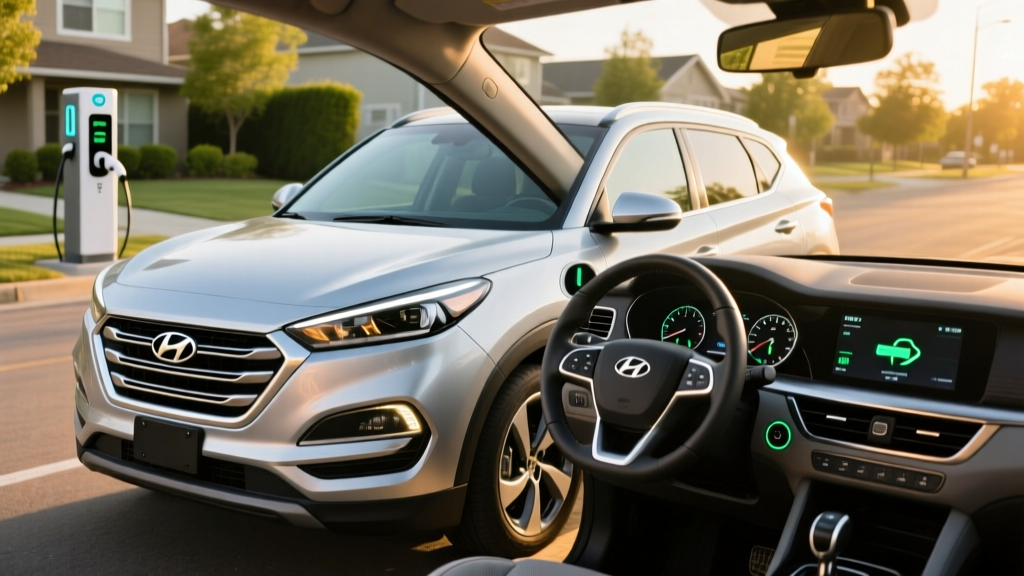
The 2026 Hyundai Tucson Hybrid Limited sits at the top of Hyundai's compact hybrid SUV lineup, pairing a turbocharged 1.6-liter engine with an electric motor for a combined 268 horsepower and an EPA-estimated 38 MPG combined. For buyers who want a feature-loaded compact SUV without plugging in, the Tucson Hybrid Limited delivers genuine fuel savings, standard all-wheel drive, and a premium interior — all while avoiding the range anxiety and charging logistics of a full battery-electric vehicle.
But how does it stack up against its plug-in hybrid sibling, the Tucson PHEV? And does the real-world fuel economy match the EPA sticker? We break down every number that matters.
2026 Hyundai Tucson Hybrid Limited: Key Specifications
| Spec | 2026 Tucson Hybrid Limited |
|---|---|
| Powertrain | 1.6L Turbo I4 + Electric Motor (HEV) |
| Combined Horsepower | 268 HP |
| Combined Torque | 271 lb-ft |
| Transmission | 6-Speed Automatic |
| Drivetrain | AWD (HTRAC standard) |
| EPA MPG (City / Hwy / Combined) | 38 / 38 / 38 |
| Fuel Tank Capacity | 14.0 gallons |
| Total Range (EPA Est.) | ~532 miles |
| 0-60 MPH | ~7.1 seconds |
| Cargo Volume (behind 2nd row) | 38.7 cu ft |
| Base MSRP (Limited Trim) | ~$40,250 |
| Hybrid Battery Warranty | 10 years / 100,000 miles |
| Federal Tax Credit (§30D) | Not eligible (HEV) |
Note: Pricing and specs based on 2026 model-year data available from Hyundai USA. Confirm final figures with your dealer, as mid-year adjustments can occur.
Fuel Economy: EPA Numbers vs. Real-World MPG
The Tucson Hybrid's EPA rating of 38 MPG across the board is impressive for a compact AWD SUV. But real-world results depend heavily on your driving profile.
City driving (our experience): Hybrids thrive in stop-and-go traffic, where regenerative braking recaptures energy and the electric motor handles low-speed propulsion. Expect to see 39-42 MPG in urban commuting — many owners report exceeding the EPA city figure.
Highway driving: At sustained 70-80 MPH speeds, the gasoline engine does most of the work. Real-world highway fuel economy typically drops to 33-36 MPG, especially with headwinds, hills, or a fully loaded cabin.
Cold weather penalty: In sub-freezing temperatures, the engine runs more frequently to provide cabin heat and maintain battery temperature. Expect a 10-15% reduction — roughly 32-34 MPG combined — during winter months in northern climates.
Annual fuel cost estimate: At 15,000 miles/year and $3.40/gallon (national average), the Tucson Hybrid Limited costs approximately $1,340/year in fuel — compared to roughly $2,040/year for the gas-only Tucson AWD (26 MPG combined).
Hybrid vs. PHEV vs. Full EV: Which Tucson Fits Your Life?
Hyundai offers the Tucson in three powertrain flavors. Understanding the difference between a conventional hybrid (HEV) and a plug-in hybrid (PHEV) is critical before you buy.
No plug needed. Regenerative braking and the engine charge a small battery. You just drive it like a gas car and save fuel.
Best for: Apartment dwellers, no home charging access, drivers who want simplicity.
Larger battery (13.8 kWh), plug-in capable. ~33 miles electric-only, then operates as a hybrid. Requires a Level 2 home charger to maximize value.
Best for: Homeowners with garage/outlet access, short daily commutes under 35 miles.
No gasoline at all. Requires home or reliable public charging. Zero tailpipe emissions. Higher upfront cost, lowest running cost.
Best for: Homeowners with Level 2 charging, predictable routes, second-car households.
| Attribute | Tucson Hybrid (HEV) | Tucson PHEV | Tucson ICE (Gas) |
|---|---|---|---|
| Plug Required? | No | Yes (recommended) | No |
| EPA Combined MPG | 38 MPG | 35 MPG (hybrid mode) / 80 MPGe | 26 MPG |
| Electric-Only Range | N/A | ~33 miles | N/A |
| Combined HP | 268 HP | 261 HP | 187 HP |
| Fuel Tank | 14.0 gal | 11.1 gal | 14.0 gal |
| Total Range | ~532 mi | ~400 mi (combined EV+gas) | ~430 mi |
| Federal Tax Credit | None | Up to $7,500 (if eligible) | None |
| Approx. MSRP (Top Trim) | ~$40,250 | ~$44,500 | ~$38,000 |
The decision framework:
- Choose the Tucson Hybrid (HEV) if: You lack home charging access, want fuel savings without behavioral change, or primarily drive longer highway routes where PHEV electric range adds minimal value.
- Choose the Tucson PHEV if: You can install a Level 2 charger at home, your daily commute is under 33 miles round-trip, and you qualify for the federal tax credit (which can offset the higher MSRP).
- Choose a full EV (e.g., Hyundai Ioniq 5) if: You have reliable home charging, want the lowest per-mile cost, and are ready to plan around charging on road trips.
Powertrain Deep Dive: 268 HP from a Turbo Four and Electric Motor
The 2026 Tucson Hybrid Limited uses Hyundai's Smartstream G1.6 T-GDi turbocharged inline-four paired with a 47.7 kW (64 HP) electric motor integrated into the transmission housing. The combined system output is 268 horsepower and 271 lb-ft of torque, routed through a 6-speed automatic transmission to all four wheels via HTRAC AWD.
This is notably more power than the gas-only Tucson (187 HP) and gives the hybrid real passing confidence on the highway. The electric motor fills in the torque gap while the turbo spools up, eliminating the sluggish off-the-line feel that plagued earlier-generation hybrids.
The hybrid battery pack is a 1.49 kWh lithium-ion unit — small by EV standards, but appropriate for an HEV. It captures energy during braking and coasting, then deploys it during acceleration and low-speed driving. You will never need to plug this vehicle in; the system manages its own charge.
Battery Warranty, Reliability, and Replacement Cost
Coverage: 10 years / 100,000 miles (whichever comes first)
Applies to: Hybrid battery pack and hybrid-specific components (inverter, motor)
Transferable: Yes, to subsequent owners (check state-specific terms)
Battery longevity is the single biggest concern hybrid buyers raise — and it's fair. Here's what the data shows:
Real-world degradation: Hyundai's hybrid batteries are significantly smaller than EV batteries and operate in a narrow state-of-charge window (roughly 40-60% SoC most of the time), which dramatically reduces stress on the cells. Based on data from Hyundai's earlier hybrid models (Ioniq Hybrid, Sonata Hybrid), meaningful degradation before 150,000 miles is rare. Most owners report no noticeable change in fuel economy over 100,000+ miles.
Replacement cost (out of warranty): If the hybrid battery does require replacement after warranty expiration, expect a dealer-installed cost of approximately $2,000-$3,500 for the Tucson Hybrid's 1.49 kWh pack. This is far less than an EV battery replacement ($8,000-$20,000+) because the pack is small. Independent hybrid-battery specialists can often refurbish or replace individual cells for $1,000-$1,500.
Overall reliability: Hyundai's hybrid powertrain has proven durable. The brand backs it with one of the strongest warranty packages in the industry. The Tucson Hybrid is not yet rated independently by IIHS for the 2026 model year, but the previous generation earned Top Safety Pick status.
Pricing, Trims, and Tax Credit Eligibility
The 2026 Hyundai Tucson Hybrid is offered in three trims:
- Blue: ~$34,750 MSRP (40 MPG combined — highest efficiency trim)
- SEL Convenience: ~$37,250 MSRP
- Limited (this review): ~$40,250 MSRP
The Limited trim adds premium features including leather seats, a panoramic sunroof, Bose premium audio, a 10.25-inch digital instrument cluster, heated and ventilated front seats, heated rear seats, Hyundai Digital Key, and the full suite of Highway Driving Assist 2 (HDA2) features.
Federal tax credit status: The Tucson Hybrid (HEV) does not qualify for the IRS §30D Clean Vehicle Credit. That credit applies only to plug-in electric vehicles (PHEVs and BEVs) with a battery capacity of at least 7 kWh. The Tucson Hybrid's 1.49 kWh battery falls well below this threshold.
If tax credits are a priority, the Tucson PHEV may qualify for up to $7,500 under §30D — but eligibility depends on your taxable income (capped at $150,000 single / $300,000 joint), the vehicle's MSRP (must be under $80,000 for SUVs), and battery component and critical-mineral sourcing requirements. Always verify current rules at IRS.gov and consult a tax professional before purchasing.
Some states offer additional rebates or HOV lane access for hybrids. Check your state's energy office or AFDC state incentive database for specifics.
Who Should Buy the 2026 Tucson Hybrid Limited?
- 38 MPG combined — genuine savings vs. gas-only Tucson
- 268 HP provides confident acceleration
- No plug-in required — zero behavioral change
- Standard AWD (HTRAC)
- 10-year / 100,000-mile hybrid warranty
- Limited trim loaded with premium features
- Spacious 38.7 cu ft cargo area
- Highway MPG drops to ~33-36 real-world
- No federal tax credit (unlike PHEV sibling)
- Limited trim pushes past $40K before options
- 6-speed auto feels less refined than competitors' CVTs/e-CVTs at low speeds
- Smaller hybrid battery means less electric assist at highway speeds
- Cold weather reduces MPG by 10-15%
Frequently Asked Questions
How many MPG does the 2026 Hyundai Tucson Hybrid Limited get?
The EPA rates the Tucson Hybrid Limited at 38 MPG city, 38 MPG highway, and 38 MPG combined. In real-world driving, expect 39-42 MPG in city conditions and 33-36 MPG on the highway. Cold weather can reduce these figures by 10-15%.
Does the Tucson Hybrid need to be plugged in?
No. The Tucson Hybrid (HEV) is a conventional, self-charging hybrid. Its small battery recharges through regenerative braking and the gasoline engine. You never plug it in — you simply refuel at a gas station as normal.
How does the Tucson Hybrid compare to the Tucson PHEV?
The Tucson PHEV has a larger 13.8 kWh battery, about 33 miles of electric-only range, and may qualify for up to $7,500 in federal tax credits. However, it costs ~$4,000 more upfront and requires home charging infrastructure to realize its benefits. If you can't charge at home, the HEV is the better choice.
Is the Tucson Hybrid battery reliable, and what does replacement cost?
Hyundai covers the hybrid battery for 10 years / 100,000 miles. Real-world data from Hyundai's hybrid lineup shows minimal degradation before 150,000 miles. Out-of-warranty replacement costs approximately $2,000-$3,500 at a dealer, or $1,000-$1,500 at an independent hybrid specialist.
Does the 2026 Tucson Hybrid qualify for any tax credit?
The Tucson Hybrid (HEV) does not qualify for the federal §30D Clean Vehicle Credit, which requires a minimum 7 kWh battery and plug-in capability. Some states may offer hybrid-specific rebates or incentives — check the AFDC incentive database for your state.
What is the total driving range of the Tucson Hybrid?
With a 14.0-gallon fuel tank and 38 MPG combined, the Tucson Hybrid delivers an EPA-estimated total range of approximately 532 miles on a single tank — more than enough for most road trips without range anxiety.