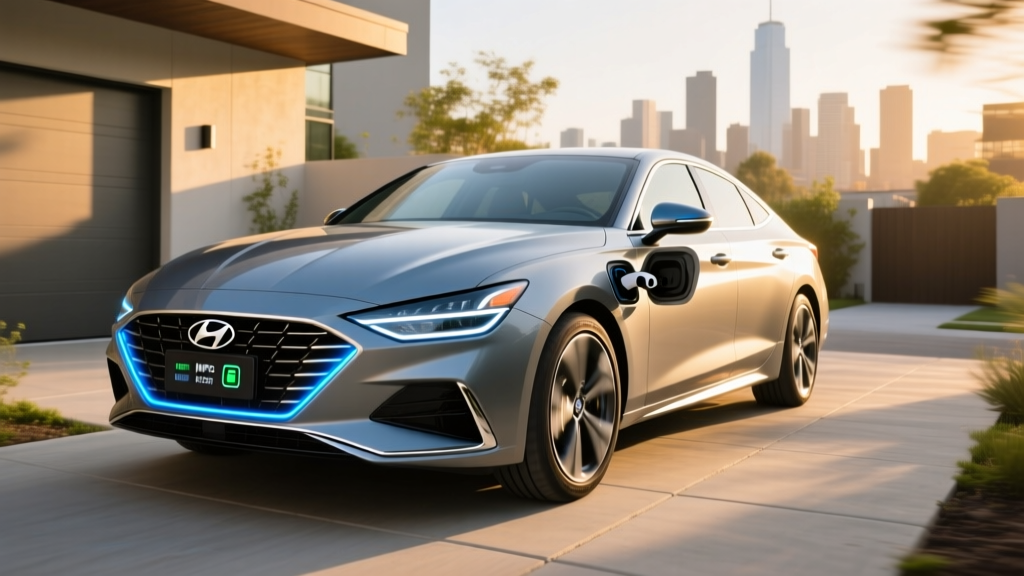
The 2026 Hyundai Sonata Hybrid occupies a specific niche that full EVs still can't fill for many buyers: sedan comfort, no plug required, and fuel economy that embarrasses most compacts. With an EPA-rated 52 MPG combined on the Blue trim, it remains one of the most efficient midsize sedans on the market. But efficiency numbers alone don't tell the full ownership story — battery longevity, real-world fuel consumption, and whether a plug-in hybrid or full EV might serve you better are all critical considerations.
This guide breaks down everything a prospective buyer needs: exact MPG figures across trims, powertrain specs, real-world efficiency expectations, battery warranty coverage, tax credit eligibility, and a clear framework for deciding between the Sonata Hybrid, a PHEV alternative, or a battery-electric vehicle.
2026 Sonata Hybrid Powertrain and Performance Specs
The 2026 Sonata Hybrid pairs a 2.0-liter four-cylinder gasoline engine with an electric motor integrated into a six-speed automatic transmission — not a CVT, which gives it a more natural driving feel than many competitors. Combined system output is 192 horsepower (150 hp from the engine, 51 hp from the electric motor), with 271 lb-ft of combined torque.
| Specification | Detail |
|---|---|
| Engine | 2.0L GDI inline-4 |
| Electric Motor | 38 kW (51 hp) permanent-magnet synchronous |
| Combined Horsepower | 192 hp |
| Combined Torque | 271 lb-ft |
| Transmission | 6-speed automatic (no CVT) |
| Hybrid Battery | ~1.6 kWh lithium-ion (HEV) |
| Drivetrain | Front-wheel drive |
| 0–60 mph (est.) | ~7.5 seconds |
| Curb Weight | ~3,490 lbs |
Unlike a plug-in hybrid (PHEV), the Sonata Hybrid is a conventional HEV. It charges its small battery exclusively through regenerative braking and the gasoline engine. You never plug it in — you simply fuel it like any gas car and let the hybrid system optimize efficiency automatically.
EPA Fuel Economy: City, Highway, and Combined MPG
The Sonata Hybrid's efficiency varies meaningfully by trim, primarily due to wheel size and weight differences. The Blue trim's smaller 16-inch wheels and lighter curb weight deliver the headline MPG number, while the more feature-laden SEL and Limited trims sacrifice a few miles per gallon for larger 18-inch alloys and additional equipment.
| Trim | City MPG | Highway MPG | Combined MPG |
|---|---|---|---|
| Blue | 50 | 54 | 52 |
| SEL | 44 | 51 | 47 |
| Limited | 44 | 51 | 47 |
Source: fueleconomy.gov — US Environmental Protection Agency
The Blue trim's 52 MPG combined is among the highest of any midsize sedan sold in the US, rivaling the Toyota Camry Hybrid (51 MPG combined on the LE trim). The highway figure of 54 MPG is particularly notable because hybrids traditionally excel in city driving where regenerative braking recaptures energy. Hyundai's aerodynamic tuning and the efficiency of its 2.0L engine at steady-state cruising explain the strong highway number.
Real-World MPG: What to Actually Expect
EPA figures are a standardized benchmark, not a guarantee. Based on aggregated owner reports and third-party testing, here's how the Sonata Hybrid performs in real-world conditions:
- City driving (stop-and-go, moderate speeds): 48–53 MPG — hybrids often match or slightly exceed EPA city estimates in urban environments where regenerative braking is most active
- Highway cruising (70–80 mph): 44–49 MPG — efficiency drops at higher speeds due to aerodynamic drag, as with all vehicles
- Mixed commuting (50/50 city/highway): 46–51 MPG for Blue trim; 42–47 MPG for SEL/Limited
- Cold weather (below 30°F): Expect a 5–10% reduction as the engine runs more frequently for cabin heat and the battery operates less efficiently
For a driver covering 15,000 miles annually in mixed conditions at a national average of $3.40/gallon, the Blue trim would consume roughly 288 gallons per year (~$980). A comparable non-hybrid midsize sedan averaging 30 MPG combined would burn 500 gallons (~$1,700). That's roughly $720 in annual fuel savings with the Sonata Hybrid.
Hybrid Battery Warranty and Longevity
Battery replacement cost is the single most common concern among hybrid shoppers. Hyundai addresses this with one of the strongest hybrid battery warranties in the industry.
- Hybrid Battery: 10 years / 100,000 miles (whichever comes first)
- Hybrid System Components (motor, inverter, converter): 10 years / 100,000 miles
- Powertrain (engine, transmission): 10 years / 100,000 miles
- New Vehicle Limited Warranty: 5 years / 60,000 miles
Note: The 10-year/100,000-mile powertrain and hybrid battery warranty applies to the original owner. Second-owner coverage drops to 5 years / 60,000 miles.
The Sonata Hybrid's ~1.6 kWh lithium-ion battery pack is small by EV standards and operates within a narrow state-of-charge window — the hybrid system never fully charges or fully depletes it, which significantly reduces degradation stress. Toyota and Hyundai hybrid batteries routinely exceed 150,000–200,000 miles without replacement.
If a replacement is needed out of warranty, a factory hybrid battery for the Sonata Hybrid typically costs between $2,000 and $3,500 including labor at a dealership. Independent hybrid specialists often offer refurbished units for $1,200–$2,000. For context, this is far less than an EV traction battery replacement, which can exceed $10,000–$15,000 for larger packs.
Pricing, Trims, and Tax Credit Eligibility
The 2026 Sonata Hybrid is available in three trims. Pricing below reflects MSRP before destination charges:
| Trim | MSRP (est.) | Key Features |
|---|---|---|
| Blue | ~$30,250 | 16" wheels, 12.3" digital cluster, 12.3" infotainment, wireless CarPlay/Android Auto, HDA-2 |
| SEL | ~$33,500 | 18" wheels, heated front seats, smart trunk, wireless charging pad, blind-spot camera |
| Limited | ~$37,900 | Leather seats, panoramic sunroof, head-up display, surround-view monitor, premium audio |
Does the Sonata Hybrid Qualify for a Federal Tax Credit?
No. The 2026 Hyundai Sonata Hybrid is a conventional HEV and does not qualify for the federal §30D Clean Vehicle Credit, which is reserved for plug-in electric vehicles (BEVs and PHEVs with at least 7 kWh of battery capacity). The IRS §30D rules require a vehicle to have a plug and meet battery sourcing, critical mineral, MSRP, and buyer income requirements.
Some states offer rebates or incentives for conventional hybrids, but these vary widely by jurisdiction. Check your state energy office or the Alternative Fuels Data Center for current local programs. Do not rely on dealer representations about hybrid tax credits — verify eligibility with a tax professional.
HEV vs PHEV vs EV: Which Powertrain Fits You?
Choosing between a conventional hybrid, plug-in hybrid, and full battery-electric vehicle comes down to your driving patterns, charging access, and budget. Here's a decision framework:
Choose the Sonata Hybrid (HEV) if:
- You have no access to home or workplace charging
- You want maximum simplicity — no plug, no charging apps, no range planning
- Your budget is under $38,000
- You drive 12,000–20,000 miles/year and want low fuel costs without behavior change
- You live in an apartment or rent and can't install a charger
Choose a PHEV (e.g., Tucson PHEV) if:
- You can install a Level 2 home charger
- Your daily commute is under 35 miles round-trip (drivable on electric only)
- You want some EV experience without range anxiety on road trips
- You want to qualify for the §30D federal tax credit (up to $7,500, income/MSRP/sourcing rules apply)
- You take frequent long road trips where gas flexibility matters
Choose a full EV (e.g., Ioniq 6) if:
- You have reliable home Level 2 charging
- Your daily driving is under 250 miles
- You want the lowest per-mile energy cost (~$0.04–0.06/mi on home electricity vs ~$0.12–0.15/mi in the Sonata Hybrid)
- You want zero tailpipe emissions and minimal maintenance (no oil changes, no engine)
- You qualify for the full §30D credit, reducing effective purchase price significantly
The Sonata Hybrid's total cost of ownership over five years is competitive with many PHEVs and EVs when you factor in its lower purchase price, even without a tax credit. A PHEV or EV only wins on operating cost if you can charge at home at residential electricity rates.
Driving Impressions and Daily Livability
The Sonata Hybrid prioritizes comfort over sportiness, which is the right call for its target buyer. The six-speed automatic avoids the rubber-band drone of CVTs found in the Camry Hybrid and Honda Accord Hybrid, delivering more natural shift behavior during acceleration. The transition between electric-motor-only and engine-assisted driving is nearly imperceptible — a sign of well-calibrated hybrid system software.
Regenerative braking is adjustable via paddle shifters, with multiple levels of regen intensity. At the highest setting, you get meaningful deceleration when lifting off the throttle, approaching a one-pedal driving feel — though it won't bring the car to a complete stop like a full EV can.
Cabin noise is well-managed. The engine only audibly engages under hard acceleration; during gentle city driving and low-speed maneuvers, the Sonata Hybrid frequently operates in EV mode on battery alone, making it whisper-quiet. Interior space is generous, with 16.0 cubic feet of trunk volume — no battery-pack intrusion compromises cargo room, as the hybrid battery is packaged under the rear seats.
Pros and Cons at a Glance
Pros
- Up to 52 MPG combined (Blue trim) — among the best midsize sedans
- No plug required — zero charging infrastructure needed
- 10-year/100,000-mile hybrid battery warranty
- Six-speed auto (not CVT) for natural driving feel
- Competitive starting MSRP under $31,000
- Spacious interior with full trunk volume
- Strong standard safety suite (HDA-2, AEB, lane-keeping)
Cons
- No federal tax credit (HEV, not a plug-in)
- 192 hp is adequate but not quick — ~7.5 sec 0–60
- SEL/Limited trims drop to 47 MPG combined
- No all-wheel-drive option (FWD only)
- No PHEV variant available in the US
- Hybrid battery replacement ($2,000–$3,500) if it fails out of warranty
Frequently Asked Questions
How many MPG does the 2026 Hyundai Sonata Hybrid get?
The Blue trim achieves an EPA-rated 50 city / 54 highway / 52 combined MPG. The SEL and Limited trims are rated at 44 city / 51 highway / 47 combined. Real-world mixed driving typically yields 46–51 MPG for the Blue trim, depending on driving style, temperature, and route composition.
Does the Sonata Hybrid need to be plugged in?
No. The Sonata Hybrid is a conventional hybrid (HEV), not a plug-in hybrid. It charges its battery through regenerative braking and the gasoline engine. You simply fill it with gasoline like any conventional car.
Is the Sonata Hybrid reliable, and what does battery replacement cost?
Hyundai's hybrid system has a strong reliability record, and the Sonata Hybrid is backed by a 10-year/100,000-mile hybrid battery warranty. Out-of-warranty replacement runs $2,000–$3,500 at a dealer, or $1,200–$2,000 through an independent hybrid specialist. Most hybrid batteries last well beyond 150,000 miles.
Does the 2026 Sonata Hybrid qualify for any tax credit?
The federal §30D Clean Vehicle Credit applies only to plug-in vehicles (BEVs and qualifying PHEVs). As a conventional hybrid, the Sonata Hybrid does not qualify. Some states may offer hybrid-specific incentives — check the Alternative Fuels Data Center for your state's programs.
How does the Sonata Hybrid compare to the Toyota Camry Hybrid?
The Camry Hybrid LE achieves 51 MPG combined (vs. the Sonata Hybrid Blue's 52), making them essentially tied on efficiency. The Sonata Hybrid offers a six-speed automatic vs. the Camry's eCVT, more standard tech features, and Hyundai's longer 10-year powertrain warranty (Toyota offers 10 years/150,000 miles on the hybrid battery specifically). The Camry offers available AWD, which the Sonata Hybrid lacks.
Is there a Sonata PHEV available?
Hyundai does not sell a Sonata plug-in hybrid in the US market for the 2026 model year. If you want a Hyundai PHEV, the Tucson PHEV (compact SUV, ~33 miles electric-only range) or the Santa Fe PHEV are the closest alternatives in Hyundai's lineup.