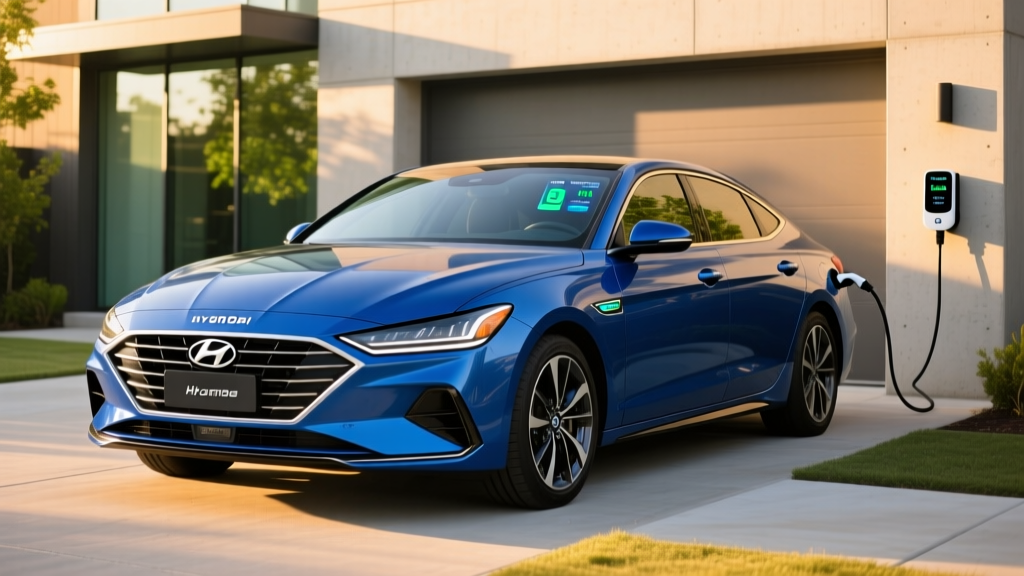
The 2026 Hyundai Sonata Hybrid Blue is a midsize sedan that prioritizes fuel economy above all else. With an EPA-estimated 47 MPG combined, it sits at the top of the hybrid sedan segment alongside the Toyota Camry Hybrid. But the Blue trim is specifically engineered for efficiency — lighter wheels, lower rolling-resistance tires, and unique aerodynamic tuning squeeze out every last mile per gallon. For buyers who want maximum fuel savings without plugging in, this is the trim to examine closely.
In this guide, we break down the Sonata Hybrid Blue's real-world efficiency, powertrain specs, battery warranty, pricing, and how it stacks up against PHEV and full-EV alternatives. No marketing fluff — just the numbers you need to decide.
2026 Sonata Hybrid Blue: Key Specifications at a Glance
| Specification | 2026 Sonata Hybrid Blue |
|---|---|
| Powertrain | 2.0L 4-cyl + electric motor (HEV) |
| Combined Horsepower | 192 hp |
| Transmission | 6-speed automatic |
| EPA MPG (City / Hwy / Combined) | 50 / 43 / 47 |
| Fuel Tank Capacity | 13.2 gallons |
| Total Driving Range | ~620 miles |
| Battery Type | Lithium-ion polymer (~1.6 kWh) |
| 0–60 mph | ~7.5 seconds (est.) |
| Drivetrain | FWD |
| Cargo Volume | 15.1 cu ft |
| Base MSRP | ~$30,250 |
| Hybrid Battery Warranty | 10 years / 100,000 miles |
How Many MPG Does the Sonata Hybrid Blue Actually Get?
The EPA rates the 2026 Sonata Hybrid Blue at 50 MPG city, 43 MPG highway, and 47 MPG combined. These figures place it among the most efficient midsize sedans on the market. For context, the standard Sonata Hybrid SEL and Limited trims are rated at 44 MPG combined — the Blue's efficiency-focused hardware makes a measurable difference.
| Driving Scenario | EPA Rating | Real-World Expectation |
|---|---|---|
| City | 50 MPG | 48–54 MPG (hybrids often exceed EPA in stop-and-go) |
| Highway (70 mph) | 43 MPG | 39–43 MPG (aero drag and sustained speed reduce gains) |
| Combined | 47 MPG | 44–49 MPG |
| Cold Weather (below 32°F) | — | 38–43 MPG (engine runs more for cabin heat) |
Real-world note: Hybrids like the Sonata Blue tend to beat their EPA city estimates because regenerative braking recaptures energy in stop-and-go traffic. On the highway, however, the electric motor contributes less and the gasoline engine does most of the work, so expect numbers closer to — or slightly below — the 43 MPG highway sticker. In cold weather, the engine must run more frequently to provide cabin heat, which can drop combined efficiency by 10–15%. This is normal for all hybrids and is not unique to Hyundai.
According to fueleconomy.gov, the Sonata Hybrid's annual fuel cost is approximately $1,100 based on 15,000 miles per year and current national gas prices — roughly half what a comparable gas-only midsize sedan costs to fuel.
HEV vs. PHEV: Understanding What the Sonata Hybrid Blue Is (and Isn't)
The Sonata Hybrid Blue is a conventional hybrid electric vehicle (HEV). It does not plug in. There is no charging port, no electric-only driving mode of any meaningful distance, and no larger battery to charge overnight. The small ~1.6 kWh lithium-ion polymer battery charges itself through regenerative braking and the gasoline engine. You fuel it at a gas station exactly like a conventional car — it simply uses far less fuel.
Conventional Hybrid (HEV) — Sonata Hybrid Blue
- No plug-in charging required
- Small battery (~1.6 kWh), self-charging
- Electric motor assists engine; cannot drive on electric alone for more than ~1 mile at low speed
- Fuel economy: 47 MPG combined
- No federal EV tax credit eligibility
Plug-In Hybrid (PHEV) — Not Offered for 2026 Sonata
- Requires plug-in charging (Level 1 or Level 2)
- Larger battery (typically 10–15 kWh for PHEVs)
- 25–35 miles of electric-only driving before the gas engine engages
- Combined MPGe when battery is charged; MPG drops once battery depletes
- May qualify for partial federal tax credit under IRS §30D (if battery and sourcing requirements are met)
Hyundai discontinued the Sonata Plug-In Hybrid after the 2019 model year. If you need plug-in capability from Hyundai in 2026, you'll need to look at the Tucson PHEV or Santa Fe PHEV — both SUVs, not sedans. The Sonata Hybrid Blue is strictly an HEV.
Powertrain and Driving Performance
The 2026 Sonata Hybrid pairs a 2.0-liter naturally aspirated 4-cylinder engine (150 hp, 139 lb-ft torque) with a 39 kW electric motor (51 hp, 151 lb-ft) integrated into the transmission. Combined system output is 192 horsepower.
The 6-speed automatic transmission is a traditional torque-converter design — not a CVT. This gives the Sonata Hybrid a more natural driving feel than some competitors (the Toyota Camry Hybrid uses an e-CVT). Acceleration to 60 mph takes approximately 7.5 seconds, which is adequate for merging and passing but not quick by modern standards.
The Blue trim specifically uses:
- 17-inch aero-optimized alloy wheels (lighter than the SEL/Limited's 18-inch wheels)
- Low rolling-resistance tires to reduce mechanical drag
- Unique front and rear bumper styling for improved aerodynamics
- Active grille shutters that close at higher speeds to reduce drag
These efficiency-focused hardware changes account for the 3 MPG combined advantage over the standard Hybrid trims. The trade-off is slightly less grip from the eco tires and a firmer ride from the smaller wheel/tire combination, though the difference is subtle in daily driving.
Hybrid Battery Warranty, Lifespan, and Replacement Cost
Hyundai Hybrid Battery Warranty: 10 years / 100,000 miles (whichever comes first) for the original owner. In CARB states (California and states that follow California emissions standards), the warranty extends to 10 years / 150,000 miles.
What's covered: Defects and capacity loss below a specified threshold (typically 70% of original capacity) under normal use.
Transferability: The 10-year/100,000-mile hybrid battery warranty transfers to a second owner but may be reduced to 5 years/60,000 miles depending on state. Verify with your dealer.
How long do hybrid batteries actually last? Modern lithium-ion hybrid batteries are significantly more durable than the nickel-metal hydride packs from the early 2000s. Based on industry data and Hyundai's track record with the Sonata Hybrid (now in its third generation), most hybrid batteries last 12–15 years or 150,000–200,000 miles before significant degradation. The small ~1.6 kWh battery in an HEV operates in a narrow state-of-charge window (roughly 40–80%), which dramatically reduces stress and extends cycle life compared to a full EV battery that charges to 100%.
Replacement cost if out of warranty: A new Hyundai Sonata Hybrid battery pack typically costs $2,500–$4,000 including labor at a dealership. Third-party remanufactured packs are available for $1,500–$2,500. This is a fraction of full EV battery replacement costs ($8,000–$20,000+) because the HEV battery is much smaller.
Pricing, Trims, and Tax Credit Eligibility
| Trim | MSRP (est.) | EPA MPG Combined |
|---|---|---|
| Sonata Hybrid Blue | $30,250 | 47 MPG |
| Sonata Hybrid SEL | $33,500 | 44 MPG |
| Sonata Hybrid Limited | $37,750 | 44 MPG |
Federal tax credit: The Sonata Hybrid Blue does not qualify for the federal §30D Clean Vehicle Credit. That credit applies only to plug-in electric vehicles (BEVs and PHEVs) with a minimum battery capacity of 7 kWh and meeting critical-mineral and battery-component sourcing requirements, as outlined by the IRS. Conventional hybrids like the Sonata Hybrid Blue are not eligible.
State incentives: Some states offer rebates or tax incentives for conventional hybrids, though these are becoming less common as states redirect funds toward BEVs and PHEVs. Check your state's energy office or department of environmental quality for current programs. A few states offer reduced registration fees or HOV lane access for hybrids, but availability varies widely.
Total cost of ownership advantage: At $30,250 MSRP, the Blue trim undercuts the Limited by $7,500 while delivering 3 MPG better fuel economy. Over 5 years and 75,000 miles at $3.50/gallon gas, the Blue's fuel cost would be approximately $5,580 versus $5,966 for the SEL/Limited — a savings of ~$386. The larger savings come from the lower purchase price itself.
Hybrid vs. PHEV vs. Full EV: Which Fits Your Situation?
Choose the Sonata Hybrid Blue (HEV) if:
- You cannot install a home charger (apartment, street parking, no garage)
- You want zero behavioral change — just fill up at a gas station, less often
- You regularly drive long distances (400+ miles) and don't want to plan charging stops
- Your budget is under $35,000 and you want maximum MPG per dollar
- You live in an area with limited or unreliable public charging infrastructure
Choose a PHEV (e.g., Tucson PHEV, Toyota Prius Prime) if:
- You have access to home or workplace Level 2 charging
- Your daily commute is under 30 miles round-trip (you could drive mostly on electricity)
- You want to reduce gas consumption significantly but still need gas-engine range for road trips
- You want partial federal tax credit eligibility (verify current §30D rules for the specific model)
Choose a full BEV (e.g., Hyundai Ioniq 6, Tesla Model 3) if:
- You can install a Level 2 home charger
- You want zero tailpipe emissions and the lowest per-mile fuel cost
- You want access to the full $7,500 federal tax credit (subject to income, MSRP, and sourcing rules)
- You're comfortable planning longer road trips around DC fast charging
- You want lower long-term maintenance costs (no oil changes, fewer moving parts)
Reliability, Safety, and Ownership Considerations
Hyundai's hybrid powertrain is now in its third generation and has a solid reliability track record. The 2.0L naturally aspirated engine is a proven design with no turbocharger complexity. The electric motor has essentially no wear components. The 6-speed automatic is a conventional transmission — simpler and more predictable long-term than CVTs.
The Insurance Institute for Highway Safety (IIHS) has historically rated the Sonata sedan well, and the 2026 model carries Hyundai's full suite of standard driver-assistance features under the Hyundai SmartSense umbrella: forward collision-avoidance assist, lane-keeping assist, blind-spot monitoring, rear cross-traffic alert, and adaptive cruise control with stop-and-go. Note that these are SAE Level 1–2 driver-assist features — they do not drive the car autonomously and require constant driver attention.
Insurance costs: Hybrid sedans typically carry insurance premiums comparable to their gas counterparts. The Sonata Hybrid Blue should not see a significant insurance premium increase over the gas Sonata. Get a quote from your insurer before purchasing to confirm.
Maintenance savings: While the Sonata Hybrid still requires oil changes, brake fluid, and coolant service, regenerative braking significantly extends brake pad life — many hybrid owners report 80,000–100,000 miles on original brake pads. Hyundai includes 3 years / 36,000 miles of complimentary maintenance (oil changes, tire rotations, inspections).
Pros and Cons of the 2026 Sonata Hybrid Blue
Pros
- Class-leading 47 MPG combined (50 city) — among the best of any midsize sedan
- No plug-in required; zero change to fueling habits
- Strong 10-year/100,000-mile hybrid battery warranty
- Competitive $30,250 starting price
- Conventional 6-speed automatic (no CVT drone)
- 620+ mile total range per tank
- Comprehensive standard safety tech
Cons
- No federal tax credit (HEV, not a plug-in)
- 192 hp is adequate but not quick; ~7.5 sec 0–60
- Eco tires trade some grip for efficiency
- Highway MPG drops to 43 — less impressive than city
- No AWD option (available on Toyota Camry Hybrid)
- Cold-weather efficiency loss (10–15%) like all hybrids
Frequently Asked Questions
How many MPG does the 2026 Hyundai Sonata Hybrid Blue get?
The EPA rates it at 50 MPG city, 43 MPG highway, and 47 MPG combined. In real-world city driving with frequent stops, many owners report exceeding 50 MPG. Highway driving at sustained speeds typically yields 39–43 MPG. Cold weather can reduce combined efficiency by 10–15%.
Does the Sonata Hybrid Blue need to be plugged in?
No. The Sonata Hybrid Blue is a conventional hybrid (HEV). It charges its own small battery through regenerative braking and the gasoline engine. You simply fill it with gasoline at any gas station. There is no charging port.
How far can the Sonata Hybrid Blue drive on electric only?
Effectively zero meaningful distance. The HEV system uses the electric motor to assist the gasoline engine and to drive at very low speeds (under ~25 mph) for brief periods, such as creeping in a parking lot. It is not designed for electric-only commuting. If you want electric-only range, you need a PHEV or a full BEV.
Is the Sonata Hybrid reliable and what does battery replacement cost?
Hyundai's third-generation hybrid system has a strong reliability record. The hybrid battery is covered for 10 years/100,000 miles (10/150,000 in CARB states). Out-of-warranty replacement runs $2,500–$4,000 at a dealer, or $1,500–$2,500 for a remanufactured pack. Most hybrid batteries last 150,000–200,000 miles in real-world use.
Does the 2026 Sonata Hybrid Blue qualify for any tax credit?
No federal tax credit applies. The IRS §30D Clean Vehicle Credit requires a plug-in vehicle with at least 7 kWh of battery capacity, plus critical-mineral and battery-component sourcing requirements. The Sonata Hybrid Blue is a conventional HEV with a ~1.6 kWh battery and does not qualify. Some states may offer minor incentives for hybrids — check your state's energy office.
How does the Sonata Hybrid Blue compare to the Toyota Camry Hybrid?
The 2026 Camry Hybrid (LE trim) is rated at 51 MPG combined with available AWD. The Sonata Hybrid Blue is rated at 47 MPG combined and is FWD only. The Camry Hybrid holds a slight efficiency edge and offers AWD, but the Sonata Hybrid Blue offers a more conventional 6-speed automatic transmission (vs. the Camry's e-CVT) and Hyundai's 10-year powertrain warranty vs. Toyota's 10-year hybrid battery warranty. Both are excellent choices; test-drive both to compare ride and technology preferences.
What is the total driving range of the Sonata Hybrid Blue?
With a 13.2-gallon fuel tank and 47 MPG combined, expect approximately 620 miles of total range. In city-heavy driving at 50+ MPG, you could approach 660 miles. Highway-heavy trips at 40–43 MPG will yield roughly 530–570 miles per tank.