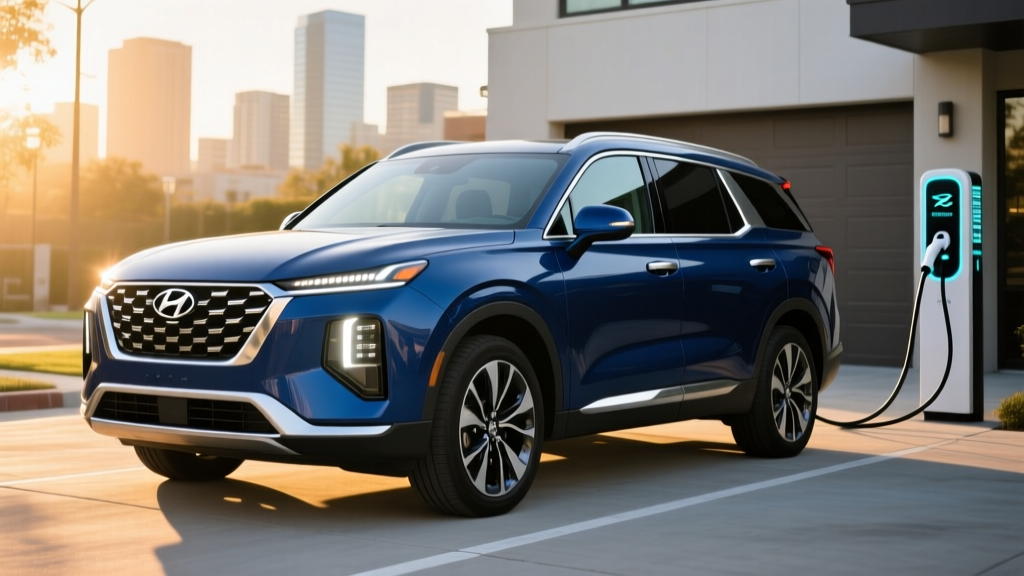
The Hyundai Palisade has long been a benchmark three-row family SUV, and for 2026, the Palisade Hybrid arrives as the electrified variant buyers have been requesting. With a turbocharged hybrid powertrain, available plug-in hybrid (PHEV) capability, and seating for up to eight, it targets families who want meaningful fuel savings without sacrificing cargo room or highway comfort. This guide covers every spec that matters — from real-world MPG and electric-only range to battery warranty and federal tax credit eligibility under current IRS §30D rules.
2026 Palisade Hybrid at a Glance: HEV vs PHEV
Hyundai offers the 2026 Palisade in two electrified configurations. Understanding the difference is essential before you visit a dealer.
| Attribute | Palisade Hybrid (HEV) | Palisade Plug-In Hybrid (PHEV) |
|---|---|---|
| Needs to be plugged in? | No — self-charging via engine + regen | Yes — plug in for electric-only miles |
| Powertrain | 1.6L Turbo + electric motor | 1.6L Turbo + larger electric motor |
| Combined Horsepower | ~258 hp | ~320 hp |
| EPA Combined MPG / MPGe | ~34 MPG combined | ~79 MPGe (electric mode) / ~30 MPG (gas-only) |
| Electric-Only Range | N/A (motor assists only) | ~33 miles (est.) |
| Battery Capacity | ~1.5 kWh (small buffer) | ~17.5 kWh usable |
| DC Fast Charging | N/A | No — AC Level 2 only |
| Starting MSRP (est.) | ~$45,500 | ~$52,000 |
The HEV version is the simpler proposition: you fuel it like any gas car, and the hybrid system recovers energy during braking and low-speed driving to cut consumption. The PHEV adds a larger battery and more powerful motor, letting you complete school runs, grocery trips, and short commutes entirely on electricity before the gas engine takes over.
Fuel Economy: EPA Ratings and Real-World MPG
Fuel economy is the core reason buyers cross-shop the Palisade Hybrid against the gas-only model (which returns roughly 22 MPG combined). Here is how the hybrid variants break down according to EPA estimates via fueleconomy.gov:
| Configuration | City MPG | Highway MPG | Combined MPG |
|---|---|---|---|
| Palisade Hybrid (HEV) FWD | 36 | 32 | 34 |
| Palisade Hybrid (HEV) AWD | 34 | 30 | 32 |
| Palisade PHEV (gas-only mode) | 31 | 29 | 30 |
| Palisade PHEV (electric mode) | ~79 MPGe combined | ||
Real-World MPG: What to Actually Expect
Hyundai's hybrid system, like Toyota's, tends to overperform its EPA city rating in stop-and-go traffic because the electric motor handles low-speed propulsion where gas engines are least efficient. In mixed suburban driving, owners of similar Hyundai hybrid systems (Tucson Hybrid, Santa Fe Hybrid) routinely report 1–3 MPG above the EPA city figure.
On sustained highway trips at 75+ mph, expect the opposite: real-world highway MPG typically drops 2–4 MPG below the sticker. The Palisade's boxy, three-row profile creates aerodynamic drag that hybrid systems can't fully offset at speed. In cold weather (below 30°F), plan for a 5–8% reduction in combined MPG as the engine runs more frequently for cabin heat and battery conditioning.
Palisade PHEV: Electric-Only Range and Charging
For the plug-in hybrid variant, the headline number is electric-only range. The 2026 Palisade PHEV is estimated to deliver approximately 33 miles on battery power alone before the 1.6L turbo engine engages. That covers the majority of daily commutes and errands for a typical family — school drop-off, grocery run, and the drive home — without burning a drop of gasoline.
Total combined range (electric + a full tank of gas) exceeds 440 miles, eliminating any range concern for road trips.
Charging the Palisade PHEV
The PHEV uses a ~17.5 kWh battery pack (usable capacity). Charging options:
| Charging Level | Power | Time (0–100%) | Notes |
|---|---|---|---|
| Level 1 (120V household) | ~1.4 kW | ~12 hours | Overnight top-up only |
| Level 2 (240V home/public) | ~7.2 kW | ~2.5 hours | Recommended daily charging |
| DC Fast Charging | N/A | N/A | Not supported on PHEV |
Most PHEV owners install a Level 2 home charger (or simply use a 240V dryer-style outlet) and wake to a full battery every morning. Public Level 2 chargers at workplaces or shopping centers work well for midday top-ups. The lack of DC fast charging is standard for PHEVs in this class — the battery is small enough that Level 2 replenishes it quickly.
Powertrain and Performance Specs
| Specification | HEV | PHEV |
|---|---|---|
| Engine | 1.6L Turbocharged I-4 | 1.6L Turbocharged I-4 |
| Electric Motor | 47 kW (integrated in transmission) | 74 kW (integrated in transmission) |
| Combined Output | ~258 hp / 271 lb-ft | ~320 hp / 332 lb-ft |
| Transmission | 6-speed automatic | 6-speed automatic |
| Drivetrain | FWD or AWD | AWD standard |
| 0–60 mph (est.) | ~7.8 sec | ~6.5 sec |
| Towing Capacity | ~4,000 lbs | ~3,500 lbs |
| Seating | 7 or 8 passengers | 7 passengers |
The PHEV's extra electric motor output gives it noticeably stronger acceleration, especially from a stop where electric torque fills the gap before the turbo spools. The HEV is no slouch for a three-row SUV, but the PHEV feels genuinely quick in daily driving. Note that the PHEV's heavier battery pack reduces towing capacity by roughly 500 lbs compared to the HEV — a tradeoff worth considering if you regularly tow a small trailer.
Pricing, Trims, and Tax Credit Eligibility
Hyundai has positioned the 2026 Palisade Hybrid across multiple trims. Estimated MSRP by trim:
- Palisade Hybrid SEL: ~$45,500
- Palisade Hybrid Limited: ~$50,200
- Palisade Hybrid Calligraphy: ~$54,800
- Palisade PHEV SEL: ~$52,000
- Palisade PHEV Limited: ~$56,500
- Palisade PHEV Calligraphy: ~$60,200
Federal Tax Credit: What Qualifies?
Under current IRS §30D clean vehicle credit rules, only the PHEV variant is potentially eligible for a federal tax credit — conventional hybrids (HEVs) do not qualify. However, eligibility is not guaranteed and depends on several factors:
- MSRP cap: SUVs must have an MSRP at or below $80,000 (all Palisade PHEV trims clear this)
- Buyer income cap: Modified AGI must not exceed $150,000 (single), $225,000 (head of household), or $300,000 (joint)
- Battery sourcing: A percentage of critical minerals and battery components must meet North American sourcing thresholds — these thresholds increase annually and may reduce or eliminate the credit amount
- Point-of-sale transfer: Eligible buyers can transfer the credit to the dealer at purchase, reducing the purchase price directly rather than waiting for a tax refund
The maximum credit is $7,500, but partial credits ($3,750) apply if only one of the two sourcing requirements (critical minerals OR battery components) is met. Always verify current eligibility on the IRS website or with a tax professional before relying on the credit in your purchase decision.
Reliability, Battery Lifespan, and Replacement Cost
Hyundai's hybrid systems have proven durable in the Tucson and Santa Fe lineups, with no widespread battery failure reports. The Palisade Hybrid uses a similar architecture — a lithium-ion polymer battery pack managed by an active thermal system that keeps cells within optimal temperature range.
For the HEV's small ~1.5 kWh battery, degradation is minimal because the system never deeply cycles the pack — it operates within a narrow state-of-charge window (roughly 40–60%). The PHEV's larger ~17.5 kWh pack will experience more typical degradation, but Hyundai's battery management software maintains a buffer (hidden capacity above and below the displayed 0–100%) to slow wear.
Battery replacement cost: If a hybrid battery does require replacement outside of warranty, expect:
- HEV battery: ~$2,500–$3,500 (parts and labor)
- PHEV battery: ~$6,000–$9,000 (parts and labor)
Given the 10-year/100,000-mile warranty, most original owners will never face this cost. Second owners should verify remaining warranty coverage via Hyundai's dealer network.
Who Should Choose the Palisade Hybrid vs. a Full EV or Gas SUV?
Choose the Palisade Hybrid (HEV) if:
- You want lower fuel costs without changing your routine — no plugs, no apps, no charging planning
- You frequently take long road trips and don't want to rely on public charging infrastructure
- You tow occasionally and want maximum towing capacity
- You lack access to home or workplace charging
Choose the Palisade PHEV if:
- You have home charging (garage or driveway with a 240V outlet) and a daily commute under 30 miles
- You want to drive mostly electric on weekdays but need gas flexibility for weekend trips
- You want the strongest acceleration and don't mind slightly lower towing capacity
- You may qualify for the federal tax credit, narrowing the price gap with the HEV
Choose a full EV (like the Hyundai Ioniq 9 or Kia EV9) if:
- You have reliable home Level 2 charging and your daily driving is under 250 miles
- You want the lowest per-mile "fuel" cost and minimal maintenance (no oil changes, no engine)
- You qualify for the full $7,500 federal credit on an eligible EV, making the total cost competitive
- You're ready to plan road trips around DC fast charging stops (20–30 minutes every 200–250 miles)
Pros and Cons
Pros
- HEV achieves 34 MPG combined — exceptional for a 3-row SUV
- PHEV offers ~33 miles electric-only for daily commuting
- 10-year/100,000-mile hybrid battery warranty
- Strong acceleration, especially PHEV at ~6.5 sec 0–60
- Spacious interior with 7–8 passenger seating
- HEV requires zero lifestyle change — fuel and go
Cons
- PHEV has no DC fast charging capability
- PHEV premium adds ~$6,500 over equivalent HEV trim
- Highway MPG drops noticeably at 75+ mph
- PHEV towing capacity reduced to ~3,500 lbs
- HEV does not qualify for any federal tax credit
- Real-world cold-weather MPG loss of 5–8%
Frequently Asked Questions
How many MPG does the 2026 Palisade Hybrid get?
The Palisade Hybrid (HEV) achieves an EPA-estimated 36 city / 32 highway / 34 combined MPG in FWD configuration, and 34 city / 30 highway / 32 combined with AWD. Real-world city driving often yields 1–3 MPG above the EPA figure, while sustained highway driving at high speeds may return 2–4 MPG below.
How far can the Palisade PHEV go on electric only?
The 2026 Palisade PHEV delivers an estimated 33 miles of electric-only range on a full charge. This covers most daily commutes and errands. Once the battery is depleted, the vehicle operates as a conventional hybrid, returning approximately 30 MPG combined on gasoline alone.
Does the Palisade Hybrid qualify for a federal tax credit?
Only the PHEV variant may qualify for the federal §30D clean vehicle credit — conventional hybrids are not eligible. The maximum credit is $7,500, but actual eligibility depends on your income, the vehicle's battery sourcing compliance, and MSRP caps. Check IRS.gov for current rules before purchasing.
Is the Palisade Hybrid battery reliable, and what does replacement cost?
Hyundai covers the hybrid battery with a 10-year/100,000-mile warranty, and the system's battery management software is designed to minimize degradation. If replacement is ever needed outside warranty, expect ~$2,500–$3,500 for the HEV battery and ~$6,000–$9,000 for the PHEV battery. Most original owners will never face this expense.
Do I need to plug in the Palisade Hybrid?
No — the conventional Palisade Hybrid (HEV) never needs to be plugged in. It charges its small battery through regenerative braking and the gas engine. Only the Palisade PHEV requires plug-in charging to access its electric-only range. If you don't plug in a PHEV, it still drives normally as a hybrid, but you forfeit the electric-only miles.
How does the Palisade Hybrid compare to a full EV like the Ioniq 9?
The Palisade Hybrid is the right choice if you lack home charging, take frequent long road trips, or don't want to plan around charging stations. A full EV like the Ioniq 9 offers dramatically lower per-mile energy costs, near-zero maintenance, and a smoother driving experience — but requires home Level 2 charging and willingness to use DC fast chargers on road trips. The PHEV splits the difference: electric daily driving with gas-engine flexibility.