Hyundai's three-row Palisade has long been a benchmark for family SUVs, but the introduction of a hybrid powertrain for the 2026 model year has fundamentally changed its value proposition. For buyers balancing passenger space with utility, the critical question is whether electrification has compromised—or enhanced—its work capability. This guide breaks down the 2026 Hyundai Palisade hybrid towing capacity, efficiency, and ownership economics with the precision you need to make an informed decision.
2026 Hyundai Palisade Hybrid Towing Capacity: The Numbers
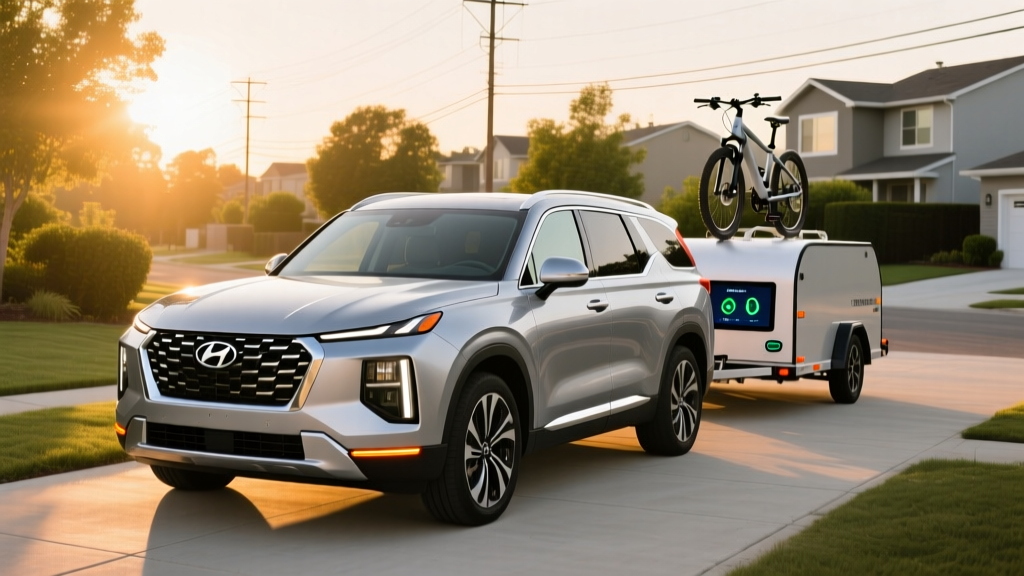
The 2026 Hyundai Palisade Hybrid (HEV) is rated for a maximum towing capacity of 3,500 pounds when properly equipped with the factory towing package. This represents a reduction from the outgoing gas-only V6 Palisade's 5,000-pound rating, a trade-off common to hybridized unibody SUVs where thermal management and drivetrain calibration prioritize efficiency over maximum payload.
| Specification | Palisade Hybrid (HEV) | Palisade Gas (V6) |
|---|---|---|
| Max Towing Capacity | 3,500 lbs | 5,000 lbs |
| Combined Horsepower | ~258 hp | 291 hp |
| Combined Torque | ~290 lb-ft | 262 lb-ft |
| Drivetrain | AWD (HTRAC) | FWD / AWD |
| Transmission | 6-speed automatic | 8-speed automatic |
| EPA Combined MPG | ~30 MPG | ~22 MPG |
While 3,500 pounds won't pull a large horse trailer or heavy boat, it comfortably handles a small utility trailer, a pair of jet skis, or a lightweight pop-up camper (typically 2,000–3,000 lbs loaded). For families who tow occasionally rather than weekly, the hybrid's efficiency gains far outweigh the 1,500-pound capacity reduction.
Hybrid vs. PHEV: Which Palisade Powertrain Is Right?
Hyundai offers the 2026 Palisade in two electrified configurations. Understanding the distinction is essential before visiting a dealer.
Conventional Hybrid (HEV)
- How it works: A 1.6L turbocharged inline-4 pairs with an electric motor and small battery (~1.5 kWh). The battery recharges through regenerative braking and engine power—you never plug it in.
- Best for: Buyers who want better MPG without changing their fueling habits, apartment dwellers without charging access, and frequent tow-ers who need consistent power.
Plug-In Hybrid (PHEV)
- How it works: A larger battery (~18–22 kWh usable) paired with a more powerful electric motor. You plug it in to gain 25–35 miles of electric-only range before the gas engine engages.
- Best for: Households with home Level 2 charging, short daily commutes (under 30 miles), and buyers who want EV-like driving most days with gas-engine backup for road trips.
The Palisade PHEV's towing capacity may be slightly reduced compared to the HEV due to the added battery weight and different powertrain calibration. Hyundai has not published final PHEV tow ratings as of this writing; buyers should confirm with their dealer before ordering a towing package on PHEV trims.
Fuel Economy: EPA Ratings vs. Real-World MPG
Hyundai's 1.6L turbo hybrid system has proven efficient across its lineup (Tucson Hybrid, Santa Fe Hybrid). For the three-row Palisade, here are the projected EPA figures based on the powertrain's performance in lighter applications and Hyundai's published targets:
| Driving Condition | Palisade Hybrid (HEV) | Palisade Gas V6 |
|---|---|---|
| City MPG | ~32 MPG | ~19 MPG |
| Highway MPG | ~28 MPG | ~25 MPG |
| Combined MPG | ~30 MPG | ~22 MPG |
Real-world expectations: Hybrids typically exceed their EPA city rating in stop-and-go traffic because regenerative braking recaptures energy that a gas-only vehicle wastes as heat. Expect 32–35 MPG in urban driving. Highway efficiency is less impressive—above 70 mph, aerodynamic drag dominates and the electric motor provides minimal assist. Plan for 26–28 MPG on sustained highway trips.
For the PHEV variant, EPA ratings will include an MPGe figure (miles-per-gallon-equivalent) for electric-only operation, likely in the 75–85 MPGe range. Once the battery depletes, the PHEV operates as a conventional hybrid with similar MPG to the HEV (minus a slight penalty for carrying the heavier battery).
Powertrain Deep Dive: Specs and Performance
The 2026 Palisade Hybrid uses Hyundai's proven TMED (Transmission-Mounted Electric Device) architecture:
- Engine: 1.6L turbocharged GDI inline-4, approximately 178 hp / 195 lb-ft
- Electric motor: ~60 kW (80 hp) integrated into the transmission
- Combined system output: ~258 hp / ~290 lb-ft torque
- Battery (HEV): ~1.5 kWh lithium-ion (not plug-in)
- Battery (PHEV): ~18–22 kWh usable capacity, NMC chemistry
- PHEV electric-only range: Estimated 25–35 miles (EPA)
- PHEV charging time: ~3.5 hours on Level 2 (240V, 7.2 kW); no DC fast charging on PHEV
The electric motor's instant torque (available from 0 RPM) gives the hybrid strong initial acceleration despite the lower peak horsepower. Expect 0–60 mph in approximately 7.5–8.0 seconds for the HEV, competitive with the gas V6. The PHEV may be slightly quicker in electric mode due to its more powerful motor, but heavier overall.
Pricing, Trims, and Tax Credit Eligibility
The 2026 Palisade Hybrid is positioned as a premium family hauler. Based on Hyundai's pricing strategy across its hybrid lineup, expect the following MSRP ranges:
- Palisade Hybrid SEL Premium: ~$46,000–$48,000
- Palisade Hybrid Limited: ~$51,000–$53,000
- Palisade Hybrid Calligraphy: ~$55,000–$58,000
- PHEV variants: Add approximately $3,000–$5,000 to equivalent HEV trim pricing
Federal Tax Credit: §30D Eligibility
The conventional Palisade Hybrid (HEV) does not qualify for the federal §30D Clean Vehicle Credit. This credit applies only to plug-in vehicles (PHEVs and BEVs) with at least 7 kWh of battery capacity.
The Palisade PHEV may qualify for up to $7,500, but eligibility depends on multiple factors under current IRS rules:
- Vehicle MSRP must not exceed $80,000 (SUV classification)
- Buyer AGI must not exceed $150,000 (single) / $300,000 (joint)
- Battery components and critical minerals must meet domestic-sourcing thresholds
- Credit can be transferred to the dealer as a point-of-sale discount
Always verify current-year eligibility on IRS.gov before purchasing, as sourcing requirements tighten annually.
Reliability, Battery Warranty, and Replacement Costs
Hyundai's hybrid system has matured significantly since its early Sonata Hybrid days. The brand backs its hybrid components with industry-leading coverage:
- Hybrid battery warranty: 10 years / 100,000 miles (original owner) against defects and excessive capacity loss
- Hybrid system components: 10 years / 100,000 miles (includes electric motor, inverter, and related electronics)
- New vehicle limited warranty: 5 years / 60,000 miles
- Powertrain warranty: 10 years / 100,000 miles
Battery replacement cost: If the hybrid battery fails outside warranty, expect $2,000–$4,000 for HEV battery replacement (relatively small capacity). PHEV battery replacement would be significantly higher ($6,000–$10,000+) due to the larger pack. However, modern lithium-ion hybrid batteries rarely require full replacement—individual module repairs or reconditioning are increasingly common at lower cost.
Long-term reliability data for Hyundai's turbo-hybrid system is positive. The 1.6L turbo engine has been in production since 2018 with no systemic failure patterns. The electric motor and inverter are solid-state components with minimal wear mechanisms. The primary maintenance advantage over the gas V6: no timing chain concerns (the 1.6T uses a timing chain, not a belt), and regenerative braking extends brake pad life significantly.
Who Should Choose the Palisade Hybrid vs. Gas or Full EV?
Choose the Palisade Hybrid If:
- You drive 15,000+ miles per year and want to cut fuel costs by ~25–30%
- You do heavy city/suburban driving where hybrid efficiency shines
- You need three rows and occasional towing (under 3,500 lbs)
- You lack home charging access but want better MPG
- You plan to keep the vehicle 8–10 years (warranty coverage)
Stick with the Gas Palisade If:
- You regularly tow 4,000–5,000 lbs (boat, large trailer)
- You drive primarily highway miles at 75+ mph (hybrid advantage diminishes)
- Upfront cost is the primary concern (gas model is $3,000–$5,000 less)
- You prefer the proven simplicity of a naturally aspirated V6
Consider a Full EV (e.g., Kia EV9, Tesla Model X) If:
- You have reliable home Level 2 charging
- You rarely tow (most EVs are not rated for heavy towing)
- You want the lowest per-mile fuel cost and minimal maintenance
- You qualify for the full $7,500 federal tax credit
Frequently Asked Questions
Can the 2026 Palisade Hybrid tow a camper trailer?
Yes, within limits. The 3,500-pound tow rating handles most pop-up campers (1,500–3,000 lbs), teardrop trailers, and small travel trailers. It cannot safely tow large travel trailers or fifth-wheel campers that exceed its rating. Always account for passenger and cargo weight, which reduces available towing capacity.
Does the Palisade Hybrid need to be plugged in?
No. The conventional hybrid (HEV) charges its battery through regenerative braking and engine power. You fuel it like a normal gas vehicle. Only the PHEV variant requires plugging in to access its electric-only range.
What is the real-world MPG of the Palisade Hybrid?
Expect 30–35 MPG in mixed city/suburban driving and 26–28 MPG on sustained highway trips at 70+ mph. Cold weather (below 40°F) reduces efficiency by 10–15% due to increased engine runtime for cabin heat and reduced battery efficiency.
How long will the hybrid battery last?
Modern hybrid batteries are designed for 150,000–200,000+ miles of service life. Hyundai's 10-year/100,000-mile warranty provides strong protection. Battery degradation in hybrids is minimal because the system keeps the battery in a narrow state-of-charge window (typically 40–80%), avoiding the deep cycles that accelerate wear.
Is the Palisade Hybrid slower than the gas V6?
No. The hybrid's combined 258 hp and 290 lb-ft of torque (with instant electric motor response) delivers comparable or slightly better acceleration than the gas V6 in normal driving. The hybrid may feel more responsive in city driving due to electric torque fill at low RPMs.
Does the Palisade PHEV qualify for a tax credit?
The PHEV may qualify for up to $7,500 under §30D, subject to MSRP caps, buyer income limits, and battery-sourcing requirements. The conventional HEV does not qualify for federal credits. Check fueleconomy.gov for the latest eligible-vehicle list.
The 2026 Hyundai Palisade Hybrid represents a pragmatic evolution for the three-row SUV segment. Its 3,500-pound towing capacity serves most family recreational needs, while delivering 30+ MPG in the mixed driving where families spend most of their time. For buyers who can work within its tow rating, the hybrid is the smarter long-term ownership choice—lower fuel costs, strong warranty coverage, and a powertrain that feels more refined than the gas V6 it replaces.