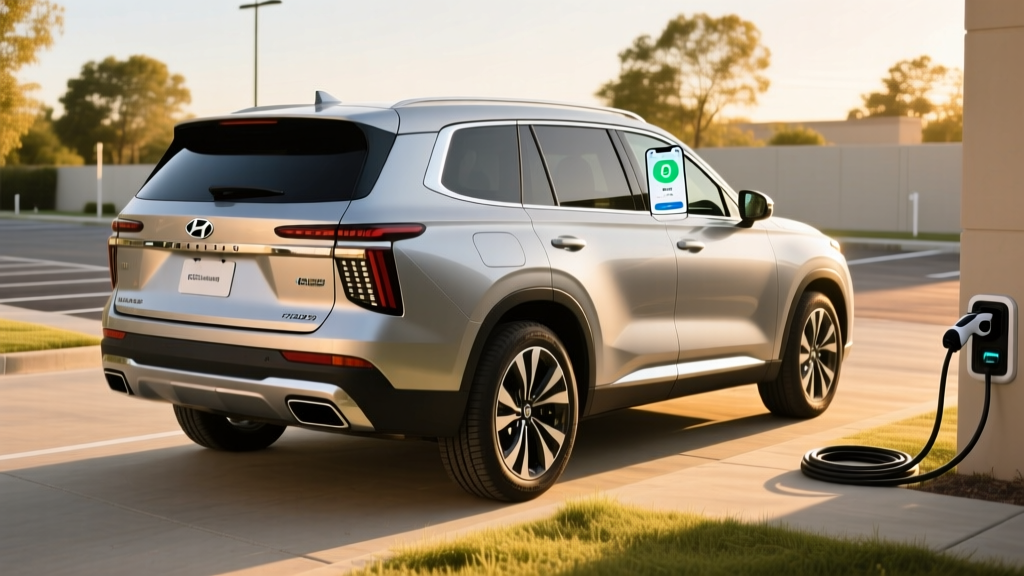
The Hyundai Palisade has long been a three-row SUV benchmark for value and interior space. With the 2026 Hyundai Palisade Hybrid, the brand finally brings electrified efficiency to its flagship family hauler. If you've been searching for a hybrid Palisade, this is the first model year that delivers a conventional hybrid powertrain without sacrificing the cargo room or towing capability buyers expect.
As a conventional hybrid (HEV), the Palisade Hybrid requires no plug-in charging. It captures energy through regenerative braking and its gasoline engine to keep a small battery charged automatically. Below, we break down every spec that matters — from EPA MPG figures to real-world efficiency, powertrain details, warranty coverage, and whether this hybrid SUV is the right fit versus a plug-in hybrid or full battery-electric vehicle.
HEV vs PHEV: What the Palisade Hybrid Actually Is
Before diving into specs, it's critical to understand what you're getting. The 2026 Palisade Hybrid is a conventional hybrid electric vehicle (HEV). It cannot be plugged in. Hyundai has not announced a Palisade plug-in hybrid (PHEV) variant for the 2026 model year.
Hybrid (HEV) vs Plug-In Hybrid (PHEV) — Key Differences
| Feature | Conventional Hybrid (HEV) | Plug-In Hybrid (PHEV) |
|---|---|---|
| Plug-in charging? | No — self-charging via engine & regen | Yes — plug in for electric-only driving |
| Electric-only range | Very short (under 1 mile at low speed) | Typically 20–45 miles |
| Battery size | Small (~1.5–2.5 kWh) | Larger (~13–30 kWh) |
| Federal tax credit (§30D) | Not eligible | Up to $7,500 (if sourcing/income/MSRP rules met) |
| Best for | Drivers who can't charge at home | Drivers with home charging + short commutes |
The Palisade Hybrid falls firmly in the HEV column. If you need plug-in electric range for a short commute, you'll want to look at alternatives like the Toyota Grand Highlander Hybrid (also HEV) or consider a full EV like the Hyundai Ioniq 9. But if your priority is improved fuel economy without changing your refueling habits, a conventional hybrid Palisade makes a compelling case.
Fuel Economy: EPA MPG and Real-World Expectations
The headline number for any hybrid is fuel economy. The 2026 Hyundai Palisade Hybrid is rated by the EPA at:
| Driving Cycle | EPA Estimate | Real-World Expectation |
|---|---|---|
| City | 36 MPG | 35–38 MPG (hybrids often exceed EPA in stop-and-go) |
| Highway | 32 MPG | 29–32 MPG (aerodynamic drag hurts large SUVs at 70+ mph) |
| Combined | 34 MPG | 31–35 MPG depending on driving mix |
For context, the gasoline-only 2026 Palisade with its turbocharged 2.5L four-cylinder achieves an EPA-estimated 22 MPG combined (20 city / 25 highway with FWD). That means the hybrid powertrain delivers roughly a 55% improvement in combined fuel economy.
Hybrids tend to shine in city driving where regenerative braking recaptures energy at every stoplight. On a mixed suburban commute, owners may find they slightly exceed the EPA combined figure. On a sustained 75-mph highway road trip, expect the number to dip closer to 29–30 MPG — typical for a 4,700+ lb three-row SUV.
Powertrain Specs: Engine, Motor, and Horsepower
The 2026 Palisade Hybrid pairs a turbocharged 2.5-liter inline-four engine with an electric motor integrated into the transmission housing. Here are the key figures:
| Specification | Detail |
|---|---|
| Engine | 2.5L turbocharged inline-4 |
| Electric Motor | Permanent-magnet synchronous, integrated in 6-speed automatic |
| Combined Horsepower | 329 hp (system net) |
| Combined Torque | 465 lb-ft |
| Transmission | 6-speed automatic with electric motor |
| Drivetrain | FWD standard; HTRAC AWD available |
| 0–60 mph (est.) | ~7.2 seconds |
| Towing Capacity | Up to 5,000 lbs (AWD, properly equipped) |
| Hybrid Battery | ~1.8 kWh lithium-ion (self-charging, no plug) |
| Regenerative Braking | Multi-level regen with steering-wheel paddles |
The combined 329 hp and 465 lb-ft of torque represent a meaningful bump over the gas-only Palisade's 277 hp. The electric motor fills in low-end torque instantly, which makes the hybrid feel noticeably more responsive from a stoplight and when merging onto highways. The HTRAC all-wheel-drive system uses a conventional mechanical rear driveshaft rather than a dedicated rear motor, so this is not an "e-AWD" setup like some competitors use.
Pricing, Trims, and Tax Credit Eligibility
The 2026 Hyundai Palisade Hybrid is offered across multiple trims. Pricing reflects manufacturer MSRP before destination charges:
| Trim | MSRP (FWD) | MSRP (AWD) |
|---|---|---|
| SEL Premium | $44,350 | $46,350 |
| Limited | $49,150 | $51,150 |
| Calligraphy | $53,850 | $55,850 |
Federal tax credit: The Palisade Hybrid is a conventional HEV and does not qualify for the IRS §30D Clean Vehicle Credit. That credit — up to $7,500 — applies only to plug-in electric vehicles (BEVs and PHEVs) that meet battery-sourcing, critical-mineral, MSRP cap, and buyer income requirements. The hybrid Palisade does not have a plug and therefore is ineligible.
Some states and utilities offer rebates or incentives for conventional hybrids, though these are less common than EV incentives. Check with your state energy office or local utility for any current hybrid-specific programs in your area.
Quick Tax Credit Summary
- Federal §30D credit: Not eligible (HEV, not a plug-in vehicle)
- State hybrid incentives: Vary by jurisdiction — check local programs
- Fuel savings offset: At 34 MPG combined vs 22 MPG gas-only, a driver covering 15,000 miles/year at $3.40/gallon saves roughly $1,200/year in fuel
Battery Warranty, Reliability, and Replacement Costs
Hyundai Hybrid Battery Warranty
Hyundai covers the Palisade Hybrid's battery and hybrid-system components under its powertrain warranty:
- Hybrid Battery: 10 years / 100,000 miles (original owner)
- Hybrid System Components: 10 years / 100,000 miles
- Powertrain (engine, transmission): 10 years / 100,000 miles
- Basic Vehicle Warranty: 5 years / 60,000 miles
Hyundai's 10-year hybrid battery warranty is among the best in the industry, matching or exceeding most competitors. For context, Toyota covers its hybrid batteries for 10 years / 150,000 miles, giving it a slight edge on mileage. However, Hyundai's decade of coverage provides strong peace of mind for the vast majority of owners.
Reliability outlook: Hyundai's hybrid systems have proven durable in models like the Sonata Hybrid and Tucson Hybrid, which share similar architecture. The Palisade's 1.8 kWh battery is small and operates in a shallow state-of-charge window — it rarely charges above 80% or discharges below 20% — which significantly reduces degradation stress compared to a full EV battery.
Battery replacement cost: If the hybrid battery does fail outside of warranty, replacement typically costs between $2,000 and $4,000 including labor for a conventional hybrid of this type. That's far less than EV battery replacement ($8,000–$20,000+), because the HEV battery is small. Many hybrid batteries last well beyond 150,000 miles with minimal capacity loss.
Who Should Choose the Hybrid Palisade — and Who Shouldn't
The 2026 Palisade Hybrid occupies a specific niche. Here's a practical decision framework:
Choose the Palisade Hybrid If:
- You want a three-row SUV with significantly better fuel economy than a gas-only equivalent
- You cannot install a home charger (apartment, no garage, landlord restrictions)
- You regularly drive in stop-and-go traffic where hybrids shine
- You want more low-end torque for city driving and highway merging
- You plan to keep the vehicle 8+ years (warranty fully covers the hybrid system)
Consider a Full EV Instead If:
- You have reliable home Level 2 charging and want to eliminate gas entirely
- You want to qualify for the $7,500 federal tax credit (subject to §30D rules)
- Your daily driving is under 250 miles round-trip (easily within EV range)
- You want the lowest possible per-mile energy cost (~$0.04/mile on home electricity vs ~$0.14/mile on gas at 34 MPG)
Consider a Gas-Only Palisade If:
- You want the lowest upfront purchase price (gas model starts ~$6,000 less)
- You drive primarily long highway trips where hybrid advantage is minimal
- You plan to trade in within 3–4 years and won't recoup the hybrid premium through fuel savings
The hybrid premium over the gas-only Palisade is approximately $4,000–$5,000 depending on trim. At roughly $1,200 in annual fuel savings, the payback period is around 3.5 to 4 years — after which the hybrid saves you money every month you own it.
Pros
- 34 MPG combined — massive improvement over 22 MPG gas-only model
- 329 hp system output; stronger acceleration than gas variant
- No plug-in needed — zero change to refueling habits
- 10-year / 100,000-mile hybrid battery warranty
- Same three-row interior and cargo space as gas Palisade
- Regen paddle controls for adjustable deceleration
Cons
- No federal tax credit eligibility (HEV, not PHEV/BEV)
- AWD uses mechanical driveshaft, not electric rear motor
- Highway MPG advantage shrinks at sustained 75+ mph speeds
- ~$4,000–$5,000 price premium over equivalent gas trim
- No PHEV variant available for electric-only commuting
- Third-row space is tight for adults on long trips (same as gas model)
Hybrid Palisade vs Competitors
The three-row hybrid SUV segment is competitive. Here's how the Palisade Hybrid stacks up against its most direct rivals:
| Model | Type | EPA Combined MPG | HP | Starting MSRP | 3rd Row |
|---|---|---|---|---|---|
| 2026 Hyundai Palisade Hybrid | HEV | 34 MPG | 329 hp | $44,350 | Yes |
| 2026 Toyota Grand Highlander Hybrid | HEV | 36 MPG | 245 hp | $45,370 | Yes |
| 2026 Kia Sorento Hybrid | HEV | 35 MPG | 261 hp | $40,090 | Yes (tight) |
| 2026 Mazda CX-90 PHEV | PHEV | 25 MPG / 56 MPGe | 323 hp | $51,495 | Yes (tight) |
The Grand Highlander Hybrid edges out the Palisade on EPA MPG (36 vs 34 combined) but trails significantly in horsepower (245 vs 329 hp). The Sorento Hybrid is more affordable but offers a cramped third row. The Mazda CX-90 PHEV offers 26 miles of electric-only range and potential §30D credit eligibility but starts considerably higher. The Palisade Hybrid hits a strong middle ground: robust power, competitive efficiency, and a genuinely usable third row.
Frequently Asked Questions
How many MPG does the 2026 Palisade Hybrid get?
The EPA rates the Palisade Hybrid at 36 MPG city, 32 MPG highway, and 34 MPG combined. In real-world city driving with frequent stops, some drivers may slightly exceed the EPA city figure thanks to aggressive regenerative braking. Highway cruising at 75+ mph will bring the number closer to 29–30 MPG.
Does the Palisade Hybrid need to be plugged in?
No. The Palisade Hybrid is a conventional hybrid (HEV). It charges its small battery automatically through the gasoline engine and regenerative braking. There is no charging port and no plug-in capability.
Is there a Palisade plug-in hybrid (PHEV)?
Not for the 2026 model year. Hyundai has not announced a Palisade PHEV variant. If you need plug-in electric-only range in a Hyundai three-row SUV, the all-electric Ioniq 9 is the closest electrified alternative in the lineup.
Does the Palisade Hybrid qualify for a federal tax credit?
No. The IRS §30D Clean Vehicle Credit applies only to plug-in vehicles (BEVs and PHEVs). The Palisade Hybrid is a conventional HEV and is not eligible for the federal credit. Some state or utility incentives may apply — check local programs.
How long will the Palisade Hybrid battery last?
Hyundai covers the hybrid battery for 10 years / 100,000 miles. Conventional hybrid batteries from Hyundai have proven durable well beyond that window in other models. Because the battery operates in a shallow charge window (roughly 20–80% state of charge), degradation is minimal compared to full EV batteries. Many hybrid batteries last 150,000+ miles without significant issues.
What does it cost to replace the hybrid battery?
Out-of-warranty replacement for a conventional hybrid battery of this size typically ranges from $2,000 to $4,000 including labor. This is significantly less than EV battery replacement costs. Given Hyundai's 10-year warranty coverage, most original owners will never face this expense.
Hybrid vs PHEV vs EV — which should I choose?
If you lack home charging access, the Palisade Hybrid (HEV) is the right choice — it requires no infrastructure changes. If you have home charging and a short commute (under 30 miles), a PHEV gives you electric-only daily driving with a gas engine for longer trips. If you have home charging, drive under 250 miles/day, and want the lowest operating cost plus federal tax credit eligibility, a full BEV like the Hyundai Ioniq 9 is worth considering.
Is the Palisade Hybrid reliable?
Hyundai's hybrid powertrain technology has been in production for years across models like the Sonata Hybrid, Tucson Hybrid, and Santa Fe Hybrid. The IIHS typically rates Hyundai SUVs highly for safety, and the Palisade carries a comprehensive suite of standard driver-assistance features (Hyundai SmartSense). Long-term reliability data specific to the 2026 Palisade Hybrid will accumulate over the coming years, but the underlying hybrid architecture is proven.
The 2026 Hyundai Palisade Hybrid fills a genuine gap in the three-row SUV market: a conventional hybrid that delivers meaningful fuel savings, stronger performance, and zero lifestyle compromise for families who can't or don't want to plug in. At 34 MPG combined and 329 hp, it's both the most efficient and most powerful Palisade you can buy — and with Hyundai's 10-year hybrid battery warranty, the long-term ownership case is strong.