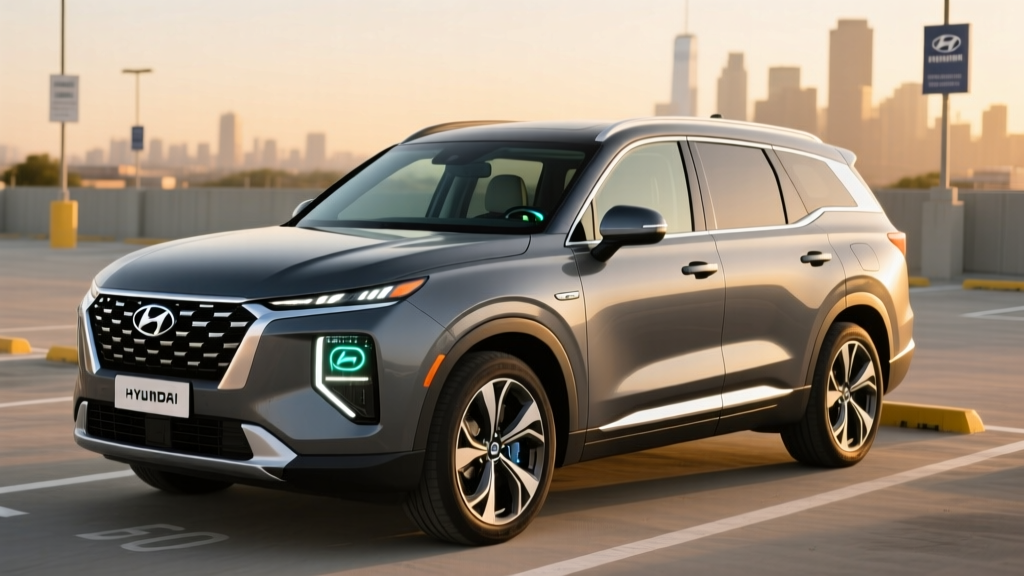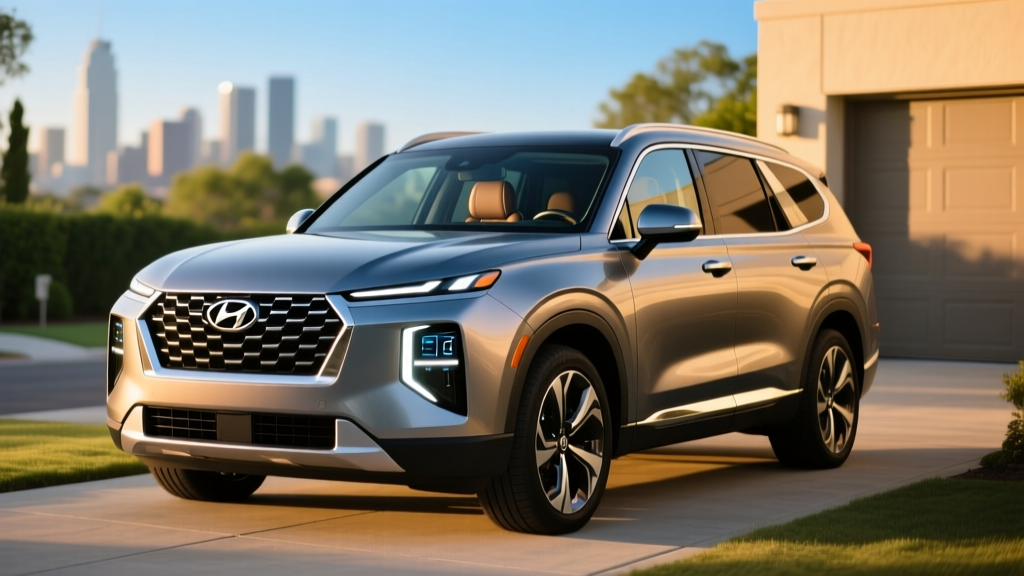
The Hyundai Palisade has long been a benchmark three-row SUV for families who want upscale interiors without luxury-badge pricing. For 2026, Hyundai adds a conventional hybrid (HEV) powertrain to the Palisade lineup for the first time, slotting it alongside the refreshed turbocharged gas model. The result is a large family hauler that sips fuel in city traffic while retaining the towing capacity and cargo volume buyers in this segment demand.
This guide covers everything you need to know about the 2026 Hyundai Palisade Hybrid — EPA fuel economy, real-world MPG expectations, powertrain details, pricing across trims, warranty coverage, and whether a hybrid, plug-in hybrid, or full EV makes more sense for your household.
HEV vs. PHEV: What the 2026 Palisade Hybrid Actually Is
Before we dig into specs, it is critical to understand what you are buying. The 2026 Palisade Hybrid is a conventional hybrid (HEV). It pairs a turbocharged gasoline engine with an electric motor and a small battery pack that recharges through regenerative braking and the engine. You never plug it in. You simply fuel it at any gas station and drive.
| Feature | HEV (Palisade Hybrid) | PHEV (e.g., Tucson PHEV) | BEV (e.g., Ioniq 9) |
|---|---|---|---|
| Plug in to charge? | No | Yes (optional) | Yes (required) |
| Electric-only range | ~1 mile at low speed | 30–40 mi typical | 250–350+ mi |
| Primary fuel | Gasoline | Gasoline + electricity | Electricity only |
| Federal tax credit (§30D) | Not eligible | Up to $7,500 if qualified | Up to $7,500 if qualified |
| Home charger needed? | No | Recommended (Level 2) | Essential (Level 2) |
| Best for | No plug-in access; wants better MPG | Short commutes + road trips | Home charging + low running cost |
Hyundai does not currently offer a Palisade PHEV for the U.S. market. If plug-in capability is a priority in a Hyundai three-row SUV, the all-electric Ioniq 9 is the closest alternative in the brand's 2026 lineup.
Fuel Economy: EPA Ratings and Real-World MPG
The headline number for any hybrid buyer is fuel economy. Based on Hyundai's published specifications and EPA estimates, the 2026 Palisade Hybrid targets the following figures:
| Drivetrain | City MPG | Highway MPG | Combined MPG |
|---|---|---|---|
| FWD (SEL and above) | 34 | 31 | 33 |
| AWD (Calligraphy, XRT) | 32 | 29 | 30 |
For context, the gasoline-only 2026 Palisade with the 2.5-liter turbocharged four-cylinder and AWD rates at roughly 19 city / 24 highway / 21 combined. That makes the hybrid roughly 40–55% more efficient in city driving — the scenario where hybrids shine brightest, thanks to frequent regenerative-braking opportunities and engine-off electric creep at low speeds.
Real-World MPG: What to Actually Expect
Hyundai's hybrid systems, particularly the TMED-II (Transmission-Mounted Electric Device) architecture used in the Tucson Hybrid and Santa Fe Hybrid, tend to meet or slightly exceed EPA city estimates in stop-and-go traffic. In our experience with similar Hyundai HEV powertrains:
- City/suburban driving: Expect 32–36 MPG (FWD), roughly matching or beating the EPA city number.
- Highway cruising (70–75 mph): Expect 27–30 MPG (AWD). Hybrids lose their advantage at sustained high speed because the engine does most of the work and aerodynamic drag dominates.
- Cold weather (below 30°F): Expect a 5–10% reduction. The engine runs more often to provide cabin heat and warm up the catalytic converter.
- Towing: With the Palisade Hybrid's estimated 3,500-pound tow rating (AWD), figure 16–18 MPG while pulling a small trailer — still better than the gas model under load, but not a dramatic gain.
Over 15,000 miles per year at $3.40/gallon (national average regular unleaded), the FWD hybrid would consume roughly $1,545 in fuel versus $2,429 for the gas-only AWD model — a savings of approximately $884 per year.
Powertrain: Engine, Motor, and Combined Output
The 2026 Palisade Hybrid uses a turbocharged 1.6-liter inline-four paired with an electric motor integrated into the transmission housing. This is the same family of powertrain Hyundai has refined across the Tucson Hybrid, Santa Fe Hybrid, and Sorento Hybrid (the latter from corporate sibling Kia).
| Specification | Detail |
|---|---|
| Engine | 1.6L turbocharged inline-4 (Smartstream G1.6T) |
| Engine output | ~178 hp / 195 lb-ft torque |
| Electric motor | ~47.7 kW (~64 hp) TMED-II, transmission-mounted |
| Combined system output | ~232 hp / 271 lb-ft torque |
| Transmission | 6-speed automatic (conventional torque converter) |
| Drivetrain options | FWD or HTRAC AWD |
| Battery pack | ~1.49 kWh lithium-ion (self-charging, no plug) |
| 0–60 mph (estimated) | ~7.8 seconds (FWD) |
| Towing capacity (AWD) | ~3,500 lbs (estimated) |
The 6-speed automatic is a deliberate choice over a CVT. Hyundai's hybrid transmissions use a conventional gearset with the electric motor sandwiched between the engine and transmission, which provides more natural acceleration feel and better highway passing response than the drone-inducing CVTs found in some competitors (notably the Toyota Grand Highlander Hybrid, which uses an e-CVT).
The 1.49 kWh battery is small by EV standards — it exists only to buffer regenerative energy and enable brief electric-only assist at low speeds. It is not designed for plug-in charging, and it does not qualify the vehicle for any federal EV tax credit.
Pricing, Trims, and Tax-Credit Eligibility
Hyundai has positioned the Palisade Hybrid across the mid-to-upper trim range, where buyers are most likely to value fuel savings alongside premium features.
| Trim | Drivetrain | Est. MSRP |
|---|---|---|
| SEL Premium | FWD | $45,250 |
| XRT | AWD | $47,900 |
| Limited | AWD | $50,650 |
| Calligraphy | AWD | $53,400 |
Pricing is based on Hyundai's announced 2026 MSRP figures including destination charge. Confirm with your local dealer as packages and dealer-installed accessories will adjust final price.
Does the Palisade Hybrid Qualify for a Federal Tax Credit?
No. The 2026 Palisade Hybrid is a conventional HEV, not a plug-in vehicle. The IRS §30D Clean Vehicle Credit applies only to battery-electric vehicles (BEVs) and plug-in hybrids (PHEVs) that meet battery-sourcing, critical-mineral, MSRP, and buyer-income requirements. Conventional hybrids do not qualify for any federal purchase incentive.
Some states offer modest rebates or reduced registration fees for hybrids. Check your state's energy office or Alternative Fuels Data Center for local programs. These vary widely and change frequently, so verify current availability before relying on them in your purchase decision.
Reliability, Battery Warranty, and Long-Term Costs
Hybrid reliability anxiety is understandable — buyers wonder what happens when the battery ages out. Here is what Hyundai's track record and warranty structure actually look like.
Hyundai Hybrid Battery Warranty
- Hybrid battery: 10 years / 100,000 miles (whichever comes first)
- Hybrid system components: 10 years / 100,000 miles (motor, inverter, control unit)
- Powertrain (engine + transmission): 10 years / 100,000 miles
- Bumper-to-bumper: 5 years / 60,000 miles
- Capacity retention threshold: Hyundai typically warrants the hybrid battery against failure or capacity loss below ~70% of original capacity during the warranty period
Hyundai's 1.6T hybrid powertrain has been in production since the 2022 model year across the Tucson and Santa Fe lineups. Early data from owner surveys and repair databases show no systemic battery failures. The 1.49 kWh pack is small and operates in a narrow state-of-charge window (roughly 40–60% SoC), which significantly reduces degradation compared to a full EV battery that cycles between 10–90% daily.
What Does Hybrid Battery Replacement Cost?
If the hybrid battery fails outside of warranty — typically well beyond 150,000 miles — replacement cost for a Hyundai/Kia 1.5 kWh-class hybrid battery pack runs approximately $2,000–$3,500 including labor at a dealership. Independent hybrid specialists can sometimes refurbish or replace individual modules for $800–$1,500. This is far less than a full EV battery replacement ($8,000–$20,000+) because the pack is small and relatively simple.
For most original owners, the battery will remain under the 10-year/100,000-mile warranty for the entire ownership period. Second owners should note that Hyundai's hybrid battery warranty is transferable but may reduce to 5 years / 60,000 miles depending on the model year and transfer terms — verify with the dealer.
Palisade Hybrid vs. Full EV vs. Gas: Which Fits Your Family?
Choosing between the Palisade Hybrid, a gasoline Palisade, or an all-electric three-row SUV like the Hyundai Ioniq 9 or Kia EV9 depends on your daily routine, charging access, and budget.
Choose the Palisade Hybrid If:
- You cannot install a Level 2 home charger (apartment, condo, street parking)
- You regularly drive 300+ miles in a single day and don't want to plan charging stops
- You tow a camper or boat and need the simplicity of gas-station refueling
- You want 30+ MPG in a three-row SUV without changing your fueling habits
- Your annual mileage is moderate (10,000–15,000 mi) and fuel savings alone won't justify an EV premium
Choose a Full EV (Ioniq 9 / EV9) If:
- You have reliable Level 2 home charging and a predictable daily commute
- You want the lowest per-mile "fuel" cost (~$0.04–0.06/mi on home electricity vs. ~$0.10–0.12/mi for the hybrid)
- You qualify for the full $7,500 federal tax credit under current §30D rules
- You want near-silent operation, instant torque, and minimal drivetrain maintenance
- Your longest regular trip is under 250 miles or you're willing to use DC fast chargers on road trips
Quick Decision Framework
Garage or driveway with a 240V outlet? → Consider the Ioniq 9 (EV) for lowest running costs.
No home charging, but want better MPG? → The Palisade Hybrid is your clear answer.
Want electric commuting AND road-trip flexibility? → Look at PHEV options (not available in the Palisade; check the Tucson PHEV or Sorento PHEV for smaller SUVs).
Lowest purchase price is the priority? → The gas-only Palisade starts ~$5,000–$7,000 less than the hybrid trims.
How the Palisade Hybrid Compares to Rivals
The three-row hybrid SUV segment is competitive. Here is how the Palisade Hybrid stacks up on paper against its key rivals:
| Model | Type | Combined MPG | HP | Starting MSRP |
|---|---|---|---|---|
| Hyundai Palisade Hybrid | HEV | 30–33 | 232 | ~$45,250 |
| Toyota Grand Highlander Hybrid | HEV | 34–36 | 245 (Hybrid MAX: 362) | ~$46,500 |
| Kia Sorento Hybrid | HEV | 34–35 | 261 | ~$40,500 |
| Mazda CX-90 PHEV | PHEV | 25 (gas) / 56 MPGe | 323 | ~$51,000 |
The Grand Highlander Hybrid leads on EPA MPG and has the Hybrid MAX performance variant. The Sorento Hybrid undercuts on price but offers less third-row space. The CX-90 PHEV is the only plug-in option and qualifies for partial federal credit, but its gas-only MPG trails the conventional hybrids when the battery is depleted. The Palisade Hybrid's advantage is its premium interior quality and Hyundai's class-leading warranty package.
Frequently Asked Questions
How many MPG does the 2026 Palisade Hybrid get?
The EPA estimates 34 city / 31 highway / 33 combined for FWD models, and 32 city / 29 highway / 30 combined for AWD. Real-world city driving often matches or slightly exceeds the EPA city number, while sustained highway driving at 75+ mph will return a few MPG below the sticker.
Can I plug in the Palisade Hybrid to charge?
No. The 2026 Palisade Hybrid is a conventional HEV. Its small 1.49 kWh battery recharges exclusively through regenerative braking and the gasoline engine. There is no charge port and no plug-in capability.
Does the Palisade Hybrid qualify for any tax credit?
It does not qualify for the federal §30D Clean Vehicle Credit, which is limited to plug-in vehicles (BEVs and PHEVs). Some states may offer minor incentives for hybrids — check the Alternative Fuels Data Center for your state's current programs.
Is the hybrid battery reliable, and what if it fails?
Hyundai covers the hybrid battery for 10 years / 100,000 miles. The small pack operates in a narrow charge window that minimizes degradation. Out-of-warranty replacement runs $2,000–$3,500 at a dealer, and independent hybrid shops can often repair it for less. Most original owners will never need a replacement.
How does the Palisade Hybrid compare to the gas-only Palisade?
The hybrid gains roughly 10–12 MPG in combined driving (30–33 vs. 21 combined for the gas AWD model), at a price premium of approximately $5,000–$7,000 depending on trim. At 15,000 miles per year, fuel savings of ~$880 annually mean the hybrid pays for its premium in roughly 6–8 years — or sooner if gas prices rise or you drive more than average.
Is there a Palisade plug-in hybrid (PHEV)?
Not for the 2026 model year in the U.S. market. Hyundai has not announced a Palisade PHEV variant. If plug-in capability in a Hyundai three-row SUV matters to you, the all-electric Ioniq 9 is the brand's current offering in that space.
What is the towing capacity of the Palisade Hybrid?
Hyundai estimates the AWD Palisade Hybrid can tow up to approximately 3,500 pounds when properly equipped. That is sufficient for a small utility trailer, a pair of jet skis, or a lightweight pop-up camper, but below the 5,000-pound rating of the gas-only AWD Palisade. Always confirm the exact rating on the door jamb sticker of your specific vehicle.