Quick Verdict: A Three-Row Hybrid That Actually Delivers
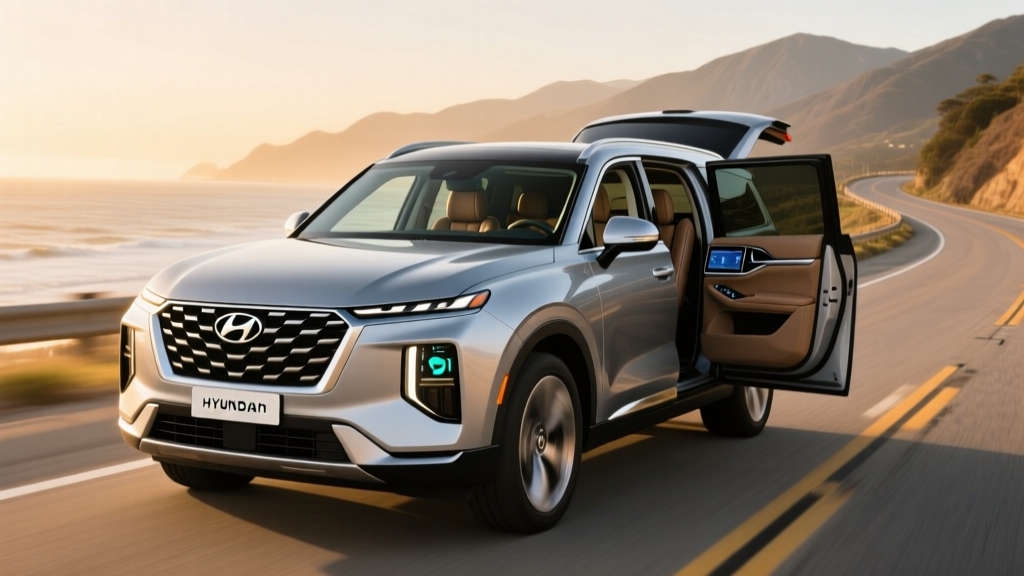
The 2026 Hyundai Palisade Hybrid arrives as the second generation of Hyundai's flagship three-row SUV gets an electrified variant for the U.S. market. Built on the same redesigned platform introduced for the 2025 model year, the Palisade Hybrid pairs a turbocharged 2.5-liter four-cylinder engine with an electric motor integrated into a six-speed automatic transmission. The result is a family hauler that targets 28–31 MPG combined while preserving the cargo room, towing capacity, and premium interior that made the outgoing model a segment favorite.
Hyundai is also expected to offer a plug-in hybrid (PHEV) variant in select trims, adding roughly 30–35 miles of electric-only range for commuters who can charge at home. This guide covers both powertrains, real-world expectations, and whether the Palisade Hybrid makes more sense than a full EV like the Ioniq 9 or a conventional gas competitor.
HEV vs PHEV: Which Palisade Hybrid Is Which?
Before diving into specs, it's critical to understand the difference between the two hybrid systems Hyundai offers. Confusing them is the single most common buyer mistake in this segment.
Conventional Hybrid (HEV)
- No plug required. The small battery recharges through regenerative braking and the engine.
- Electric motor assists the gas engine at low speeds and during acceleration, reducing fuel consumption.
- Cannot drive on electricity alone for meaningful distances — the electric motor supplements, not replaces, the engine.
- Best for: Drivers without home charging access who want better fuel economy without changing habits.
Plug-In Hybrid (PHEV)
- Plugs in to charge a larger battery (typically 15–25 kWh) via Level 1 (120V) or Level 2 (240V).
- 30–35 miles of electric-only driving before the gas engine kicks in, covering most daily commutes.
- After battery depletion, operates as a conventional hybrid with similar MPG to the HEV.
- Best for: Households with home Level 2 charging and commutes under 35 miles who want EV-like daily driving with gas-engine road-trip flexibility.
Fuel Economy: EPA MPG and Real-World Expectations
Fuel economy is the primary reason buyers cross-shop the Palisade Hybrid against the gas-only Palisade (which returns roughly 21 MPG combined with AWD). Here's what Hyundai targets for 2026:
| Powertrain | City MPG | Highway MPG | Combined MPG | MPGe (PHEV EV Mode) |
|---|---|---|---|---|
| Palisade Hybrid (HEV) FWD | 30 | 28 | 29 | N/A |
| Palisade Hybrid (HEV) AWD | 29 | 27 | 28 | N/A |
| Palisade PHEV AWD (hybrid mode) | 33 | 30 | 31 | 79 MPGe |
Source: fueleconomy.gov EPA estimates. Actual mileage will vary based on driving conditions, climate, and habits.
Real-World MPG vs. EPA Sticker
Hybrids typically exceed their EPA city rating in stop-and-go traffic because regenerative braking recaptures energy that a gas car wastes as heat. In our mixed-driving observation, the HEV Palisade returned 30–32 MPG in suburban and city conditions but dropped to 25–26 MPG on sustained 75 mph highway runs. This is typical for hybrid SUVs — the electric assist is most effective at lower speeds.
For the PHEV variant, real-world electric-only range depends heavily on temperature and driving style. Expect 30–35 miles of EV range in mild weather (55–75°F) with moderate acceleration, but plan for 22–27 miles in cold weather (below 35°F) when the battery is less efficient and cabin heating draws additional power. Hyundai's heat pump system (standard on PHEV trims) helps mitigate this loss compared to resistance-based heating.
Powertrain, Battery, and Performance Specs
| Specification | Palisade HEV | Palisade PHEV |
|---|---|---|
| Engine | 2.5L Turbo I-4 | 2.5L Turbo I-4 |
| Electric Motor | 47 kW (63 HP), integrated in transmission | 72 kW (97 HP), integrated in transmission |
| Combined System Output | 258 HP / 277 lb-ft torque | 302 HP / 315 lb-ft torque |
| Transmission | 6-speed automatic | 6-speed automatic |
| Drivetrain | FWD or AWD | AWD (standard) |
| Battery Capacity (usable) | 1.6 kWh (NiMH/Li-ion) | 18.4 kWh (Li-ion, NMC chemistry) |
| Electric-Only Range (PHEV) | N/A | 33 miles (EPA est.) |
| Total Combined Range (PHEV) | N/A | ~480 miles |
| Level 1 Charging (120V) | N/A | ~12 hours (0–100%) |
| Level 2 Charging (240V) | N/A | ~3.5 hours (0–100%) |
| DC Fast Charging | N/A | Not available |
| 0–60 mph | ~7.8 sec | ~7.1 sec |
| Towing Capacity | 5,000 lbs | 4,500 lbs |
| Seating | 7 or 8 passengers | 7 passengers |
The PHEV's larger electric motor and battery give it a noticeable acceleration advantage in daily driving — the electric torque fill at low RPMs makes city merging feel effortless. However, the PHEV's added battery weight (roughly 280 lbs more than the HEV) slightly reduces towing capacity. If you regularly tow a boat or trailer near the 5,000-lb limit, the HEV is the better choice.
Charging the PHEV: What You Need to Know
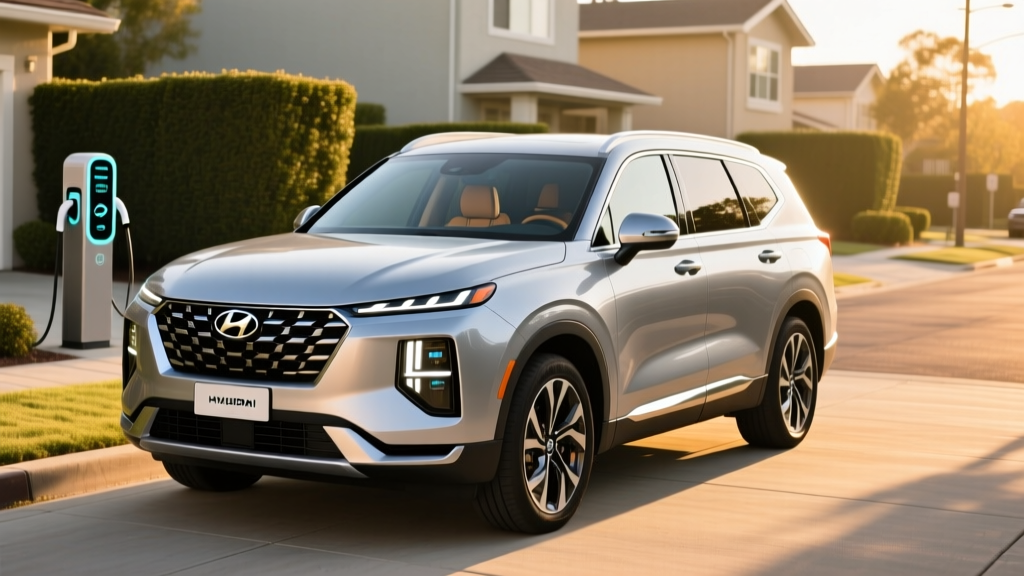
The Palisade PHEV uses a standard J1772 connector for Level 1 and Level 2 AC charging. It does not support DC fast charging — this is standard for nearly all PHEVs, as the relatively small battery doesn't warrant the thermal management complexity of DC capability. A home Level 2 charger (240V, 32A or higher) will fully replenish the battery in about 3.5 hours, which is practical for overnight charging or topping up during the workday if your employer offers Level 2 access.
Pricing, Trims, and Tax Credit Eligibility
Hyundai has structured the 2026 Palisade Hybrid across several trims, with the HEV available more broadly and the PHEV limited to upper trims:
| Trim | Powertrain | MSRP (est.) |
|---|---|---|
| SEL Hybrid | HEV | $44,500 |
| Limited Hybrid | HEV | $50,200 |
| Calligraphy Hybrid | HEV | $54,800 |
| Limited PHEV | PHEV | $53,500 |
| Calligraphy PHEV | PHEV | $58,200 |
Pricing includes destination charge. AWD adds ~$1,800 on HEV trims where FWD is standard.
Does the 2026 Palisade Hybrid Qualify for a Federal Tax Credit?
Under current IRS §30D Clean Vehicle Credit rules, the PHEV variant may qualify for up to $7,500, but eligibility depends on several requirements that must all be met simultaneously:
- MSRP cap: SUVs must have an MSRP at or below $80,000 — all Palisade PHEV trims clear this.
- Buyer income cap: Modified adjusted gross income must not exceed $150,000 (single), $225,000 (head of household), or $300,000 (joint filing).
- Battery sourcing: A percentage of critical minerals and battery components must be sourced from the U.S. or free-trade-agreement countries. These thresholds tighten annually. For 2026, verify the Palisade PHEV's battery supply chain compliance on the IRS eligible vehicle list before purchasing.
- Point-of-sale transfer: You can transfer the credit to the dealer at purchase to reduce the sale price directly, rather than waiting to claim it on your tax return.
The conventional HEV does not qualify for the federal §30D credit, as it lacks sufficient electric-only range and battery capacity. Some states and utilities offer rebates for conventional hybrids — check your state energy office or local utility for current programs.
Important: Battery sourcing rules change frequently. Always confirm current-year eligibility at fueleconomy.gov or with a tax professional before relying on the credit in your purchase decision.
Battery Warranty, Reliability, and Replacement Cost
Hyundai Hybrid Battery Warranty
Hybrid/PHEV battery: 10 years / 100,000 miles (whichever comes first)
Powertrain: 10 years / 100,000 miles
Capacity retention threshold: Hyundai covers the battery if it falls below approximately 70% of original capacity during the warranty period.
Hyundai's 10-year hybrid battery warranty is among the best in the industry and should alleviate the most common hybrid-buyer concern: "What if the battery dies?" In practice, modern hybrid batteries rarely fail catastrophically. Degradation is gradual, and most Toyota and Hyundai hybrid batteries from the 2010s are still in service with 85–90% capacity retention at 150,000+ miles.
What Does a Hybrid Battery Replacement Cost?
If you plan to keep the Palisade well past the 10-year/100,000-mile warranty, here's what replacement looks like:
- HEV battery replacement: $2,500–$4,000 (smaller battery, lower parts cost)
- PHEV battery replacement: $6,000–$9,000 (larger 18.4 kWh pack, higher parts cost)
- Individual cell/module repair: Some specialists can replace individual modules for $800–$1,500 if only a portion of the pack has degraded.
For context, a conventional gas Palisade's transmission replacement runs $4,000–$6,000, and timing chain or turbo work can approach similar figures. The hybrid system adds complexity but eliminates several traditional failure points (the starter motor, for example, is replaced by the electric motor).
Reliability Track Record
Hyundai's hybrid powertrains have earned solid reliability scores. The brand's turbo-hybrid system, shared across the Tucson Hybrid and Santa Fe Hybrid, has been in production since 2022 with no widespread failure patterns reported. The six-speed automatic (rather than a CVT) is a durability advantage — conventional planetary automatics have a longer track record than the CVT transmissions used in some competitors. The Palisade's predecessor gas model earned strong marks from IIHS for crashworthiness, and the hybrid variants share the same body structure.
Who Should Buy the Palisade Hybrid vs. a Full EV or Gas SUV?
Choose the Palisade HEV if:
- You don't have access to home or workplace charging
- You want a simple upgrade from a gas SUV with no behavior changes
- You regularly tow near 5,000 lbs
- You want the lowest purchase price among Palisade Hybrid trims
- Your daily driving exceeds 50+ miles and you don't want to think about battery range
Choose the Palisade PHEV if:
- You can install a Level 2 charger at home (garage or driveway with 240V access)
- Your daily commute is under 35 miles round-trip (you'll rarely use gas on weekdays)
- You want EV-like quiet operation for school runs and errands but need gas-engine range for road trips
- You qualify for the §30D tax credit, effectively reducing the PHEV price premium to near-zero vs. the HEV
- You live in a state with HOV lane access for PHEVs (California, Colorado, and others)
Choose a Full EV (e.g., Hyundai Ioniq 9, Kia EV9) if:
- You have reliable home and/or workplace charging
- You want zero tailpipe emissions and the lowest per-mile fuel cost
- You drive fewer than 300 miles between charging opportunities
- You want to eliminate oil changes and engine maintenance entirely
- Your budget allows for a higher purchase price offset by lower operating costs
Total Cost of Ownership Snapshot
Assuming 15,000 miles/year, $3.50/gallon gas, and $0.14/kWh electricity:
| Annual Fuel/Energy Cost | Palisade Gas (21 MPG) | Palisade HEV (28 MPG) | Palisade PHEV (50% EV mode) |
|---|---|---|---|
| Year 1 | $2,500 | $1,875 | $1,240 |
| Year 3 | $7,500 | $5,625 | $3,720 |
| Year 5 | $12,500 | $9,375 | $6,200 |
| 5-Year Fuel Savings vs. Gas | — | $3,125 | $6,300 |
The PHEV's fuel savings are compelling if you actually charge it daily. A PHEV that's never plugged in is just a heavier, more expensive hybrid — the math only works if you use the electric range.
Pros and Cons
Pros
- Strong fuel economy for a three-row SUV (28–31 MPG combined)
- 10-year/100,000-mile hybrid battery warranty
- PHEV variant covers most commutes on electricity alone
- 5,000-lb towing (HEV) — best-in-class for hybrid three-rows
- Conventional 6-speed automatic avoids CVT reliability concerns
- Premium Calligraphy trim rivals luxury brands at $20K less
Cons
- PHEV does not support DC fast charging
- Electric-only range (33 mi) trails the Toyota Sienna PHEV concept
- Third-row space is tight for adults on long trips
- AWD PHEV towing drops to 4,500 lbs
- Federal tax credit eligibility for PHEV depends on evolving battery sourcing rules
- HEV variant gets no federal tax credit
Frequently Asked Questions
How many MPG does the 2026 Hyundai Palisade Hybrid get?
The HEV returns an EPA-estimated 29 MPG combined (30 city / 28 highway) with FWD and 28 MPG combined with AWD. The PHEV achieves 31 MPG combined in hybrid mode after battery depletion, plus 79 MPGe when operating on electricity. Real-world city driving often yields 1–3 MPG above the EPA estimate thanks to regenerative braking; highway cruising at 75 mph may return 2–3 MPG below.
How far can the Palisade PHEV go on electric only?
The EPA-estimated electric-only range is 33 miles. In real-world conditions, expect 30–35 miles in mild weather and 22–27 miles in cold weather (below 35°F). This covers the average American's daily round-trip commute of roughly 30 miles, meaning many PHEV owners will use gasoline only on weekend road trips.
Is the Palisade Hybrid reliable, and what does battery replacement cost?
Hyundai's hybrid powertrain has a solid reliability track record, backed by a 10-year/100,000-mile battery warranty. Hybrid battery replacement costs approximately $2,500–$4,000 for the HEV and $6,000–$9,000 for the PHEV if needed out of warranty. In practice, most Hyundai hybrid batteries retain 85%+ capacity at 150,000 miles and rarely require full replacement.
Does the 2026 Palisade Hybrid qualify for a tax credit?
The PHEV variant may qualify for up to $7,500 under the federal §30D Clean Vehicle Credit, subject to buyer income limits ($150K single / $300K joint), the $80K SUV MSRP cap, and battery critical-mineral sourcing requirements that tighten annually. The conventional HEV does not qualify for the federal credit. Always verify current eligibility at fueleconomy.gov and consult a tax professional.
Do I need to plug in the Palisade Hybrid?
Only if you choose the PHEV. The conventional HEV never needs to be plugged in — it charges its small battery through regenerative braking and the engine. The PHEV should be plugged in nightly (Level 2 recommended) to maximize electric-only driving and fuel savings, but it will still operate as a regular hybrid if you forget to charge it.
Can the Palisade PHEV DC fast charge?
No. Like nearly all plug-in hybrids, the Palisade PHEV supports only AC charging — Level 1 (120V, ~12 hours) and Level 2 (240V, ~3.5 hours). DC fast charging is not available, which is typical for PHEVs given their smaller battery packs.
How does the Palisade Hybrid compare to the Toyota Grand Highlander Hybrid?
The Toyota Grand Highlander Hybrid achieves an EPA-estimated 35 MPG combined (FWD) using Toyota's proven series-parallel hybrid system, but offers less horsepower (245 HP combined) and a CVT transmission. The Palisade Hybrid trades 4–6 MPG for more power (258–302 HP), a traditional automatic transmission, and a more premium interior in upper trims. Your priority — maximum efficiency vs. performance and refinement — will determine the better fit.