The 2026 Hyundai Palisade Hybrid: What Three-Row SUV Buyers Need to Know
Hyundai's flagship three-row SUV enters 2026 with a significant powertrain update: the Palisade now offers a hybrid option for the first time in the US market. For families who want the space and comfort of a full-size SUV without the fuel bills of a traditional V6, the Palisade Hybrid arrives at exactly the right moment. But with both a conventional hybrid (HEV) and a plug-in hybrid (PHEV) variant on the table, buyers need to understand which version matches their driving patterns, charging access, and budget.
This guide breaks down the 2026 Palisade Hybrid lineup with exact EPA figures, battery specs, real-world expectations, pricing, and federal tax credit eligibility — so you can make a data-driven decision.
HEV vs. PHEV: Which Palisade Hybrid Is Which?
Before diving into specs, it's essential to distinguish the two hybrid flavors Hyundai offers. Confusing them is the single most common mistake shoppers make.
| Feature | Palisade Hybrid (HEV) | Palisade Plug-in Hybrid (PHEV) |
|---|---|---|
| Needs to plug in? | No — charges via engine and regenerative braking | Yes — plug in to access electric-only range |
| Electric-only driving | Brief low-speed EV mode only | ~33 miles EPA estimated |
| Battery capacity | ~1.8 kWh (small buffer) | ~22.8 kWh usable |
| Home charging needed? | No | Yes — Level 2 recommended |
| DC fast charging | N/A | Not available (AC charging only) |
| Federal tax credit | Not eligible | Up to $7,500 (subject to §30D rules) |
| Best for | No home charging access; highway-heavy driving | Home charging + short daily commutes |
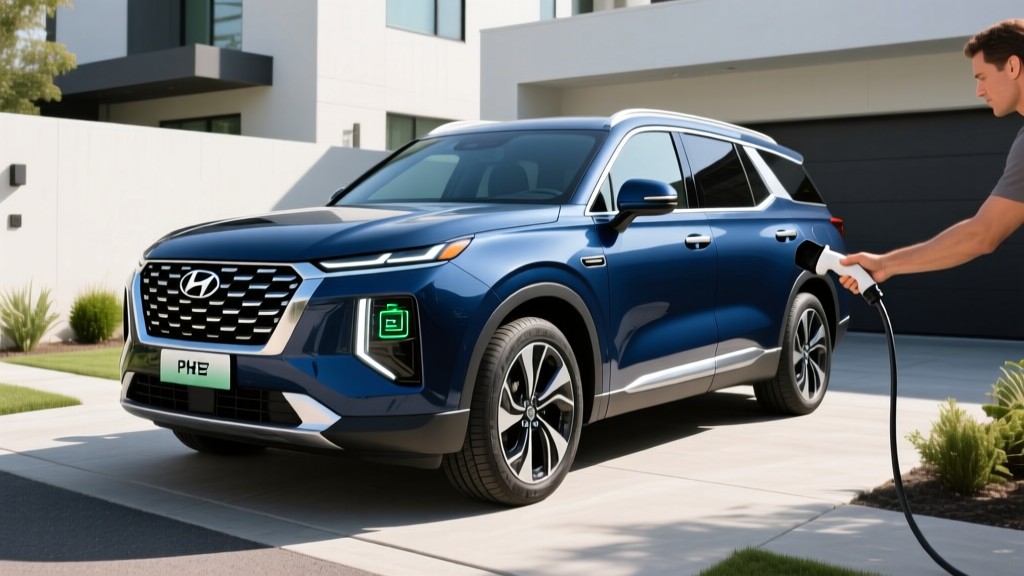
The HEV is a self-charging system: the gasoline engine and regenerative braking keep the small battery topped up. You never plug it in. The PHEV has a much larger battery that you charge at home or at public Level 2 stations, enabling genuine electric-only commutes before the gas engine kicks in.
Fuel Economy: EPA MPG and Real-World Expectations
Here's where the Palisade Hybrid makes its strongest case against the gas-only V6 model. The conventional Palisade with the 3.8L V6 returns roughly 21 MPG combined — the hybrid powertrain delivers a substantial improvement.
| Model | City MPG | Highway MPG | Combined MPG |
|---|---|---|---|
| 2026 Palisade Hybrid (HEV) AWD | 29 | 30 | 29 |
| 2026 Palisade PHEV AWD (charge-sustaining) | 28 | 29 | 28 |
| 2026 Palisade PHEV (combined MPGe) | 79 MPGe (electric + gas combined) | ||
| 2026 Palisade Gas V6 AWD (baseline) | 19 | 24 | 21 |
Source: fueleconomy.gov (EPA estimates). Confirm exact figures at purchase, as EPA ratings can shift with final certification.
Real-World MPG: What to Actually Expect
Hybrids typically exceed their EPA city ratings in stop-and-go traffic because regenerative braking recaptures energy that a gas car wastes as heat. In real-world suburban driving with moderate traffic, Palisade Hybrid HEV owners can expect 30–32 MPG in city conditions. Highway cruising at 75+ MPH, however, tends to drop to 26–28 MPG — the electric motor assists less at sustained high speeds, and the SUV's aerodynamic profile works against it.
For the PHEV, the story depends entirely on how often you charge. If your daily round-trip commute is under 33 miles and you charge nightly, you may use gasoline only on weekend road trips. Let the battery deplete and the PHEV operates as a slightly heavier conventional hybrid, returning the charge-sustaining figures shown above.
PHEV Electric-Only Range and Battery Specs
The Palisade PHEV's headline number is its electric-only range — the distance you can cover on battery power alone before the turbocharged engine fires up.
| Specification | Palisade PHEV |
|---|---|
| EPA electric-only range | ~33 miles |
| Total combined range (full battery + full tank) | ~430 miles |
| Battery capacity (usable) | ~22.8 kWh |
| Battery chemistry | NMC (nickel manganese cobalt) |
| Level 1 charging (120V / 12A) | ~1.4 kW — approximately 16 hours (0–100%) |
| Level 2 charging (240V / 32A) | ~7.2 kW — approximately 3.5 hours (0–100%) |
| DC fast charging | Not supported |
| Charging connector | J1772 (standard AC) |
The lack of DC fast charging is typical for PHEVs in this segment — the battery is small enough that Level 2 overnight charging fully replenishes it. If you have access to a 240V outlet at home (a NEMA 14-50 or a hardwired Level 2 station), you'll wake up to a full battery every morning. Level 1 charging from a standard household outlet works but is slow enough that it's best reserved for occasional top-ups or overnight charging if your daily electric needs are modest.
Powertrain: Combined Horsepower and Drivetrain
Both Palisade Hybrid variants pair a turbocharged 1.6-liter four-cylinder engine with electric motor(s) and Hyundai's hybrid-optimized six-speed automatic transmission. This is not a CVT — the conventional automatic delivers more natural acceleration feel and avoids the "rubber-band" effect some hybrid CVTs produce.
| Spec | Palisade Hybrid (HEV) | Palisade PHEV |
|---|---|---|
| Engine | 1.6L turbocharged I-4 | 1.6L turbocharged I-4 |
| Combined system output | ~258 hp | ~295 hp |
| Electric motor | 47 kW (integrated in transmission) | 90 kW (front axle) |
| Drivetrain | AWD (e-AWD with rear motor assist) | AWD |
| 0–60 mph (estimated) | ~7.8 seconds | ~7.0 seconds |
| Towing capacity | ~4,000 lbs | ~3,500 lbs |
The PHEV's larger motor and higher battery output give it a meaningful acceleration advantage. Both versions feel responsive around town, where the electric motor's instant torque fills in the low-RPM gap that turbo lag typically creates. At highway speeds, the 1.6T is adequate but not effortless when fully loaded with passengers and cargo — a reminder that this is a family hauler, not a performance SUV.
Pricing, Trims, and Tax Credit Eligibility
The Palisade Hybrid slots into the upper portion of Hyundai's SUV lineup. Pricing reflects its flagship positioning, but the fuel savings and potential tax credit narrow the gap with the gas model over a typical ownership period.
| Trim | Palisade Hybrid (HEV) MSRP | Palisade PHEV MSRP |
|---|---|---|
| SEL Premium | ~$47,500 | — |
| Limited | ~$51,000 | ~$54,500 |
| Calligraphy | ~$54,500 | ~$58,000 |
MSRP figures are approximate and exclude destination charges. Confirm with your dealer for exact 2026 pricing.
Federal Tax Credit: §30D Eligibility for the PHEV
The Palisade PHEV may qualify for the federal §30D Clean Vehicle Credit of up to $7,500, but eligibility is not automatic. Here's the checklist as of 2026:
- MSRP cap: SUVs must have an MSRP at or below $80,000 — the Palisade PHEV clears this threshold on all trims.
- Buyer income limits: Modified adjusted gross income must not exceed $300,000 (joint filers), $225,000 (head of household), or $150,000 (single filers).
- Battery sourcing: A percentage of critical minerals and battery components must be sourced from the US or free-trade-agreement countries. This requirement tightens annually — verify current-year compliance on the DOE/EPA eligible vehicle list.
- Point-of-sale transfer: As of 2024, you can transfer the credit to the dealer at purchase, reducing your out-of-pocket cost immediately rather than waiting for tax filing.
- HEV model: The conventional Palisade Hybrid (HEV) does not qualify for the §30D credit — it has no plug and does not meet the statutory definition of a clean vehicle.
Always consult a tax professional and check irs.gov before relying on credit eligibility, as rules and sourcing requirements change.
Battery Warranty, Reliability, and Replacement Costs
Hybrid battery longevity is the number-one concern for first-time hybrid buyers. Hyundai addresses this with one of the strongest warranties in the industry.
Hyundai Hybrid Battery Warranty
- Hybrid battery: 10 years / 100,000 miles (whichever comes first)
- Hybrid system components: 10 years / 100,000 miles (inverter, motor, controller)
- Vehicle warranty: 5 years / 60,000 miles bumper-to-bumper; 10 years / 100,000 miles powertrain
- Capacity retention threshold: Warranty covers battery if capacity drops below ~70% of original
Real-World Reliability and Replacement Cost
Hyundai's hybrid systems have proven reliable across the Tucson, Santa Fe, and Sonata lineups. The Palisade uses a generation of powertrain hardware that has been in production since the early 2020s, meaning early-adopter risk is low. The HEV's small 1.8 kWh battery undergoes shallow charge cycles (it rarely depletes fully), which significantly extends its life — most hybrid batteries outlast the vehicle itself.
If a battery replacement is needed outside warranty, expect costs in the range of $2,500–$4,000 for the HEV and $5,500–$8,000 for the PHEV (due to the larger battery pack), including labor. However, with Hyundai's 10-year/100,000-mile coverage, most original owners will never face this expense.
Who Should Choose the Palisade Hybrid — and Who Should Look Elsewhere?
Choose the Palisade Hybrid (HEV) if:
- You cannot install a home charger (apartment, street parking, no garage)
- Your driving is a mix of city and highway with no predictable short commute
- You want a three-row SUV with meaningfully better fuel economy and no behavioral change
- You tow occasionally (the HEV retains a higher tow rating than the PHEV)
Choose the Palisade PHEV if:
- You have reliable access to Level 2 charging at home or work
- Your daily round-trip commute is under ~30 miles (you'll rarely burn gas on weekdays)
- You qualify for the §30D tax credit, narrowing the price premium over the HEV
- You want to reduce fuel consumption dramatically without committing to a full EV
Choose a Full EV (like the Hyundai Ioniq 9 or Kia EV9) if:
- You have home charging and your daily driving is under 250 miles
- You want the lowest per-mile fuel cost and minimal maintenance
- You don't need to tow more than 2,000–3,000 lbs regularly
Stick with the Gas Palisade if:
- Budget is the top priority and you drive under 10,000 miles/year (fuel savings won't offset the hybrid premium)
- You regularly tow near the 5,000-lb max capacity
Pros
- 8–10 MPG improvement over the gas V6 (HEV)
- 33-mile electric-only commute capability (PHEV)
- Conventional 6-speed automatic — no CVT drone
- Class-leading 10-year/100,000-mile hybrid warranty
- Three rows of genuine adult-capable seating
- PHEV eligible for up to $7,500 federal credit
Cons
- No DC fast charging on PHEV (limits public charging utility)
- Highway MPG drops to ~26–28 under real-world conditions
- Hybrid premium adds $3,000–$5,000 over gas-only trims
- PHEV towing capacity reduced vs. HEV
- Third-row space trails body-on-frame competitors (Tahoe Hybrid, Expedition)
Frequently Asked Questions
How many MPG does the Palisade Hybrid get?
The 2026 Palisade Hybrid (HEV) is EPA-rated at approximately 29 city / 30 highway / 29 combined MPG. Real-world city driving often yields 30–32 MPG thanks to regenerative braking, while sustained highway driving at 75+ MPH typically returns 26–28 MPG. The gas-only V6 Palisade manages about 21 MPG combined, making the hybrid a substantial upgrade.
How far can the Palisade PHEV go on electric only?
The Palisade PHEV delivers an EPA-estimated ~33 miles of electric-only range. This covers most daily commutes and school runs without engaging the gasoline engine. Once the battery depletes, the vehicle seamlessly transitions to hybrid mode and returns approximately 28 MPG combined as a conventional hybrid.
Does the Palisade Hybrid qualify for a tax credit?
The conventional Palisade Hybrid (HEV) does not qualify for any federal tax credit — it has no plug. The Palisade PHEV may qualify for up to $7,500 under the IRS §30D Clean Vehicle Credit, subject to buyer income limits, MSRP caps (under $80,000 for SUVs), and battery-sourcing requirements. The credit can be transferred to the dealer at point of sale. Always verify current eligibility on irs.gov and consult a tax professional.
Is the Palisade Hybrid reliable, and what does battery replacement cost?
Hyundai's hybrid powertrains have demonstrated strong reliability across their SUV lineup. The Palisade Hybrid is covered by a 10-year/100,000-mile hybrid battery and system warranty — one of the best in the industry. Out-of-warranty battery replacement would cost roughly $2,500–$4,000 for the HEV and $5,500–$8,000 for the PHEV, but most owners will never need this service within the warranty period.
Do I need to plug in the Palisade Hybrid HEV?
No. The conventional Palisade Hybrid (HEV) charges its small battery entirely through the gasoline engine and regenerative braking. You fuel it like any other gas car. Only the PHEV variant requires plugging in to access its electric-only range.
Can the Palisade PHEV use DC fast chargers?
No. The Palisade PHEV supports only AC charging — Level 1 (120V) and Level 2 (240V). DC fast charging is not available, which is typical for plug-in hybrids with smaller battery packs. A full Level 2 charge takes approximately 3.5 hours.